
Home | Category: Desert Animals
ANIMALS OF THE SAHARA AND MIDEAST
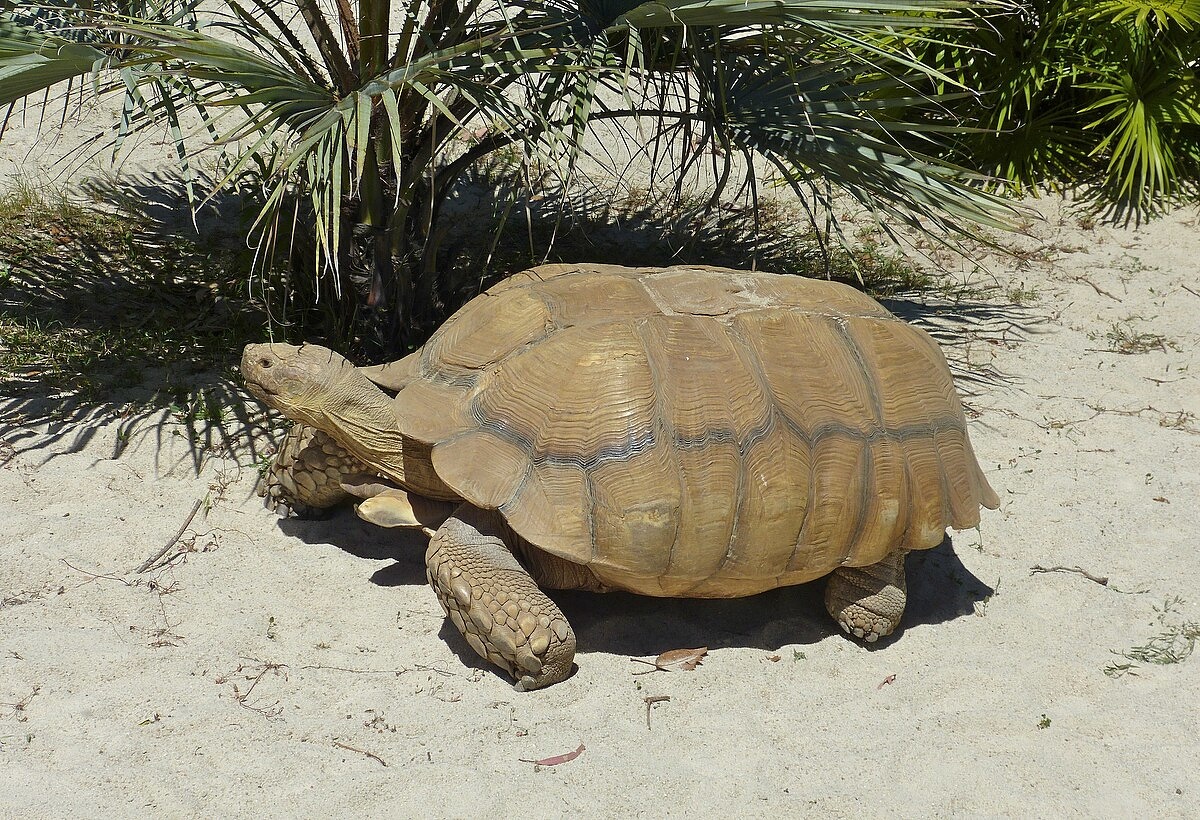
African spurred tortoise
The margins of the Sahara in West Africa are the only place in the world other than Namibia where "desert elephants" can be found. These large animals only need to drink once every three or four days and can travel up to 45 miles in a 24-hour period. They were once thought to have larger feet and longer legs than other elephants, and they are different enough to regarded as an ecotype but they don't quite qualify as a subspecies.
There are enough gazelles running around in some places in the Sahara to hunt. Many desert antelope get all their water needs from the plants they eat. Arabian sand gazelles (formerly Gazella subgutturosa marica) were long considered a subspecies, but have been recognized as the species Gazella marica since 2011. They occurs in Saudi Arabia, southern Syria, southwestern Iraq, United Arab Emirates, Oman and offshore Persian Gulf islands.
The African spurred tortoises are the largest inland turtle species. Only the Galapagos and Indian Ocean island giant tortoises are bigger. African spurred tortoises can weigh to 82 kilograms (180) pound or more. Found along the southern fringes of the Sahara, they escape the heat by digging burrows. When the get overheated they froth all over their head. When this happens their body temperature stabilizes but they begin losing weight rapidly. They recovere by drinking water, something they do not normally do.
Green Sahara
In some dried up lake beds in the middle of the Sahara you can still see footprints from giraffes, hippopotami and elephants. The climate of the Sahara region was much wetter in prehistoric times than it is today, and some areas that are now barren desert were green and relatively wet. One famous archaeological site that illustrates this is the "Cave of Swimmers" on the Gilf Kebir plateau in southwestern Egypt. The area is desert now, but thousands of years ago, it was wetter and figures in "Cave of Swimmers" appears to be people swimming, according to the British Museum. This rock art dates back between 6,000 and 9,000 years ago. The wetter period ended around 5,000 years ago, and since then, the deserts of Egypt have remained pretty similar to those that exist now, Marilyn Milton Simpson, a professor of classics at Yale University, told Live Science. [Source: Owen Jarus, Live Science, October 6, 2022]
Other Extraordinary images of animals and people from a time when the Sahara was greener and more like a savannah have been left behind. Engravings of hippos and crocodiles are offered as evidence of a wetter climate. Most of the Saharan rock is found in Algeria, Libya, Morocco and Niger and to a lesser extent Egypt, Sudan, Tunisia and some of the Sahel countries. Particularly rich areas include the Air mountains in Niger, the Tassili-n-Ajjer plateau in southeastern Algeria, and the Fezzan region of southwest Libya. Some of the art found in the Sahara region is strikingly similar to rock art found in southern Africa. Scholars debate whether it has links to European prehistoric cave art or is independent of that. [Source: David Coulson, National Geographic, June 1999; Henri Lhote, National Geographic, August 1987]
Among the animals depicted in ancient Saharan rock art are gazelles, elephants, rhinoceros, hippopotamus, wild Barbary sheep, antelope, giraffes, and prehistoric wild oxen ( Babalus antiquus ). Surprisingly there aren’t any lions. The earliest art appeared about 12,000 years ago. The art from 12,000 years ago to 9,000 years ago is called Babulus period art after the wild oxen. Most of images from this period are of large animals hunted by humans.
Arabian Wolves
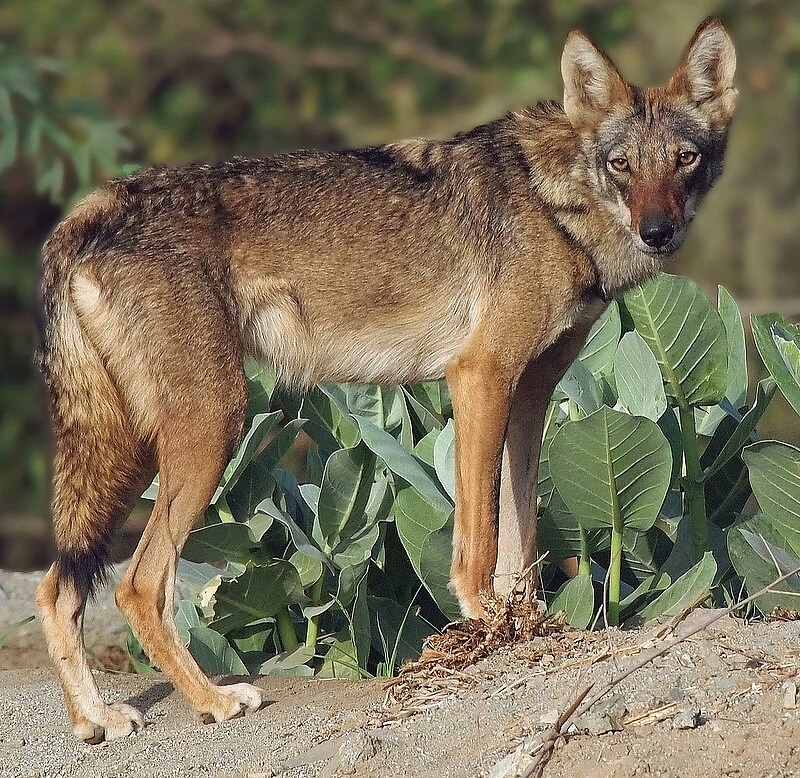
Arabian wolf in Jordan
Arabian wolves (Canis lupus arabs) are a subspecies of gray wolf native to the Arabian Peninsula (southern Saudi Arabia, Oman and Yemen) and also found in Israel’s Negev and Arava Deserts, Jordan, Palestine, and Egypt's Sinai Peninsula. They are the smallest gray wolf subspecies and a specialized arid-adapted animal that normally lives in small familial packs. Arabian wolves are omnivorous and opportunistic eaters; they consume small to medium-sized prey, from insects, reptiles and birds to rodents and small ungulates, such as young Nubian ibex and several species of gazelle (Arabian, goitered, Dorcas, and mountain gazelles). [Source: Wikipedia]
Wolves found in deserts are smaller and have lighter, thinner coats than wolves found further north. of wolf. Arabian wolves stands on average 64 to 66 centimeters (25–26 inches) at shoulder weigh an average 20.4 kilograms (45 pounds). Their skulls are smaller than most wolves. The Arabian wolf’s adapttions to life in a hot, dry climate is an example of Bergmann's rule, which states that mammal size varies by the warmth of their environment. Arabian wolf ears are proportionally larger in relation to their body size compared to other wolves, an adaptation that help them disperse body heat.
Arabian wolves are usually a grayish beige color. Similar to other canines, Arabian wolves do not have sweat glands and so must control their body temperature by rapid panting, which causes evaporation from the lungs. Occasionally the pads of the third and fourth toes are fused in the back; a feature which differentiates its tracks from a dog's. Arabian wolves are similar to Indian wolves but are distinguished from them by having a smaller skull, smaller size and thinner coat.
Wolf Attacks in the Middle East
Saudi Arabia: Our media survey picked up 7 cases that reported a wolf attack on humans. One of these was reported in sufficient detail that we could accept it as being a “verified” case, involving a shepherd who was injured while defending his sheep flock against an attacking wolf. The other six cases involved reports of wolves attacking people close to farmhouses, but were not reported in sufficient detail to permit an evaluation of their veracity, or of the circumstances (rabies or predatory).
Judean Desert, Israel: Between May and September 2017 there are reports of 10 children being attacked by wolves in two popular tourist locations in Israel’s Judean Desert. The locations are Masada National Park and the Ein Gedi Reserve, only 20 km apart. Information is fragmented with details only available from media, but the events have been verified by two biologists who interviewed some of the victims’ families. In all cases the families describe a wolf calmly approaching them at campsites, in car parks or other outdoor areas and trying to grab a child (ages from 1.5 to 6-years-old). Although the children were bitten and scratched in these attacks none of them suffered serious harm because adults were able to rapidly intervene and rescue the children. Some attacks were preceded by observations of a totally fearless wolf approaching them, or entering their tent. There were also rumours of tourists feeding wolves. Although authorities were slow to act, they initially responded with hazing (paint balls) but finally removed at least one wolf after which the attacks appear to have stopped. An older media account describes a similar case from Masada in 2008 when a 3- year-old girl was grabbed next to her parents, but was rescued. Media also report 2 cases of rabid wolves biting people in the Golan Heights region. Other media accounts report different cases resulting 6 people being bitten by rabid wolves in the Golan Heights region of northern Israel.
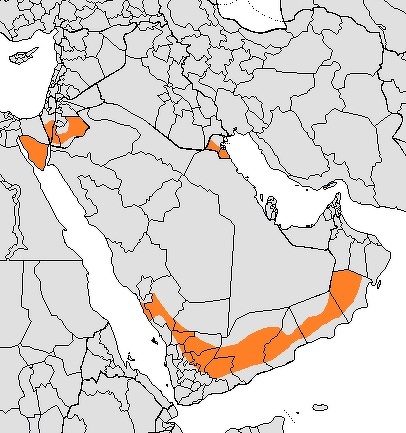
Arabian wolf range
Hamedan Province of West Iran: 53 wolf attacks were recorded on humans, between April 2001 and April 2012. The majority of victims were children and most incidents took place during the Wolf's pup-rearing season Behdarvand describes the attacks. According to “Wolf Attacks on Humans: an Update for 2002–2020": The data is based on face-to-face interviews with survivors or witnesses of attacks that led to compensation claims in official reports. Most attacks (n=33) were directed at children. A total of 5 attacks resulted in the death of victims, all were children aged from 3 to 6 years old. The authors characterised 68 percent of the attacks as predatory, with the rest being described as petrelated, investigative and defensive. Although rabies is widespread in the west of Iran, including among wolves it was excluded from this dataset of attacks. The landscape is very agricultural, with only small areas of natural vegetation, and a high human density (88 per km2). Wild ungulate prey are essentially absent from the landscape. Subsequent studies have shown that wolves in the landscape subsist on a diet of anthropogenic food. Livestock being the most important (both scavenged and depredated), but also with frequent consumption of garbage and poultry from farm dump-sites. Overall, these feeding habits will constantly bring wolves into the immediate vicinity of people in the rural landscape. Further episodes of attacks on children (5 non-fatal, 1 fatal) were reported from the same province in the media in 2015 and 2016. [Source: John D. C. Linnell, Ekaterina Kovtun & Ive Rouart,“Wolf Attacks on Humans: an Update for 2002–2020", Norwegian Institute for Nature Research (NINA), 2021].
Zanjan and Kermanshah Provinces, Western Iran: Media reports provide detailed accounts of 14 people injured in attacks in the neighbouring province of Zanjan during the period April 2016 to January 2018. Two episodes involved rabid wolves in which 3 and 7 people were injured, respectively. Two attacks on children appeared to have been predatory in nature, while two attacks on adult men have so few details that it is impossible to determine the circumstances . There are also details of a fatal predatory attack on a 3-year-old boy in the neighbouring Kermanshah province in 2017.
Rabies in Iran and Iraq. Our survey of media reports revealed a series of attacks by wolves with rabies that led to 52 people being injured in Iran and 4 in Iraq in the period from 2015 to 2018. This high frequency indicates that such attacks are widespread.
Turkey and southern Caucasus. Wolves are widespread in Turkey. Recent scientific articles have provided an overview of attacks by wolves in Turkey. Ambarli surveyed Turkish online media and evaluated cases for veracity in the period 2004 to 2016 for all cases of human-wolf conflict. Within this dataset were 58 episodes where 107 people were injured and 12 killed by wolves. 88 percent of the injuries and 75 percent of the deaths were associated with rabid wolves. None of the non-rabies attacks were viewed as predatory, being attributed to defensive or provoked categories. The medical literature verifies several of the cases , including a case where a patient died of rabies despite receiving post-exposure prophylaxis. Our survey of more recent media also revealed multiple reports from Turkey, two of which could be verified as being due to rabid wolves Media also revealed multiple cases of attacks by rabid wolves in Armenia and Azerbaijan in the period 2015–2018. Six of these could be verified. Although 20 of the victims survived, two children from a case in Azerbaijan died of rabies despite having been given post-exposure treatment.
Arabian Leopards
Arabian leopards (Panthera pardus nimr) are the smallest leopard subspecies but the largest cats in the Middle East. Arabian Peninsula.[9][10. Native to the Arabian Peninsula, they are widely distributed in rugged hilly and montane terrain until the late 1970s. Today, the population is severely fragmented and is thought to be in continuous decline. [Source: Wikipedia]
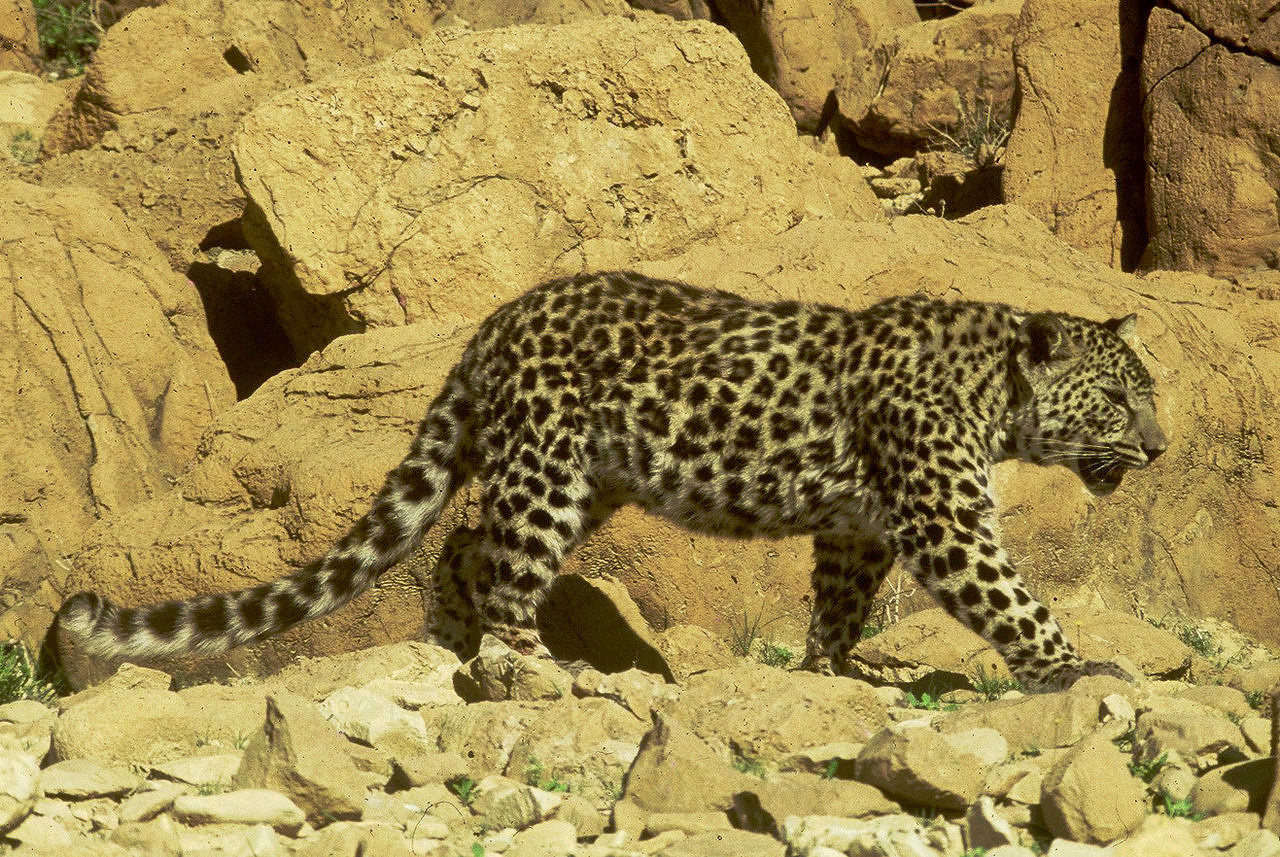
Arabian leopard
Arabian leopards number fewer than 250 individuals in the wild. In 2008, an estimated 45–200 individuals in three isolated subpopulations were restricted to western Saudi Arabia, Oman and Yemen. However, as of 2023, it is estimated that 100–120 in total remain, with 70-84 mature individuals, in Oman and Yemen, and it is possibly extinct in Saudi Arabia.
The fur of Arabian leopards varies from pale yellow to deep golden, tawny or grey and is patterned with rosettes like most leopards. Males are 1.82 to 2.03 meters (5 to 6½ feet), including a 77–85-centimeter (30–33-inch) tail and weigh about 30 kilograms (66 pounds); females are 1.60–1.92 meters (5.25 to 6.3 feet), in length, including a 67–79-centimeter (26–31 inch) tail and weigh around 20 kilograms (44 pounds).
Arabian leopards are mainly nocturnal, but they are occasionally seen during the day. They hunt small to medium prey, and usually store carcasses of large prey in caves or lairs but not in trees. Scat analyses revealed that the main prey species are Arabian gazelles, Nubian ibexa, Cape hares, rock hyraxes, porcupines, Ethiopian hedgehogs, small rodents, birds, and insects. Since local people have overhunted ungulates — the leopards traditional prey — leopards sometimes have no other choice but to take smaller prey and livestock such as goats, sheep, donkeys and young camels.
Oryx and Large Antelope in North Africa and the Middle East
Addax (Addax nasomaculatus) are also known as white antelope and screwhorn antelope. Native to the Sahara Desert, they are the only member of the genus Addax. Addax formerly occurred in desert and semidesert areas of the Sahara from Western Sahara and Mauritania in the west to Egypt and Sudan in the east. Today they only found in a few isolated areas of Northeastern Niger, North Central Chad, and Eastern Mauritania. Addax are not restricted to areas with free water, and are usually found within the desert or the surrounding stony country. [Source: Berke Altan, Animal Diversity Web (ADW) /=\; Wikipedia]
Scimitar oryxes (Oryx dammah) are also known as scimitar-horned oryxes and Sahara oryxes. They were once widespread across North Africa and parts of West Africa and Central Africa and roamed from Senegal to Egypt and from the Sahel across the Sahara to the Mediterranean Sea. In 2000, they were declared extinct in the wild on the International Union for Conservation of Nature (IUCN) Red List, but in 2023 they were downlisted to endangered, after a group was successfully reintroduced in Chad.
Arabian oryxes (Oryx leucoryx) are also called or white oryxes. Native to the deserts and steppe areas of the Arabian Peninsula and the smallest member of the genus Oryx, they are medium-sized antelope and bovids with a distinctive shoulder bump, long, straight horns, and a tufted tail. The Arabian oryx was extinct in the wild by the early 1970s, but was saved in zoos and private reserves, and was reintroduced into the wild starting in 1980.
RELATED ARTICLES: SCIMITAR ORYX: CHARACTERISTICS, BEHAVIOR, HOW IT SURVIVES IN THE SAHARA africame.factsanddetails.com ARABIAN ORYX: CHARACTERISTICS, BEHAVIOR, REINTRODUCTION TO THE WILD africame.factsanddetails.com ADDAX: CHARACTERISTICS, BEHAVIOR AND REPRODUCTION africame.factsanddetails.com
Wild Goats and Sheep of the Middle East and North Africa
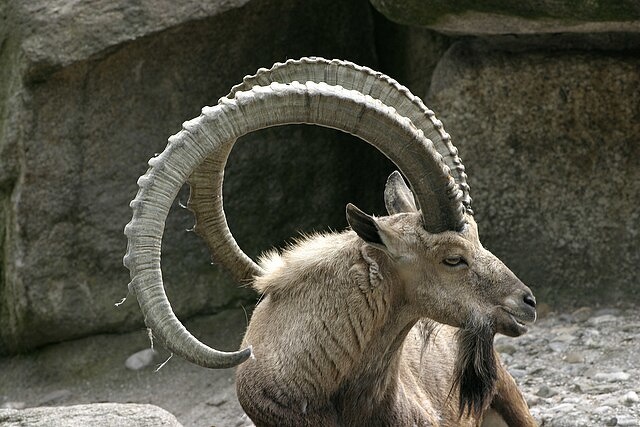
Nubian ibex
Nubian ibex (Capra nubiana) are desert-dwelling goats in the Genus Capra found in mountainous areas of northern and northeast Africa, and the Middle East. For a long time they were considered to be a subspecies of the Alpine ibex (C. ibex), but is now considered a distinct species. There are believed to be around 4,500 adults in the wild. On the International Union for Conservation of Nature (IUCN) Red List they are listed as Vulnerable. [Source: Wikipedia]
Barbary sheep (Ammotragus lervia) are also known as aoudad (pronounced owdad) They are a species of caprine (sheeps and goats) native to rocky mountains in North Africa and parts of West Africa. They are the only species in genus Ammotragus and six subspecies have been described. They are now rare in North Africa but have been introduced to North America, southern Europe, and elsewhere. They are known in the Berber language as waddan or arwi, and in former French territories as the mouflon.
Arabian tahr (Arabitragus jayakari or Hemitragus jayakari) are a species of tahr native to eastern Arabia. They are the smallest tahrs. Tahrs are large artiodactyl ungulates related to goats and sheep. There are three species, all native to Asia. Previously it was thought they were closely related to each other and placed in a single genus, Hemitragus, but genetic studies have since shown that they are not so closely related and they are now considered as members of three separate monotypic genera: Hemitragus is now reserved for the Himalayan tahr, Nilgiritragus for the Nilgiri tahr in India, and Arabitragus for the Arabian tahr. [Source: Wikipedia]
RELATED ARTICLES:
NUBIAN IBEX: CHARACTERISTICS, BEHAVIOR AND REPRODUCTION africame.factsanddetails.com
BARBARY SHEEP: CHARACTERISTICS, BEHAVIOR AND REPRODUCTION africame.factsanddetails.com
ARABIAN TAHR: CHARACTERISTICS, BEHAVIOR AND REPRODUCTION africame.factsanddetails.com
Hamsters, Gerbils, Jerboas and Jirds
There are over 100 species in the subfamily Gerbillinae of rodents, which includes gerbils, jirds, and sand rats. Most species are found in Asia, the Middle East or Africa, generally inhabiting arid and semi-arid environments like deserts, sandy plains, and salt flats. Among the gerbils native to the Middle East are: 1) Cheesman's gerbil (Gerbillus cheesmani) (See Below); 2) Balochistan gerbil (Gerbillus nanus), widely distributed across North Africa, the Arabian Peninsula, the Middle East, and western Asia; and 3) Pygmy gerbil (Gerbillus henleyi), found in areas ranging from Algeria to Israel and the Arabian Peninsula; and 4) Wagner's gerbil (Gerbillus dasyurus), found in the Middle East, particularly in rocky areas, deserts, semi-deserts, and salt flats. They are solitary, nocturnal, and feed primarily on seeds and grains.
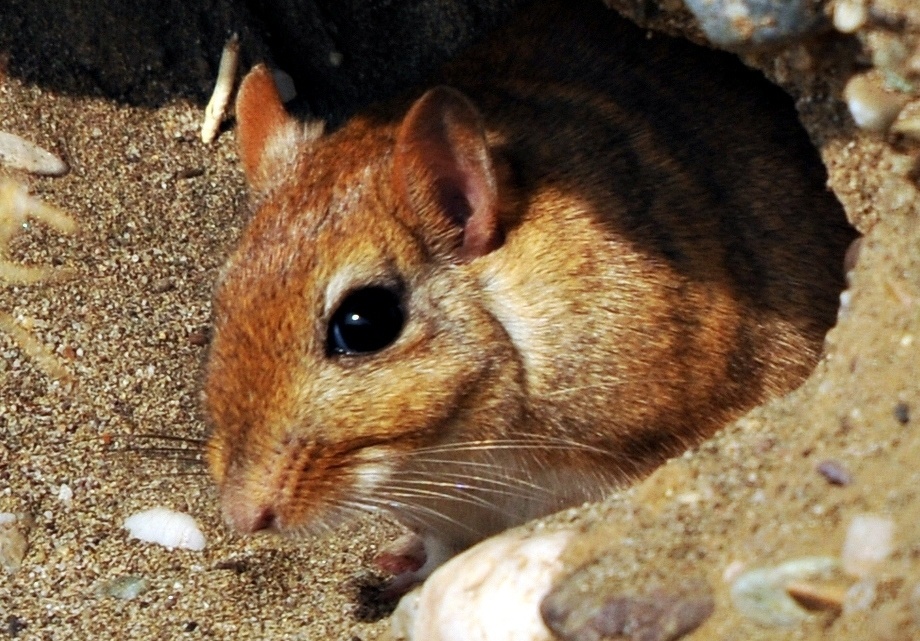
Tristam's jird
Jirds are rodents that belong to the genus Meriones, which also includes the gerbil most commonly kept as a pet — Meriones unguiculatus, commonly known as the Mongolian gerbil or Mongolian jird. The Meriones genus contains most animals referred to as jirds, but a few jirds are members of the genera Sekeetamys, Brachiones, and sometimes Pachyuromys. Jirds are found in northern Africa, the Middle East and Central Asia as far east as Mongolia. They tend to inhabit arid regions including clay desert, sandy desert, and steppe, but also inhabit slightly wetter regions, and can be agricultural pests. [Source: Wikipedia]
Jirds and gerbils are similar. They look similar and both belong to the subfamily Gerbillinae. Adult jirds have a head and body size that ranges from 9 to 18 centimeters (3.5 to 7 inches), with tails equal to or slightly longer than the head and body. They vary widely in weight by species, but are generally between 30 and 200 grams (1.1 and 7 ounces) They are more rat-like in appearance than many other gerbillines, but are still good jumpers. Jirds have strong front claws, used to dig their burrows.
Jerboas are hopping desert rodents found throughout North Africa, the Middle East and Central Asia that belong to the family Dipodidae. They tend to live in hot deserts, are generally nocturnal and can move very quickly. When chased, jerboas can run or hop at up to 24 km/h (15 mph). Most species of jerboas have excellent hearing that they use to locate prey and to avoid becoming prey themselves to predators such as little owls. The typical lifespan of a jerboa is around two to three years. [Source: Wikipedia]
Golden hamsters (Mesocricetus auratus) are also called or Syrian hamsters. They are the species that have traditionally been pet hamsters. They are native to an arid region of northern Syria and southern Turkey. Their numbers in the wild have declining so much due to a loss of habitat from agriculture and deliberate elimination by humans because they are considered agricultural pests that they are now considered endangered by the International Union for Conservation of Nature (IUCN). However, captive breeding of golden hamsters is very common mainly to supply the pet and scientific research animal trade. [Source: Wikipedia]
RELATED ARTICLES:
HAMSTERS: TAXONOMY, CHARACTERISTICS, BEHAVIOR factsanddetails.com
HAMSTER SPECIES IN EURASIA: EUROPEANS, ROBOROVSKIS, CAMPBELL'S DWARVES factsanddetails.com
GOLDEN (SYRIAN) HAMSTERS: CHARACTERISTICS, BEHAVIOR, DISCOVERY, DOMESTICATION africame.factsanddetails.com
MOUSE-LIKE HAMSTERS: CHARACTERISTICS, SPECIES, BEHAVIOR, AND REPRODUCTION factsanddetails.com
GERBILS: CHARACTERISTICS, BEHAVIOR AND REPRODUCTION factsanddetails.com
GERBIL SPECIES IN ASIA: MONGOLIAN, GREAT, INDIAN factsanddetails.com
GERBILS OF THE MIDDLE EAST AND NORTH AFRICA africame.factsanddetails.com
JIRDS: CHARACTERISTICS, BEHAVIOR, SPECIES AND REPRODUCTION africame.factsanddetails.com
Desert Hedgehogs
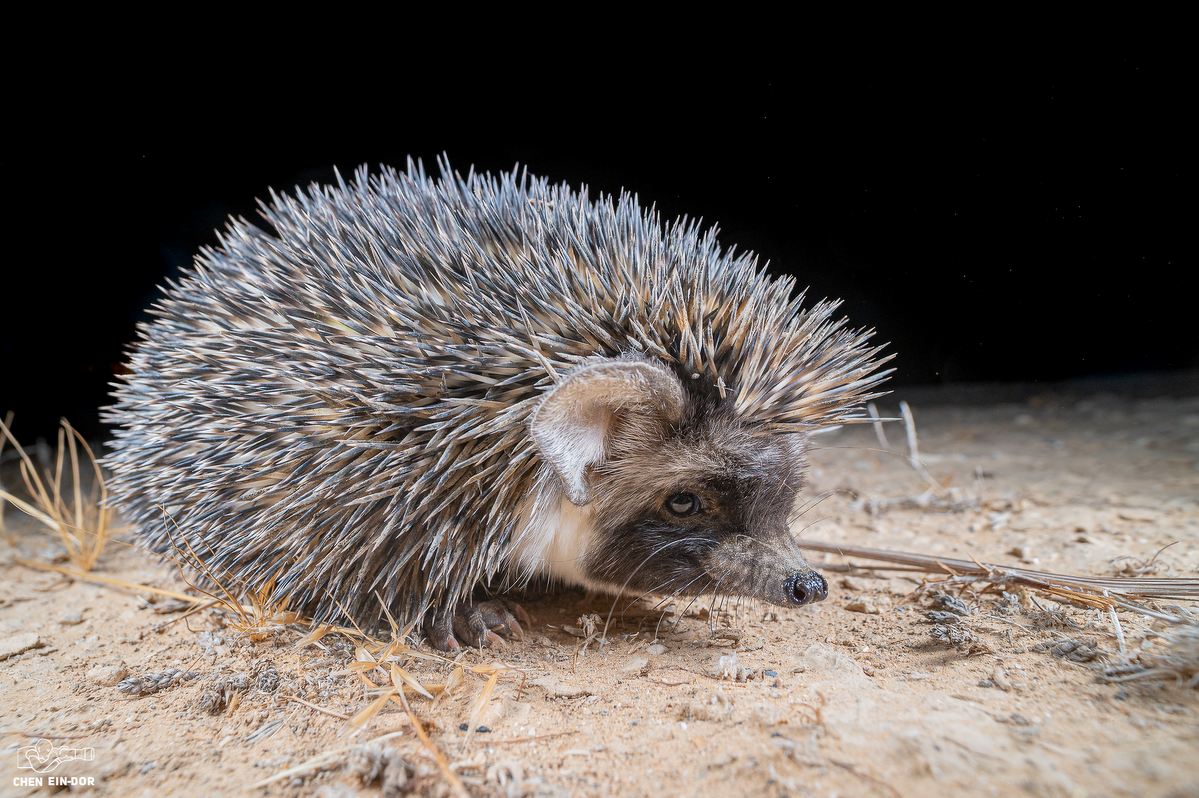
desert hedgehog
Desert hedgehogs (Paraechinus aethiopicus) are one of the smallest hedgehogs, measuring 14 to 28 centimeters (5.5 to 11 inches) in length and weighing about 280 to 510 grams (10 to 18 ounces). The spines on their backs can be banded with coloring similar to the four-toed hedgehog. They can usually be identified by their dark muzzle. Desert hedgehogs are not endangered and are quite common in some parts of their range. On the International Union for Conservation of Nature (IUCN) Red List they are listed as a species of Least Concern.
Desert hedgehogs generally live in hot, dry deserts and dune areas. Well adapted for arid conditions. but also found in vegetated areas around oases and along coasts, are found in northern Africa, the Middle East and the Arabian Peninsula. from Morocco in the west to to Syria and Iraq in the east in: Morocco, Mauritania,, Mali, Niger, Chad, Algeria, Libya, Tunisia, Egypt, Somalia, Sudan, Djibouti, Eritrea, Israel, Jordan, Kuwait, Oman, Saudi Arabia, Bahrain, United Arab Emirates, Yemen, Syria, Iraq, Iran, and possibly Ethiopia.
Hedgehogs typically live three to four years in the wild is 3-4 years and average 4.5 years in and have lived as long as 10 years in captivity. The phylogeny of desert hedgehogs has been debated. They are mostly classified in the genus Paraechinus genus but have also been placed in the genus Hemiechinus. Up to five subspecies have been recognized. Hedgehogs are sometimes kept as pets. The common pet hedgehog is a hybrid of two other African species, not desert hedgehogs. [Source: Dustin Hall, Animal Diversity Web (ADW) /=]
Desert hedgehogs are mainly insectivorous (eat insects), but also eat a variety of other foods based on availability. They occasionally prey on small invertebrates, the eggs of ground-nesting birds, frogs, snakes and scorpions but do not eat plant matter. Desert hedgehogs, like other hedgehogs, have a high tolerance for snake, scorpion and insect venoms — 30 to 40 times that of a similar sized rodent. Known predators of desert hedgehogs include eagles, owls and other birds of prey,. The spines of hedgehogs are their main line of defense against predators. When threatened they tuck their its head into its backs region and effectively roll themselves into a ball. Only spines exposed to the potential predator, making the hedgehogs difficult to eat.
See Separate Article: HEDGEHOGS factsanddetails.com
Desert Hedgehog Characteristics and Behavior
Desert hedgehogs measure 14 to 28 centimeters (5.5 to 11 inches) in length and weighing about 280 to 510 grams (10 to 18 ounces). Spines cover their backsides from the base of their head to their rear end. There are no spines on the head. The spines are hollow and pale brown with dark tips. The color of the ventral side and feet is a variable combination of brown, black, white, solid brown or solid white. The muzzle and mask are black with lighter bands on the forehead. Desert hedgehogs are larger than the other species of hedghog that shares their region, Long-eared hedgehogs look quite similar to them.
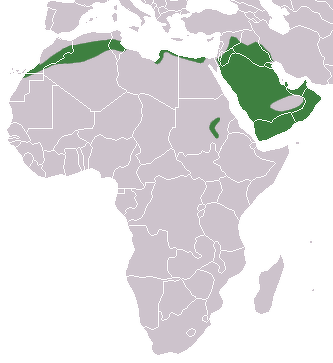
range of desert hedgehog
Desert hedgehogs are nocturnal (active at night), motile (move around as opposed to being stationary) and solitary. They sense using touch and chemicals usually detected with smell. During the daytime they rest near rocks and cliffs — out of reach of birds of prey, their main predators. They sleep on their sides, so their spines give them little protection while at rest. They hunt at night. Insects and other prey congregate nears coastline or around vegetation at oases, which is why you often find desert hedgehogs in these areas. During prolonged periods of cold weather, these hedgehogs hibernate, waking periodically to forage for food. Hibernation may be necessary as a result of the poor insulation offered by their spines. /=\
If desert hedgehogs are threatened, their muscles go tight and they pull the outer layer of skin around the body, making their quills stick out in all directions. It has been theorized that spines evolved as a means of defense, but research seems to indicate that this is likely incidental. Hedgehog spines do not break like porcupine quills — they bend. The spines are also able to absorb mechanical energy, providing protection from falls.
Desert hedgehogs engage in seasonal breeding from May to June. The average gestation period is 30 to 40 days. The number of offspring ranges from two to seven. Young are altricial, meaning they are relatively underdeveloped at birth. The average weaning age is 40 days. Young are deaf and blind at birth. During the actual birth the spines are under the skin but emerge afterwards. Young weigh about eight or nine grams at birth, and their eyes open in 23 to 29 days. Parental care is provided by females. After about 40 days they begin eating solid food (in addition to mother's milk). Not all of the offspring in a litter survive to adolescence. Some die soon after birth. It has been reported that females sometimes cannibalize their young, probably in times of food shortage.
North African Hedgehogs
North African hedgehogs (Atelerix algirus) are also known as Algerian hedgehogs. They live in Algeria, Libya, Malta, Morocco, Spain, Tunisia and some islands. Little is known about them even though they are are source of most common breed of domesticated hedgehogs via crossbreeding with four-toed hedgehogs. Because they are is native to Africa, it has been suggested that North African hedgehogs were introduced by humans to the other countries where they are found, including Spain and the Canary Islands. Of the four African hedgehog species, North African hedgehogs are the only ones that occur outside Africa. North African hedgehogs have a wide habitat range and seem to have a stable population. On the International Union for Conservation of Nature (IUCN) Red List they are listed as a species of Least Concern. [Source: Wikipedia]
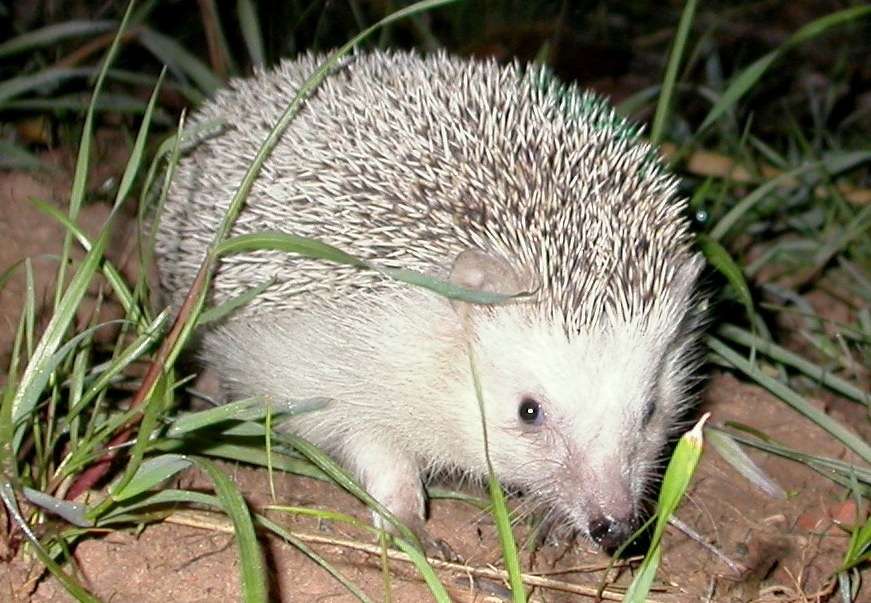
North African hedgehog
North African hedgehogs prefer arid climates, but are found in a broad range of habitats including dry Mediterranean scrub, grasslands, pastures, cultivated fields, semi-desert, gardens and places with sizable human populations. They are typically found at altitudes of 400 meters (1,312) or less, although they have been seen at elevations of up to 900 meters (2952.76 feet) in Morocco. Little is known about the lifespan of . Hedgehogs their size have an expected lifespan of three and seven years in the wild and eight to 10 years in captivity. North African hedgehogs [Source: Andrew Everett, Animal Diversity Web (ADW) /=]
North African hedgehogs are generalist omnivores (eat a variety of things, including plants and animals). Animal foods include birds, mammals, amphibians, reptiles, eggs carrion, insects non-insect arthropods, mollusks and worms. Among the plant foods they eat are seeds, grains, and nuts fruit. They also eat fungus. They forage at night and mainly eat insects.
North African hedgehogs have been killed by humans for food, traditional medicines and witchcraft. Perhaps their biggest threat today is roads and cars. It is believed that Eurasian eagle owls feed on North African hedgehogs as their geographic ranges overlap and the eagles owls are known to prey on other species of hedgehogs. North African hedgehogs use their sharp spines to deter predators and are also cryptically colored.
North African Hedgehog Characteristics and Behavior
North African hedgehogs range in length from 20 to 25 centimeters (7.9 to 9.8 inches) and weigh up to 650 grams (1.4 pounds). They are paler in color than most hedgehogs from Europe. The most distinguishing characteristic is the spine-free “part” on the crown of the head, which appears as a lack of a widow’s peak often seen in similar species. They also have larger ears, longer snouts, and longer legs than European hedgehogs. The underbelly of North African hedgehogs is colored either brown or white. Their back is covered in sharp but relatively soft spines made of tough keratin and which are mostly white with darker banding. [Source: Andrew Everett, Animal Diversity Web (ADW) /=]
North African hedgehogs are smaller than European hedgehogs but are larger than other African hedgehogs species and have longer snouts and longer legs, making them faster runners. The face of North African hedgehog is light usually whitish in color, and the legs and head are brown. Their relatively large ears are highly visible on the head.
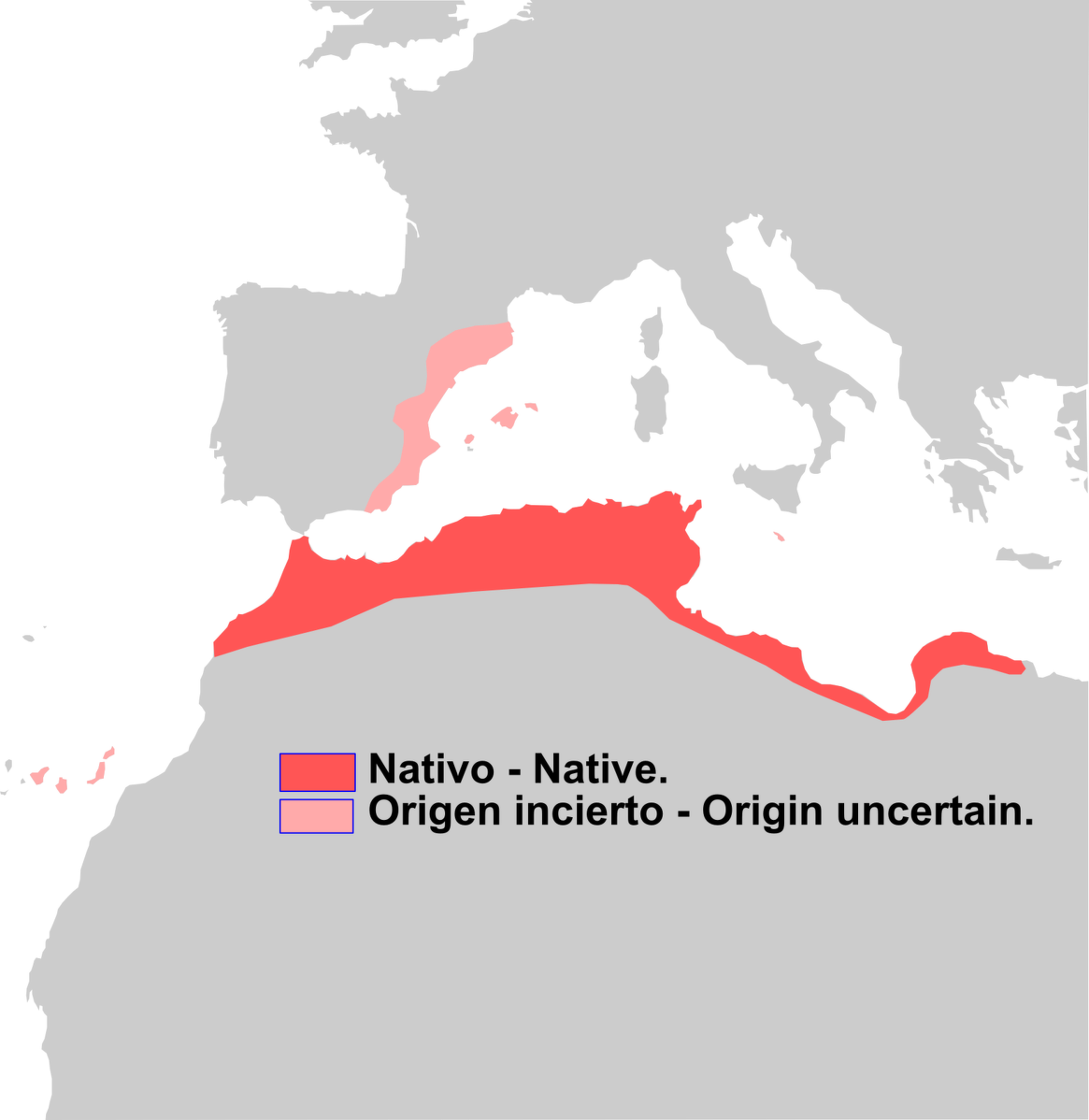
North African hedgehog range
North African hedgehogs are terricolous (live on the ground), nocturnal (active at night), motile (move around as opposed to being stationary) and solitary. These animals are difficult to study in because they are mainly active at night. When threatened, they roll into a ball so only their spines are exposed. North African hedgehogs communicate with sound and sense using vision, touch, sound and chemicals usually detected with smell. Hedgehogs raise their quills and make hissing noises when alarmed and often make purring noises when content.
North African hedgehogs do not mate for life or engage in pair-bonding. They engage in seasonal breeding from October to March. Females produces two litters per breeding season. The gestation period ranges from 30 to 40 days. The number of offspring ranges from three to 10. Parental care is provided by females. Young weigh 12 to 20 grams at birth. They are born blind, but gains vision quickly. The spines begin to emerge from underneath the birthskin and membranous about 36 hours after birth. On average males and females reach sexual or reproductive maturity between eight to 10 weeks.
See Separate Article: HEDGEHOGS factsanddetails.com
Patagonian Mara Take Up Residence a Dubai Lake
A number of Patagonian mara — rabbit-like mammals with long legs, big ears and a body like a hoofed animal — now roam the grounds of Al Qudra Lakes, typically home to gazelle and other desert creatures of the United Arab Emirates. Jon Gambrell wrote in Associated Press: How they got there remains a mystery in the UAE, a country where exotic animals have ended up in the private homes and farms of the wealthy. But the pack has already survived several years in a network of warrens among the dunes. One estimate suggests that as many as 200 could be thriving in the area and the wider Al Marmoom Desert Conservation Reserve nearby, as only a few dead maras have been found. [Source Jon Gambrell, Associated Press, November 25, 2024]
An AP journalist happened upon at least five maras on a recent visit to Al Qudra Lakes, a vast desert area some 40 kilometers (25 miles) south of downtown Dubai. On another visit, he saw multiple packs of the animals, including one mother still nursing a baby. Al Qudra sits at the end of a long bicycle track popular in the winter months and draws campers and others who enjoy the outdoors in the cooler weather among the area's lakes. Some have been manmade into the shapes of a crescent moon, two hearts or even an advertisement for Dubai's Expo 2020.
The Patagonian maras first appeared publicly in 2020 during the height of the coronavirus pandemic. A request for information on their sightings first made a summertime issue of the Dubai Natural History Group's monthly newsletter, with volunteers describing them as being seen both in Al Qudra and on Saadiyat Island near the country's capital of Abu Dhabi. “This large rodent is a common species in zoological collections and undoubtedly found its way out from captivity," wrote Jacky Judas, who long has studied mammals in the UAE, in a chapter in the recent book “A Natural History of the Emirates."
"They can regularly be seen sleeping or eating grass in the middle of roundabouts at Al Qudra. This species is not adapted to live in arid environment, although in the absence of his usual predators, like pumas, it can possibly survive in highly modified habitats with tree plantations, lawns and ponds,” Judas wrote. That's the exact environment found at Al Qudra — likely contributing to the maras' continued survival there despite temperatures in the UAE regularly reaching 45 degrees Celsius (113 degrees Fahrenheit) in the summer with high humidity.
The number at Al Qudra also suggests they are breeding. Patagonian maras mate for life and females only enter heat a few times a year for about 30 minutes apiece. They can give birth to one to three offspring at a time. In Argentina, the animals can be hunted and eaten, their fur used for rugs and blankets. While the Patagonia maras are herbivores and pose no threat to humans, they likely have very few predators at Al Qudra. Arabian red fox do live and hunt in the area.
How the Patagonian maras got there remains a mystery. Maras are on display at the children's section of the Dubai Safari Park zoo, but at the same distance from Al Qudra as downtown. There are surrounding tracks and farms owned by Dubai's elite near Al Qudra, which suggests the maras escaped either overland or through digging their way out of a nearby property.
Patagonian maras, which typically live in central and southern Argentina, have been trafficked into areas as exotic pets in the past. In Lakewood, Colorado, a suburb of Denver, the appearance of one sparked wide local news coverage earlier this year. However, the animal is now believed by authorities to be dead. In August, a Patagonian mara was found in the trunk of a car carrying other animals trying to enter Turkey from Greece in a suspected trafficking attempt.
Though it is illegal to keep endangered or threatened wildlife as pets in the Emirates, there have been numerous sightings and social media videos of Emirati men in luxury cars accompanied by pet lions along for the cruise. In 2021, authorities put out a warning that a “wildcat” had been seen loose in one neighborhood.
Image Sources: Wikimedia Commons
Text Sources: Animal Diversity Web animaldiversity.org ; National Geographic, Live Science, Natural History magazine, CNTO (China National Tourism Administration) David Attenborough books, New York Times, Washington Post, Los Angeles Times, Smithsonian magazine, Discover magazine, The New Yorker, Time, BBC, CNN, Reuters, Associated Press, AFP, Lonely Planet Guides, Wikipedia, The Guardian, Top Secret Animal Attack Files website and various books and other publications.
Last updated May 2025