
Home | Category: Desert Animals
JIRDS
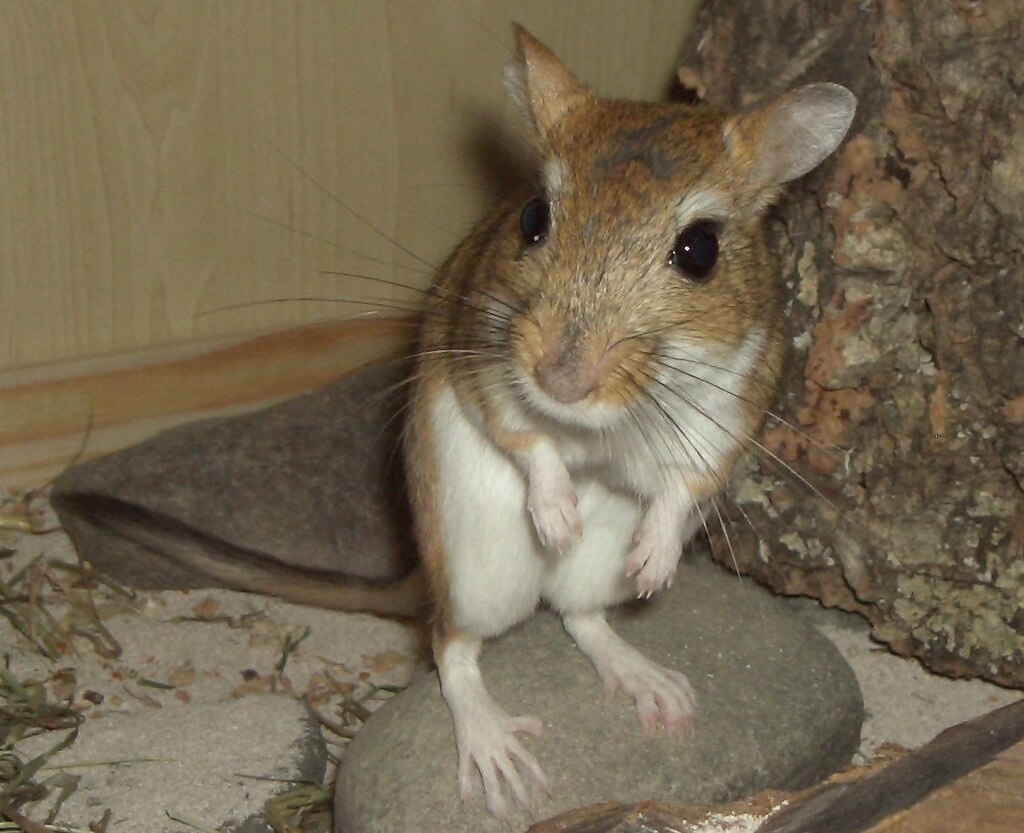
Persian jird, a two-and-a-half-year-old female
Jirds are rodents that belong to the genus Meriones, which also includes the gerbil most commonly kept as a pet — Meriones unguiculatus, commonly known as the Mongolian gerbil or Mongolian jird. The Meriones genus contains most animals referred to as jirds, but a few jirds are members of the genera Sekeetamys, Brachiones, and sometimes Pachyuromys. Jirds are found in northern Africa, the Middle East and Central Asia as far east as Mongolia. They tend to inhabit arid regions including clay desert, sandy desert, and steppe, but also inhabit slightly wetter regions, and can be agricultural pests. [Source: Wikipedia]
Jirds and gerbils are similar. They look similar and both belong to the subfamily Gerbillinae. Adult jirds have a head and body size that ranges from 9 to 18 centimeters (3.5 to 7 inches), with tails equal to or slightly longer than the head and body. They vary widely in weight by species, but are generally between 30 and 200 grams (1.1 and 7 ounces) They are more rat-like in appearance than many other gerbillines, but are still good jumpers. Jirds have strong front claws, used to dig their burrows.
Jirds construct burrows for safety, to beat the heat, to aid in food storage, and to retain water. The burrows of some species are rather simple, but others are quite elaborate. Sundevall's jirds reportedly build burrows over 30 meters in length with 18 entrances. Jirds feed on roots, seeds, fruits, and insects. Food is stored in chambers of the burrows. Stored food has the capacity to reabsorb moisture given off by the animal during respiration inside the burrow. Jirds can go their entire lives without drinking, relying instead on water consumed in their food and generated during metabolism and .
Jirds can be both social and solitary but among solitary species, home ranges often overlap. Females give birth to one to 12 young after a gestation period of about 20 to 30 days. Sexual maturity is reached after about 9 to 15 weeks. Longevity in the wild is usually less than six months, but the record for a captive animal is over five years.
RELATED ARTICLES:
GERBILS: CHARACTERISTICS, BEHAVIOR AND REPRODUCTION factsanddetails.com
GERBIL SPECIES IN ASIA: MONGOLIAN, GREAT, INDIAN factsanddetails.com
GERBILS OF THE MIDDLE EAST AND NORTH AFRICA africame.factsanddetails.com
HAMSTERS: TAXONOMY, CHARACTERISTICS, BEHAVIOR factsanddetails.com
HAMSTER SPECIES IN EURASIA: EUROPEANS, ROBOROVSKIS, CAMPBELL'S DWARVES factsanddetails.com
GOLDEN (SYRIAN) HAMSTERS: CHARACTERISTICS, BEHAVIOR, DISCOVERY, DOMESTICATION africame.factsanddetails.com
MOUSE-LIKE HAMSTERS: CHARACTERISTICS, SPECIES, BEHAVIOR, AND REPRODUCTION factsanddetails.com
JERBOAS OF CENTRAL ASIA: CHARACTERISTICS, BEHAVIOR, SPECIES factsanddetails.com
JERBOAS OF THE MIDEAST AND NORTH AFRICA: CHARACTERISTICS, BEHAVIOR, SPECIES africame.factsanddetails.com
EGYPTIAN JERBOAS: GREATER, LESSER, CHARACTERISTICS, BEHAVIOR africame.factsanddetails.com
PYGMY JERBOAS (WORLD'S SMALLEST RODENTS): CHARACTERISTICS, BEHAVIOR, SPECIES factsanddetails.com
Jird Species
Genus Meriones: Subgenus Meriones: Tamarisk jird (Meriones tamariscinus)
Subgenus Parameriones: Persian jird (Meriones persicus) and King jird (Meriones rex)
Genus Sekeetamys: Bushy-tailed jird (Sekeetamys calurus)
Subgenus Cheliones: Indian desert jird (Meriones hurrianae)
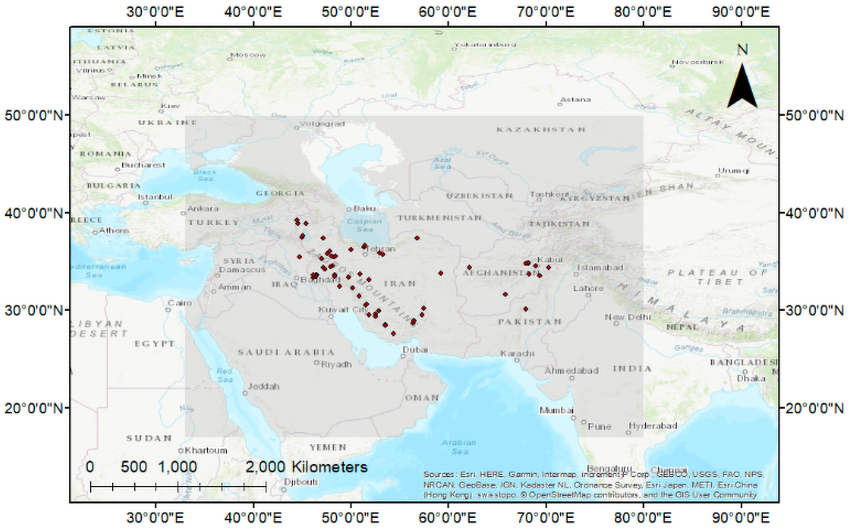
places where Persian jirds have been observed
Subgenus Pallasiomys:
Arabian jird (Meriones arimalius)
Cheng's jird (Meriones chengi)
Sundevall's jird (Meriones crassus)
Dahl's jird (Meriones dahli)
Moroccan jird (Meriones grandis)
Libyan jird (Meriones libycus)
Midday jird (Meriones meridianus)
Buxton's jird (Meriones sacramenti)
Shaw's jird (Meriones shawi)
Tristram's jird (Meriones tristrami)
Mongolian jird (Meriones unguiculatus), Mongolian Gerbil
Vinogradov's jird (Meriones vinogradovi)
Zarudny's jird (Meriones zarudnyi)
Persian jirds (Meriones persicus) are found in dry rocky hillsides with little vegetation and semi-desert areas in Afghanistan, Armenia, Azerbaijan, Iran, Iraq, Pakistan, Saudi Arabia, Turkey and Turkmenistan. They are about 15 centimeters (6 inches) long and have a brush-tipped tail that is slightly longer than their body. They are brown with white bellies. Persian jirds shelter in either small burrows or under overhanging rocks. They can also be found living near humans, such as under walls. In the wild, Persian jirds eat dry plant material, grains, and small insects. Persian jirds usually have two litters a year, each with around seven pups. Some people keep Persian jirds as pets. They can live to be six or seven years old and need large cages that allow climbing and leaping. The are not endangered and there are lots of them in some areas. [Source: Wikipedia]
Libyan Jirds
Libyan jirds(Meriones libycus) are found in dry shrubland, intermittent saline lakes, hot deserts, and rural gardens in North Africa, the Middle East and Central Asia — in Mauritania, Morocco, Algeria, Tunisia, Libya, Egypt, Jordan, Syria, Saudi Arabia, Iran, Iraq, Afghanistan, Turkmenistan, Uzbekistan, Kazakhstan and Western China. Libyan jirds are mainly restricted to valleys and low lying areas and rarely venture into higher elevation. They often make their homes in areas where there is lots of vegetation present, particularly with plants that are sources of food. [Source: Wikipedia +]
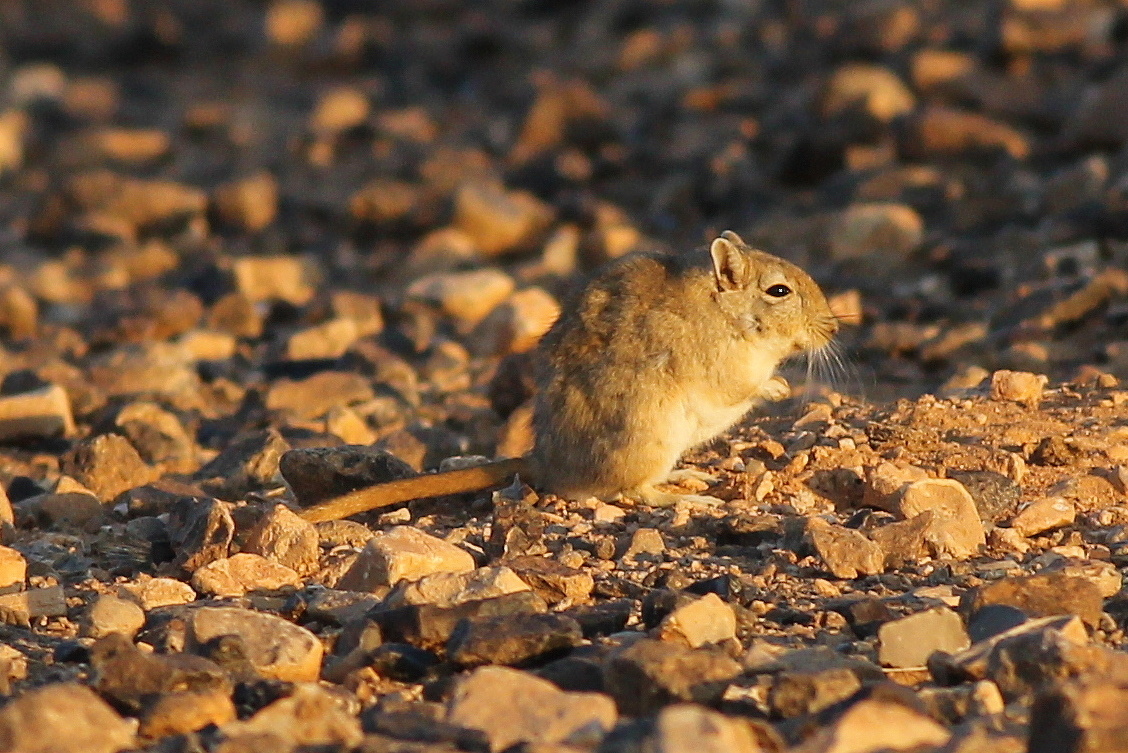
Libyan jird in Jordan
Libyan jirds are sometimes kept as pets. Their average lifespan in captivity is 5.2 years. Libyan jird petowners say while solitary individuals are very passive but individualsin groups can be very aggressive towards other jirds and fighting and biting are not uncommon. In the wild, Libyan jirds are very tolerant of humans, and can live in very close proximity with them. [Source: Andrew Masi, Animal Diversity Web (ADW) /=]
Libyan jirds are not endangered and are fairly common throughout a wide area. On the International Union for Conservation of Nature (IUCN) Red List they are listed as a species of Least Concern. In CITES (Convention on International Trade in Endangered Species of Wild) they have no special status. Sometimes they breed rapidly and huge numbers of them can be agricultural pests. They especially are known for damaging tomato and potato crops. /=\
Libyan jirds have made a home for themselves in the Aralkum — the man-made desert formed by the shrinkage of the Aral Sea in Uzbekistan and Kazakhstan. There they live along with other small rodents such as northern three-toed jerboas, midday jirds and great gerbils. These rodents are about four times more abundant on the dried-up seabed than in the surrounding terrain, and the presence of this abundance of rodent prey has attracted carnivores such as red foxs, corsac foxes, mountain weasels, steppe polecats, marbled polecat and Turkestan wildcats. +
Libyan Jird Characteristics and Diet
Libyan jirds are relatively large for a jird, with a head-and-body length of 10 to 16 centimeters (3.9 to 6.3 inches) and a tail of similar length. They weigh of 56 to 105 grams (2.0 to 3.7 ounces). Their head is broad and their eyes are large. The fur is fine and dense and the hind legs are long. The upper parts of their body are greyish-brown. Their underside hair has white tips and grey bases. The tail is pale brown except for the last third, which is deep brown or blackish. The claws are dark-coloured, and the soles of the hind feet are partly hairy so that patches of bare skin are visible. [Source: Wikipedia]
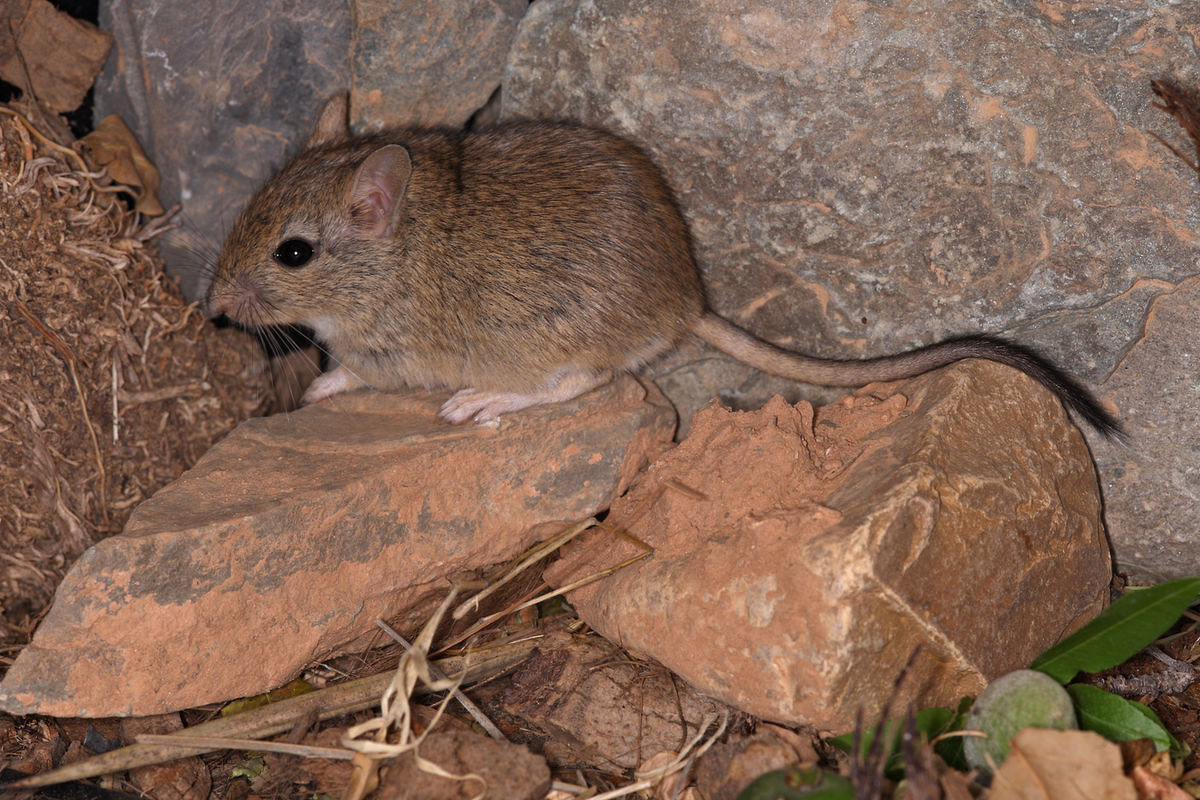
Sundevall's jird in Morocco
Libyan jirds are very similar in size and shape to many other species of jirds. In parts of their range they may be confused with Sundevall's jirds (See Below), which are smaller, have pale claws and a smaller dark tail tuft. Libyan jirds are darker in color and bigger than the middays jirds (Meriones meridianus). The primary physical feature that sets Libyan jirds apart form other jirds is that their head is slightly narrower. [Source: Andrew Masi, Animal Diversity Web (ADW) /=]
Libyan jirds in the wild eat the seeds of a wide array of grasses. They also eat bulbs, tubers, some types of leaves and the succulent desert fruits. Which grasses and food they eat depends on where they live. In agriculture areas in their range they are particularly fond of potatoes and tomatoes. When foraging they often carry food back to their burrow, where large quantities of food are stored in chambers.
Libyan Jird Behavior
Libyan jirds are motile (move around as opposed to being stationary), diurnal (active during the daytime), nocturnal (active at night), colonial (live together in groups or in close proximity to each other) and and opportunistically migratory (moving to new territories when food becomes scarce). The build burrows that have shallow tunnels with multiple entrances. These entrances are usually situated near a plant or bush, as the foliage provides some cover. Libyan jird burrows are up to 1.5 meter (5 feet) deep which and may be comprised of fairly complex series of passages. They sometimes use empty burrows of great gerbils. The upper chambers are often used for food storage while deeper ones are used for nesting. [Source: Wikipedia, Andrew Masi, Animal Diversity Web (ADW) /=]
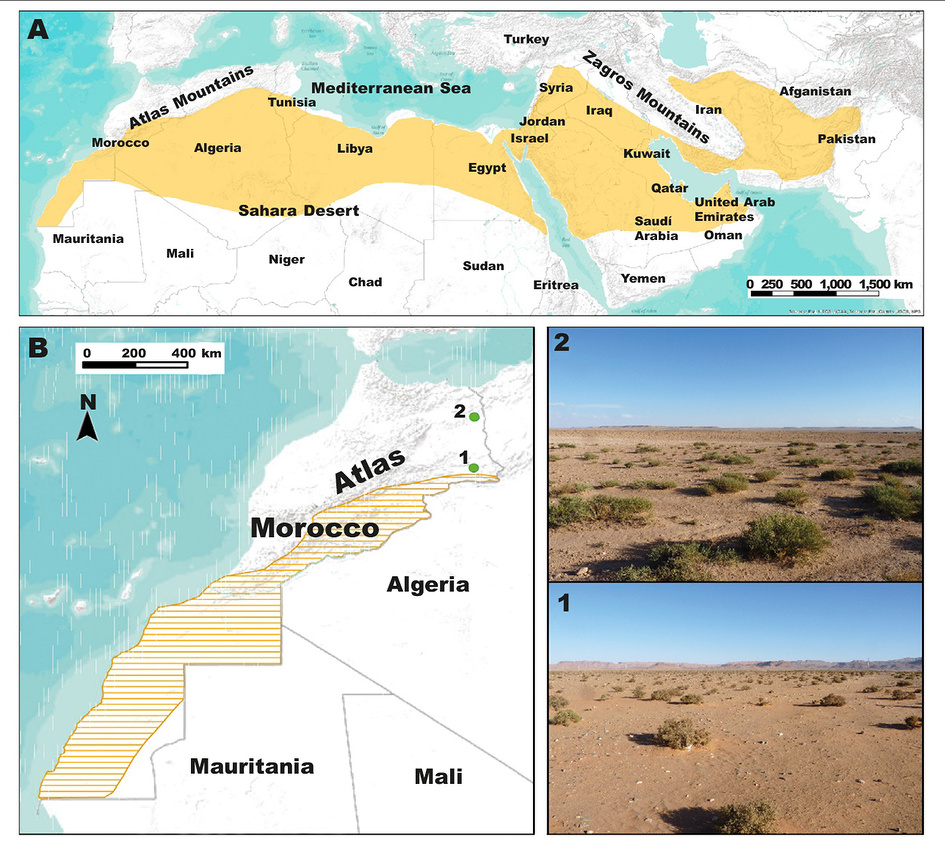
A) entire known range of Sundevall's Jirds; B) their range in Morocco based on confirmed observations from the literature and two sampled localities: 1 and 2) their habitats in Morocco
Libyan jirds are generally social animals that live in small colonies but may live alone. They are more sociable in winter when colonies may contain twenty or thirty individuals. As a warning call they rapidly stomp their feet, much as rabbits do. Libyan jirds nap and forage at regular intervals both day and night.. When they venture out of their burrows, they do so quickly. When running between burrows, the stick their tails up in the air and rapidly move from one area of cover to the next. Some individuals in colder northern areas may hibernate during the coldest months of the year, but most are active year-round.
Adaptations to surviving in extreme desert environments include a nocturnal activity burrowing and water conservation through excretion of concentrated urine. In a study of two different jird species, including Libyan jirds, jirds were exposed to 12 days of light and 12 days of dark. Even under these conditions Libyan jird exhibited maintained their normal circadian rhythm. Burrowing behavior helps jirds regulate their body temperature mainly by getting them out of the direct sun. During hot summer days, the jirds’ body temperature was an average of 38.20°C; In the winter, it was 37.0°C. By keeping their body warmer in the summer, jirds may avoid water loss necessary due to evaporative cooling.
Breeding takes place throughout most of the year with several litters of about five young being born each time. The average gestation period is 26 days. Young being fully independent around four to five weeks. On average females reach sexual or reproductive maturity at 91 days. /=\
Sundevall's Jirds
Sundevall's jirds (Meriones crassus) live in hot deserts in North Africa, the Middle East and Central Asia and are in found in Morocco, Western Sahara, Niger possibly Mali, Algeria, Tunisia Libya, Egypt, Sudan, Syria, Israel, Jordan, Kuwait, Palestine, Oman, Saudi Arabia, United Arab Emirates, Bahrain, Iran, Iraq, Turkey, Afghanistan and Pakistan. Their average lifespan in captivity is 5.6 years.
Sundevall's jirds live in areas with sandy soil and rocky environments in hot and dry environments and build burrows, which are not necessarily made near vegetation which is the case with many jird and gerbil species. Sundevall's jird burrows can be quite complex, sometimes with multiple exits and several chambers. [Source: Sean Maher, Animal Diversity Web (ADW) /=]
Sundevall's jirds are omnivores (eat a variety of things, including plants and animals) but are are primarily herbivores (primarily eat plants or plants parts). Among the plant foods they eat are leaves, seeds, grassy vegetation, twigs, grains, nuts and fruit. Animal foods include insects such as locusts. They store and cache food in their burrows. Jirds normally return from foraging before eating. Sundevall's jirds are able to exploit the low quality food in their environment in part because of their low energy requirements. The long period in which food stays within the lower digestive tract may enhance this ability. Their diet shifts from mainly seeds in the summer to more green vegetation in the winter, possibly to increase water consumption. Changes in the amount of food consumption have been linked to change in circadian rhythm, which is related to seasonal light changes. Sexual Dimorphism (differences between males and females) also leads to different food selection, as the larger males tend to be less selective
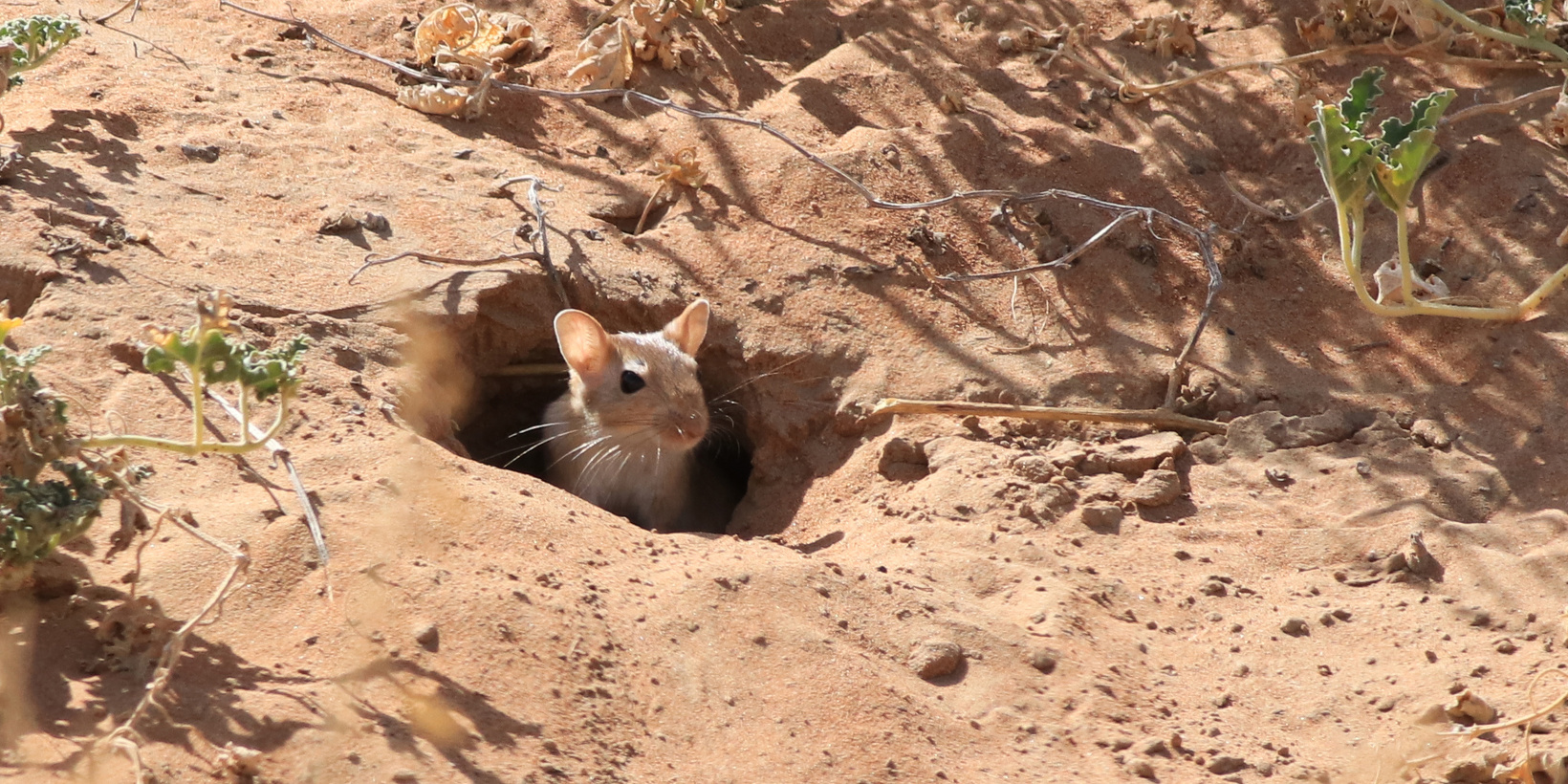
Sundevall's jird
Sundevall's jirds are kept as pets and used in medical research. They are sometimes viewed as pests because they can eat crops, damage irrigation structures with their burrows, and may spread disease On the International Union for Conservation of Nature (IUCN) Red List they are listed as a species of Least Concern. In CITES (Convention on International Trade in Endangered Species of Wild) they have no special status. Known predators include owls and reptiles. Defenses employed by these jirds include nocturnal activity, quick movements and having a burrow nearby to make an escape. Their fur coloration of the fur may also be an adaptive trait to avoid being seen by predators. /=\
Sundevall's Jird Characteristics, Behaviot and Reproduction
Sundevall's jirds are small, but relatively large compared to some other gerbils and jirds. They range in weight from 29 to 110 grams (1.02 to 3.88 ounces) and have a head and body length that ranges from 20 to 29 centimeters (8 to 11.4 inches), with their average length being 25.1 centimeters (9.9 inches). Their fur is soft and dense. Their coat displays counter-shading with a sandy color and black spots on the back and solid white on the undersides, The claws are white. The upper lip, inside of the limbs, and the bottoms of the feet, are also white. The tail has a black tip and is about the same length as body and head,[Source: Sean Maher, Animal Diversity Web (ADW) /=]
Sundevall's jirds are nocturnal (active at night), motile (move around as opposed to being stationary) and colonial (live together in groups or in close proximity to each other). They sense using touch and chemicals usually detected with smell. Sundevall's jirds’ small colonies tend to have 10 individuals or more. The colonies occupy complex burrow structures. Individual burrow design varies . Individuals ususally do not leave their burrows until evening hours, presumably to avoid the high heat of day and diurnal predators. They have specific physiological adaptations for water conservation, including highly efficient kidneys and te production of unusually dry fecal matter. /=\
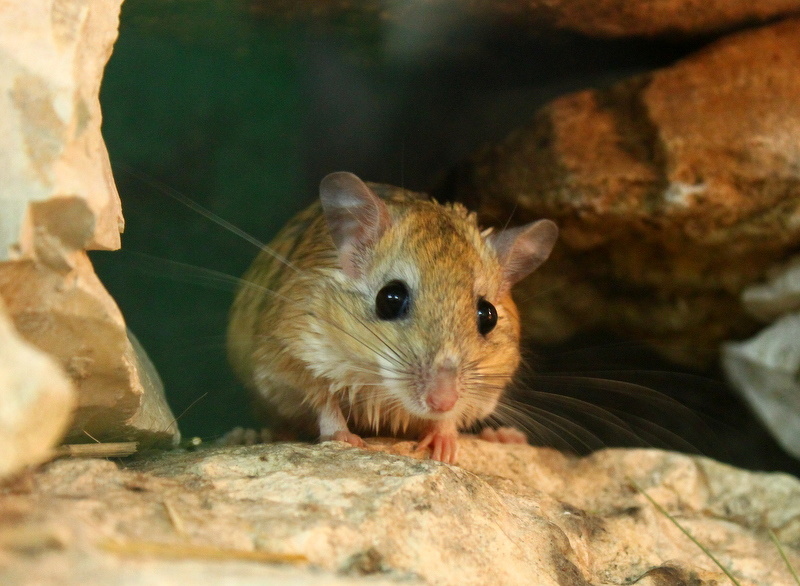
Bushy-tailed jird
Sundevall's jirds engage in year-round breeding. The estrus cycle of females lasts 4.5 days on average and is negatively affected by poor food intake. Pairs mate during the night, for the period of about two hours with quick copulations and repetition . The mating behavior includes tail beats by the male during mounting; and foot-stomping takes place during courtship. Between mounts, the female grooms the male.
The gestation period ranges from 21 to 31 days. The number of offspring ranges from one to eight, with the average number being four. Young are altricial, meaning they are relatively underdeveloped at birth. Newborns weigh 2.5 to 4.5 grams at birth and do not have hair. Hair growth begins after six to nine days, with a full coat complete after two weeks. Parental care is provided by females. The average weaning age is one month. Females and males reach sexual or reproductive maturity at a minimum of 53 days.
Bushy-Tailed Jirds
Bushy-tailed jirds (Sekeetamys calurus) are also known as bushy-tailed dipodil and are the only species in their genus — Sekeetamys. They live in Israel, eastern Egypt, Jordan, the Sinai, Saudi Arabia and Sudan. They favor arid and rocky environments and escape the heat and spend much of their time in burrows constructed in rocky terrain under edges of rocks or boulders. These mouse-like jirds are good at climbing and scampering around the rocks. They are mainly active at night and are found at elevations from 90 to 1200 meters (295 to 3937 feet) at an average elevation of 300 meters (984 feet). Their lifespan in the wild is typically 5.6 to six months. Their lifespan in captivity is one to four years. Males tend to live longer than females. [Source: Kimberlee Carter, Animal Diversity Web (ADW) /=]
Bushy-tailed jirds have several adaptations aimed at beating the heat and making up for a lack of water. They respond to osmotic stress from dehydration by reducing their resting metabolic rate (RMR), increasing non-shivering thermogenesis (NST), and reducing their volume and increasing the concentration of urine. A high capacity NST allows desert rodents to compensate for their low RMR and allows them to be active during cold desert nights. Low RMR allows them to conserve energy during the day when they are sheltered from the heat, and then a high NST capacity allows the animal to increase heat production within a short period of time before nightfall.
On the International Union for Conservation of Nature (IUCN) Red List bushy-tailed jirds are listed as a species of Least Concern. In CITES (Convention on International Trade in Endangered Species of Wild) they have no special status. They are kept as pets and are used research laboratories. They make good pets due to their mild manner and good and lab animals because of their unique ways of thermoregulating.
The main predators of bushy-tailed jirds are desert foxes such as Ruppel's foxes, pale foxes and fennecs but they also preyed upon by rock hyraxes. Remains of Bushy-tailed jirds have been found in some owl feces. Snakes inhabiting arid regions may also prey upon bushy-tailed jirds, although no evidence was found. When Bushy-tailed jirds feel threatened they thump their feet to scare the predator and warn others. If that tactic does not succeed, they attempt to outrun their predator or escape in the cover of rocks.
Bushy-Tailed Jird Characteristics and Diet
Bushy-tailed jirds range in weight from 45 to 90 grams (1.59 to 3.17 ounces), with their average weight being 64 grams (2.26 ounces). They have a head and body length that ranges from 9.8 to 12.8 centimeters (3.86 to 5.04 inches). Bushy-tailed jirds have low metabolic rates. Their average basal metabolic rate (BMR) is 0.274 watts. This is 47 percent of the expected BMR for rodents their size. A low BMR is likely an adaptation to their arid environment. Sexual Dimorphism (differences between males and females) is present: Ornamentation is different. Males have bigger and bushier tails. Generally, the bushier the tail a male has, the higher his social status is.. [Source: Kimberlee Carter, Animal Diversity Web (ADW) /=]
Bushy-tailed jirds can be distinguished from their gerbil relatives by the color of their coats. The fur is a yellowish, reddish in color and is flecked with black hairs. There is a distinct line where the fur on the baxk meets the white undersides fur. The ears are grey and sometimes have white hairs behind them. The hind feet naked soles which are useful in gripping and climbing rocks. Bushy-tailed jirds get their name names from their bushy tails, which are brownish grey with white tips. The tails are covered with long hairs that stand out, creating a feather-like effect. This is what makes tails look bushy. Young have fuller, softer fur. /=\
Bushy-tailed jirds are omnivores (eat a variety of things, including plants and animals). Animal foods include insects and worms. Among the plant foods they eat are leaves, seeds, grains, herbs, small bushes. nuts and fruit. They store and cache food especially in the presence of potential competitors such as golden spiny mice. Depending on their environment, bushy-tailed jirds diets may vary greatly as what particular plants they eat. In captivity, bushy-tailed jirds eat seeds, vegetables, fruits, mealworms and commercialized rat and gerbil food. Bushy-tailed jirds need to have a high protein diet and it is recommended not to give them too much lettuce and citrus fruits. In captivity, lime blocks are needed to supply nutrition and used for play.
Bushy-Tailed Jird Behavior
Bushy-tailed jirds are terricolous (live on the ground), saltatorial (adapted to leaping), nocturnal (active at night), motile (move around as opposed to being stationary), sedentary (remain in the same area), employ aestivation (prolonged torpor or dormancy such as hibernation (the state that some animals enter during winter in which normal physiological processes are significantly reduced, thus lowering the animal’s energy requirements), have daily torpor (a period of reduced activity, sometimes accompanied by a reduction in the metabolic rate, especially among animals with highmetabolic rates), are social (associates with others of its species; forms social groups), and have dominance hierarchies (ranking systems or pecking orders among members of a long-term social group, where dominance status affects access to resources or mates). /=\
Bushy-tailed jirds are very active from late evening to early morning but activity comes to halt during the heat of the day. The size of the territory of bushy-tailed jirds is 8,811 to 103,672 square meters, with the average being 56,242 square meters. Home range size depends on the sex. Males have a home range anywhere from 103,672 square meters to 44,303 square meters, and that of females ranges from 70,563 square meters to 8,811 square meters. [Source: Kimberlee Carter, Animal Diversity Web (ADW) /=]
Bushy-tailed jirds are quite social. The prefer to live with at least one other bushy-tailed jird. In groups, especially family groups, they bathe each other, huddle together while sleeping, box, wrestle and chase one another. Aggression is rare but does occur. One sign that things have gone too far is when two animals roll up into a tight ball when fighting. This behavior is a characteristic of a fight to the death. If bushy-tailed jirds feel threatened they let out a loud screech and often run frantically from their aggressor. Aggressive behavior is often seen in males who have a developed hierarchy. Generally, the bushier the tail a male has, the higher his social status is. /=\
Bushy-tailed jirds sense using vision, touch, sound and chemicals usually detected with smell. They communicate with sound and scent marks (produced by special glands and placed so others can smell or taste them) and vibrations. These rodents are not very vocal. When they are, it is usually because they are injured or feel severely threatened. Most communication is done through foot thumping. Bushy-tailed jirds thump their feet loudly when they sense danger or when they become sexually excited. Bushy-tailed jirds use have small scent glands on the undersides of their bodies. They spread scent by rubbing their bellies on everything that they consider their property, including territory and family members. Each animal has its own distinct scent that distinguishes its property from that of any other Bushy-tailed jirds.
Bushy-Tailed Jird Mating, Reproduction and Offspring
Bushy-tailed jirds are seasonally monogamous species. Mating pairs tend to stay in close contact throughout the mating season. The mating season for bushy-tailed jirds in the wild is February and March. Captive animals can mate year round. The gestation period ranges from 21 to 24 days. The number of offspring ranges from one to five, with the average number of offspring being 2.9. Young are altricial, meaning they are relatively underdeveloped at birth. Pre-weaning and pre-independence provisioning and protecting are done by females and males. The age in which young are weaned ranges from four to five weeks and the age in which they become independent ranging from four to five weeks. Females and males reach sexual or reproductive maturity at 60 to 80 days.[Source: Kimberlee Carter, Animal Diversity Web (ADW) /=]
Scent markings are important in attracting mates. Male bushy-tailed jirds also use foot thumping to show females that they are interested in mating. Once a male has selected a female to mate with, he chases her. Chasing of the female commences in the early evening, and may last several hours. During the period in which they they stay in close contact mating pairs often wrestle, with the loser being pinned down and given a thorough bathing by the winner.
Both members of a bushy-tailed jird mating pair help care for young. Both the male and female invest time in watching and gathering food for their young. In groups, the parents protect the young from being eaten by members of their own species. For pet owners, is important to make sure that new bushy-tailed jird parents have enough calcium and protein in their diet. If they do not, they often resort to cannibalism and eat their young. Captive breeding of bushy-tailed jirds is difficult as it is dependent on the bushy-tailed jirds’ diet. They need to have a high protein and low fat diet.
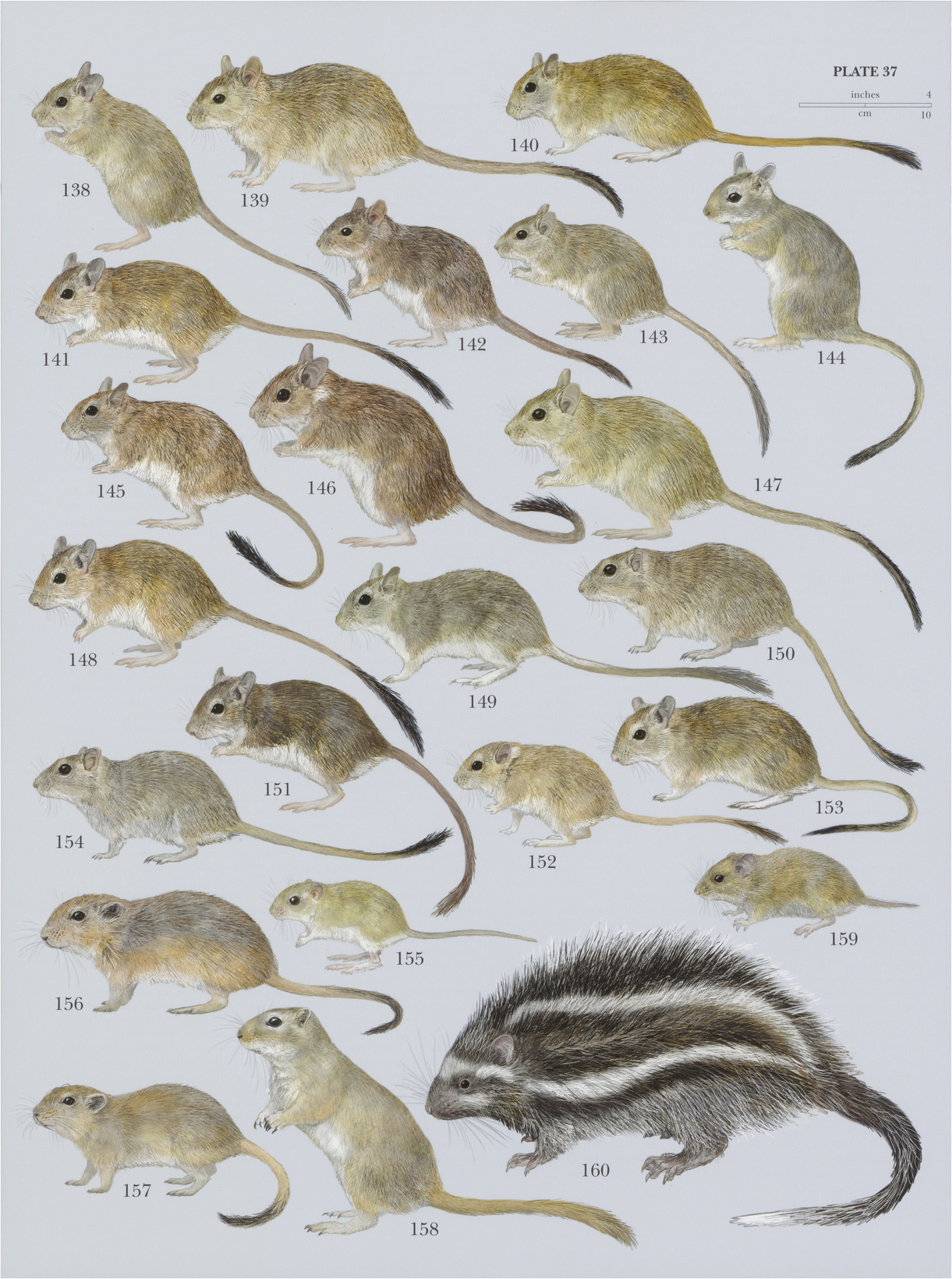
Jird species: 138) Sundevall’s Jird (Meriones crassus), 139) Moroccan Jird (Meriones grandis), 140) Libyan Jird (Meriones libycus), 141) Shaw's Jird (Meriones shaw), 142) Tristram’s Jird (Meriones tristrami), 143) Dahl's Jird (Meriones dahl), 144) Vinogradov’s Jird (Meriones vinogradoui), 145) Buxton’s Jird (Meriones sacramenti), 146) King Jird (Meriones rex), 147) Arabian Jird (Meriones arimalius), 148) Persian Jird (Meriones persicus), 149) Zarudny’s Jird (Meriones zarudnyi), 150) Indian Desert Jird (Meriones hurrianae), 151) Cheng’s Jird (Meriones chengi), 152) Midday Jird (Meriones meridianus), 153) Tamarisk Jird (Meriones tamariscinus), 154) Mongolian Jird (Meriones unguiculatus), 155) Przewalski’s Jird (Brachiones przewalskii), 156) Fat Sand Rat (Psammomys obesus), 157) Lesser Sand Rat (Psammomys vexillaris), 158) Great Gerbil (Rhombomys oprmus), 159) Buttner’s African Forest Mouse (Leimacomys buettneri), 160) Maned Rat (Lophiomys imhausi)
Image Sources: Wikimedia Commons
Text Sources: Animal Diversity Web animaldiversity.org ; National Geographic, Live Science, Natural History magazine, CNTO (China National Tourism Administration) David Attenborough books, New York Times, Washington Post, Los Angeles Times, Smithsonian magazine, Discover magazine, The New Yorker, Time, BBC, CNN, Reuters, Associated Press, AFP, Lonely Planet Guides, Wikipedia, The Guardian, Top Secret Animal Attack Files website and various books and other publications.
Last updated May 2025