
Home | Category: Desert Animals
GERBILS OF THE MIDDLE EAST AND NORTH AFRICA
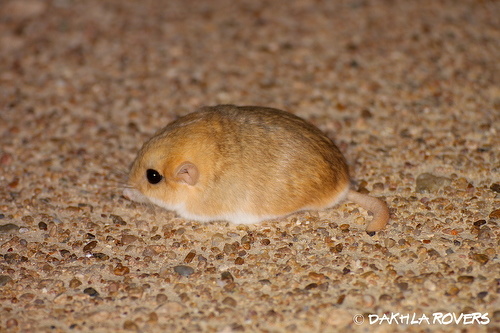
Pouched gerbil
There are over 100 species in the subfamily Gerbillinae of rodents, which includes gerbils, jirds, and sand rats. Most species are found in Asia, the Middle East or Africa, generally inhabiting arid and semi-arid environments like deserts, sandy plains, and salt flats.
Among the gerbils native to the Middle East are: 1) Cheesman's gerbil (Gerbillus cheesmani) (See Below); 2) Balochistan gerbil (Gerbillus nanus), widely distributed across North Africa, the Arabian Peninsula, the Middle East, and western Asia; and 3) Pygmy gerbil (Gerbillus henleyi), found in areas ranging from Algeria to Israel and the Arabian Peninsula; and 4) Wagner's gerbil (Gerbillus dasyurus), found in the Middle East, particularly in rocky areas, deserts, semi-deserts, and salt flats. They are solitary, nocturnal, and feed primarily on seeds and grains.
Several other gerbil species are associated more with North Africa. Among them are: 1) North African gerbils (Dipodillus campestris), found in arable land, rocky areas, and Saharan deserts across North Africa; 2) Fat-tailed gerbil (Gerbillus muralis) (See Below); 3) Lesser Egyptian gerbils (Gerbillus gerbillus), found Morocco, Mauritania, areas in Egypt and the Sinai Peninsula; 4) Greater Egyptian gerbils (Gerbillus pyramidum), inhabiting sandy deserts, semi-arid areas, and oases in northern Africa; 5) Tarabul's gerbil (Gerbillus tarabuli), found in arid regions of northwest Africa, including areas in Mauritania, Morocco, and Chad.
Pouched gerbils (Desmodilliscus braueri) are probably the smallest members of the familia Muridae (murids) — the largest or second-largest family of rodents and of mammals, containing approximately 870 species, including mice, rats, and gerbils. Adult Pouched gerbils weigh 6 to 14 grams (0.21 to 0.49 ounces) and have a head and body length of 4 to 8 centimeters (1.6 to 3.1 inches). Pouched gerbils inhabit dry savanna. across northern Africa from Mauritania in the west to Sudan in the east.
RELATED ARTICLES:
GERBILS: CHARACTERISTICS, BEHAVIOR AND REPRODUCTION factsanddetails.com
GERBIL SPECIES IN ASIA: MONGOLIAN, GREAT, INDIAN factsanddetails.com
JIRDS: CHARACTERISTICS, BEHAVIOR, SPECIES AND REPRODUCTION africame.factsanddetails.com
HAMSTERS: TAXONOMY, CHARACTERISTICS, BEHAVIOR factsanddetails.com
HAMSTER SPECIES IN EURASIA: EUROPEANS, ROBOROVSKIS, CAMPBELL'S DWARVES factsanddetails.com
GOLDEN (SYRIAN) HAMSTERS: CHARACTERISTICS, BEHAVIOR, DISCOVERY, DOMESTICATION africame.factsanddetails.com
MOUSE-LIKE HAMSTERS: CHARACTERISTICS, SPECIES, BEHAVIOR, AND REPRODUCTION factsanddetails.com
JERBOAS OF CENTRAL ASIA: CHARACTERISTICS, BEHAVIOR, SPECIES factsanddetails.com
JERBOAS OF THE MIDEAST AND NORTH AFRICA: CHARACTERISTICS, BEHAVIOR, SPECIES africame.factsanddetails.com
EGYPTIAN JERBOAS: GREATER, LESSER, CHARACTERISTICS, BEHAVIOR africame.factsanddetails.com
PYGMY JERBOAS (WORLD'S SMALLEST RODENTS): CHARACTERISTICS, BEHAVIOR, SPECIES factsanddetails.com
Cheesman's Gerbils
Cheesman's gerbils (Gerbillus cheesmani) live mainly in the Arabian Peninsula, the Middle East and southwestern Iran. Named in honour of their discoverer, British military officer, explorer and ornithologist Robert Ernest Cheesman (1878 -1962) who collected the animal while on an exploratory expedition in Saudi Arabia, these gerbils have orange-brown fur and very large eyes and a very long tail. They are similar in appearance to lesser Egyptian gerbils (Gerbillus gerbillus) and Anderson's gerbils (Gerbillus andersoni).
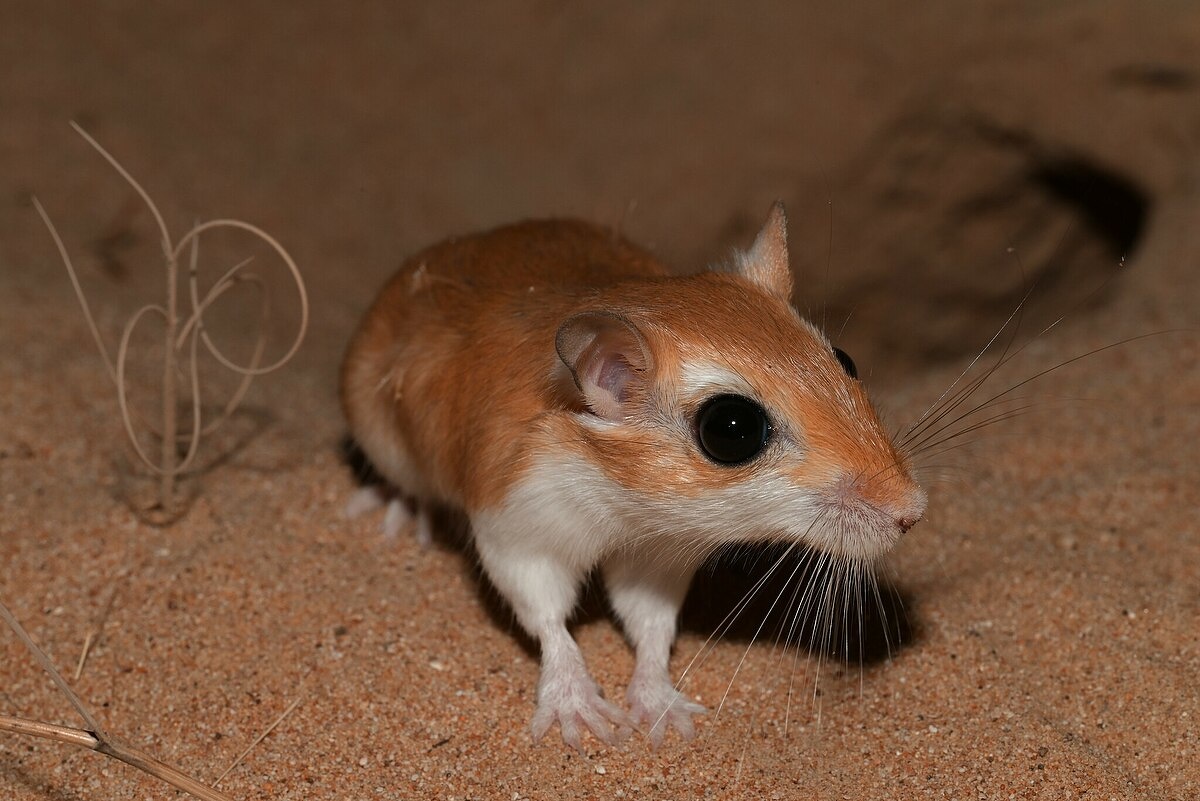
Cheesman's gerbil
Cheesman’s gerbils are one of the northern pygmy gerbils. They are found in rocky and sandy dry areas, arid plains with sandy soils, deserts, sabkha (arid coastal or inland flat, with evaporite minerals and lack of vegetation) and flat coastal salt pans — often where coarse or sparse vegetation such as Haloxylon, Calligonum, Ephedra alata and Artemisia grow. The countries in which they are found include Saudi Arabia, United Arab Emirates, Oman, Yemen, Kuwait, Iraq, Iran, Syria and Jordan.
On the International Union for Conservation of Nature (IUCN) Red List, Cheesman’s gerbils are listed as a species of Least Concern. In CITES (Convention on International Trade in Endangered Species of Wild) they have no special status. These gerbils are a common species, have a wide range and are presumed to have a large total population. The population trend seems to be stable and no particular threats to the animal have been identified.
Cheesman's Gerbil Characteristics and Diet
Cheesman’s gerbils are medium-sized gerbils. They range in weight from 10 to 63 grams (0.35 to 2.22 ounces) and have a head and body length that ranges from 70 to 11 centimeters (2.8 to 4.3 inches). Their tail is longer than their head and body, ranging from 6.9 to 18 centimeters in length (2.7 to 7 inches). Their hind feet are long and can be over 25 percent of the head and body length.[Source: Wikipedia, Divya Jain, Animal Diversity Web (ADW) /=]
The fur of Cheesman’s gerbils is orange-brown or sand-colored, allowing them to blend into their surroundings. Usually the middle part of the back dorsum is a bit darker than the sides. The paler sides blend in to the belly of the gerbil, which ranges from cream to white. The tail is furry and the underside of the tail usually is similar in color to the underside of the body. The end of the tail has a small tuft and is usually white. The fur of Cheesman's gerbil is soft and dense.
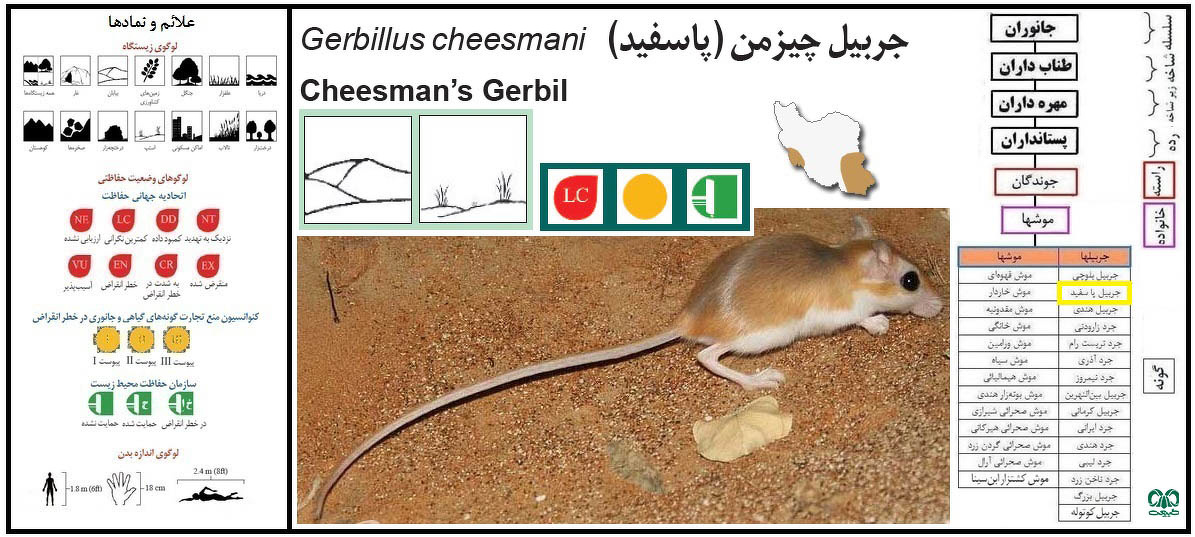
Cheesman’s gerbils are lean and have long ears and claws. The soles of the feet are hairy, giving them traction in the sand. Unlike some gerbils, the teeth of Cheesman’s gerbils are not hypsodont (having high crowns and short roots). The skull of Cheesman’s gerbils ranges in length from 2.6.to 3.3 centimeters. It has large tympanic bullae (bony capsules enclosing the middle ear). The rostrum (hard, beak-like structures projecting out from the head or mouth) is narrow and the braincase is enlarged
Cheesman’s gerbils are primarily herbivores (eat plants or plants parts) but are best classified as omnivores (eat a variety of things, including plants and animals) because they eat insects. Among the plant foods they eat are seeds, grasses, leaves, roots, tubers grains, and nuts. They store food in their burrows.
Cheesman's Gerbil Behavior and Reproduction
Cheeseman's gerbils are scansorial (able to or good at climbing), terricolous (live on the ground), fossorial (engaged in a burrowing life-style or behavior, and good at digging or burrowing), saltatorial (adapted to leaping), nocturnal (active at night), motile (move around as opposed to being stationary), sedentary (remain in the same area) and colonial (live together in groups or in close proximity to each other). [Source: Divya Jain, Animal Diversity Web (ADW) /=]
Cheeseman's gerbils dig tunnels that vary from simple holes to intricate, maze-like burrows. The burrows may be short or long and may also serve as storage sites for food. The entrances are blocked off by sand. These gerbils usually dig their burrows close to each other, forming colonies. They usually spend the hot daytime in their burrow and emerge at night to forage for seeds and grasses and the hunt the occasional insect. The soles of their feet are adapted for running across sand. They can also make long leaps. Feeding at night enables them to get dew on plants. They also conserve water by producing dry feces and very little urine. They carry damp vegetation to their burrow which raises the humidity level inside. The burrow entrance is often at the base of a shrubby plant, and the gerbil closes the entrance when it enters by flicking sand across with its tail. It is preyed on by predators such as owls, the Arabian red fox and Rüppell's fox.
Cheeseman's gerbils engage in year-round breeding. Females are polyestrous, meaning that they ovulate more than once a year. The gestation period ranges from 20 to 22 days. Litters average four or five pups, but be up to eight. Young are altricial, meaning they are relatively underdeveloped at birth. Parental care is provided by females. The average weaning age is one month.
Fat-Tailed Gerbils
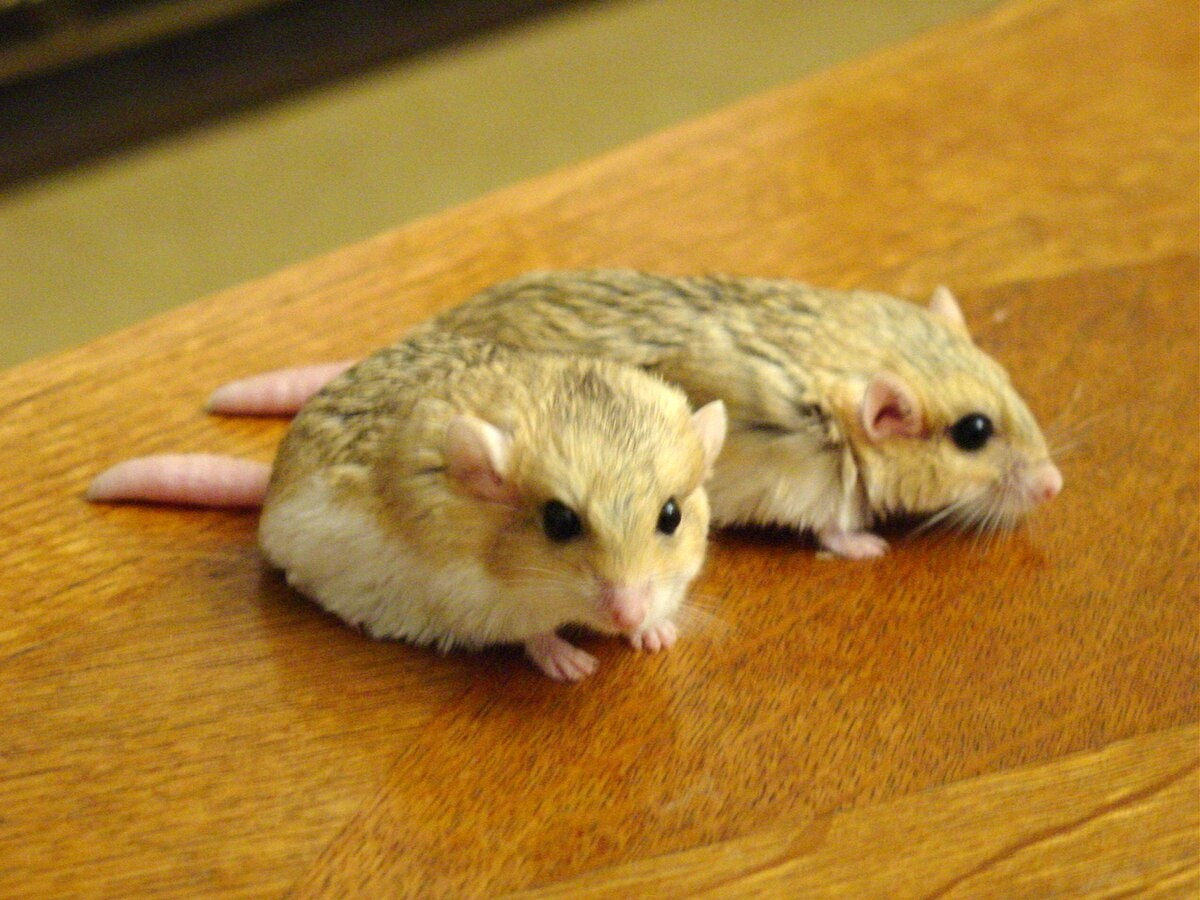
male and female fat-tailed gerbils
Fat-tailed gerbils (Pachyuromys duprasi) are also called duprasi gerbils, doops, fat-tailed jirds, fat-tailed rats and beer mat gerbils. Frequently kept as pets, they are native to northern Egypt, Libya, Tunisia, and Algeria and are found in sand sheets with vegetation, south of the western Mediterranean coastal desert, sometimes in rocky deserts. Their habitat has been described as "transitional deserts which run roughly parallel to the more lush coastal plains". They live in burrows down to one meter in depth and sometimes occupy burrows of other rodents.[Source: Sheunna Barker, Animal Diversity Web (ADW) /=]
On the International Union for Conservation of Nature (IUCN) Red List, fat-tailed gerbils they are listed as a species of Least Concern. In CITES (Convention on International Trade in Endangered Species of Wild) they have no special status. They are kept as pets because they are cute, docile, easy to care for, fun to play with, and tend to get along well with other gerbils.
Captive fat-tailed gerbil have a life span between five and seven years, relatively long for a gerbil. It is likely that those in the wild don’t live nearly as long. The age of Fat-tailed gerbils can be determined by molar wear and the closing of the skull sutures. Predation of Fat-tailed gerbils has not been well documented but it is presumed they may be hunted snakes, birds of prey and foxes. Anti-predator behavior includes escaping to burrows. Their light-colored fur serves as camouflage in the desert,
Fat-Tailed Gerbil Characteristics
Adult fat-tailed gerbils weigh between 36.5 and 40 grams (1.3 and 1.4 ounces) and have an average head and body length of 10.8 millimeters (4.25 inches). Their tail is 5.8 centimeters (2.2 inches) long; their feet are 2.3 centimeters (0.9 inches) long; their ears are 1.4 centimeters (.55 inches) long and their skull is 3.4 centimeters (1.3 inches) long. Sexual Dimorphism (differences between males and females) is not present: Both sexes are roughly equal in size and look similar. [Source: Sheunna Barker, Animal Diversity Web (ADW) /=]
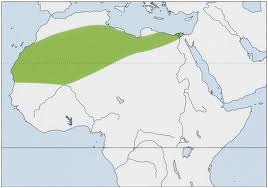
range of fat-tailed gerbils
Fat-tailed gerbils have fur that is long and fluffy. They have a round body with fairly large, oval-shaped eyes and pink ears that are positioned low on the head. Their fur color ranges from gray to tan with dorsal hairs sometimes tipped with black. Coloration of fur may vary according to subspecies and region. Their undersides and feet are white. The soles of their feet and ears are sparsely haired.
The tails of fat-tailed gerbils give them their common name and distinguish them from other gerbils. The tails are shorter than their heads and bodies, are thick and club-shaped, and lack brush hairs. These tails store fat and water. The general health of an individual may be determined by the thickness of the tail. Those with skinny tails may not be getting enough food and nutrients.
Fat-tailed gerbils are omnivores (eat a variety of things, including plants and animals). They are mostly insectivorous (eat insects) but it in the wild have been observed feeding on plants of Anabasis articulata and Artemisia monosperma. In captivity, they are fed meal worms, crickets, beetles, grain, various vegetables, Gerbil Mix, and even chopped meat.
Fat-Tailed Gerbil Behavior and Reproduction
Fat-tailed gerbils are terricolous (live on the ground), fossorial (engaged in a burrowing life-style or behavior, and good at digging or burrowing), nocturnal (active at night), crepuscular (active at dawn and dusk), motile (move around as opposed to being stationary), sedentary (remain in the same area) and both solitary and social. They can be found in colonies, and alone. [Source: Sheunna Barker, Animal Diversity Web (ADW) /=]
Fat-tailed gerbils are one of the most docile of gerbiles. When captured, they don’t make much of an effort to escape and rarely bite. However, with other members of their species, they can be aggressive and sometimes cannibalistic. Females have been known to eat their young. In captivity, owners have noted that when they fight, they bite each other's tails, often leaving scars. In the wild, fat-tailed gerbils most often become active at dusk. Some are active off and on both day and night. Owners of captive one say they are active for very short periods of time in between longer periods of sleep.
Fat-tailed gerbils sense using vision, touch, sound, vibrations and chemicals usually detected with smelling or smelling-like senses. They communicate with vision, touch, sound and chemicals. Males have scent glands on their stomachs they use to mark territories. Tactile and visual communication are important, especially during mating, when a form of sparring occurs between males and females. Vocalizations are also involved.
Fat-tailed gerbils engage in seasonal breeding and can breed up to three times a year. In captivity, breeding occurs between April and November. In captivity, the mating ritual of fat-tailed gerbils is often mistaken for fighting. Males and females stand on their hind legs and wrestle while making shrieking noises. The gestation period ranges from 19 to 22 days. The number of offspring ranges from three to 9, with the average number of offspring being 4.5. Young are altricial, meaning they are relatively underdeveloped at birth. They are born blind, naked, and vulnerable. During the pre-weaning stage provisioning and protecting are done by females in some type of nest, probably in a burrow. Pre-independence protection is provided by females. Males have not been observed taking part in parental care. The age in which young are weaned ranges from three to four weeks. Females and males reach sexual or reproductive maturity at three to six months.
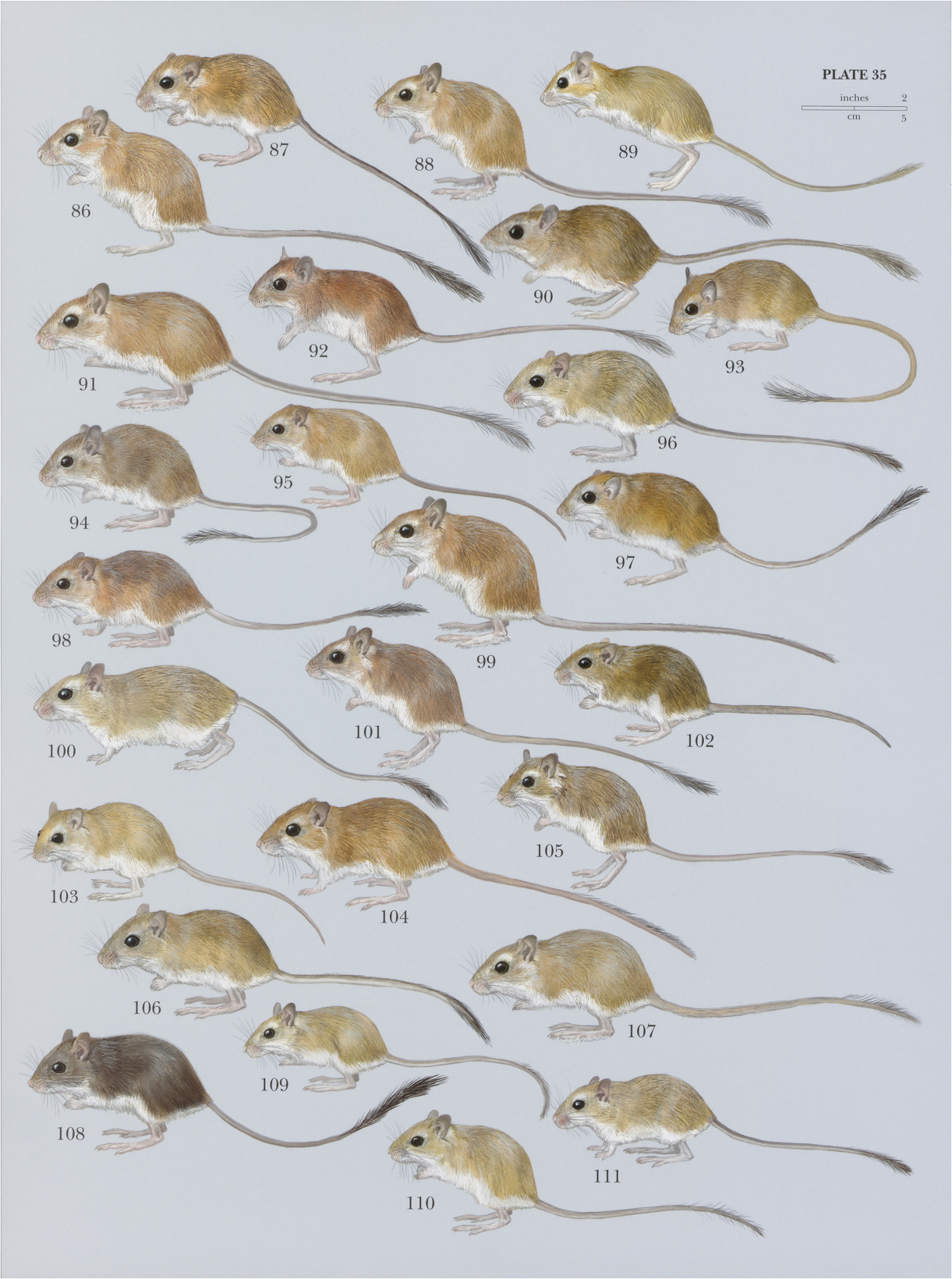
Some gerbil species: 86. Ammodile (Ammodillus imbellis), 87. Pleasant Gerbil (Gerbillus amoenus), 88. Anderson’s Gerbil (Gerbillus andersoni), 89. Botta’s Gerbil (Gerbillus bottai), 90. North African Gerbil (Gerbillus campestris), 91. Flower’s Gerbil (Gerbillus floweri), 92. Algerian Gerbil (Gerbillus garamantis), 93. Lesser Egyptian Gerbil (Gerbillus gerbillus), 94. Grobben’s Gerbil (Gerbillus grobbeni), 95. Pygmy Gerbil (Gerbillus henleyi), 96. Moroccan Gerbil (Gerbillus hesperinus), 97. Hoogstraal’s Gerbil (Gerbillus hoogstraali), 98. James's Gerbil (Gerbillus jamesi), 99. Lataste’s Gerbil (Gerbillus latastei), 100. Greater Short-tailed Gerbil (Gerbillus maghrebi), 101. Occidental Gerbil (Gerbillus occiduus), 102. Lesser Short-tailed Gerbil (Gerbillus simoni), 103. Sand Gerbil (Gerbullus syrticus), 104. Tarabul Gerbil (Gerbillus tarabuli), 105. Vivacious Gerbil (Gerbillus vivax), 106. Waters’s Gerbil (Gerbillus watersi), 107. Agag Gerbil (Gerbillus agag), 108. Lowe’s Gerbil (Gerbillus lower), 109. Mauritanian Gerbil (Gerbillus mauritaniae), 110. Darfur Gerbil (Gerbillus muriculus), 111. Sudan Gerbil (Gerbillus nancillus)
Image Sources: Wikimedia Commons
Text Sources: Animal Diversity Web animaldiversity.org ; National Geographic, Live Science, Natural History magazine, CNTO (China National Tourism Administration) David Attenborough books, New York Times, Washington Post, Los Angeles Times, Smithsonian magazine, Discover magazine, The New Yorker, Time, BBC, CNN, Reuters, Associated Press, AFP, Lonely Planet Guides, Wikipedia, The Guardian, Top Secret Animal Attack Files website and various books and other publications.
Last updated May 2025