
Home | Category: Desert Animals
BARBARY SHEEP

Barbary sheep
Barbary sheep (Ammotragus lervia) are also known as aoudad (pronounced owdad) They are a species of caprine (sheeps and goats) native to rocky mountains in North Africa and parts of West Africa. They are the only species in genus Ammotragus and six subspecies have been described. They are now rare in North Africa but have been introduced to North America, southern Europe, and elsewhere. They are known in the Berber language as waddan or arwi, and in former French territories as the mouflon.
Barbary sheep originated in the hills of the Sahara and have inhabited all the major mountains of North Africa. In the late 1800s, they were introduced into Europe, including Germany and Italy. Around 1900, the first Barbary sheep were transferred to the United States to be placed in zoos. Surplus zoo stock was sold to private parties who eventually released some to the wild in New Mexico in 1950 and in Texas in 1957. This has allowed a wild population to develop in the southwestern United States. [Source: Matthew Steinway, Animal Diversity Web (ADW) /=]
Barbary sheep live in the desert mountains from sea level up to snowline. They are well adapted to a dry climates and are able to survive long periods of time without fresh water intake; instead they use metabolic water. Their average lifespan in the wild is around 10 years. In captivity they have lived up to 20.9 years. A viable female offspring was produced when a female domestic goat was mated with a male Barbary sheep. This was confirmed by a backcross with a male Barbary sheep. /=\
Barbary Sheep Characteristics and Diet
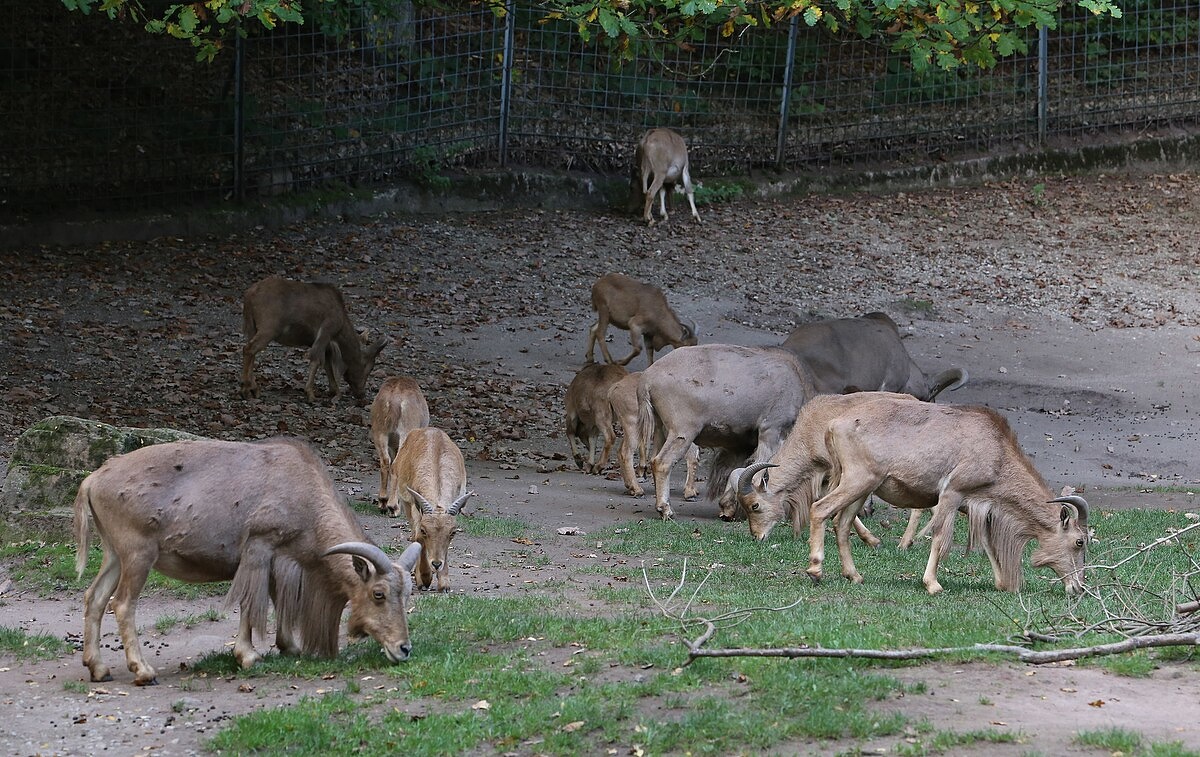
Barbary sheep is a relatively large sheep. They range in weight from 65 to 145 kilograms (143 to 320 pounds), stand 0.75 to 1.1 centimeters (2.5 to 3.6 feet) tall at the shoulder, with a length around 1.5 meters (5 feet). Sexual Dimorphism (differences between males and females) is present: Males are larger than females. Ornamentation is different. Males can weigh up to 145 kilograms, while females are much smaller, the largest are up to 65 kilograms. Both males and females have horns that curve outward, backward, and point inward toward the neck. Females' horns are smaller, but have the same shape. [Source: Matthew Steinway, Animal Diversity Web (ADW) /=]
The fur of Barbary is mostly sandy brown and darkens with age,. The chin, throat, and insides of the front limbs are covered with long, white hair. This white hair is called the ventral mane and appears as if the sheep has a beard. This shaggy hair extending down to the chest in males. Upper parts and the outer parts of the legs are a uniform reddish- or grayish-brown. Their horns have a triangular cross-section and can exceed 76 centimeters (30 inches) in length. The horns are fairly smooth, with slight wrinkles evident at the base as the animal matures.
Barbary sheep are herbivorous (eating plants or plants parts). They feed on a variety of vegetation such as grass, forbs (herbaceous flowering plants), and shrubs. Seasonal variation plays a role in determining their diet. In the winter, grass makes up the majority of food intake, while shrubs are the more common food the rest of the year.
Barbary Sheep Behavior
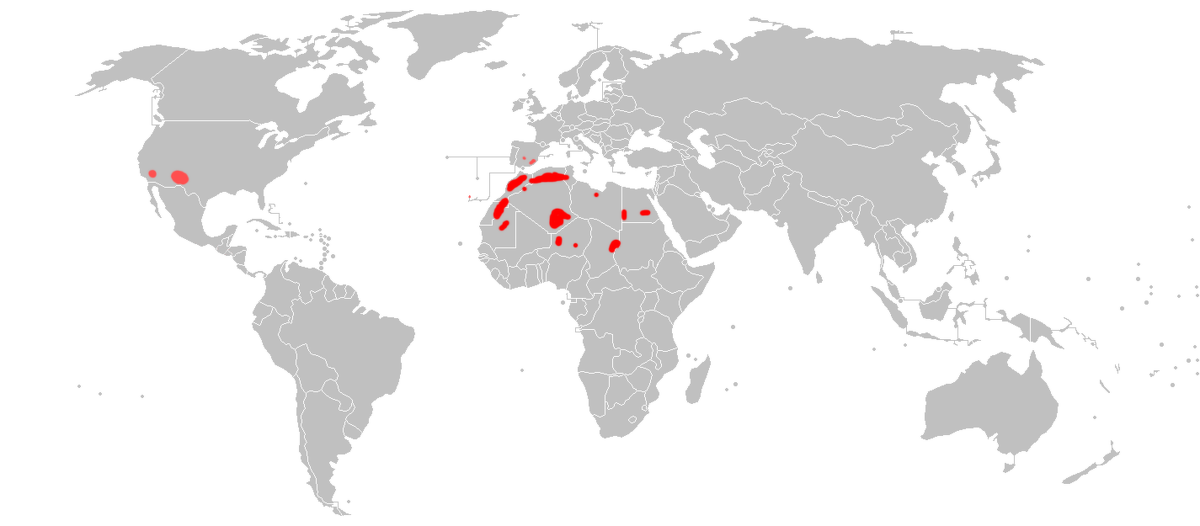
range of Barbary sheep
Barbary sheep are terricolous (live on the ground), diurnal (active mainly during the daytime), motile (move around as opposed to being stationary), nomadic (move from place to place, generally within a well-defined range), territorial (defend an area within the home range), social (associates with others of its species; forms social groups), and have dominance hierarchies (ranking systems or pecking orders among members of a long-term social group, where dominance status affects access to resources or mates). They sense using touch and chemicals usually detected with smell. [Source: Matthew Steinway, Animal Diversity Web (ADW) /=]
The social hierarchy of Barbary sheep. is "one of linear descent through males, females, and juveniles." Males are the dominant sex, at least in part because of their large size. In groups, however, dominant females are the leaders. Dominance among juveniles is determined by the strength of the pair bond with their mothers. As the bond is broken, juveniles can sense their dominance position among their peers. /=\
Barbary sheep have a very distinct threat posture used in conflicts with other Barbary sheep. They direct their horns toward their oponent. Aggressive behavior also includes the head-on charge, when two males charge into each other making contact with their horns, and wrestling. In the later, males butt their heads or hook their horns and then twist and make gouging movements. Females have been seen to fight, but they rarely perform the head-on charge. Unlike many of their relatives, Barbary sheep do not kick.
Barbary Sheep Mating, Reproduction and Offspring
Barbary sheep are polygynous (males have more than one female as a mate at one time). They engage in seasonal breeding — once yearly, generally from September to November. The gestation period ranges from 5.17 to 5.5 months. The number of offspring is usually one, and sometimes two. There is an extended period of juvenile learning. [Source: Matthew Steinway, Animal Diversity Web (ADW) /=]
During estrus, females lick the sides of the prospective mate. The animals may touch muzzles while courtimg. The male mounts the female and achieves copulation. Males defend groups of females from other males. Most lambs are born between March and May. However, births have been seen as late as November. Twins are born one out of every six or seven births. /=\
The timing of sexual maturity varies among males. Sperm were found in one male at eleven months; however, this is probably not the norm. Females are considered sexually mature at 19 months; however, females as young as eight months of age have produced offspring.
Barbary Sheep, Humans and Conservation
On the International Union for Conservation of Nature (IUCN) Red List Barbary sheep are listed as Vulnerable. In CITES (Convention on International Trade in Endangered Species of Wild) they are in Appendix II, which lists species not necessarily threatened with extinction now but that may become so unless trade is closely controlled. [Source: Matthew Steinway, Animal Diversity Web (ADW) /=]
Humans utilize Barbary sheeo for food; their body parts are sources of valuable materials. /=\ Nomads of the Sahara have traditionally depended on Barbary sheep for meat, hide, hair, sinews, and horns. In the United States today, Barbary sheep are commercially bred to be used for sport hunting. Commercially raised and wild populations of Barbary sheep are legally hunted in New Mexico and Texas. /=\
The impact of Barbary sheep as introduced species has not been fully assessed. It has been suggested that they may compete directly with mule deer for food or the may affects attempts at reintroduction of bighorn sheep as they feed on the same types of food. Barbary sheep have been found feeding on winter wheat crops in Texas /=\
Image Sources: Wikimedia Commons
Text Sources: Animal Diversity Web animaldiversity.org ; National Geographic, Live Science, Natural History magazine, CNTO (China National Tourism Administration) David Attenborough books, New York Times, Washington Post, Los Angeles Times, Smithsonian magazine, Discover magazine, The New Yorker, Time, BBC, CNN, Reuters, Associated Press, AFP, Lonely Planet Guides, Wikipedia, The Guardian, Top Secret Animal Attack Files website and various books and other publications.
Last updated May 2025