
Home | Category: Desert Animals
SCIMITAR ORYX
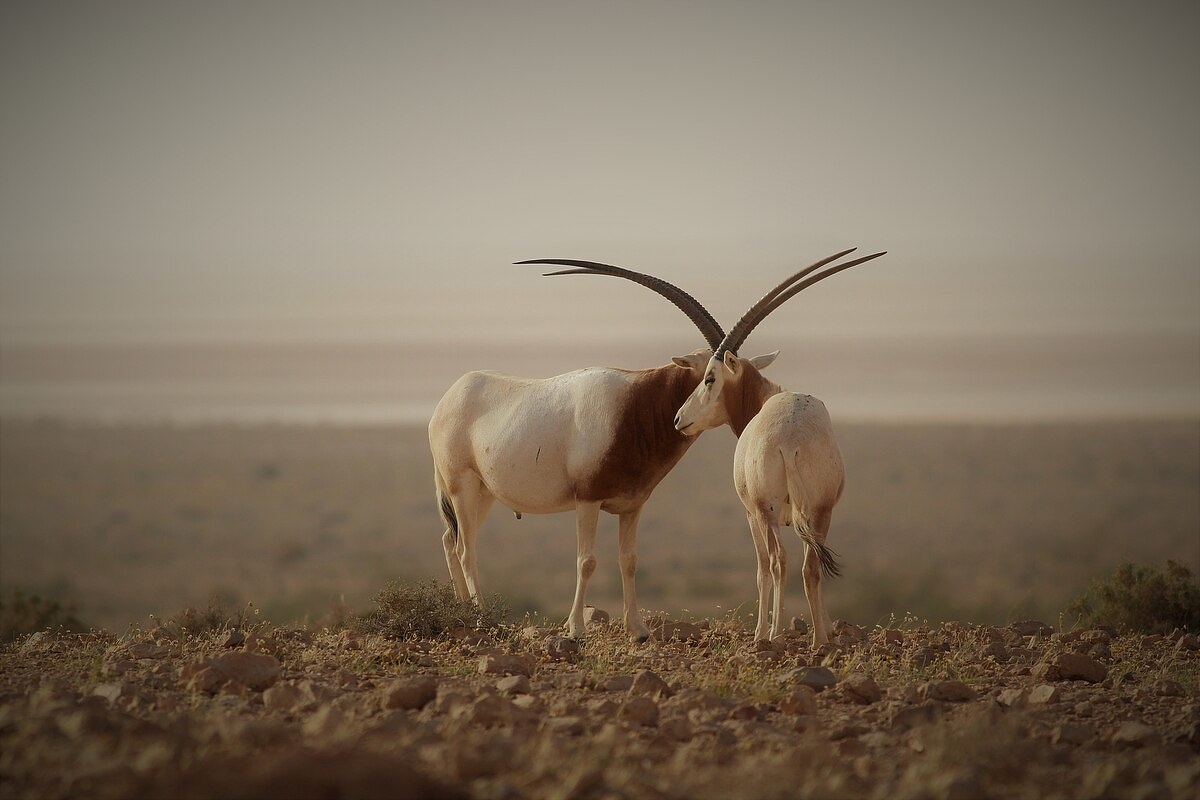
Scimitar oryx in Dghoumes National Park, Tunisia
Scimitar oryxes (Oryx dammah) are also known as scimitar-horned oryxes and Sahara oryxes. They were once widespread across North Africa and parts of West Africa and Central Africa and roamed from Senegal to Egypt and from the Sahel across the Sahara to the Mediterranean Sea. In 2000, they were declared extinct in the wild on the International Union for Conservation of Nature (IUCN) Red List, but in 2023 they were downlisted to endangered, after a group was successfully reintroduced in Chad. [Source: Wikipedia +]
Scimitar oryxes are large antelope but average size oryx. They can be almost two meters in length and reach a shoulder height of 1.2 meters (four feet). They are mostly white with some brown markings. They have backswept horns that can reach a meter in length. Their average lifespan in captivity is 27.5 years. /=\
Scimitar-horned oryx have traditionally made their home in the desert to semidesert region of Africa known as the "Great Steppe." This area is a strip of arid grassland extending from Senegal to central Sudan, which borders the southern edge of the Sahara Desert. Vegetation includes stands of dense, spiny shrubs with tough (hard or waxy) evergreen leaves. [Source: Hugh Johnson, Animal Diversity Web (ADW)]
Scimitar oryxes were the emblem of the ancient Egyptian Oryx nome and today are the animal symbol of the Sahara Conservation Fund. Their decline began as a result of climate change thousands of years ago during the Neolithic period. Later they hunted extensively for their horns and meat. Today, they are captively bred in special reserves in Tunisia, Morocco, Israel and Senegal, and on private exotic animal ranches in the Texas Hill Country in the U.S. In 2016, the reintroduction program was launched in Chad that produced the small herd that lives and reproduces there now. +
How Scimitar Oryxes Survive in the Saharan Heat
Scimitar oryxes can survive extreme heat that would kill most animals. They don't need to seek shelter during the day and drink very little water. They can survive for months or even years without drinking water. Grazing animals, they derive most of their daily moisture from plants. They also employ a form of deep nighttime breathing that generates sufficient moisture for them to live on.
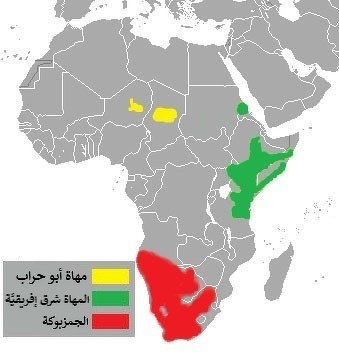
oryx range; scimitar oryx range in the 1990s in yellow
Hugh Johnson wrote in Animal Diversity Web: Several physiological abilities unique to desert oryxes enable them to live nomadic lifestyles in near-desert environments. Under conditions of water stress these oryxes can raise their body temperature up to 116 degrees F (46.6 C). With functioning metabolism at these high temperatures, less water is needed for evaporation in order to help conduct heat away from the body. This reduced evaporation of bodily fluids helps these oryxes go long periods without water. In times of ample supply, oryxes can also use fluid loss through urination and feces, to lower their body temperatures below 97 F (36 C) at night, thus allowing them more time before maximum body temperature is reached the following day. [Source: Hugh Johnson, Animal Diversity Web (ADW) /=]
Another anatomical adaptation allows the oryx to tolerate high temperatures that would be lethal to most mammals. They have a network of fine blood vessels that carry blood from the heart to the brain. These blood vessels travel close to the nasal passage, allowing cooling of up to five degrees F of the blood before it is pumped to the brain, one of the most heat sensitive organs of the body. /=\
Scimitar Oryx Characteristics and Diet
Scimitar oryxes weigh around 200 kilograms (440 pounds). Their average length is 1.7 meters (5.5 feet) with a shoulder height of about 1.2 meters (3.9 feet ). They are the only oryx whose horns curve backwards. The horns average about one meter (3.3 feet) but lengths of 1.2 meters (3.9 feet) or more have been recorded. Both sexes have horns and, like other oryxes, the female's tend to be more slender. Scimitar oryxes are smaller than East African oryxes and larger than Arabian oryxes. [Source: Hugh Johnson, Animal Diversity Web (ADW) /=]
Like other oryxes, scimitar oryxes have a black and white face mask but their black tends to fade to a brownish color. Most of their coat is whitish, with rusty brown necks and chests. Some individuals have brown bands on their flanks along with a rusty brown spot outlined on the thigh. Like all orxyes, calves are born with yellow coats and lack distinguishing marks which appear later in life.
Scimitar oryxes are herbivores (eat plants or plants parts). They on annual grasses, herbs, juicy roots, buds, and when water is scarce, fruits and vegetables. To deal with unpredictable and variable amounts of precipitation and vegeation, Scimitar oryxes can travel large distances to find new green grass which sprouts up quickly after sudden down pours. In the past, they tended to stay in small groups of about 40 but when food was scarce and concentrated they could form herds of more than a hundred. /=\
Bovids
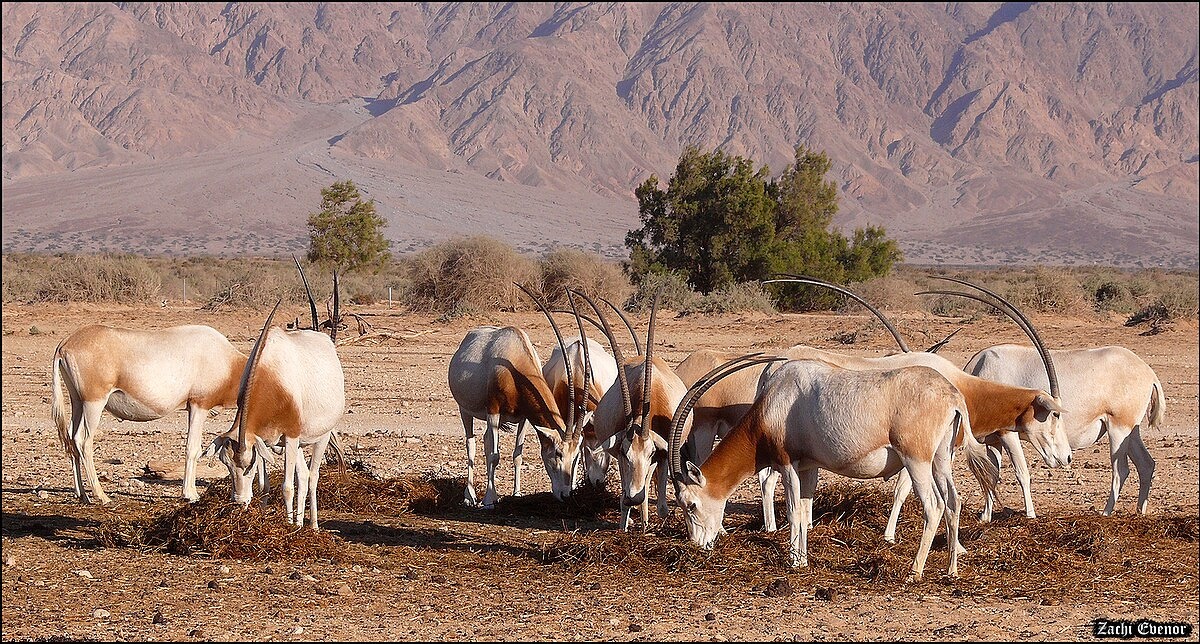
Scimitar oryx at Hai-Bar Yotvata, Israel in 2013
Oryx are bovids. Bovids (Bovidae) are the largest of 10 extant families within Artiodactyla, consisting of more than 140 extant and 300 extinct species. According to Animal Diversity Web: Designation of subfamilies within Bovidae has been controversial and many experts disagree about whether Bovidae is monophyletic (group of organisms that evolved from a single common ancestor) or not. [Source: Whitney Gomez; Tamatha A. Patterson; Jonathon Swinton; John Berini, Animal Diversity Web (ADW) /=]
Wild bovids can be found throughout Africa, much of Europe, Asia, and North America and characteristically inhabit grasslands. Their dentition, unguligrade limb morphology, and gastrointestinal specialization likely evolved as a result of their grazing lifestyle. All bovids have four-chambered, ruminating stomachs and at least one pair of horns, which are generally present on both sexes.
Bovid lifespans are highly variable. Some domesticated species have an average lifespan of 10 years with males living up to 28 years and females living up to 22 years. For example, domesticated goats can live up to 17 years but have an average lifespan of 12 years. Most wild bovids live between 10 and 15 years, with larger species tending to live longer. For instance, American bison can live for up to 25 years and gaur up to 30 years. In polygynous species, males often have a shorter lifespan than females. This is likely due to male-male competition and the solitary nature of sexually-dimorphic males resulting in increased vulnerability to predation. /=\
See Separate Article: BOVIDS: CHARACTERISTICS, BEHAVIOR, SUBFAMILIES factsanddetails.com
Ruminants
Cattle, sheep, goats, yaks, buffalo, deer, antelopes, giraffes, and their relatives are ruminants — cud-chewing mammals that have a distinctive digestive system designed to obtain nutrients from large amounts of nutrient-poor grass. Ruminants evolved about 20 million years ago in North America and migrated from there to Europe and Asia and to a lesser extent South America, where they never became widespread.
As ruminants evolved they rose up on their toes and developed long legs. Their side toes shrunk while their central toes strengthened and the nails developed into hooves, which are extremely durable and excellent shock absorbers.
Ruminants helped grasslands remain as grasslands and thus kept themselves adequately suppled with food. Grasses can withstand the heavy trampling of ruminants while young tree seedlings can not. The changing rain conditions of many grasslands has meant that the grass sprouts seasonally in different places and animals often make long journeys to find pastures. The ruminants hooves and large size allows them to make the journeys.
Describing a descendant of the first ruminates, David Attenborough wrote: deer move through the forest browsing in an unhurried confident way. In contrast the chevrotain feed quickly, collecting fallen fruit and leaves from low bushes and digest them immediately. They then retire to a secluded hiding place and then use a technique that, it seems, they were the first to pioneer. They ruminate.
Clumps of their hastly gathered meals are retrieved from a front compartment in their stomach where they had been stored and brought back up the throat to be given a second more intensive chewing with the back teeth. With that done, the chevrotain swallows the lump again. This time it continues through the first chamber of the stomach and into a second where it is fermented into a broth. It is a technique that today is used by many species of grazing mammals.
See Ruminants Under MAMMALS factsanddetails.com
Scimitar Oryx Behavior and Reproduction
Scimitar oryxes are motile (move around as opposed to being stationary), social (associates with others of its species; forms social groups), and have dominance hierarchies (ranking systems or pecking orders among members of a long-term social group, where dominance status affects access to resources or mates). [Source: Hugh Johnson, Animal Diversity Web (ADW) /=]
Orxyes usually travel in groups ranging from two to 40. Most herds contain a dominant or alpha bull. Usually these bulls provide guidance to the group directing other members as to when and where they move and seek forage. The leaders enure the group moves in formation and chase down stragglers and force them to get a move on. Unlike other oryxes, solitary male Scimitar oryxes are seldom seen. Male oryxes often engage in fights. However, these confrontations are well-choreographed and seldom end in bloodshed, unless there is strong competition for vital resources. Scimitar oryxes sense using touch and chemicals usually detected with smell. Fights and mating rituals often end same way with inferior males or female lowering their head to the dominant the male.
Courting is done with a mating circle in which a male and a female stand parallel to one another facing opposite directions. They then circle around one another until the cow allows the male to mount from behind. If the female is not ready to mate, she can run away and circle in the reverse direction. The gestation period ranges from eight to eight and half months. Only one calf — weighing an average of 9 to 15 kilograms (20 to 33 pounds) — is born. The post-independence period is characterized by the association of offspring with their parents. On average females reach sexual or reproductive maturity at 21 months.
Scimitar Oryxes, Humans and Conservation
On the International Union for Conservation of Nature (IUCN) Red List, Scimitar oryx were listed as Extinct in the Wild but are now listed as Endangered thanks to the group in Chad. On the US Federal List they are classified as Endangered. In CITES (Convention on International Trade in Endangered Species of Wild) they are in Appendix I, which lists species that are the most endangered among CITES-listed animals and plants. /=\
The Scimitar oryx recovered thanks to the efforts of conservationists and zoos worldwide. The successfully relocated group wanders the plains of Chad’s Ouadi Rimé-Ouadi Achim Faunal Reserve, where they were first reintroduced in August 2016. In December 2023, scimitar oryx officially had their status changed from extinct in the wild to endangered by the IUCN. Between 2016 and 2022, 285 scimitar oryx have been released in the unfenced area at the reserve. As of September 2022 the total number of the species in Chad was 575. “The change from the previous category of Extinct in Wild is genuine, as it results from the successful re-establishment of the species in the wild,” the IUCN’s website reads. [Source: Leo Collis,The Cool Down, December 26, 2023]
The reclassification of the scimitar oryx was one of the few times an animal was moved from the “extinct in the wild” designation to “endangered”. Przewalski’s horses were similarly downgraded in 2011. Zoological Society of London’s (ZSL’s) senior conservation biologist Tim Wacher said: “The return of the Scimitar oryx is the result of a long-term conservation effort for the species — following in-depth, careful preparation, and championed and supported by the Environment Agency of Abu Dhabi. All Saharan antelope species are severely threatened, but this project is proof that with the right will and resources, we can secure a future for them all.”
According to The Cool Down: The ZSL noted that the reintroduction of the Scimitar oryx has also allowed the recovery of the ecosystem in the Ouadi Rimé-Ouadi Achim Faunal Reserve. The scimitar oryx help to maintain grassland and prevent the spread of desertification, providing a natural solution as the region learns to deal with the impact of rising global temperatures exacerbated by human-caused pollution.
In the past Scimitar oryx were a food source, now they are probably most valuable as ecotourism draws. Though Scimitar oryx are scare in the wild, there are thousands of them in captivity at zoos and game preserves. Some were bred at Hair-Bar from 15 oryxes imported from zoos in Europe and the United States. As of 2001 about 60 animals had been produced and more than a half dozen had been released in the wild in Senegal. Several large game preserves, mainly in Texas, run successful programs for breeding the Scimitar oryx. You can even hunt them in Texas — a rare opportunity to kill an animal that until recently was extinct in the wild.
Image Sources: Wikimedia Commons
Text Sources: Animal Diversity Web animaldiversity.org ; National Geographic, Live Science, Natural History magazine, CNTO (China National Tourism Administration) David Attenborough books, New York Times, Washington Post, Los Angeles Times, Smithsonian magazine, Discover magazine, The New Yorker, Time, BBC, CNN, Reuters, Associated Press, AFP, Lonely Planet Guides, Wikipedia, The Guardian, Top Secret Animal Attack Files website and various books and other publications.
Last updated May 2025