
Home | Category: Desert Animals
ARABIAN TAHR
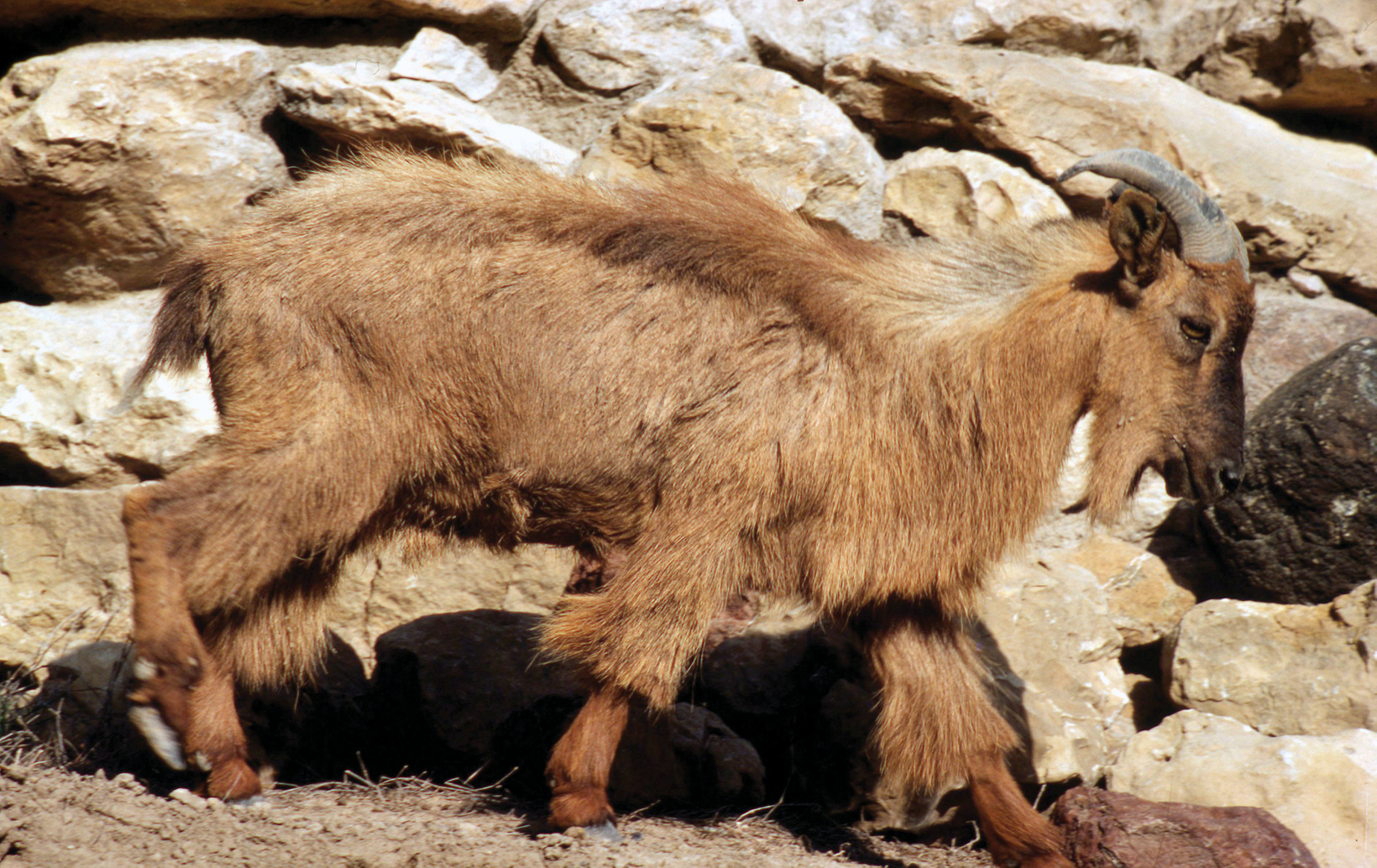
Arabian tahr
Arabian tahr (Arabitragus jayakari or Hemitragus jayakari) are a species of tahr native to eastern Arabia. They are the smallest tahrs. Tahrs are large artiodactyl ungulates related to goats and sheep. There are three species, all native to Asia. Previously it was thought they were closely related to each other and placed in a single genus, Hemitragus, but genetic studies have since shown that they are not so closely related and they are now considered as members of three separate monotypic genera: Hemitragus is now reserved for the Himalayan tahr, Nilgiritragus for the Nilgiri tahr in India, and Arabitragus for the Arabian tahr. [Source: Wikipedia]
Arabian tahrs are currently found in the Hajar Mountains of the United Arab Emirates and the northern parts of Oman at elevations from 1000 to 1800 meters (3281 to 5905 feet) at an average elevation of 1200 meters (3937 feet). Their current known range is 8,863 square kilometers, and the total possible range is 15,787 square kilometers. They inhabit north slopes of the Hajar Mountains and Musandan masifs, where they favor steep ground. Tahrs occupy the relatively rainy slopes of these mountains which contain enough water and diverse vegetation for them to survive. At the bottoms of these mountains, water sources in valleys, called wadis, are important for the survival of Arabian tahrs.
Arabian tahrs have a lifespan in captivity of up to 22 years. With predation, hunting, and destruction of habitat, the lifespan in the wild is lower but it is uncertain how much lower. As of a 2018, the wild population was estimated to have around 2,200 individuals. The species was first described in 1894 by Oldfield Thomas who proposed the name Hemitragus jayakari for zoological specimens collected in Oman Jebel Taw. It was separated into the newly created genus Arabitragus in 2005 on the basis of a study on the molecular phylogeny of the group.
Arabian leopards prey on Arabian tahr, whose primary defense is escaping to cliffs and maneuvering around on rocks. Their rubbery hooves give them a sure grip and they can move very quickly. Their horns are pointed backwards but can be used to thwart an attack. Their shaggy, reddish-brown fur helps them blend in with their rocky habitat.
See Separate Articles: HIMALAYAN TAHR: CHARACTERISTICS, BEHAVIOR AND REPRODUCTION factsanddetails.com; For Nilgiri Tahr, See ANTELOPE AND GOAT-LIKE WILD ANIMALS IN INDIA AND SOUTH ASIA factsanddetails.com
Arabian Tahr Characteristics and Diet
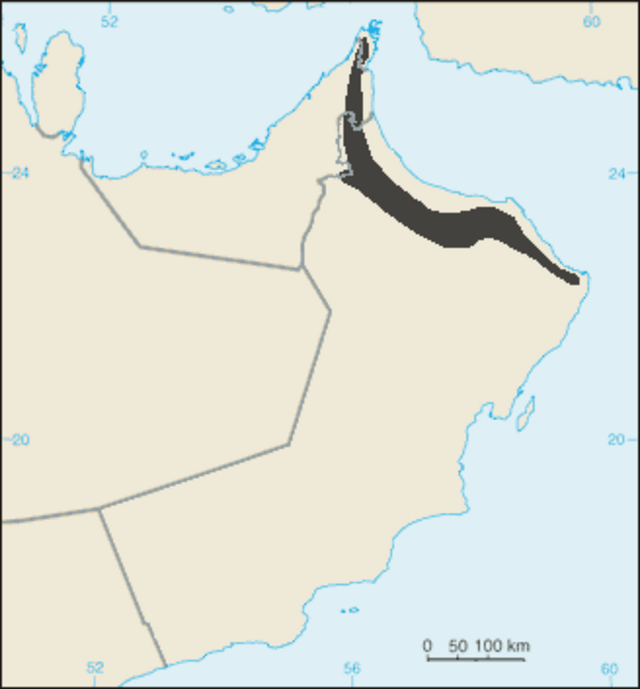
range of the Arabian tahr in the UAE and Oman
Arabian tahr are smallest than the other two tahr species. They stand 59.7 to 63.5 centimeters (2 to 2.1 feet) at the shoulder, compared to Himalayan tahrs and Nilgiri tahrs (both around one meter, 3.3 feet). Arabian tahr range in weight from 17 to 40 kilograms (37.44 to 88.11 pounds). Sexual Dimorphism (differences between males and females) is present: Males are larger than females. male more colorful Ornamentation is different. Males weigh approximately 40 kilograms (88 pounds) and females weigh 17 to 20 kilograms (37.4 to 44 pounds) [Source: Alexander Emmitt, Animal Diversity Web (ADW) /=]
Both sexes have horns pointing backwards. Those of Arabian tahr males are larger and more dense than those of females. Their hair is long and reddish with a dark brown stripe running down the back from the head to the tail. Males grow noticeable manes every year along their backs and have impressive, long hair on their chins and chests that extend down their front legs, and can grow quite long. Their hooves are supple and provide traction in their mountainous terrain.
Arabian tahrs are herbivores (eat plants or plants parts), and are also classified as folivores (eat leaves). Among the plant foods they eat are leaves, wood, bark, stems, seeds, grains, nuts fruit. Arabian tahrs are strict browsers, meaning they eat mainly leaves and other plant parts off bushes rather than graze on grass on the ground. Otherwise they have a diverse diet, eating whatever they can find in their habitat. Water supplies are limited. Droughts can seriously affect Arabian tahr populations. /=\
Arabian Tahr Behavior and Communication
Arabian tahrs are terricolous (live on the ground), diurnal (active mainly during the daytime), motile (move around as opposed to being stationary), sedentary (remain in the same area), solitary territorial (defend an area within the home range) and social (associates with others of its species; forms social groups). [Source: Alexander Emmitt, Animal Diversity Web (ADW) /=]
Arabian tahrs begin grazing in the early morning and continue for most of the day until a few hours before dusk. They travel along cliffs and steep mountain grades to reach good foraging areas and available water. They sometimes descend to reach "wadis," the bottom of canyons or other lowlands to reach water sources. They can be solitary but are typically found in small groups of two or three — typically a female and her young, a female and male, or a female, male, and their young. In captivity, Arabian tahrs sometimes form larger groups with more complex social hierarchies. This suggests that their social structures in the wild may be a result of their isolation and rarity and that if that was not the case they would form larger, social groups.

illustration of an Arabian tahr made in 1894
Arabian tahrs sense using vision, touch, sound and chemicals usually detected with smell and communicate with vision, sound and chemicals and employ pheromones (chemicals released into air or water that are detected by and responded to by other animals of the same species) and scent marks produced by special glands and placed so others can smell and taste them. Males use urine to mark their mates. /=\
Arabian tahr males mark their territory by scratching their hooves on the ground and urinating. The average area covered by an Arabian tahr is 0.3 square kilometers, which usually contains water and vegetation. When this water supply is not enough, they temporarily travel outside of their territory. /=\
Arabian Tahr Mating, Reproduction and Offspring
Arabian tahrs engage in year-round breeding, with mating peaking in November and December. The gestation period ranges from 140 to 145 days. The number of offspring is usually one but sometimes two. Young are precocial. This means they are relatively well-developed when born. Pre-weaning stage provisioning and protecting are provided by females. Pre-independence provisioning is provided by females and protecting is done males and females. The post-independence period is characterized by the association of offspring with their mother. The average age in which young become independent ranges from two to three years. Females and males reach sexual or reproductive maturity at two to three years. [Source: Alexander Emmitt, Animal Diversity Web (ADW) /=]
Arabian tahrs appear to be monogamous. Many sightings are of a single male with a single female in his territory. They are unusual among bovids in defending territories. Males use their urine to mark their territory and their mates. Their horns are used in male-male combat over females. Himalayan tahr and Nilgiri tahr are polygamous and Arabian tahr is only polygamous in captivity. Againm maybe the isolation of Arabian tahrs forces them into a monogamous lifestyle rather a polygamous one they might otherwise choose.
Breeding by Arabian tahrs is opportunistic. They find a mate and form small exclusive groups of two to four related individuals. They do not form rutting herds. Females are more likely to give birth to two offspring when resources are plentiful. Birthing peaks in March and April. Females nurse, and protect their young until independence. Males defend territories with good resources and help defend the young, although there have been few observations of this in the wild.
Arabian Tahrs, Humans and Conservation
On the International Union for Conservation of Nature (IUCN) Red List Arabian tahr are listed as Endangered. On the US Federal List they are classified as Endangered. In CITES (Convention on International Trade in Endangered Species of Wild) they are in Appendix I, which lists species that are the most endangered among CITES-listed animals and plants.[Source: Alexander Emmitt, Animal Diversity Web (ADW) /=]
The number of Arabian tahrs is currently estimated to be fewer than 2,500 individuals. Subpopulations are mall and fragmented, with none having more than 250 individuals. Populations are not increasing protective measures and captive breeding. The biggest threat to these animals is loss of habitat. Poaching and competition with domestic goats for resources have also contributed to their endangered status. Arabian tahrs were once hunted for sport and meat. Even though there are laws against it, poaching still occurs. Tahrs may also get diseases from domestic animals. Mining and oil exploration threatens habitat quality and use up and degrades water.
Arabian tahrs are protected by law and bred in captivity. In Oman, it is illegal to hunt them. Enforcement efforts include appointing tribesmen to be tahr guards and look after their habitat. Farming families have been told to keep their livestock away from tahrs so as not to spread disease and eat the tahr’s food. Currently, tahrs living in captivity are not considered sufficiently prepared to live in the wild and reintroductions have not been attempted. There are plans to establish more reserves for the tahrs and better enforce laws that protect them.
Image Sources: Wikimedia Commons
Text Sources: Animal Diversity Web animaldiversity.org ; National Geographic, Live Science, Natural History magazine, CNTO (China National Tourism Administration) David Attenborough books, New York Times, Washington Post, Los Angeles Times, Smithsonian magazine, Discover magazine, The New Yorker, Time, BBC, CNN, Reuters, Associated Press, AFP, Lonely Planet Guides, Wikipedia, The Guardian, Top Secret Animal Attack Files website and various books and other publications.
Last updated May 2025