
Home | Category: Desert Animals
ADDAX
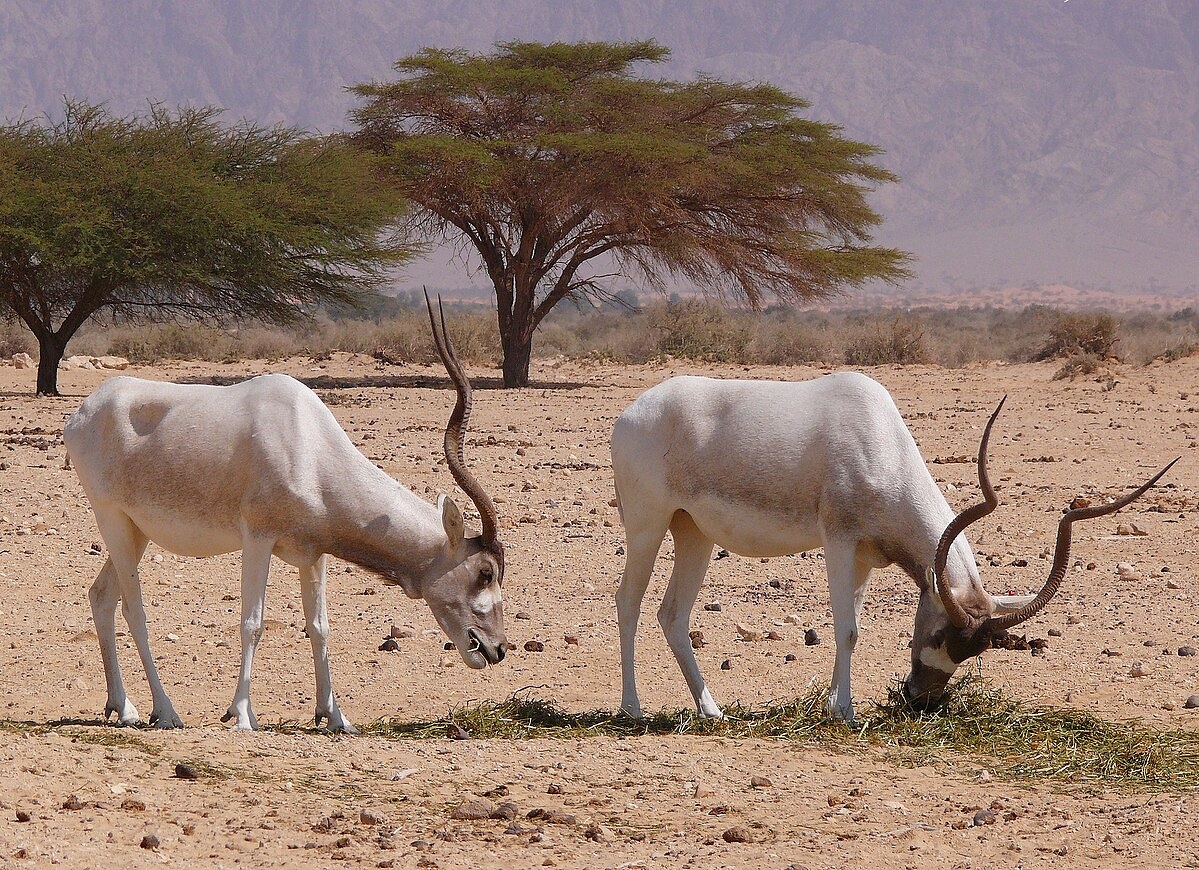
addax
Addax (Addax nasomaculatus) are also known as white antelope and screwhorn antelope. Native to the Sahara Desert, they are the only member of the genus Addax and were first described scientifically by Henri de Blainville in 1816. Addaxes have lived up to 25 years in captivity. It is not certain what their lifespan in the wild is. [Source: Berke Altan, Animal Diversity Web (ADW) /=\; Wikipedia]
Addax formerly occurred in desert and semidesert areas of the Sahara from Western Sahara and Mauritania in the west to Egypt and Sudan in the east. Today they only found in a few isolated areas of Northeastern Niger, North Central Chad, and Eastern Mauritania. Addax are not restricted to areas with free water, and are usually found within the desert or the surrounding stony country. /=\
Addax are classified as critically endangered in the wild on the International Union for Conservation of Nature (IUCN) Red List. Although extremely rare in their native habitat due to unregulated hunting, they are common in captivity. They were once abundant in North Africa and were found in Northwestern Mali, Southern Libya, and Northwestern Sudan not so long ago but now are only native to Chad, Mauritania, and Niger. They have been extirpated from Algeria, Egypt, Libya, Sudan, and Western Sahara, but has been reintroduced into Morocco and Tunisia.
Addax are the most desert-adapted of the antelopes. They spend most of their lives without drinking water. They get moisture from their food and from dew that condenses on plants and have a number of adaption that help them survive in intense heat and without water. Researchers believe that addax have a special lining in their stomach that stores water in pouches to use in times of dehydration. They also produces highly concentrated urine to conserve water. The pale color of their coat reflects radiant heat, and the length and density of their coat aids in thermoregulation. During the day addax huddle together in shaded areas. On cool nights they rests in sand hollow. These practices dissipate body heat and save water by cooling the body through evaporation.
Addax Characteristics and Diet
Addax range in weight from 60 to 125 kilograms (132 to 275 pounds) and have a head and body length that ranges from 1.5 to 1.7 meters (5 to 6 feet). Tail length is 25 to 35 centimeters (10 to 14 inches. Sexual Dimorphism (differences between males and females) is present: Males are larger than females. Ornamentation is different. Males stand from 105 to 115 centimeters (41 to 45 inches) at the shoulder, while females stand 95 to 110 centimeters (37 to 43 inches) at the shoulder. [Source: Berke Altan, Animal Diversity Web (ADW) /=\; Wikipedia]
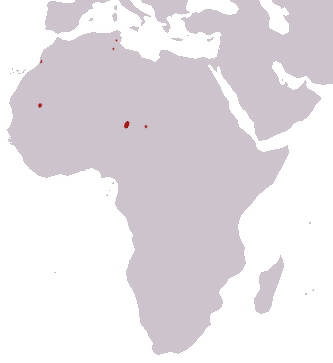
addax range
As suggested by their alternative name — screwhorn antelope — addax have long, spiral horns that ar typically 55 to 80 centimeters (22 to 31 inches) in females and 70 to 85 centimeters (28 to 33 inches) in males. The horns have approximately 1.5 to three spiral twists. The hooves are widely splayed, an adaption to moving over desert sand.
Coat color depends on the season. Addaxes are sandy to almost white in color during the summer, darkening to a grayish brown in the winter, with white hindquarters and legs, and long, brown hair on the head, neck, and shoulders. White markings are present on the face, ears, belly, hips, and legs, and there is a black tuft of hair on the forehead.
Addax are herbivores (eat plants or plants parts), and are also classified as folivores (eat leaves). Among the plant foods they eat are leaves, wood, bark, stems and flowers, primarily feeding on desert grasses and scrub. They travel great distances through the Sahara searching for sparse vegetation. A study of eight addaxes on a diet of grass hay found there was a long retention time for food in their digestive tract. This was viewed as an adaptation to a diet that included a high proportion of slow fermenting grasses and also increased fluid retention as a water-saving mechanisms due to low water turnover and a roomy rumen.
Addax Behavior
Addax are cursorial (with limbs adapted to running), terricolous (live on the ground), diurnal (active mainly during the daytime), motile (move around as opposed to being stationary), territorial (defend an area within the home range), social (associates with others of its species; forms social groups), and have dominance hierarchies (ranking systems or pecking orders among members of a long-term social group, where dominance status affects access to resources or mates). They sense using touch and chemicals usually detected with smell. [Source: Berke Altan, Animal Diversity Web (ADW) /=\; Wikipedia]
Addax move about the desert in herds of about five to 20 individuals led by a dominant adult male. Males attempt to establish their own territory, trying to keep fertile females within these territories. A single male can mate with several females in his territory. In captivity, males show signs of territoriality and mate guarding. Females establish a hierarchy of dominance, with the oldest animals ranking the highest. Herds generally stay in one place if they can but wander widely in search of food.
Herds are more likely to be found along the northern edge of rain systems during the summer and move north as winter falls. They are able to track rainfall and head for these areas where vegetation is more plentiful. Addax are "short leg" runners. This means they cannot run really fast and sometimes are taken by faster predators such lions, leopards, cheetahs and African wild dogs. Caracals, servals and hyenas prey on calves. Addax are normally not aggressive, though individuals may charge if they are disturbed.
Addax Mating, Reproduction and Offspring

Addax adult male and juvenile at Souss-Massa National Park, Morocco
Addax engage in year-round breeding. Females give birth to one young each year. Breeding can occur at any time of the year, but is most common during the winter and early spring. In the northern Sahara, breeding peaks at the end of winter and the beginning of spring; in the southern Sahara, breeding peaks from September to October and from January to mid-April. Each estrus period lasts for one or two days. [Source: Berke Altan, Animal Diversity Web (ADW) /=\; Wikipedia]
The gestation period ranges from 8.6 to 8.8 months. The number of offspring is usually one, rarely two. Females may lie or stand while giving birth. A postpartum estrus occurs after two or three days. Calves weighs five kilograms (11 pounds) at birth. The age in which young are weaned ranges from 5.4 to 9.1 months, with the average being 7.2 months. Females reach sexual or reproductive maturity at two to three years; males do so at two years. /=\
Addax, Humans and Conservation
On the International Union for Conservation of Nature (IUCN) Red List addax are listed as Critically Endangered. On the US Federal List they are classified as Endangered. In CITES (Convention on International Trade in Endangered Species of Wild) they are in Appendix I, which lists species that are the most endangered among CITES-listed animals and plants. [Source: Berke Altan, Animal Diversity Web (ADW) /=\; Wikipedia]
In the past addax meat was prized by local people and the hides were used make shoes and sandal soles. Because addax were large, slow-running targets they were easy prey for humans with modern weapons. Hunting decimated many resident populations in many parts of their original range. Tourists in four-wheel-drive vehicles also harmed the animals by chasing them until they died of exhaustion. In the Sahel increasing human population have put pressure on addax populations. Droughts and desertification also have taken their toll.
Declines in the population of the addax have been ongoing since the mid-1800s. Overhunting is the main culprit. Roadkill, the availability of firearms and nomadic settlements near waterholes also contributed to the addax’s demose. Fewer than 500 individuals are thought to exist in the wild today, most of them between the Termit area of Niger, the Bodélé region of western Chad, and the Aoukar in Mauritania.
At the same there are over 600 addaxes in Europe, Yotvata Hai-Bar Nature Reserve (Israel), Sabratha (Libya), Giza Zoo (Egypt), North America, Japan and Australia under captive breeding programmes. There are thousands more in private collections and ranches in the United States and the Middle East. Addaxes are legally protected in Morocco, Tunisia, and Algeria; hunting of all gazelles is forbidden in Libya and Egypt. Addax has been reintroduced into Bou-Hedma National Park (Tunisia) and Souss-Massa National Park (Morocco). Reintroductions in the wild are underway in Jebil National Park (Tunisia) and Grand Erg Oriental (the Sahara), and another is planned for Morocco Image Sources: Wikimedia Commons
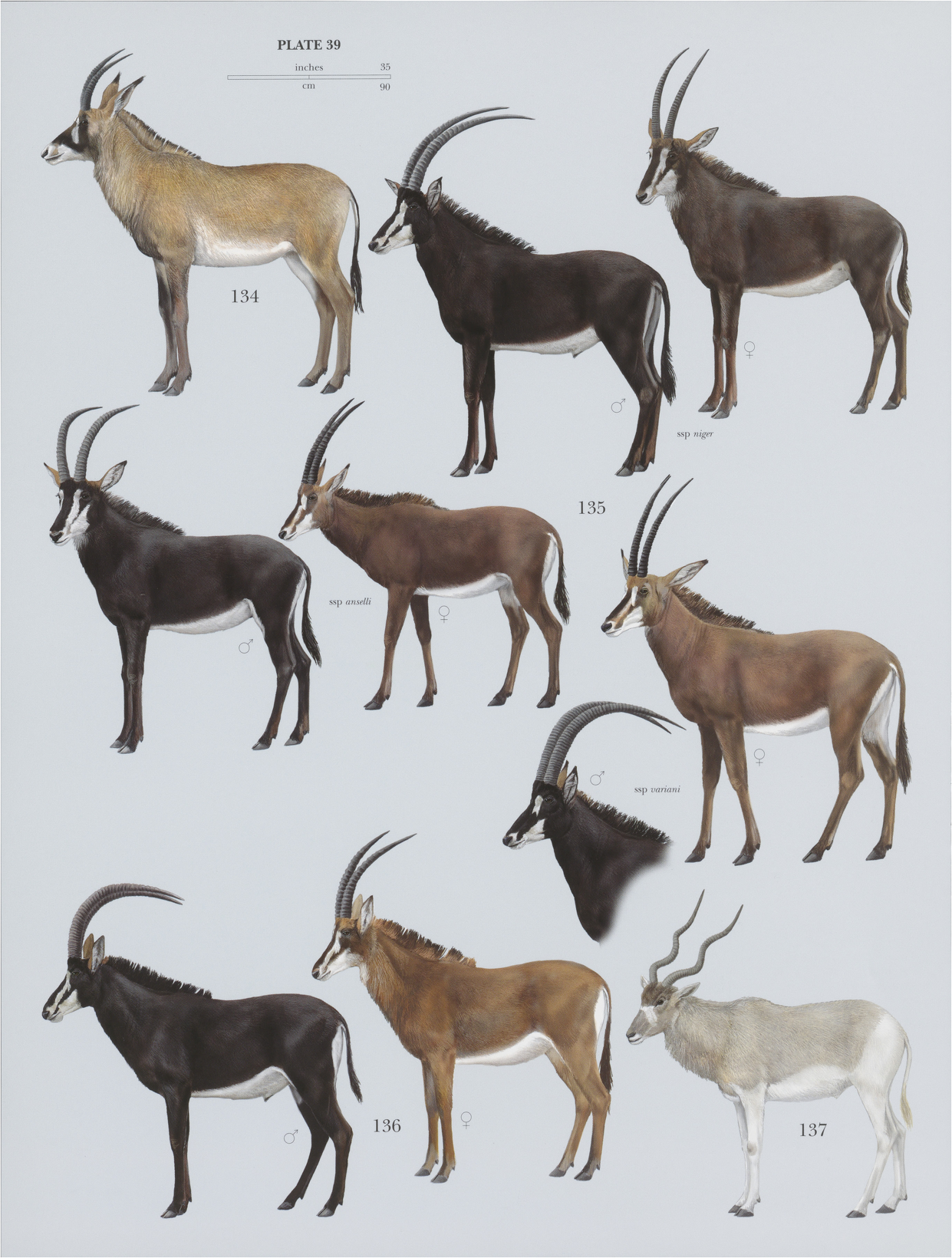
Addax and its relatives: 134) Roan Antelope (Hippotragus equinus), 135) Southern Sable Antelope (Hippotragus niger), 136) Roosevelt's Sable Antelope (Hippotragus roosevelti), 137) Addax (Addax nasomaculatus)
Text Sources: Animal Diversity Web animaldiversity.org ; National Geographic, Live Science, Natural History magazine, CNTO (China National Tourism Administration) David Attenborough books, New York Times, Washington Post, Los Angeles Times, Smithsonian magazine, Discover magazine, The New Yorker, Time, BBC, CNN, Reuters, Associated Press, AFP, Lonely Planet Guides, Wikipedia, The Guardian, Top Secret Animal Attack Files website and various books and other publications.
Last updated May 2025