
Home | Category: Death and Mummies
MUMMY MEDICINES
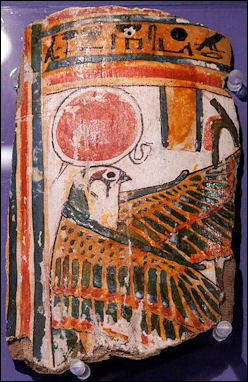
Mummy cartonnage Crushed up mummies had been used in the Middle East as a remedy for a host of ills for a long time. From the 13th to the 17th century mummies were pulverized into medicine in Europe. Apothecary shops sold real and fake mummy powder as cures for a number of ills. Ground mummy was an ingredient of Macbeth's witches brew.
Edward Rothstein wrote in the New York Times, The word mummy comes from the Arabic mumiya, referring to bitumen or asphalt, which was thought to have medicinal properties. It turns out that many of the oils and resins used in embalming are similar in character to mumiya (or mumia). So after the 12th century, a desire for this curative compound not only helped inspire a covetous mummy cult but also gave these corpses their now common name. Countless mummies were pulverized into powders believed to preserve life before death, if not afterward.
Marcus Harmes wrote: Faith that mummies could cure illness drove people for centuries to ingest something that tasted awful. Mumia, the product created from mummified bodies, was a medicinal substance consumed for centuries by rich and poor, available in apothecaries’ shops, and created from the remains of mummies brought from Egyptian tombs back to Europe. [Source: Marcus Harmes, University of Southern Queensland, The Conversation. published June 11, 2022]
Mummies were a prescribed medicine in Europe for 500 years. Not all doctors thought dry, old mummies made the best medicine. Some doctors believed that fresh meat and blood had a vitality the long-dead lacked. The claim that fresh was best convinced even the noblest of nobles. England’s King Charles II took medication made from human skulls after suffering a seizure, and, until 1909, physicians commonly used human skulls to treat neurological conditions. For the royal and social elite, eating mummies seemed a royally appropriate medicine, as doctors claimed mumia was made from pharaohs. Royalty ate royalty.
A contemporary tube of “Mumijo Crème” claims to have the same ingredients as a vintage bottle of mumiya. There is also a 1924 Merck pharmaceutical catalog in which “Mumia vera aegyptic” — true Egyptian mummy extract — is sold just a page before the catalog offers “Vaseline Pennsylvania.”
RELATED ARTICLES:
ANCIENT EGYPTIAN MUMMIES: HISTORY, PURPOSE, OLDEST AND SPECIAL ONES africame.factsanddetails.com ;
MUMMIES AROUND THE WORLD: MUMMIFICATION, SOUTH AMERICA AND THE OLDEST ONES africame.factsanddetails.com ;
ANCIENT EGYPTIAN MUMMY-MAKING: EMBALMING, GUIDES, HISTORY africame.factsanddetails.com ;
MUMMY BUSINESS IN ANCIENT EGYPT: PRICES, LABOR, WASTE africame.factsanddetails.com ;
MUMMIFICATION WORKSHOPS IN ANCIENT EGYPT: ROOMS, EQUIPMENT AND EMBALMING INGREDIENTS africame.factsanddetails.com ;
ROMAN-ERA MUMMIES: RITUALS, GOLD AND STUNNING FAIYUM PORTRAITS OF THE DEAD africame.factsanddetails.com ;
ANCIENT EGYPTIAN ANIMAL MUMMIES africame.factsanddetails.com ;
STUDY OF ANCIENT EGYPTIAN MUMMIES africame.factsanddetails.com
RECOMMENDED BOOKS:
“Mummified: the Stories Behind Egyptian Mummies in Museums”
by Angela Stienne Amazon.com;
”Canopic Jars: Tales of Mummies and Mummification (2013) by Tracy L. Carbone, Gregory L. Norris, H. P. Lovecraft Amazon.com;
“Mummies, Magic and Medicine in Ancient Egypt: Multidisciplinary Essays for Rosalie David” (2016) Amazon.com;
“Egyptian Mummies: Unraveling the Secrets of an Ancient Art” by Bob Brier (1994) Amazon.com;
“The Mummy Makers of Egypt” by Tamara Bower (2016) Amazon.com;
“Mummy in Ancient Egypt: Equipping the Dead for Eternity” by Salima Ikram and Aidan Dodson (1999) Amazon.com;
“The Encyclopedia of Mummies” by Bob Brier (1998) Amazon.com;
“Mummies and Death in Egypt” by Françoise Dunand (1998, 2006) Amazon.com;
“Egyptian Mummies and Modern Science” by Rosalie David (2008) Amazon.com;
“In Search of the Immortals: Mummies, Death and the Afterlife”
by Howard Reid (2014), mummies around the world Amazon.com;
Mummies the Middle Ages
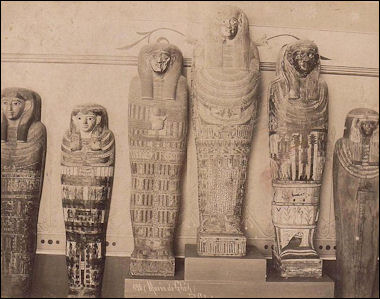
mummy cases in Cairo in the 1880s During the Middle Ages, the Crusaders returning from the Middle East brought back news of the healing powers of mummies. "They spread the information about the mūmiyā, which was thought to be a panaceum — medicine practically from everything from headache to impotence to healing wounds," Wojciech Ejsmond, co-director of the Warsaw Mummy Project, told Business Insider. For Ejsmond, the origins of these beliefs may be attributed to the 12th century Arab physician Abd-al Latif, who wrote a treatise about the healing properties of a type of resin called mūmiyā, a word that later misconstrued for "mummies.". [Source: Marianne Guenot, Business Insider, May 5, 2023]
Marcus Harmes wrote: By the 12th century apothecaries were using ground up mummies for their otherworldly medicinal properties. Mummies were a prescribed medicine for the next 500 years. In a world without antibiotics, physicians prescribed ground up skulls, bones and flesh to treat illnesses from headaches to reducing swelling or curing the plague. [Source: Marcus Harmes, University of Southern Queensland, The Conversation. published June 11, 2022]
Not everyone was convinced. Guy de la Fontaine, a royal doctor, doubted mumia was a useful medicine and saw forged mummies made from dead peasants in Alexandria in 1564. He realised people could be conned. They were not always consuming genuine ancient mummies. But the forgeries illustrate an important point: there was constant demand for dead flesh to be used in medicine and the supply of real Egyptian mummies could not meet this. Apothecaries and herbalists were still dispensing mummy medicines into the 18th century.
Describing a Momia found about six miles from the Pyramids, London merchant John Sanderson wrote in 1586: There "are thousand of embalmed bodies; which were buried thousands of years past in a sandy Cave...We were let down by ropes , as into a Well, with Waxe-candles burning in our hands, and so walked upon the bodies of all sorts and sizes, great and small, and some embalmed in little earthen Pots....they gave no noysome smell at all." [Source: “Eyewitness to History”, edited by John Carey, Avon, 1987]
"I broke all the bodies to see how the flesh was turned to drugge, and brought home divers head, hands, arms and feet, for a show: were bought also 600 pounds for the Turkie Companie in Pieces...together with one body: they are lapped in above an hundred double of cloth which rotting and pilling off , you may see the skin, flesh fingers and nayles firm, altered black. One little hand I brought into England, to show; and presented it to my brother, who gave the same to a Doctor in Oxford." [Ibid]
Mummies in the 19th Century

18th century mumia apothecary vessel
Napoleon’s first expedition into Egypt in 1798 piqued European curiosity in mummies and ancient Egypt in general. In the 19th century, mummies were displayed in European homes and European aristocrats, such as the Habsburgs, collected them. Mummies were so common that explorers reputedly stepped on them in tombs and tourist brought them home.
In “Innocents Abroad” Mark Twain asserted that mummies were used to power Egyptian steam locomotives, a claim most likely untrue. Mummies were exported for use in the papermaking industry. Americans made paper from mummy linen purchased for 3 cents a pound and it was said that mummies were used as firewood for steam engines even though people complained they didn't burn very well. Mummies also provided material for the pigment “Egyptian brown.”
Among those who collected mummies were the artist Gabriel von Max (1840-1915), whose collection of mummies and skulls must have been related to his fascination with parapsychology, hypnosis, somnambulism and spiritualism. His paintings combine kitsch spirituality, a fascination with the primitive and a preoccupation with his large family of pet monkeys.
Mummy Unwrapping Parties
In the 19th century, travelers to Egypt were allowed to bring mummies back to Europe they bought on the street of Cairo. Victorians held private parties dedicated where mummies were unwrapped for entertainment. Dr Joann Fletcher of the University of York wrote for BBC: “With 'mummy unwrapping parties' all the rage, otherwise sanctimonious Victorians felt no qualms desecrating pre-Christian bodies and even sent specially-printed invitation cards: 'Lord Londesborough at Home: A Mummy from Thebes to be unrolled at half-past Two'. [Source: Dr Joann Fletcher, BBC, February 17, 2011 |::|]
Thomas "Mummy" Petty unwrapped mummies in front of large audiences to piano music. One mummy was covered in gold, another had his genitals intact and another held an onion. Surgeons sometimes dissected them and drew applause when they turned up something like a huge ovarian cyst.
Marcus Harmes wrote: Early unwrapping events had at least a veneer of medical respectability. In 1834 the surgeon Thomas Pettigrew unwrapped a mummy at the Royal College of Surgeons. In his time, autopsies and operations took place in public and this unwrapping was just another public medical event. Soon, even the pretence of medical research was lost. By now mummies were no longer medicinal but thrilling. [Source: Marcus Harmes, University of Southern Queensland, The Conversation. published June 11, 2022]
A dinner host who could entertain an audience while unwrapping was rich enough to own an actual mummy. The thrill of seeing dried flesh and bones appearing as bandages came off meant people flocked to these unwrappings, whether in a private home or the theater of a learned society. Strong drink meant audiences were loud and appreciative.
Mummies in the Modern World
Marcus Harmes wrote: In 2016 Egyptologist John J. Johnston hosted the first public unwrapping of a mummy since 1908. Part art, part science, and part show, Johnston created a an immersive recreation of what it was like to be present at a Victorian unwrapping. It was as tasteless as possible, with everything from the Bangles’ Walk Like an Egyptian playing on loud speaker to the plying of attendees with straight gin. The mummy was only an actor wrapped in bandages but the event was a heady sensory mix. The fact it took place at St Bart’s Hospital in London was a modern reminder that mummies cross many realms of experience from the medical to the macabre. Today, the black market of antiquity smuggling – including mummies – is worth about US$3 billion.[Source: Marcus Harmes, University of Southern Queensland, The Conversation. published June 11, 2022]
In 2003, an Egyptian truck driver bought a 2,500-year-old mummy for $7,000 with hopes of reselling it to help pay off a tractor loan. Believing he could resell it for $2 million, he knocked on doors in a rich neighborhood of Cairo. Police arrested him before he could find a buyer.
Mummies and Popular Culture
Mummies have been one of the British Museum’s biggest draws ever since it opened in 1759. Director Neil MacGregor told Associated Press that 6.8 million people visited the museum in 2013, “and every one asked one of my colleagues, ’Where are the mummies?”’ [Source: Associated Press, April 9, 2014]
“In popular fiction mummies were reduced to little more than bandaged corpses with arms outstretched as they staggered towards some hapless victim. In Bram Stoker's 'Jewel of the Seven Stars', his reanimated Egyptian princess established an enduring image of the villainous mummy endlessly repeated by Hollywood, from Boris Karloff's 1932 film 'The Mummy' ('It comes to Life!') to the current big-budget re-makes of recent years.. |::|
Stories about the "Curse of King Tut" materialized shortly after the tomb’s discovery in 1922 when the excavation’s financier Lord Carnarvon — and purportedly several members of the expedition — mysteriously died. There were stories that the mummy’s bandages were soaked with cyanide extracted from peach pits, poisoning anyone who touched them, and that an array of booby traps surrounded the tomb. The curse was invented by journalist Arthur Weigalll who was angry that Carnarvon gave the exclusive right of his story to a rival paper. The curse increased the pharaoh's fame and inspired the Boris Karfloff film The Mummy.
Mummy Films
The Mummy series with Brendan Fraser and were sort of remakes of the 1932 Universal Classic Monster movie — “The Mummy” — which in turn was inspired by the discovery of Tutankhamun's tomb in 1922 and the so-called Curse of Mummy. Boris Karloff starred in the 1932 film as Imhotep, an ancient Egyptian high priest who was buried alive and cursed. James Grebey wrote in SYFY: When his tomb is uncovered, he comes back from the dead and attempts to resurrect his lover in 1920s Cairo. Karloff’s Imhotep doesn’t actually spend much time wrapped in bandages in the original film, which might partially be why the ‘99 remake further borrows inspiration from another Universal Classic Monster movie, 1940’s The Mummy's Hand. [Source:James Grebey, SYFY, September 21, 2023]
Written and directed by Stephen Sommers, the ‘99 Mummy stars Brendan Fraser as Rick O'Connell, an American adventurer who may have come across the fabled City of the Dead while fighting with the French Foreign Legion. Aspiring archeologist Evelyn Carnahan (Rachel Weisz) and her brother Jonathan (John Hannah) enlist the down-on-his-luck Rick for help finding the City of the Dead, but in the process, they unwittingly revive Imhotep (Arnold Vosloo), a high priest who was cursed and wants to bring his lost love, Anck-su-namun, back to life.
Whereas a lot of horror remakes attempt to transpose the original into the current day (the Tom Cruise-led 2017 remake of The Mummy, for example), the ‘99 Mummy is a period piece. It’s set in 1926, during a time when explorers and adventurers still were viable professions — or at least it feels that way in pop-culture depictions of the era. Fraser, who it must be said is exceptionally hot in this movie (as is Weisz and pretty much every single member of the cast) is a true swashbuckling hero. He’s molded in the image of Indiana Jones without ever trying to be Harrison Ford. There are hoots and thrills as he rescues Evelyn (a capable if somewhat clumsy heroine in her own right) from attackers mundane and supernatural, and the entire movie has the warm sheen of a good old-fashioned adventure. It’s a breezy, fun romp in an exotic locale.
Except, of course, it’s not all breezy and fun. While the heroes, setting, and action setpieces are all straight out of a great pulp adventure, the titular Mummy is very much a horror monster. Stepping into a horror legend like Karloff’s shoes (err, wraps) is no small task, but Vosloo brings the right mixture of menace and oozy, threatening charisma to the role. The Industrial Light & Magic special effects used to create Imhotep in his more monstrous, decayed form largely hold up even two decades later, and the design is fittingly creepy and gross.
In scene after scene, The Mummy seamlessly transitions from suspense to horror to thrills. Take the swarms of scarab beetles, reimagined in this movie as piranha-like flesh-eaters who burrow under their victim’s skin as they devour down to the bone. It’s a great and relatively gory-without-being-too-graphic horror gimmick, and the scarabs work just as well as a body horror-inducing threat as they crawl inside poor Jonathan, and they’re an exciting setpiece as our heroes need to outrun a wave-like swarm of them. Rick also escapes a zombie-like horde of Cairo’s residents who have come under Imotep’s thrall, but he does so with pizazz in a car chase.
The Mummy’s two sequels, The Mummy Returns and The Mummy: Tomb of the Dragon Emperor have scares and adventure, too, but the balance was never quite as perfect as it was in the original film. (The Scorpion King spin-off series is pure action shlock, which to be clear is not a bad thing. ) The Tom Cruise-led Mummy from 2017 also fails to fully balance the two genres, as despite some tense setpieces and horror aesthetic, it primarily feels like an action movie in the style of an old monster flick, rather than a perfect symbiosis of the two. The 1999 Mummy, then, is a movie treasure as valuable as any of the riches in Hamunaptra. Just as Imotep straddles the world of the living and the dead, so too does The Mummy straddle the line between horror and action.
Image Sources: Wikimedia Commons, The Louvre, The British Museum, The Egyptian Museum in Cairo
Text Sources: UCLA Encyclopedia of Egyptology, escholarship.org ; Internet Ancient History Sourcebook: Egypt sourcebooks.fordham.edu ; Tour Egypt, Minnesota State University, Mankato, ethanholman.com; Mark Millmore, discoveringegypt.com discoveringegypt.com; Metropolitan Museum of Art, National Geographic, Smithsonian magazine, New York Times, Washington Post, Los Angeles Times, Discover magazine, Times of London, Natural History magazine, Archaeology magazine, The New Yorker, BBC, Encyclopædia Britannica, Time, Newsweek, Wikipedia, Reuters, Associated Press, The Guardian,AFP, Lonely Planet Guides, “World Religions” edited by Geoffrey Parrinder (Facts on File Publications, New York); “History of Warfare” by John Keegan (Vintage Books); “History of Art” by H.W. Janson Prentice Hall, Englewood Cliffs, N.J.), Compton’s Encyclopedia and various books and other publications.
Last updated July 2024