
Home | Category: Death and Mummies
MUMMIES AROUND THE WORLD
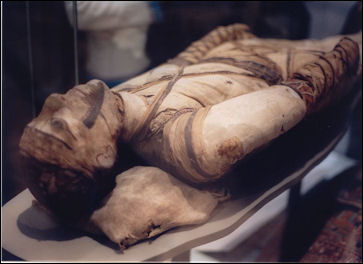
Mummy at the British Museum Mummification wasn't only practiced in ancient Egypt. Mummy-making was also practiced the Paraca Indians of Peru, the Chinchorro People of Chile and the Guanches in the Canary Islands. Similar practiced are done by other cultures around the world. Prehistoric Aleutian islanders used to place their dead, wrapped in bird skins and furs, inside caves heated by volcanic vents, where they were preserved. Two thousand mummies — most of theme clothed but not wrapped and preserved by excellent ventilation and dry limestone walls — lie in catacomb beneath the 16th century Capuchin monastery in Palermo, Sicily. Bodies have also been preserved by glaciers as was with the Iceman of the Alps, and by European bogs, which remove metal ions that facilitate decay.
Dr Joann Fletcher of the University of York wrote for BBC: “Mummification can be found on every continent of the world, but the process itself is inextricably linked with the culture of ancient Egypt and for many the word 'mummy' is synonymous with Egypt itself...These totally fascinating, wonderful 'artefacts' were once living people, and preserving them in as lifelike a way as possible was actually regarded as a way of providing a permanent home for the soul whilst effectively denying and ultimately cheating death itself. [Source: Dr Joann Fletcher, BBC, February 17, 2011 |::|]
The cave-dwelling, goat-herding Guanches — the native inhabitants of the Canary Islands and descendants of the Berbers from nearby North Africa — mummified their dead. The Spanish destroyed all the mummies they could find, but the few which remain display highly sophisticated techniques of preservation using locally available materials. Recent examination has also suggested a link with the mummification practices of ancient Egypt, an important connection since the Guanches were still mummifying their dead when the Spanish arrived in the 15th century AD. |::|
In 2011 the Franklin Institute in Philadelphia hosted an exhibit called “Mummies of the World. Describing itself as “the largest exhibition of real mummies and related artifacts ever assembled,” the exhibit featured 150 objects, most on loan from German museums. Edward Rothstein wrote in the New York Times, “There is the silken, flaxen hair of an eighth-century Coptic Egyptian child, visible past the edges of an ancient embroidered tunic, or the oval tattoos on the skin above the bony breasts of a 13th-century Peruvian woman, or — almost nightmarishly touching — the dark, rolled flesh of an 8- to 10-month-old Peruvian child who died 6,500 years ago, at least 1,000 years before Egyptians were known to preserve their dead rulers for an eternity of posthumous pleasures. [Source: Edward Rothstein, New York Times, June 16, 2011]
The sensations accumulate, for displayed here too are far less well-known mummies of South America, where, over thousands of years, multiple cultures honed embalming techniques, from the ancient Chinchorros in Peru to the 13th-century Chiu-chiu in Chile, leading up to the Incas, with their human sacrifices and death celebrations. And here, too, are the members of a single family from 18th-century Hungary, the ill-fated Orlovitses, who perished when tuberculosis ravaged the small town of Vac. Their bodies were rediscovered in 1994, naturally mummified, their paper-thin skin pocked with small holes left by stray bugs in a forgotten church crypt.
RELATED ARTICLES:
TARIM MUMMIES IN XINJIANG (WESTERN CHINA) factsanddetails.com
OTZI, THE ICEMAN: HIS HOME, BACKGROUND, DNA AND TOOLS europe.factsanddetails.com ;
OTZI’S DEATH AND FINAL HOURS europe.factsanddetails.com
ANCIENT EGYPTIAN MUMMIES: HISTORY, PURPOSE, OLDEST AND SPECIAL ONES africame.factsanddetails.com ;
ANCIENT EGYPTIAN MUMMY-MAKING: EMBALMING, GUIDES, HISTORY africame.factsanddetails.com ;
MUMMY BUSINESS IN ANCIENT EGYPT: PRICES, LABOR, WASTE africame.factsanddetails.com ;
MUMMIFICATION WORKSHOPS IN ANCIENT EGYPT: ROOMS, EQUIPMENT AND EMBALMING INGREDIENTS africame.factsanddetails.com ;
ROMAN-ERA MUMMIES: RITUALS, GOLD AND STUNNING FAIYUM PORTRAITS OF THE DEAD africame.factsanddetails.com ;
ANCIENT EGYPTIAN ANIMAL MUMMIES africame.factsanddetails.com ;
STUDY OF ANCIENT EGYPTIAN MUMMIES africame.factsanddetails.com ;
MUMMY MANIA: MEDICINES, UNWRAPPING PARTIES, MOVIES africame.factsanddetails.com
RECOMMENDED BOOKS:
“In Search of the Immortals: Mummies, Death and the Afterlife”
by Howard Reid (2014), mummies around the world Amazon.com;
“Mummies, Disease and Ancient Cultures” by Thomas Aidan Cockburn, Eve Cockburn (1998) Amazon.com;
“Beyond Death: The Chinchorro Mummies of Ancient Chile” by Bernardo T. Arriaza and John W. Verano | Dec 31, 1995 Amazon.com;
“The Handbook of Mummy Studies: New Frontiers in Scientific and Cultural Perspectives”
by Dong Hoon Shin and Raffaella Bianucci (2021) Amazon.com;
“The Tarim Mummies: Ancient China and the Mystery of the Earliest Peoples from the West” by Victor H. Mair and J. P. Mallory Amazon.com;
“The Mummies of Urumchi” by Elizabeth Wayland Barber
Amazon.com;
“Ötzi, the Iceman: The Full Facts at a Glance” by Angelika Fleckinger (2018) Amazon.com;
“The Glacier Mummy: Discovering the Copper Age with the Iceman” by Gudrun Sulzenbacher (2017) Amazon.com;
“Egyptian Mummies: Unraveling the Secrets of an Ancient Art” by Bob Brier (1994) Amazon.com;
“The Mummy Makers of Egypt” by Tamara Bower (2016) Amazon.com;
“Mummy in Ancient Egypt: Equipping the Dead for Eternity” by Salima Ikram and Aidan Dodson (1999) Amazon.com;
“Mummies, Magic and Medicine in Ancient Egypt: Multidisciplinary Essays for Rosalie David” (2016) Amazon.com;
“Egyptian Mummies and Modern Science” by Rosalie David (2008) Amazon.com;
Dead Bodies and Mummification
Mummification is the process of preserving the body after death by deliberately drying or embalming flesh. This typically involved removing moisture from a deceased body and using chemicals or natural preservatives, such as resin, to desiccate the flesh and organs.The skin, ribs and chest membranes of a mummy are generally stuck together. Unless measures are taken to prevent it, mummies will naturally curl up, and prying them open can be quite difficult. It is not uncommon for the legs to be removed by severing the hip ligament and twisting them counterclockwise. If organs are not taken out and preserved in some way they shrink considerably, turn brown and eventually lose their shape and turn powdery and disappear. As they age the lungs collapse and go to the back of the rib cage; the bladder slips down to pelvis.
Kevin Kajick wrote in The New Yorker: “When the human body expires, it usually disappears in a quick predictable schedule. Within minutes, cell organelles rupture, releasing enzymes that eat the surrounding flesh. Bacteria that inhabit the gut proliferate, race through the visceral veins to the lungs and the hair, then spread to other organs through the arteries. The corpse begins rotting, a process that typically ends” with “the dissolution of skeletal tissue by the interaction of bone mineral with ions in the groundwater.” In the hours after death the liver is most obvious organ in the chest cavity. It is dark brown and big and leads to the kidneys. The lungs are still puffy and pinkish, The other organs are various shades of gray. [Source: Kevin Krajick, The New Yorker, May 16, 2005]

mummification experiment shows a bound body's breakdown of soft tissue after three weeks, and after seven months; from the European Journal of Archaeology
The process behind mummification is similar to that used to make beef jerky and dried fruit. And the key to that is desiccation — depriving flesh-eating enzymes of the water they need to go about their business. Many mummies have their eyes because water inside the eyes drains out quickly, leaving behind a durable protein casing. Penises tend to shrivel up, in the words of Krajick, resembling “vacated butterfly cocoons. “The brain liquefies within days, leaving behind a reddish-brown precipitate when the skull dries out.
The ancient Egyptians removed the internal organs, which eliminates both water and decay-causing microbes. Salts they used leeched out remaining moisture. Resins such as myrrh and oil pitch smeared on the body helped to seal it from moisture and humidity in the air. Wrapping the body in linen — or even just leaving cloths on — helps the preservation process in dry climates by drawing moisture away from the body but overall doesn’t really help that much.
Tom Metcalfe wrote in Live Science: Although mummification is relatively straightforward in very dry conditions like the Atacama Desert, it is difficult to find evidence for it in Europe, where much wetter conditions mean that mummified soft tissues rarely stay preserved, said Rita Peyroteo-Stjerna, a bioarchaeologist at Uppsala University in Sweden. It's very hard to make these observations, but it's possible with combined methods and experimental work," she told Live Science. Peyroteo-Stjerna is the lead author of a study on the discovery published this month in the European Journal of Archaeology. [Source:Tom Metcalfe, Live Science, March 15, 2022]
Mummies
Some say old mummies smell like old books. Others say the smell is closer to dried leather. Kevin Krajick wrote in The New Yorker the scent was closer to “some edible dried ants” he purchased in South America. “It was faintly acrid, dried-cheese aura — the distilled essence of testy old proteins.”
On a mummy exhibit, Edward Rothstein wrote in the New York Times, “After a while, you get used to the trappings of death: the vacant, hollow stares; prongs of teeth protruding from desiccated gums; the shriveled flesh pulled like dried leather over jutting joints. And there’s a dreadful uniformity in those signs, whether you look at the remains of a 500-year-old dog that was found in 1953 in a peat bog in Germany or at an 800-year-old embalmed child from Peru who had been interred in a crunched and compact crouch. What you don’t get used to in this haunting, engrossing and somewhat creepy exhibition... are the trappings of life that are still evident in these mummified bodies, the hints of something before death, whether left intact by ice or bog or crypt, or jealously preserved using linen wrappings, various salts, tarlike paste and obsessive determination.[Source: Edward Rothstein, New York Times, June 16, 2011]
Stephanie Pappas wrote in Science Mummies buried with riches and personal objects are found all over the world.In some cases, these mummies provide detailed glimpses into the beliefs and practices of ancient cultures. Mummies, and the objects entombed with them, reveal what people found important, their spiritual symbols, and what they believed happened after death. Autopsies conducted by modern-day scientists can reveal what these ancient people ate, what diseases they suffered from, and ultimately what killed them. [Source:Stephanie Pappas, Live Science, July 20, 2022]
And who can avoid thinking that even in historical detail there are elements of the fantastical, at least when it comes to mummies? The early-17th-century corpse of Baron von Holz is here; so is the mummified Baroness. Both were interred in Sommersdorf Castle in Southern Germany. And both, we are told, were given to the exhibition by Dr. Manfred Baron von Crailsheim, their living descendent — on “private loan.”
World's Oldest Mummy — 8,000 Years Old — Found in Portugal
Tom Metcalfe wrote in Live Science: Roughly 60 years ago, an archaeologist snapped photos of several skeletons buried in 8,000-year-old graves in southern Portugal. Now, a new analysis of these previously undeveloped photos suggests that the oldest human mummies don't hail from Egypt or even Chile, but rather Europe. [Source:Tom Metcalfe, Live Science, March 15, 2022]
More than a dozen ancient bodies were found in Portugal's southern Sado Valley during excavations in the 1960s, and at least one of those bodies had been mummified, possibly to make it easier to transport before its burial, researchers said after analyzing the images and visiting the burial grounds. And there are signs that other bodies buried at the site may have also been mummified, which suggests that the practice could have been widespread in this region at this time.

artificial mummification of remains found in Portugal's Sado Valley; from European Journal of Archaeology
The newly identified mummy in Portugal is the oldest ever found and predates the previous record holders — mummies in the coastal region of Chile's Atacama Desert — by about 1,000 years. he evidence of mummification comes from several rolls of photographic film found among the belongings of a deceased Portuguese archaeologist, Manuel Farinha dos Santos, who died in 2001.
Farinha dos Santos had worked on human remains excavated from the Sado Valley in the early 1960s. When the researchers on the new study developed the images, they discovered black-and-white photographs of 13 burials from the Mesolithic, or Middle Stone Age. After using the photographs to reconstruct the burials at the two sites, the scientists observed that the bones of one skeleton were "hyperflexed" — that is, the arms and legs had been moved beyond their natural limits — which indicated the body had been tied with now-disintegrated bindings that were tightened after the individual's death. n addition, they noted the bones of the skeleton were still articulated, or attached and in place, after the burial — in particular the very small bones of the feet, which usually fall apart completely when a body decomposes, she said.
There were also no signs that the soil of the ancient grave had moved as the soft tissue of the body decomposed — a process that shrinks the volume of the body, resulting in the surrounding sediment filling in the voids left behind — suggesting there was no such decomposition. Taken together, these signs indicated that the body had been mummified after death; the individual was likely deliberately desiccated and then progressively made smaller by the tightening of the bindings, she said.
The assessment of the ancient burials also relied on findings from human decomposition experiments conducted at the Forensic Anthropology Research Facility at Texas State University, where one of the researchers had studied, Peyroteo-Stjerna said. hose experiments on recent cadavers showed which steps ancient people likely took while mummifying the individual in the Sado Valley, she said.
It seemed the dead person had been trussed up and probably placed on an elevated structure, such as a raised platform, to allow decomposition fluids to drain away from further contact with the body, the researchers wrote in the study. t also seemed the mummification procedure included the use of fire to dry out the cadaver, and that the bindings on the body were progressively tightened over time, retaining its anatomical integrity while increasing the flexion of the limbs, the researchers wrote. hile evidence from other ancient skeletons from the same site had suggested those bodies were treated in the same way, those specimens do not show the same combination of evidence, Peyroteo-Stjerna said. f some of the dead were brought to the Sado Valley sites from elsewhere to be buried, as the researchers suggest, then mummification — which resulted in much smaller and lighter dead bodies — would have made them easier to transport, she said.
Suggestions of 10,000-year-old mummifications had been found at El Wad and Ain Mallaha in Israel, and there were signs of mummifications 30,000 years ago at Kosteni in Belarus. "These sites are just crying out for the type of analysis carried out in this new study," he said.
South American Mummies

Atacama mummy
Pre-Columbian mummies dating to at least 7,000 years ago (and maybe as far back as 10,000 years ago) have been found in the high, dry deserts of Chile and Peru. Many were buried in dry sand which is an excellent preservative. Three out of four bodies have been naturally mummified.
Dr Joann Fletcher of the University of York wrote for BBC: “For all their skill, the Egyptians were comparative latecomers to the art of body preservation, which had already been practised in South America for thousands of years before the Egyptians ever began. Discovered on the coastal area of the Atacama desert in northern Chile and southern Peru, some of the world's oldest mummies were created by small fishing communities known as the Chinchorro. Although regarded as primitive in the absence of farming, pottery, textiles and literacy, their complex mummification techniques actually reveal a highly sophisticated culture. [Source: Dr Joann Fletcher, BBC, February 17, 2011 |::|]
“It is difficult to know exactly why such pre-literate societies practised mummification, but it must surely reflect a desire to keep their dead with them since the mummies do not seem to have been buried immediately. In some cases the faces have been repainted several times and damage to the area of the feet suggests they stood upright, perhaps as objects of veneration. When finally buried the mummies were interred in family groups, and since the earliest Chinchorro mummies are children and foetuses, it is possible that women were the first to practice mummification in an attempt to keep their dead children with them. |::|
“The mummification begun by the Chinchorro continued and evolved throughout pre-Hispanic times amongst localised Peruvian cultures such as the Nazca and Chiribaya of the desert regions, and the Chachapoyas 'Cloud People' whose mummies have been found high above the Amazon rain forests. Bodies were mummified in a sitting position with knees drawn up under the chin and hands placed near the face, and with jaws often having fallen open, Edvard Munch's celebrated painting 'The Scream' is based on a Peruvian mummy he saw in a Paris museum. The upright position allowed body fluids to drain away through gravity, with the body itself preserved and protected within masses of superbly decorated textiles. |::|
Chinchorro Mummies
The Chinchorro mummies, found in Chile, are among the oldest known human-made mummies in the world, dating back 7,000 years — 2,000 years earlier than the oldest Egyptian mummies. The Chinchorro people developed a process that accelerates mummification in which smoking coals were placed in the body after it was disemboweled. According to Archaeology magazine, these mummies were as carefully prepared as any royal in ancient Egypt but not just the elite were mummified; all segments of Chinchorro society were, including infants, children, adults and even fetuses
According to Live Science: Although the practice became more sophisticated over time, the basic process remained the same. It involved the removal of soft tissue, organs and brains. Muscles were stripped from the bones. The hollow body was then dried out and reassembled. The skin was stuffed with reeds, dried plants or other vegetal matter. Sticks were inserted into the arms and legs. Clay masks were placed on the corpses' faces and wigs were often attached. The finished mummy was then painted. [Source: Tom Garlinghouse, Live Science, July 15, 2020]
Dr Joann Fletcher of the University of York wrote for BBC: “From around 6000 B.C., the Chinchorro began to 'rebuild' their dead, with bodies carefully defleshed and the skin, brain and internal organs removed. The bones were dried with hot ashes before the whole lot was then reassembled using twigs for reinforcement bound tightly with reeds. Over this framework the skin was reapplied, and supplemented where needed with sea lion or pelican skin. A thick layer of ash paste was applied over the body and a stylised clay mask used to cover the face, painted with either black manganese or red ochre to give the mummies a rather clone-like, uniform appearance. [Source: Dr Joann Fletcher, BBC, February 17, 2011 |::|]

Atacama mummy
The San Miguel de Azapa Archaeological Museum in Arica, Chile is the home of the world's oldest mummies. Found in the Atacama Desert, the world’s driest desert, they are said to be 10,000 years old, which would make them about 5,500 years older than the oldest mummies in Egyptians, but are more likely about 7,000 years old. Hundreds of these mummies have been found in the Atacama Desert. Many have been stuffed into urns, and preserved by dry air. Flesh doesn't decay in the dry desert air. Most date back to the last millennia.
One of mummies at the Arica museum , known as Miss Chile, still has its hair and clothes but lost half the skin from its face.. Many of the of the mummies were found in jars with their knees bound to their chests. Graham Green said the of Indian mummies, "with their hair and dresses intact dating from before the Conquest...put the British Museum in the shade." Some of the mummies have Asian-like features and some of the artefacts look similar to items found in Africa and ancient Egypt.
Chinchorro People
The Chinchorro culture existed 9,000 to 3,100 years ago in what is now southern Peru and northern Chile. Chinchorro people were hunter-gatherers and fishermen. They settled in coastal villages and relied on fishing as their primary means of subsistence, using fishing hooks made out of shellfish. They also hunted animals on land and gathered edible plants from the surrounding area. [Source: Tom Garlinghouse, Live Science, July 15, 2020]
The Chinchorro mummies were unearthed in the Camarones Valley of Chile. They were found in 1917 by the German archaeologist Max Uhle at Chinchorro Beach near the town of Arica. The Chinchorro left no written records, so the lovingly preserved dead offer a rare window into their beliefs and culture. They buried their dead in shallow graves near domestic areas and water sources. According to Archaeology, the Chinchorro mummified everyone regardless of rank — even stillborn children. The Chinchorro seemed to honor all human beings whether they contributed to society or not, paying particular attention to those who never achieved their potential," anthropologists wrote in the magazine. "In the minds of the Chinchorro, life as a mummy may have been viewed as a second chance." **
Around 4,000 years ago, the region became much drier and coastal waters became less productive, at about this time the Chinchorro stopped making artificial mummies, researchers say, and they probably moved inland to the highlands of the Andes. [Source: Wynne Parry, Live Science, August 14, 2012]
Chinchorro Black and Red Mummies
During the early phases of Chinchorro society (about 7,050 – 4,500 years ago), mummies were painted with black manganese. From 2500 B.C. until the practice died out sometime during the first century B.C., red ochre replaced the manganese. Wynne Parry wrote in Live Science: Some Chinchorro mummies are covered in black paint and wear simple face masks and wigs of human hair; others are painted red, with more lifelike faces and bodies filled with earth, feathers and clay. Still others are wrapped in coiled vegetable fiber, and others covered in mud, but otherwise left alone. Nature inspired all of these, according to researchers, who point to the bone-dry land upon which the Chinchorro lived. South America's Atacama Desert is one of the driest in the world, and bodies don't naturally decompose there. [Source: Wynne Parry, Live Science, August 14, 2012]
The Chinchorro made the black mummies, the first artificial mummies, from corpses by removing the organs, cleaning the skeletons and reinforcing the bones with sticks. They then reshaped the body and dressed it with the person's own skin or with the skin from an animal. The head was covered with a simple face mask and a wig of human hair, and then the entire body was painted with manganese oxide, which made it appear black, according to a description on study researcher Bernardo Arriaza's website.
Other types came later. These included red mummies. The Chinchorro made incisions in the abdomen, shoulder, groin and ankles to remove organs and muscle tissue. The bones were also reinforced and the body cavities dried and filled with earth, feathers and clay. The head received a long wig and a mask with delineated features. The rest of the body was painted red, Arriaza's website, Momias Chinchorro, states. Others were prepared in a similar fashion but wrapped in coils of vegetable fiber. Still other corpses were left unaltered except for being covered by a layer of mud.
Did Population Pressures Play a Role Chinchorro Mummification?
Wynne Parry wrote in Live Science: But it wasn't just the desert; climate helped create these elaborate mummies in other ways. Periods of greater rainfall on the margins of the desert and in the nearby highlands of the Andes Mountains, and a more productive ocean nearby, prompted a growth in population that peaked about 6,000 years ago, they write in a study published online on August 13, 2012 in the journal Proceedings of the National Academy of Sciences. [Source: Wynne Parry, Live Science, August 14, 2012]
A growing population meant the dead multiplied as well. The mummies “became a strong presence for the living population, and they would have a strong impact on the living," lead researcher Pablo Marquet, of the Catholic University of Chile and the Santa Fe Institute in New Mexico, told LiveScience. He and colleagues write that at about the time the first man-made mummies appeared — the black-painted ones, dating between 7,000 and 8,000 years ago — a typical Chinchorro individual could potentially be exposed to a "population" of several thousand natural human mummies. "The lack of decomposition may have had a profound influence upon the living population, because the dead would have still been among them, albeit in a different state of existence," they write.
Marquet and his colleagues compared the estimated size of the human population over time with records that provided evidence of climate around the time in which the Chinchorro were making mummies. With data dating back about 14,000 years, they looked at piles of debris left by rodents, geological records of freshwater bodies, as well as chemical measurements from ice cores taken from the summit of the Bolivian volcano Sajama. They estimated the human population using radiocarbon dates taken from remains.
The results indicated artificial mummification emerged when resources, particularly fresh water, were more plentiful, and the human population was rapidly increasing. A larger population fosters the creation of new tools and new ideas, and in this case, probably led to the development of elaborate funerary practices, they write.
Ice Mummies from the Andes
Dr Joann Fletcher of the University of York wrote for BBC: “Mummies also date from the Inca period, when the habit of offering human sacrifices on mountain tops also produced 'Ice Mummies' through the natural process of freeze-drying. In recent times over 100 such mummies have been found high in the Andes, surrounded by gold and silver figurines and offerings designed to accompany them to the gods. |::|
“The Inca also used artificial techniques to preserve their dead, with mummified royalty regarded as very much alive and fed, clothed, paraded at important events and consulted in times of trouble. Although the mummies of the Inca kings were 'so intact that they lacked neither hair nor eyebrows and were in clothes just as they had worn when alive', the Spanish conquerors of 1532 could not accept the way in which the dead were treated as living beings and to preserve their mortal souls they destroyed as many mummies as they could find-once stripped of their gold adornments. |::|
Mummies in North America, Europe and Asia
Dr Joann Fletcher of the University of York wrote for BBC: “ Mummies have also been found in Alaska, southwest USA, Italy, Australia and Japan, and every one of them can reveal much about the times in which they lived. Since most of their cultures were pre-literate, their actual remains are often the only means of finding out about them, and bearing in mind that the majority of mummies recovered today are part of rescue excavations, modern examination techniques are now virtually non-destructive. From the early days of X-ray analysis, CAT-scans (computerised axial tomography), endoscopy, electron microscopy and DNA analysis for example are now used to provide valuable information regarding lifestyle, profession, relationships, health, disease, diet and even drug use of those living thousands of years ago. [Source: Dr Joann Fletcher, BBC, February 17, 2011 |::|]

llustration comparing the burial of a fresh cadaver and a desiccated body that has undergone guided mummification. from the Uppsala University and Linnaeus University in Sweden and University of Lisbon in Portugal.
Superbly preserved 3500-years-old mummies with Caucasian features, red-blond hair and even tartan clothing have been found in the Taklamakan Desert in China. The presence of ancient Europeans in China must be connected with the fact that the region lay at the crossroads of ancient trade routes between China and Europe. The vast expanses of the Eurasian Steppes were also inhabited by Scythian nomads who also mummified their dead with great success to judge from mummies such as the so-called 'Ice Maiden', recently discovered in the permafrost in the Altai Mountains between Siberia and Outer Mongolia. |::|
"The majority of European and North American mummies were created by completely natural means, such as the 'Iceman' whose frozen body was recently discovered high in the Alps near the Austrian-Italian border where he had died some 5000 years ago. A further 8 frozen bodies of women and children in seal-skin clothing were found at Qilakitsoq in Greenland, although these 'Greenland Mummies' are only 500 years old. Closest to home are the 'Bog Mummies' of north-western Europe, discovered in peat bogs where the acidic environment has preserved their soft tissue and produced a dark brown leather-like appearance. Dating largely from the Iron Age (c.400 B.C.-AD 400), many of these Celtic bodies show evidence of fractured skulls, garrotting and slit throats, their violent deaths suggesting that they were victims of ritual sacrifice. |::|
Image Sources: Wikimedia Commons, The Louvre, The British Museum, The Egyptian Museum in Cairo
Text Sources: UCLA Encyclopedia of Egyptology, escholarship.org ; Internet Ancient History Sourcebook: Egypt sourcebooks.fordham.edu ; Tour Egypt, Minnesota State University, Mankato, ethanholman.com; Mark Millmore, discoveringegypt.com discoveringegypt.com; Metropolitan Museum of Art, National Geographic, Smithsonian magazine, New York Times, Washington Post, Los Angeles Times, Discover magazine, Times of London, Natural History magazine, Archaeology magazine, The New Yorker, BBC, Encyclopædia Britannica, Time, Newsweek, Wikipedia, Reuters, Associated Press, The Guardian,AFP, Lonely Planet Guides, “World Religions” edited by Geoffrey Parrinder (Facts on File Publications, New York); “History of Warfare” by John Keegan (Vintage Books); “History of Art” by H.W. Janson Prentice Hall, Englewood Cliffs, N.J.), Compton’s Encyclopedia and various books and other publications.
Last updated July 2024