
Home | Category: Religion and Gods
HELIOPOLIS ENNEAD AND THE CREATION OF MANKIND
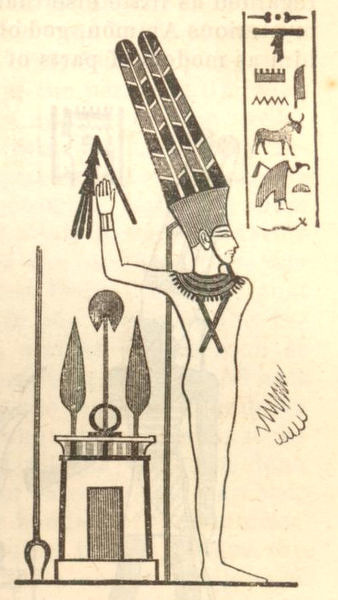
Amun
Shu, Tefnt, Nut and Geb are regarded as the original Egyptian gods as they were the first gods created by the creator god Atum. Shu was the god of air. Shu separated space into Geb (earth) and Nut (sky). Osiris, Isis, Seth and Nephyhys were all offspring of Geb and Nut.
The Heliopolis Ennead or Great Ennead was a group of eight or nine deities in Egyptian mythology worshiped at Heliopolis, an early ancient Egyptian religious center now underneath a suburb of Cairo. The nine deities were: 1) the sun god Atum; his children 2) Shu and 3) Tefnut; their children 4) Geb and 5) Nut; and their children Osiris, 6) Isis, 7) Seth, and 8) Nephthys. The Ennead sometimes includes 9) Horus, the son of Osiris and Isis, Horus. The Heliopolis Ennead rose to importance in Dynasties V and VI of the Old Kingdom and remained prominent in Egypt into the Ptolemaic era.
According to the Heliopolitan Scheme, a religious concept elaborated by the priests of Heliopolis, Atum, the early Egyptian sun god creator god, created Shu and Tefnut because he was lonely. Lee Huddleston of the University of North Texas wrote: “Finding himself alone, Atum used his hand and begat, then brought out of himself, the first generation of Gods: a) Shu [Air], and his sister/wife Tefnut [Ma'at/ Mayet]. The root meaning of Ma'at is right-thinking or Order, but she was also Space. They then wandered off into the endless body of Nun. Atum sent Eye to find them and return them. While Eye was gone, Atum created a second eye, possibly the Moon. When Shu and Tefnut returned, Tefnut gave birth to b) Geb [Earth], and his sister/wife b) Nut [Sky]. Geb and Nut were born in sexual embrace. Shu forcibly interposed himself between them, thus separating Earth from Sky. Nut gave birth to two sets of twins: d) Osiris [the Nile, God of the Dead] and his sister e) Isis, who was his wife [the Fertile soil, the star Sirius]; f) Seth [Disorder, Foreign Places], brother to Nepthys, his wife, and to Osiris and Isis. The son of Isis and Osiris was g) Horus [the Pharaoh, the Fruit of the Land]. An older God, h) Thoth, who was reborn as the son of Horus and Seth, was the Law [of God], the Word [of God], the Seed [of God].” [Source: Lee Huddleston, Ancient Near East Page, January, 2001, Internet Archive, from UNT]
According to Heliopolis story Atum produced Shu and Tefnut from his own sneeze, or in some accounts, semen, after uniting his male and female side through masturbation. The brother and sister, curious about the primeval waters that surrounded them, went to explore the waters and disappeared into the darkness. Unable to bear his loss, Atum sent a fiery messenger, the Eye of Ra, to find his children. The tears of joy he shed on their return were the first human beings. [Source: Wikipedia]
RELATED ARTICLES:
ANCIENT EGYPTIAN CREATION GODS AND MYTHS africame.factsanddetails.com ;
ANCIENT EGYPTIAN GODS AND GODDESSES: TYPES, ROLES, BEHAVIOR AND LETTERS africame.factsanddetails.com ;
FORMS AND EPITHETS OF ANCIENT EGYPTIAN GODS AND GODDESSES africame.factsanddetails.com ;
LIST OF EGYPTIAN GODS AND GODDESSES africame.factsanddetails.com ;
DEMONS IN ANCIENT EGYPT: HISTORY, TYPES, ROLES africame.factsanddetails.com
RECOMMENDED BOOKS:
“Egyptian Mythology: A Guide to the Gods, Goddesses, and Traditions of Ancient Egypt”
by Geraldine Pinch (2004) Amazon.com;
“The Complete Gods and Goddesses of Ancient Egypt” by Richard H. Wilkinson (2003) Amazon.com;
“Uncovering Egyptian Mythology: A Beginner's Guide Into the World of Egyptian Gods, Goddesses, Historic Mortals and Ancient Monsters” by Lucas Russo (2022) Amazon.com;
“The Penguin Book of Myths and Legends of Ancient Egypt” by Joyce Tyldesley (2010) Amazon.com;
“Egyptian Gods: Discover the Ancient Gods of Egyptian Mythology” by Stephan Weaver (2016) Amazon.com;
“The Egyptian Myths: A Guide to the Ancient Gods and Legends” by Garry J. Shaw (2014) Amazon.com;
“Egyptian Mythology: A Traveler's Guide from Aswan to Alexandria” by Garry J. Shaw (2021) Amazon.com;
“Egyptian Mythology: An Enthralling Overview of Egyptian Myths, Gods, and Goddesses” by Enthralling History (2022) Amazon.com;
“The Routledge Dictionary of Egyptian Gods and Goddesses” by George L. Hart (1986) Amazon.com;
“Gods and Myths of Ancient Egypt” by Robert A. Armour Amazon.com;
“Daily Life of the Egyptian Gods” by Dimitri Meeks (1993) Amazon.com;
”Religion and Ritual in Ancient Egypt” by Emily Teeter (2011) Amazon.com;
“Gods, Rites, Rituals and Religion of Ancient Egypt” by Lucia Gahlin (2001) Amazon.com;
“Religion and Magic in Ancient Egypt” by Rosalie David (2003) Amazon.com;
“Religion in Ancient Egypt: Gods, Myths,and Personal Practice” by John Baines (1991) Amazon.com;
Myth of the Heavenly Cow
Nadine Guilhou of the Université de Montpellier III wrote: The Myth of the Heavenly Cow,” also known as “The Destruction of Mankind,” is the name scholars of today use in reference to a mythological narrative that tells about the rebellion of mankind against the sun god and about the sun god’s subsequent decision to reorganize the cosmos. The narrative is embedded in a larger ritual text, the so-called Book of the Heavenly Cow. [Source: Nadine Guilhou, Université de Montpellier III, UCLA Encyclopedia of Egyptology 2010, escholarship.org ]
“This composition forms part of the corpus of royal funerary compositions of the New Kingdom, the so-called Books of the Netherworld. It is first attested on the inside of the outermost of the four gilded shrines of Tutankhamen (KV 62), where it appears in excerpts on the left and back panels . It also occurs in variant versions in four other royal tombs located in the Valley of the Kings, namely those of Sety I (KV 17), Ramesses II (KV 7), Ramesses III (KV 11), and Ramesses VI (KV 9). In the tombs of Sety I, Ramesses II, and Ramesses III, the composition fills all four walls of a subsidiary room annexed to the sarcophagus chamber, to the right of the latter’s entrance.
“In the tomb of Ramesses VI, one episode only has been retained, inscribed in a small recess built into the left (south) wall of the third corridor. A fragment of wall relief with text of the Book of the Heavenly Cow is preserved at the Musée Lapidaire in Avignon, France; it comes from a royal tomb, in all likelihood that of Sety I. In addition, two papyri from the Egyptian Museum of Turin also preserve parts of the composition; they date to the late New Kingdom and derive from the craftsmen’s village of Deir el-Medina.”

Heavenly Cow
Myth of the Heavenly Cow Story
Nadine Guilhou of the Université de Montpellier III wrote: “The Myth of the Heavenly Cow is one of the few coherent narrative accounts of the deeds of the gods of ancient Egypt. The events in the narrative take place in a mythical time at a moment when the sun god Ra has reached old age and mankind stirs up rebellion against his rule. Upon the advice of the council of gods, Ra sends his daughter Hathor, the fiery, protective “Sun Eye,” to kill the rebels. When she returns in the evening from her slaughterous undertaking, Ra feels pity for humankind and decides against continuing the massacre. To appease the raging goddess he orders that beer be mixed with red ochre, so as to make it look like blood, then spread throughout Egypt during the night. The next morning, the goddess discovers the red liquid and, in her blood-thirst, drinks it until she is intoxicated. Thereupon she returns appeased to the palace, leaving the rest of humanity undisturbed. As an alternative solution, the sun god decides to leave the earth for the sky, which is created for him in the form of the Heavenly Cow, a manifestation of the sky goddess Nut. Humanity is now left without the presence of the gods on earth. Subsequently the sun god reorders the cosmos into three layers of existence—the sky, the earth, and the beyond (duat)—and assigns specific tasks to the gods Geb, Osiris, and Thoth in this new configuration. [Source: Nadine Guilhou, Université de Montpellier III, UCLA Encyclopedia of Egyptology 2010, escholarship.org ]
“The version preserved in the tomb of Sety I is the most complete. It includes the complete sequence of events, the rubrics with ritual instructions, and all three vignettes. The other versions are abbreviated—some even leave out entire sections. The vignette of the Heavenly Cow appears in all monumental versions except for Ramesses VI’s, occupying the wall opposite the entrance to the annexed chamber. It shows the heavenly cow, looking to the left, with star- spangled belly. The god Shu, standing between the cow’s legs, supports her belly with his raised arms. Each leg is itself supported by two Heh-gods. Two solar barks traverse her belly, one between her front legs displaying the sun god as a passenger, the other beneath her udder. The two additional vignettes, much smaller in size, show the king holding the pillar of the sky and the gods Djet and Neheh holding the supports of the sky. The composition is rendered into distinct episodes by way of rubrics at the end of each episode. These rubrics are concerned with practical instructions on how to perform the accompanying ritual and also elaborate on the ritual function of the myth. Tutankhamen’s version contains only a limited selection of episodes, but preserves, together with the Avignon fragment, the final rubric in its most complete form.
“Being an etiological myth, the narrative structure follows the scheme of the folktale. Set at the end of the reign of the gods on earth, the story line explains the origin of representative kingship and of the king’s destiny after death. It also aims at explaining the creation of the invisible night sky (duat), through which the sun god travels each night. Additionally, the myth provides an explanation for the dangers present during the five final days of the year (epagomenal days) before the yearly return of the inundation.
“The myth is structured in two principal parts. The first part (columns 1 - 27, following the Sety I version), which deals with the aging of the sun god and the ensuing rebellion of mankind, gives the reasons for the reorganization of the created world. The reorganization is the topic of the second part (columns 27 - 95), which is itself subdivided into subsections. This reorganization is concerned with the distinct, interacting layers of visible and invisible reality. It organizes the various forms of the divine by causing the ba’s (the visible manifestations of the gods) to be present in different beings and phenomena of the material world (the so-called ba-theology). It also regulates the relations between the worlds of gods and men by establishing certain customs and rituals, which thus serve as codified memories of divine providence. Although the myth is presented as a narrative about the destruction of mankind and subsequent separation of the spheres of existence, it is, like all Egyptian myths, performative, and thus inseparable from its function in ritual, which in this case is primarily funerary in nature, but also bears relevance to the living.”
Context of the Myth of the Heavenly Cow
Nadine Guilhou of the Université de Montpellier III wrote: “The myth must be read in combination with the rubrics, which provide an extension of the narrative and instructions for its application in ritual. In fact, the rubrics determine the form of the narrative and the selection of embedded “mythemes.” The application of the myth is twofold. First, it serves as a model, setting forth a mythological precedent, so to speak, in which the reigning king, earthly representative of the gods, will upon his death follow the example of the sun god in leaving the earth for the sky. The sun god’s departure, and by extension that of the reigning king, is not presented as his “death,” but rather as his departure for another world—namely, the duat and the Island of Baba. His absence necessitates a reorganization of the earthly realm as well as the creation of a celestial space. As such, the narrative is self-sufficient. Inscribed in a royal tomb, it is transformed from a literary text into a ritual text, its application guaranteed and perpetuated through its written presence. [Source: Nadine Guilhou, Université de Montpellier III, UCLA Encyclopedia of Egyptology 2010, escholarship.org ]
“Secondly, the rubrics point to the execution of rituals as part of the burial proceedings and funerary cult. Such metatextual markers are rare in the royal funerary corpora of the New Kingdom. In the Book of the Heavenly Cow, the recurrent use of the technical term “incantation” (rA) in the first rubric (related to the ba-theology and concerning the supports of the sky) is indicative of the myth’s ritual function. Moreover, the ritual execution of the vignette of the Heavenly Cow herself is described in this rubric. This reveals that the first rubric— with its ritual instructions, and which closes the first part of the narrative—is inextricably related to the myth.
“The concluding section of the text is no longer narrative in nature, but rather an incantation. Known as the ba-theology, it explains how the sun god installed the ba’s, or manifestations of the gods, in nature. The extant versions differ in the way the text is reproduced. The Ramesses VI and Papyrus Turin 1982 versions entitle this part “an incantation” (rA), whereas the Sety I version is without title. The Sety I version also includes ritual prescriptions for the preparation of a female figurine and injunctions of ritual purity, which are missing in the former. The incantation proper reproduces the speech of the sun god addressing “the gods who rise in the east of the sky” (i.e., the stars) in the first person singular: “It is I who made the sky, established to place the ba’s of the gods therein.” When reciting these words, the ritualist identifies with the sun god, ritually becoming one with him. In the Ramesses VI version, the text switches from first-person- singular to third-person-singular discourse in line 11 by substituting the “I am,” preserved in the Sety I version, with “King Ramesses VI is.” This substitution activates the magical power of the spell for the deceased king. The ritualist, speaking on the king’s behalf, thus achieves for the ruler identification with the sun god: “King Ramesses VI is Ra, the radiant one.”
Meaning of the Myth of the Heavenly Cow

Heavenly Cow
Nadine Guilhou of the Université de Montpellier III wrote: “The myth allows for three complementary interpretations. First, it displays how the gods share power and tasks after the departure of the sun god. Shu becomes the support of the Heavenly Cow, separating the sky from the earth; Geb is now responsible, together with Osiris, for guarding the earth—in particular the mounds and the snakes that inhabit them. This scenario can be understood as a “spatial distribution” of power. Moreover, the installation of the god Thoth as both vizier and moon, substituting for the sun god in the sky each night, can refer additionally to a “temporal distribution” of power. The pharaoh, physical representative of the gods on earth, partakes in the organizing: mortal, he nonetheless endures like the sun god through his integration in the cosmos, rendered visually with the vignette of the king supporting the pillar of heaven. From the onset of the narrative, the royal character of the sun god’s office is emphasized: he is called “majesty” (Hm) and “king of Upper and Lower Egypt” (nswt-bjtj), his name in the latter case being written within a cartouche. In this way, the assimilation of the king with the sun god, a major theme in the so-called “Litany of the Sun,” is further reinforced. [Source: Nadine Guilhou, Université de Montpellier III, UCLA Encyclopedia of Egyptology 2010, escholarship.org ]
“Second, the myth can be interpreted in relation to the Egyptian calendar. Hathor’s deadly assault on humanity can be understood as a mythical explanation of the uncompromising heat and contagion in summer, which falls at the end of the year according to the Egyptian calendar. The final five days of the year, the so-called epagomenal (“added on”) days, were particularly feared as a period of danger and misfortune. The danger was believed to have passed at the moment the Nile began to flood, commencing a new year and a new agricultural cycle. The red color of the beer, produced by mixing it with Nubian hematite (red ochre), can then be read as a reference to the red silt of the first inundation waters. The appeased goddess returning to the palace evokes the episode of the “return of the Distant Goddess,” which was yearly celebrated in the Festivals of Drunkenness (Tekhy), attested, for example, on the 20th day of the first month of akhet, or the inundation season, in texts in the Ptolemaic Temple of Hathor in Dendara. In addition, the reorganization of the cosmos resulted in a daily cycle of day and night: the sun and moon travel in succession through the visible sky, while the sun descends at night into the invisible sky (duat).
“Third, the myth can be interpreted as raising the issues of the existence of evil, mankind’s free will, and divine providence. The existence of evil is attributed to humanity and not to the creator god. The latter crushes mankind’s rebellion brutally through the intervention of Hathor; to destroy evil he is compelled to annihilate humanity, an action that conflicts with the idea of creation itself. The ultimate solution—a separation of the cosmic levels of existence—limits the problem to the earthly realm. In this sense, the composition is complementary to the other netherworld books, such as the Amduat, the Book of Gates, and the Book of Caverns, which show how manifestations of disorder are punished and overcome in the Beyond.”
Image Sources: Wikimedia Commons
Text Sources: UCLA Encyclopedia of Egyptology, escholarship.org ; Internet Ancient History Sourcebook: Egypt sourcebooks.fordham.edu ; Tour Egypt, Minnesota State University, Mankato, ethanholman.com; Mark Millmore, discoveringegypt.com discoveringegypt.com; Metropolitan Museum of Art, National Geographic, Smithsonian magazine, New York Times, Washington Post, Los Angeles Times, Discover magazine, Times of London, Natural History magazine, Archaeology magazine, The New Yorker, BBC, Encyclopædia Britannica, Time, Newsweek, Wikipedia, Reuters, Associated Press, The Guardian, AFP, Lonely Planet Guides, “World Religions” edited by Geoffrey Parrinder (Facts on File Publications, New York); “History of Warfare” by John Keegan (Vintage Books); “History of Art” by H.W. Janson Prentice Hall, Englewood Cliffs, N.J.), Compton’s Encyclopedia and various books and other publications.
Last updated July 2024