
Home | Category: Life (Homes, Food and Sex)
ANCIENT EGYPTIAN JEWELRY
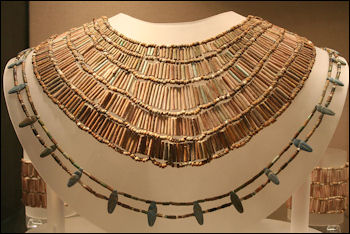 Egyptians liked jewelry. They wore necklaces with blue faience beads, and gold leaf; girdles of cowrie shells molded in gold; silver bracelets with semi-precious stones; golden amulets decorated with the face of Hathor, the Egyptian goddess of love and fertility; and pencil thick glass-stud earrings. Some jewelry was believed to be imbued with magical powers. Glass eyes bead were worn perhaps to ward off evil.
Jewelry was made from gold, silver, faience (a blue stone), lapis lazuli, carnelian, green feldspar, green jasper, ivory, bone, amethyst, and black quartz. Silver was regarded as more valuable than gold. Tombs were filled with jewelry the dead wanted to take with them to the netherworld. Tomb paintings and reliefs are also full depictions of people loaded down with jewelry.
In Genesis 41:41-42 a pharaoh gives Joseph a ring to symbolize a deal has been made. Most ancient rings were made of steatite of medals such as bronze, silver or gold. Few were adorned with precious stones. Those that were usually contained amethyst, coral or lapis lazuli. Some of the oldest known rings were used as signets by rulers, public officials and traders to authorize documents with a stamp. Signatures were not used until late in history.
See Separate Article: CLOTHES IN ANCIENT EGYPT africame.factsanddetails.com ; GEM STONES IN ANCIENT EGYPT factsanddetails.com
RECOMMENDED BOOKS:
“Ancient Egyptian Jewelry: 50 Masterpieces of Art and Design” by Nigel Fletcher-Jones (2020) Amazon.com;
“Ancient Egyptian gold: Archaeology and science in jewellery (3500-1000 BC)” by Dr Maria Filomena Guerra, Marcos Martinón-Torres, et al. (2023) Amazon.com;
“Ancient Egyptian Jewelry” by Carol Andrews (1991) Amazon.com;
“Nubian Gold: Ancient Jewelry from Sudan and Egypt” by Peter Lacovara and Yvonne J. Markowitz (2019) Amazon.com
“Jewels of Ancient Nubia” by Yvonne Markowitz, Denise Doxey (2014) Amazon.com;
“Ancient Egyptian, Mesopotamian & Persian Costume” by Mary Galway Houston (1920) Amazon.com;
“Amulets of Ancient Egypt” by Carol Andrews (1994) Amazon.com;
“Lives of the Ancient Egyptians: Pharaohs, Queens, Courtiers and Commoners” by Toby Wilkinson (2007) Amazon.com;
"The Ancient Egyptians: Life in the Old Kingdom" by Jill Kamil (1998) Amazon.com;
Types of Jewelry in Ancient Egypt
In all periods both men and women wore colored embroidered necklets,' as well as bracelets for the wrist and the upper arm; "' anklets were also worn as ornaments by the ladies. [Source: Adolph Erman, “Life in Ancient Egypt”, 1894]
Earrings were probably first introduced into Egypt by foreigners, in the time of the New Kingdom. Under the 18th dynasty they consisted of broad ornamented disks; under the 20th of large rings. Rings for the fingers, of which many are preserved, were generally seal rings; they bear for the most part the name of the reigning king.
The members of the royal family wore a special covering for the head. The Pharaoh wore his crowns, his helmet, or his folded kerchief. His sons wore (at any rate under the New Kingdom) a kerchief with a broad band, which took the place of the youthful sidelock, the ancient princely badge; they also wore a diadem round the head. The queen wore the so-called vulture head-dress, in which that sacred bird, the protector of the king in battle, appeared to spread his wings over the head of the queen. Ordinary people contented themselves, when in gala costume, with wearing a wreath or a colored ribbon round the hair. Women as a rule also wore the same; under the Old Kingdom only we occasionally find a man wearing a diadem.
Men possessed one badge of honour however above women — a very important one, according to Egyptian ideas. We refer to the various sticks which men of rank of all epochs carry in such a dignified manner. To our profane eyes the differences between the various sticks appear to be trifling and one stick seems as good as another; but to the Egyptian each had its own significance and its particular name. The stick in common use was of man's height, as a rule smooth or with a knob at the top. It was used as a walking stick and as a support when standing still. Next there was the staff of this form which was carried as a symbol of command.
Amulets in Ancient Egypt

Amanishakheto Jewelry
Amulets were carried by the living and wrapped with mummies. The mummy of King Tut had 143 of them. Their primary purpose was to attract “sympathetic magic” that would protect the wearer from misfortune and maybe bring some good luck. Amulets were inserted in different stages of the embalming process, each with special spells and incantations to go along with it. Some bore inscriptions and were made of materials, such as gold, faience (a blue stone), lapis lazuli, carnelian, green feldspar, and green jasper.
Amulets with protective cobras, “ ba” (winged symbols of the soul), “ re” (sun disk), ankhs, and scarabs were popular. There were amulets for limbs, organs and other body parts and ones derived from the hieroglyphics for “good,” “truth,” and “eternity.” Hearts, hands and feet were often found on mummies in places where the real body parts were normally found, the idea being that they could be offered as substitutes if the real ones were coveted by demons.
See Separate Article: ASTROLOGY, SUPERSTITIONS, CURSES AND AMULETS IN ANCIENT EGYPT africame.factsanddetails.com
Symbols and Crowns of the Egyptian Pharaoh
The symbols of authority of the ancient Egyptian king included a crook and a flail. The crook was a short stick curved at the top, much like a shepherd’s crook. The flail was a long handle with three strings of beads. When the king sat on his throne wearing all of his symbols of office—the crowns, scepters, and other ceremonial items—it was believed the spirit of the great god Horus spoke through him. [Source: Mark Millmore, discoveringegypt.com discoveringegypt.com]
Crowns and headdresses were mostly made of organic materials and have not survived but we know what they looked like from many pictures and statues. The best known crown is from Tutankhamun’s golden death mask. The White Crown represented Upper Egypt, and the Red Crown, Lower Egypt (around the Nile Delta). Sometimes these crowns were worn together and called the Double Crown, and were the symbol of a united Egypt.
There was also a third crown worn by the kings of the New Kingdom, called the Blue Crown or war helmet. This was called the Nemes crown and was made of striped cloth. It was tied around the head, covered the neck and shoulders, and was knotted into a tail at the back. The brow was decorated with the “uraeus,” a cobra and vulture.
Jewelry in King Tut’s Tomb

Tutankhamun pendant
More than 200 pieces amulets and of jewelry were found in King Tutankhamun’s tomb. Many were encrusted with semiprecious stones and glass, and symbolic of nature and gods that would imbue the wearer with powers and protection.
King Tutankhamun’s tomb is regarded as the the richest royal collection every found. When the king’s coffin was opened, 143 amulets and pieces of jewelry were found tucked in the linen layers of the mummy. There are also jeweled daggers, earrings, necklaces, gold figures, 15 gold and jeweled rings and ear and neck ornaments.
The Gold Mask is the most famous item discovered in King Tutankhamun’s tomb. Found covering the head and shoulders of Tutankhamun's mummy, this is perhaps the most famous Egyptian antiquity ever found, and a splendid example of the art of the goldsmith. Made of solid gold, inlaid with semi-precious stones and coloured glass paste, the face is an idealised portrait of the young king. Two protective animals, the cobra and vulture, are shown on the forehead, and the king wears the Nemes head-dress, the false beard of the gods and a broad inlaid collar.
3000-Year-Old Gold Jewelry Found in Amarna
Archaeologists excavating the tombs of ancient Egyptian royals and nobility have found rooms filled with objects made of gold — solid gold masks, golden furniture, and thousands upon thousands of pieces of gold jewelry — namely from King Tutankhamun’s tomb but they also have made some smaller finds. [Source: Jarrett A. Lobell, Archaeology, November/December 2023]
An Egyptian-English mission from the University of Cambridge uncovered three gold rings and a hollow gold bead necklace from a burial site at Tel el-Amarna, a large archaeological site about 370 kilometers (230 miles) south of Cairo, according to December 13 2022, news release from Egypt’s Ministry of Tourism and Antiquities. [Source: Moira Ritter, Miami Herald, December 15, 2022]
The Miami Herald reported: Among the unearthed rings, two were engraved with pictures and heiroglyphics, the ministry said. The first ring showed a picture of the ancient Egyptian deity known as the god of fun. The second ring was decorated with symbols. The burial also contained a necklace composed of hollow gold beads, the ministry said.
Ancient Egyptian Silver Jewelry
Although archaeologists have found a fair amount of gold objects dating ro Perhaps surprisingly, they have found very little silver, especially dating from the Old Kingdom (ca. 2649–2150 B.C.). Archaeology magazine reported: A rare exception are the bracelets of Hetepheres I, wife of the founder of the 4th Dynasty, Snefru (reigned ca. 2575–2551 B.C.), and mother of Khufu (reigned ca. 2551–2528 B.C.), builder of the Great Pyramid. The queen’s wooden jewelry box containing her bracelets was discovered in her tomb in Giza in 1925, but the bangles had not been studied for decades. A team has now reexamined the bracelets, employing the latest scientific techniques, and has found answers to some of the questions that have always surrounded them — including where the silver came from. [Source: Jarrett A. Lobell, Archaeology, November/December 2023]
In the past, it has been thought that Egyptian silver was derived from electrum — an alloy of gold and silver with a high silver content — mined in Egypt, which has no native sources of pure silver. The new study has shown that the bracelets are indeed pure silver and that the source of the metal was either the Cyclades in the Aegean Sea or the mines at Lavrion on the Greek mainland.
“That’s a big shift away from traditional views,” says archaeologist Karin Sowada of Macquarie University. “Previously, a connection with Greece during the early Old Kingdom was never really considered feasible. Identifying the source of silver for the bracelets connects a lot of previously disparate evidence, and the silver’s Aegean origin exposes a previously hidden exchange network across the eastern Mediterranean. ”
Ancient Egyptian Teenager Buried with Exquisite Jewelry

Golden Mask of Psusennes I
In April 2020, Spanish and Egyptian archaeologists announced that they uncovered a teenager who was only 15 or 16 years old when she died during the 17th dynasty (1580 B.C. to 1550 B.C. along with one of the world’s oldest pairs of leather shoes, José Galán, director of the archaeological mission, said. Laura Geggel wrote in Live Science: The girl's mummy was resting on its right side in the Draa Abul Naga necropolis on Luxor's West Bank, according to Ahram Online, an Egyptian newspaper. Though the mummy had deteriorated over the millenia, restoration returned her jewelry to pristine condition. This included two spiral earrings coated with a thin metal leaf — possibly of copper — in one of her ears, as well as two rings on her fingers and four necklaces draped around her neck. [Source: Laura Geggel, Live Science, April 29, 2020]
One ring was fashioned out of bone, while the other was made of metal and held an embedded blue glass bead with string wrapped around it. The four necklaces were tied together with a glazed ceramic, or "faience" clip. Like the rings, each necklace was unique. One 70 centimeters (27.5-inch) -long necklace was made of round beads that alternated between dark and light blue faience, and another necklace, measuring 62 centimeters (24.4 inch) -long necklace, had green faience and glass beads.
The third necklace was a treasure even by today's standards; the 24-inch-long (61 cm) necklace had 74 pieces, including beads of amethyst; a brownish-red gemstone called carnelian; amber; blue glass; and quartz, according to the Egyptian Ministry of Tourism and Antiquities. It also sported two scarabs, including one showing Horus (a god depicted as a falcon) and five faience amulets. Finally, the fourth necklace was designed with several strings of faience beads, which were knotted together at both ends with a ring.
Image Sources: Wikimedia Commons
Text Sources: UCLA Encyclopedia of Egyptology, escholarship.org ; Internet Ancient History Sourcebook: Egypt sourcebooks.fordham.edu ; Tour Egypt, Minnesota State University, Mankato, ethanholman.com; Mark Millmore, discoveringegypt.com discoveringegypt.com; Metropolitan Museum of Art, National Geographic, Smithsonian magazine, New York Times, Washington Post, Los Angeles Times, Discover magazine, Times of London, Natural History magazine, Archaeology magazine, The New Yorker, BBC, Encyclopædia Britannica, Time, Newsweek, Wikipedia, Reuters, Associated Press, The Guardian, AFP, Lonely Planet Guides, “World Religions” edited by Geoffrey Parrinder (Facts on File Publications, New York); “History of Warfare” by John Keegan (Vintage Books); “History of Art” by H.W. Janson Prentice Hall, Englewood Cliffs, N.J.), Compton’s Encyclopedia and various books and other publications.
Last updated August 2024