
Home | Category: Religion and Gods
SETH
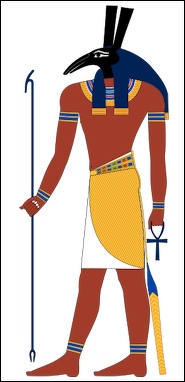
Seth
Seth (also known as Set, Setekh, Suty and Sutekh) was the son of Geb and Nut, and the evil brother of Osiris. The god of storms, darkness, chaos, confusion and violence, he murdered Osiris and was identified with many animals, including the pig, donkey, desert oryx, okapi, and hippopotamus, and sometimes represented as an animal of unidentified type. He murdered his brother of Osiris and was the enemy and rival of Horus. [Source: Minnesota State University, Mankato, ethanholman.com]
Barbara Waterson wrote for the BBC: “Seth, the Red God, god of the desert and promulgator of thunderstorms and violence, was represented as an animal, of a kind not yet identified by Egyptologists. He has the graceful body of a greyhound, but with a long, stiff, forked tail and square-topped ears unlike any of the canine family. He was one of Egypt's oldest deities, and the Egyptians had an ambivalent attitude towards him. They feared him for his capacity to do harm, yet admired his strength and ferocity. The Greeks equated him with the monster Typhon.” [Source: Barbara Waterson, BBC, March 29, 2011]
Benjamin Leonard wrote in Archaeology magazine: The god Seth is one of the most enigmatic deities in the Egyptian pantheon. He was regarded as a god of confusion and disorder, and was often depicted in the form of one of many animals, including a hippopotamus, a falcon, and, most frequently, the “Seth animal,” a long-snouted creature with a forked tail and pert ears. The deity embodied both positive and negative aspects, but even his violent and destructive tendencies could be used for the good of the cosmos. [Source Benjamin Leonard, Archaeology magazine, March-April 2020]
During the first millennium B.C., some scholars claim, mentions of the god cease in hieroglyphic inscriptions. In some temples across the Nile Valley, images of Seth were defaced at an as-yet-undetermined time, though others, including some of those at one of the god’s cult centers, at the “Gold City” of Nubt, were left untouched. Bolstered by a lack of evidence for temple dedications to Seth during this period and the emphasis on the god’s negative aspects in mythological narratives popularized by the second-century A.D. Greek writer Plutarch, scholars have suggested that this deliberate erasure constitutes proof of a state-decreed proscription of the cult of Seth in the first millennium B.C.
RELATED ARTICLES:
OSIRIS (GOD OF THE DEAD AND THE AFTERLIFE): MYTHS, CULTS, RITUALS africame.factsanddetails.com ;
ISIS (EGYPTIAN GODDESS OF MAGIC AND MOTHERLY LOVE): HISTORY, IMAGES, AND SPREAD OF HER CULT africame.factsanddetails.com ;
HORUS, THE FALCON-HEADED PATRON OF KINGS africame.factsanddetails.com ;
ANCIENT EGYPTIAN GODS AND GODDESSES: TYPES, ROLES, BEHAVIOR AND LETTERS africame.factsanddetails.com ;
FORMS AND EPITHETS OF ANCIENT EGYPTIAN GODS AND GODDESSES africame.factsanddetails.com ;
LIST OF EGYPTIAN GODS AND GODDESSES africame.factsanddetails.com
RECOMMENDED BOOKS:
“The Complete Gods and Goddesses of Ancient Egypt” by Richard H. Wilkinson (2003) Amazon.com;
“The Routledge Dictionary of Egyptian Gods and Goddesses” by George L. Hart (1986) Amazon.com;
“Gods and Myths of Ancient Egypt” by Robert A. Armour Amazon.com;
“Gods and Men in Egypt: 3000 BCE to 395 CE” by F. Dunand, C. Zivie-Coche and translated by David Lorton (2005) Amazon.com;
“The Complete Encyclopedia of Egyptian Deities: Gods, Goddesses, and Spirits of Ancient Egypt and Nubia” by Tamara Siuda (2024) Amazon.com;
“Daily Life of the Egyptian Gods” by Dimitri Meeks (1993) Amazon.com;
“The Gods of Egypt” by Claude Traunecker (1992) Amazon.com;
“The Gods of the Egyptians, Volume 1" by E. A. Wallis Budge (1969) Amazon.com;
“The Gods of the Egyptians, Volume 2" by E. A. Wallis Budge (1969) Amazon.com;
“Egyptian Mythology: A Guide to the Gods, Goddesses, and Traditions of Ancient Egypt”
by Geraldine Pinch (2004) Amazon.com;
“Uncovering Egyptian Mythology: A Beginner's Guide Into the World of Egyptian Gods, Goddesses, Historic Mortals and Ancient Monsters” by Lucas Russo (2022) Amazon.com;
“The Penguin Book of Myths and Legends of Ancient Egypt” by Joyce Tyldesley (2010) Amazon.com;
“Egyptian Mythology: A Traveler's Guide from Aswan to Alexandria” by Garry J. Shaw (2021) Amazon.com;
“Egyptian Mythology: An Enthralling Overview of Egyptian Myths, Gods, and Goddesses” by Enthralling History (2022) Amazon.com;
”Religion and Ritual in Ancient Egypt” by Emily Teeter (2011) Amazon.com;
“Gods, Rites, Rituals and Religion of Ancient Egypt” by Lucia Gahlin (2001) Amazon.com;
“Religion and Magic in Ancient Egypt” by Rosalie David (2003) Amazon.com;
“Religion in Ancient Egypt: Gods, Myths,and Personal Practice” by John Baines (1991) Amazon.com;
Seth Myths
Benjamin Leonard wrote in Archaeology magazine: Seth’s dual nature appears in the earliest texts containing myths about the Egyptian gods, the Pyramid Texts, which covered the walls of funeral chambers built for Old Kingdom pharaohs and queens at the necropolis of Saqqara in the late third millennium B.C. In a later collection of spells called the Coffin Texts, which date to the Middle Kingdom (ca. 2030–1640 B.C.), Seth spears Apep, the serpent of chaos, to protect the sun god, Ra, and preserve the established order of the universe. “Seth was the only god strong and aggressive enough to drive off Apep’s attack and prevent him from swallowing the sun,” says Egyptologist Ian Taylor. “Without Seth, the sun would not have risen the following morning.” Seth also served as a divine protector of pharaohs, and was portrayed in this role in painted coronation scenes and images carved on thrones throughout the Middle Kingdom and the New Kingdom (ca. 1550–1070 B.C.).
The Pyramid Texts also contain early allusions to darker myths. In several texts, driven by jealousy, Seth is said to have murdered his brother Osiris, one of the god-kings of early Egypt. In another, he enters into a protracted battle with his nephew Horus, the son of Osiris, for the throne of Egypt. In the end, other gods adjudicate the conflict, eventually ceding control of the Nile Valley to Horus, and foreign lands and the desert, which the Egyptians called the Red Land, to Seth.
Mark Millmore wrote in in discoveringegypt.com: Seth “usurped the throne of Egypt and most of the other gods despised him. Horus eventually defeated Seth, but it was thought that their battle was an eternal struggle between good and evil. Although Seth failed to keep the throne of Egypt he continued to be a companion of Ra. He sometimes accompanied Ra across the sky in his solar boat, causing storms and bad weather. Seth was venerated by some, and his main cult center was at Naqada. Some kings would liken themselves to Seth in battle, but for the most part the people loathed him and his defeat by Horus was regularly celebrated.” [Source: Mark Millmore, discoveringegypt.com discoveringegypt.com]
Seth Murders Osiris
“When Osiris returned to Egypt, Seth had designed a plot for His overthrow with the aid of seventy-two conspirators. A banquet had been planned in honour of Osiris; one that Cunning Isis would not be attending. During the festivities, Seth began to speak of a splendid chest that had been made for Him. He sent for the chest, and all present admired the fine wood and gilding. Seth declared that He would gift the chest to any man who could fit it exactly. [Source: Theology WebSite]
“Each man, in his turn, laid within the chest. Some were too short, and others too tall. Seth knew that only Osiris would fit the chest exactly, for he had constructed it to Osiris' exact measurements. Osiris' turn came, and He lay trustingly back into the chest, fitting snuggly within it. There was laughter amoung the guests who thought that Seth had lost His prize to the Pharoah. Seth signaled his conspirators, and the chest was immediately slammed shut and locked. The chest was carried in the dark of night to a branch of the Nile, and was tossed into the cold waters. Seth then declared the death of the King, and crowned Himself King of Egypt. When Isis came to know of Her husband's death, she became half mad with grief. She cuff off a lock of Her hair and dressed in widow's clothing. She then went out in search of Her husband's body.
“During Her travels, Isis came to learn that Osiris had known Her sister Nephthys. From that union had been born a child-Anubis-but Nephthys had turned Him away at birth. And so Kindly Isis tracked Him with the help of dogs, and raised Him to be Her guardian and attendant. From village to village She traveled, until finally She found that the chest had come to rest in the land of Byblos. It had been entangled in the roots of a young sapling. Strengthend by the murdered God, it had grown in a single night into a tall and graceful tree. When the King of Byblos heard of this marvel, he had sent for the tree to be made into a pillar for his palace. No one suspected that the tree contained a coffin within it's trunk.
“Isis heard of this and made Her way into the palace, residing there for many months. At last she convinced the Queen of Byblos to give Her the pillar, and she cut it open to reveal the coffin inside. She was given the best boat in Byblos, and She journed home to Egypt; finally hiding Osiris' body in the marshes by the Nile. One night, whilst Mighty Isis slept, Seth happened upon the Dead King. In a fury, He tore the body of Osiris into fourteen pieces and scattered them throughout Egypt to ensure they would not all be found.”
Horus Versus Seth and Pharaonic Rule
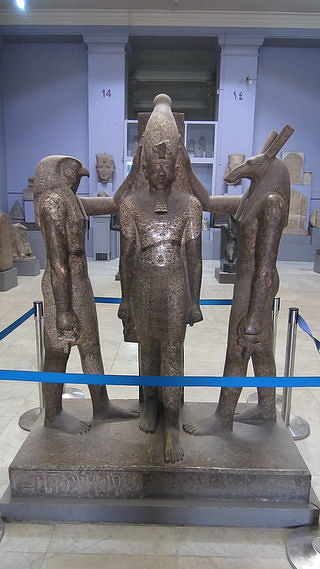
Horus and Seth crowning Ramses III
On the fight between Horus and Seth at the beginning of creation, Lee Huddleston of the University of North Texas wrote: “Father Geb faced a unique problem. Atum had resigned his rule to his only son, Shu; Shu in turn gave way for his only son, Geb. Geb had two sets of twins from Nut's one pregnancy. When it came time for him to turn over control of earth [EGYPT], he had two sons from which to choose the next ruler. Some stories suggest he may have divided Egypt; others say he gave it all to Osiris and gave the rest of the world to Seth. Whatever the circumstance may have been, Seth was unhappy with his lot. He murdered his brother, Osiris; cut his body into small pieces, and threw them into the NILE. There, Osiris merged with, and became the River. Isis, assisted by her sister, Nepthys, found all the pieces of Osiris except the phallus. Isis hovered over him imploring him to arise and impreg-nate her. Miraculously, Osiris did revive, and did impregnate his wife before passing to the West, the home of Atum, where he became the Spirit in whom the souls of the righteous dead would eventually find salvation. [Source: Lee Huddleston, Ancient Near East Page, January, 2001, Internet Archive, from UNT \=/]
“In term, Isis gave birth to Horus. She hid him from his uncle, Seth, until he was eighteen. Then she presented Horus to the Council of the Gods arguing that, as the only son of Osiris, Horus ought to be given his father's realm [Egypt]. Geb was unable to decide whether the young Horus or the older and stronger Seth should rule. There followed a series of contendings between the ex-ruler's brother and his son to determine which of them was best suited to rule Egypt. In the process, Seth was tricked into admitting that a son's rights of inheritance took precedence over the rights of a brother; and into the appearance of having dishonored himself. As a result of these contendings, the following conventions evolve.
“1) Horus is always Pharaoh, and Pharaoh was King of Egypt by Right of Divinity. (In actuality, not all Pharaohs claimed to be Horus; some identified with Seth, especially if they were involved with foreign lands or their capitals lay in Seth's land; others identified with their own preferred gods.) The idea of a Divine King persisted in the Mediterranean basin until the triumph of monotheistic religions more than 3400 years later. 2) Pharaoh, at first possessed sole right to enter Heaven, but by 2200 B.C. the spiritual dynamics of Salvation were understood and the Democratization of Heaven completed.
“3) The Rule of primogeniture was another victor in the struggle between Horus and Seth for the birthright of Osiris. Horus, Isis, and their supporters used the argument that Osiris, the first born son of Geb, rightfully owned Egypt and that his Domain should pass intact to his Son, not to his brother. Horus' victory was, retroactively, a victory for Osiris' contention in his earlier quarrel with Seth. The Institution called Primogeniture has endured for more than five thousand years, but has declined in social acceptance with the decay of the Institution called the Nobility.”
Contention of Horus and Seth
The 80 Years of Contention Between Horus and Seth goes: “Horus, the Avenger of Osiris, came before the Great Ennead. With His Mother beside Him, He spoke of the cruel murder of His Father at the hands of Seth. He spoke of the usurption of the Throne of Egypt. The Gods were impressed by the eloquence of the Falcon-Headed One, and They pitied Him. Shu, Son of the Creator, was the first to speak: "Right should rule might. Mighty Seth hath force on His side, but Young Horus hath Justice. We shalt do Justice unto Horus by proclaiming, 'Yes! Ye shalt have the throne of Thy Father!'" Thoth, Lord of Wisdom, spake unto the Ennead, "This is right a million times!" Isis gave a great cry of Joy. She begged the North Wind to change direction Westward to whisper the news unto Osiris. Lord Shu declared, "Giving the Throne unto Horus seems right to the whole of the Ennead! Thoth shalt give the Royal signet ring to Horus. We shall crown Him with the White Crown!" [Source: Theology WebSite]
“And, to this, Seth proclaimed, "It is I who slay the Enemy of Re daily. It is I Who stand in the prow of the Bark of Millions of Years, and no other God can do it. It is I who should recieve the office of Osiris!" The Gods knew the Terrors of the Serpents of Chaos. They muttered that Seth was right. Horus, Lord of Light, spake and said, "Shall one give office to the uncle when the bodily Son is there?" Isis became furious at the Ennead for not speaking in favour of Her Son. She complained to Them until, for the sake of peace, They promised that Justice should be given unto Horus. Mighty Seth was angered. "How dare Ye cowards break Thine Oath! I shalt fetch My Great Septre and strike one of You down with it each day! I swear that I will not argue My case in any Court where Isis is present!" Re proclaimed, "We shall cross the river to the Island in the Midst, and try the case thereon. I shalt further order the ferryman not to ferry Isis across."
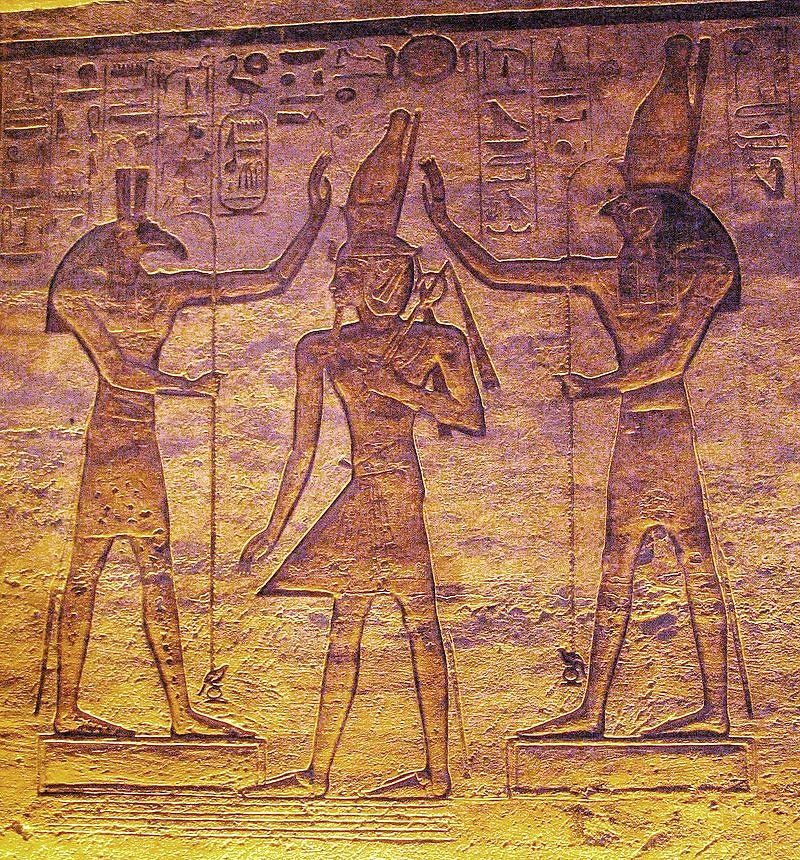
Seth and Horus
“Cunning Isis, the Mistress of Magick, changed Herself into a bent old woman. She carryied a jar of flour and honey cakes. She offered a golden ring to the ferryman to give Her passage, and They were soon across. She slipped through the trees, and towards the camp of the Ennead. The Gods were holding a feast, but Seth stood apart from the Divine Comapany. Isis had changed Her shape once more. She now appearing as a beautiful young woman, dressed as a widow. The Great Lady approached the Lord of Storm. "Who art Thou, my pretty?" asked Seth, "And why hast Thou come here?" “Isis hid her face and wept, "O Great Lord, I am looking for a champion. I was the wife of a herdsman, and I bore for him a son. Then, my dear husband died, and the boy began to tend his father's cattle. But, lo! a stranger came and ceased our byre, and told my son that he would take our cattle and turn us out. My son wished to protest, but the stranger threatened to beat him. Great Lord, help me! Be my son's champion!"
“Seth heard Her words and dried Her tears. "Do not cry, my pretty. I shalt be your champion and destroy this villain! How dare a stranger take the father's property whilst the son is still alive!" Great Isis shrieked with laughter. She became a kite. She flew into an acacia tree. "Cry thyself, Mighty Seth! Ye hath condemed thyself! Thou hast judged Thine own case!" Seth was angered unto tears of rage. The Gods demanded to know what had transpired. He told Them of how He had been tricked by the cunning Lady Isis. Re said unto the Dark God, "It is true, Seth. Thou hast judged Thyself."”
Seth Rips Out the Eyes of Horus
“Now the Ennead crossed over the river and camped in the Western Mountains. Plans were made for the coronation of Horus. Seth, still, would not admit His defeat. He exclaimed, "I challenge You, Horus! Let us turn Ourselves into hippopatami and fight deep within the river! Who-so-ever surfaces first shall admit defeat!" Horus acccepted gladly, but Isis fell to the ground and wept, afraid that Seth would slay Her Son. The two Gods plunged into the depths of the river. The battle raged for many days. Vicotry inclined first to one side, and then to the other; and the heart of Isis suffered bitterly. She took yarn and copper; making them into a magickal harpoon. She threw the weapon into the white water. The copper point stabbed Horus in the flank; He surfaced and roared, "Mother! Thy spear hath pierced Me! Let me go!" [Source: Theology WebSite]
“Isis called to Her magic weapon to release Horus. It returned to Her hand. She threw it again, and this time it caught hold of Seth. With a bellow of pain Seth arose. "O My Sister, why must Thou always be My enemy? What have I done to Thee? I am Your Brother; Let Me go!" Great Isis' heart grew soft, and She released Her pleading Brother. Horus was furious with His Mother for the release of His enemy. He leaped out of the river, His face like a leopard, and cut off the head of Isis with one stroke of His copper knife. He then strode away towards the Mountains of the West. Isis, Mistress of Magick, calmly turned Her body into a statue; She walked towards the tent of Re. The Gods were horrified, even Thoth Himself. The Great God of Words of Power transformed Isis' head amd set it again upon Her shoulders in the form of that of a cow. The Ennead went into the Mountains of the West in search of Horus.
“The Young God had found an oasis. He was alseep in the shadow of a palm tree. Seth found Horus, seized hold of Him, threw Him down, removed His two Eyes from their sockets, and buried them on the mountain so as to illumine the earth. The two balls of His eyes became two bulbs which grew into lotuses. When He returned to the encampment, He told the Gods that He had found no trace of His nephew.
“Hathor, Lady of the Southern Sycamore, finally came upon the blinded God. She pityed His agony. She caught a gazelle and milked it, and then knelt beside the Young God, saying gently, "Uncover Your face." She dripped the milk onto His wounds. At once the pain vanished. "Open Your eyes," commanded Hathor. He obeyed and found that the healing Magick of the Goddess had restored His eyes and He could see again. Hathor returned to the Ennead and said, "Seth has been lying to you. He hath torn out the Eyes of Horus. I hath healed the Young God. He approacheth now!" Re called the Two Contendors before Him. He passed Divine Jugdment upon Them for Their wrong-doings. He demanded that They cease their quarreling. Seth appeared to agree. He invited Horus to stay with Him in His palace.”
Decisive, Deceptive Confrontation Between Seth and Horus and Their Sperm
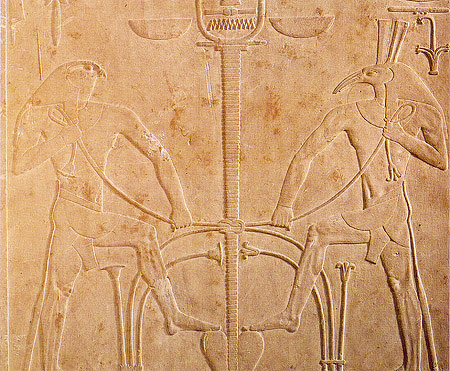
Seth and Horus
“One evening, as the two lay together resting, Seth inserted his penis between the thighs of Horus. Horus, however, unknown to the Dark Lord of Storm, had caught Seth's semen in His hand. With the help of His mother, Isis, He placed His own semen upon lettuce growing in a garden; lettuce that Seth was to eat. Seth spake unto Horus, "Come, let us go, that I may contend with you in the Court." Within the Court, Seth declared, "Let the office of Ruler be given to Me, for as regards Horus who stands here, I have done a man's deed to Him." [Source: Theology WebSite]
“Horus laughed and said, "What Seth has said is false. Let the semen of Seth be called, and let us see from where it will answer."And so Thoth, the Self Created, called upon the semen of Seth. The answer came from a far-away marsh, where Isis had long since deposited it. Horus said, "Let mind be called, and let us see from where it will answer." Then Thoth laid His hand on the arm of Seth and said, "Come out, semen of Horus!" And it spake unto Him, "Where shall I come out?" Thoth said to it, "Come out of His ear." It replied to Him, "Should I come out of His ear, I who am Divine Seed?" Then it came out as a Golden Sun Disk upon the head of Seth. Seth became very angry, and He stretched forth His hand to seize the Golden Disk. In desperation, Seth demanded one more contest with Horus. Before the whole Ennead he declared, "Let both of us build a ship of stone. We shall race them down the Nile. Who-so-ever wins the race shall wear the Crown of Osiris." Horus agreed to the contest at once.
“Mighty Seth took up His club. He struck the top of a mountain. Then he built a huge ship of solid stone and dragged it to the river. Horus' ship was already afloat, for the Young God had secretly made a boat of pine and plastered it so as to appear as stone. Seth tried to launch His boat; it sank to the bottom of the Nile and the Ennead laughed. Seth leaped into the water. He turned Himself into a hippopotamus once more. He attacked the bark of Horus. The wooden boat splintered and sank. Horus grabbed His spear and thrust at Seth, but the Ennead shouted at Him to stop; He had to obey the command of the Great Gods of Annu.
“Horus made His complaint against Seth: "It is now eighty years We are in the Court, but They do not know how to judge amoung Us. I have contended with Him in the Hall of the Way of Truth. I was found right against Him. I have contended with Him in the Hall of the Horned Horus. I was found right against Him. I have contended with Him in the Hall of the Field of Rushes. I was found right against Him. I have contended with Him in the Hall of the Field Pool. I was found right against Him."”
Gods Choose Horus Over Seth
“In the Trial, Re-Atum asked this important question: "What shall We do about these two Gods, Who for eighty years now have been before the tribunal?" Geb, Lord of the Gods, commanded the Nine Gods gather to Him. He judged between Horus and Seth; He ended Their great quarrel. He made Seth as king of Southern Egypt, up to the place in which He was born, which is Su. And Geb made Horus king of Egypt in the land of Northern Egypt, up to the place in which His Father was drowned, which is the Division of the Two Lands. Thus Horus stood over one region, and Seth stood over one region. They made peace over the Two lands. That was the division of the Two Lands. [Source: Theology WebSite]
“Geb's words to Seth, "Go to the place in which You were born." Seth: Southern Egypt. Geb's words to Horus, "Go to the place where Your Father was drowned." Horus: Northern Egypt. Geb's words to Horus and Seth, "I have separated You."-Lower and Upper Egypt. Then Horus spake and said, "It is not good to defraud Me before the Ennead and to take the office of my Father Osiris from Me!" Shu and Thoth persuaded the Court to send a letter to Osiris. After a time, the messanger returned. He bore an angry letter from the King of the Dead. Osiris demanded to know why His son had been robbed of the throne. He demanded to know if the Gods had forgotten that it was He, Osiris, Who had given the world the precious gifts of barley and wheat.
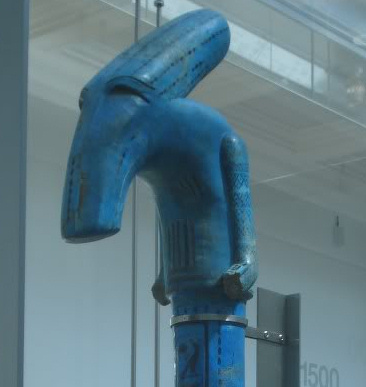
Seth Ouas sceptre
“Re was offended at Osiris' words. He returned a letter of arrogance. After many days, another weary messenger returned. He bore a second letter from the King of the Dead. Thoth read it aloud: "How good are the deeds of the Ennead? Justice has sunk into the underworld. Now, listen to Me; The land of the Dead is full of demons who fear no God or Goddess. If I send them out into the world of the living they will bring back the hearts of evil-doers to the place of punishment. Who amoung You is more powerful than I? Even the Gods must come, at last, to the Beautiful West." At these words even the Creator was afraid. Then it seemed wrong to Geb that the portion of Horus was like the portion of Seth. So Geb gave to Horus His inheritance, for He is the Son of His Firstborn Son.
“Geb's words to the Nine Gods: "I have appointed Horus, the Firstborn, Him alone, Horus, the inheritance. To the Son of My Son, Horus, the Jackal of Southern Egypt...the First-Born Horus, the Opener of the Ways." Then Horus stood over the land. He is the uniter of this land, proclaimed in the Great Name Ta-tenen, South of His Wall, Lord of Eternity. Then sprouted the two Great Magickians upon His head. He is Horus who arose as King of Upper and Lower Egypt, who united the Two Lands in the Nome of the Wall, the place in which the Two Lands were united. Reed and papyrus were placed on the double door of the House of Ptah. That means Horus and Seth, pacified and united. They fraternized so as to cease quarrreling in whatever place They might be, being united in the House of Ptah, the Balance of the Two Lands in which Upper and Lower Egypt had been weighed.”
Seth Cult Center in the Western Desert
In Egypt’s Western Desert, worship of Seth continued long after it disappearred elsewhere Benjamin Leonard wrote in Archaeology magazine: Bordered to the north by a high limestone escarpment, the Dakhleh Oasis in Egypt’s Western Desert was home to a cult center dedicated to the god Seth. Objects found within the temple complex at the ancient city of Mut, located in the oasis, include figures of Seth in two of his animal guises: a copper alloy “Seth animal” figure and a miniature carved carnelian hippopotamus. [Source Benjamin Leonard, Archaeology magazine, March-April 2020]
Mut was an ancient city in the 770-square-mile expanse of the e Dakhleh Oasis, one of five oases in Egypt’s Western Desert. Since 2000, archaeologist Colin Hope of Monash University has directed excavations at the site and uncovered evidence for a ritual landscape over which Seth presided as Lord of the Oasis. With the support of the state’s central administration, as well as gifts bestowed by Egyptian pharaohs to ensure the temple’s growth, the cult of Seth thrived in Dakhleh and surrounding oases throughout the first millennium B.C. and into the Roman period, through the second and third centuries A.D. At Mut and other cult centers and shrines across the desert, Seth was worshipped alongside other major deities, including his siblings, Osiris and Isis, and Amun, the king of the gods, not as an outsider, but as a significant and positive figure in his own right. “There’s some evidence for hostility to the cult in the Nile Valley, but clearly this did not extend into the oasis region, where Seth remained a dominant deity,” Hope says. “The whole of the Western Desert was the domain of Seth and was under his protection.”
The earliest evidence for the site’s religious function dates to the Middle Kingdom, around 2000 B.C. An inscription engraved on a stone block that was reused in a later temple at the site indicates the existence of a monument dedicated to the god Igai, who was also sometimes called Lord of the Oasis. Igai was a local deity of the Western Desert whose cult appears to have originated in the northern oases before the Egyptians annexed the region. It is known that Mut was a primary cult center for Igai’s worship, but he was eventually adopted into the Egyptian pantheon and venerated outside the oases, in Upper Egypt, as well. By the time of the New Kingdom, Seth came to be linked with Igai at Mut. An inscription that Hope and his team found in the temple precinct records that the area was “in the domain of Igai,” implying that it was still under that god’s protection. However, by this time, Seth was the central figure worshipped there and he had become the new Lord of the Oasis.
In the Ptolemaic period (304–30 B.C.), when a series of Greek pharaohs ruled Egypt, four primary centers of Seth’s cult are known to have been in use. Three of these were in the Nile Valley and were all situated at the beginning of routes into the Western Desert, and the fourth, in the oases, was likely the temple of Seth at Mut Almost nothing of the settlement at Mut survives, apart from the foundations and poorly preserved walls of various buildings within the complex dedicated to Seth. Measuring up to 26 feet thick, the outer walls of this complex enclose an area measuring approximately 800 by 600 feet, making it the largest temple complex known in the Western Desert. In addition to the stone temple building, the complex contains a well and mudbrick structures that probably served administrative functions.
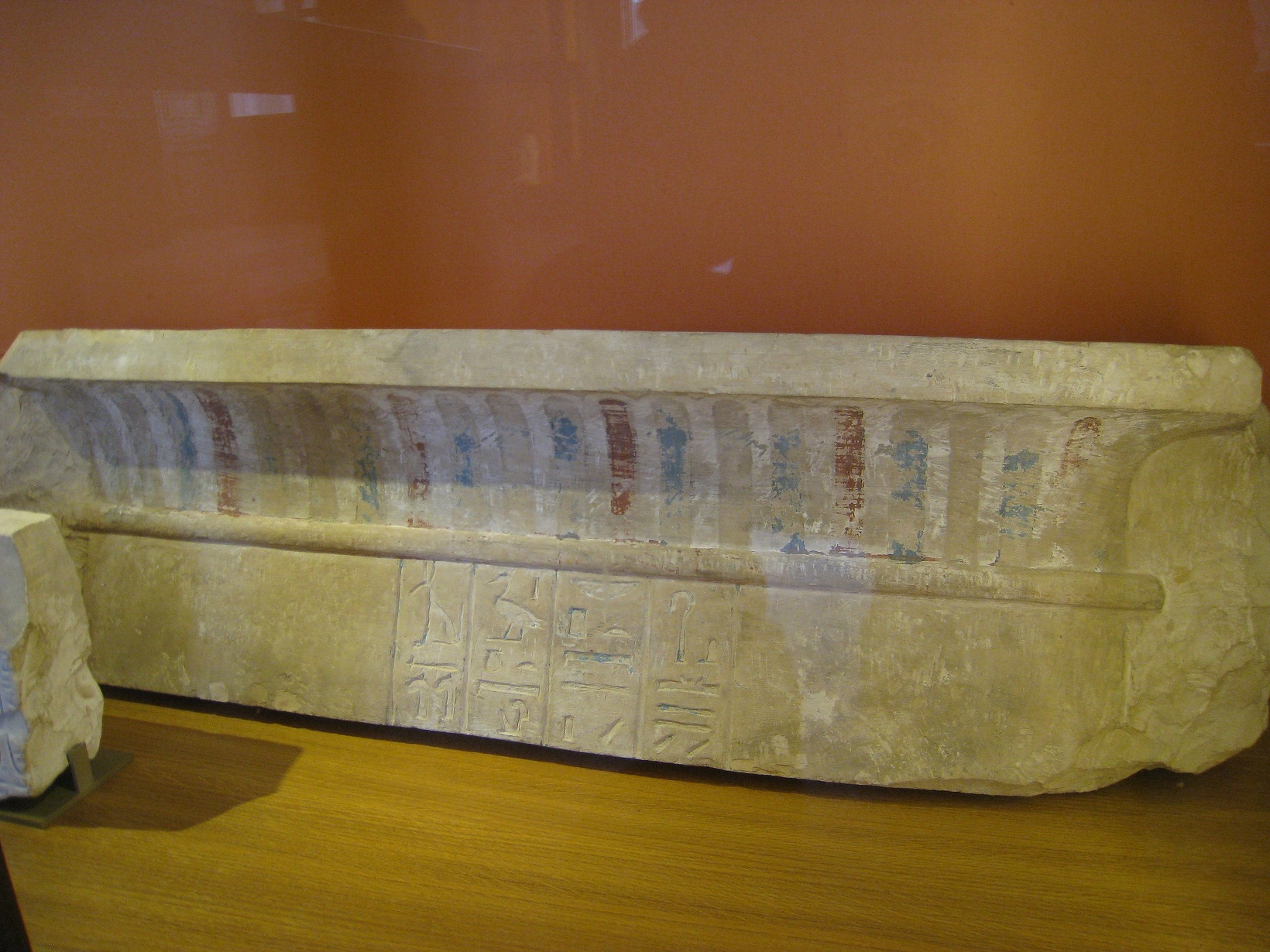
Linteau Seth Louvre
Seth Worship in the Western Desert
Benjamin Leonard wrote in Archaeology magazine: Among the temple’s paving stones, Hope also found the earliest evidence for the cult of Seth at Mut in the form of a sandstone stela dating roughly to the New Kingdom’s 19th Dynasty (ca. 1295–1186 B.C.). The stela is inscribed with a hymn to Seth, one of a small number of existing prayers or invocations to the god. Above the text is a partially preserved image of Seth, who stands before Amun with his sister and consort, Nephthys. At the bottom is a scene showing the stela’s donor and his family, probably expressing adoration of Seth. [Source Benjamin Leonard, Archaeology magazine, March-April 2020]
During the New Kingdom, Amun was venerated at Mut alongside Seth and a cadre of other deities, including Nephthys, Isis, and Osiris. Seth and Amun were also worshipped together at the temple of Amun at Hibis, in the Kharga Oasis east of Mut. Like other oasis temples, the temple of Seth at Mut was supported and maintained by Egypt’s central administration. The largesse bestowed on the cult center by New Kingdom pharaohs and their successors, Hope says, belies the notion that there was a deliberate policy to erase Seth from the religious landscape of the Nile Valley. “All this activity seems to show that in the first millennium B.C., there was an active cult dedicated to Seth when, supposedly, he had fallen out of favor in the Nile Valley,” he says.
In a side chamber of the temple, Hope and his colleagues unearthed hundreds of ostracons, or inscribed potsherds, most of which date from the late 25th to early 26th Dynasties, from about 700 to 600 B.C. The sherds detail relatively small offerings of bread and wine made to Seth by priests on behalf of a large number of worshippers, underscoring the continued significance of Mut as the center of the Seth cult in the Western Desert. Some are written in Demotic, a script frequently used during this period to make notes about economic transactions. Scribes working inside the temple kept detailed records of such transactions on the recycled sherds, including days of the month, quantities of wine offered to Seth and other gods, and the names of individual priests who made the dedications. On other sherds, offerings were tallied in Abnormal Hieratic, a script that is not usually found in Dakhleh but was commonly used by Egyptian religious authorities at Thebes, the capital of Egypt during much of the New Kingdom and again during this period.
With outstretched wings and a crown atop his falcon head, Seth is probably depicted in these images in one of his well-known mythological roles, harpooning Apep, the serpent of chaos. Similar iconography of the god found throughout the Dakhleh and Kharga Oases, particularly his depiction in a relief from the temple at Hibis, has allowed Hope to tentatively date the molds to a range spanning from the 26th Dynasty into the Ptolemaic period, when a major refurbishment of the temple took place. Beneath the pavement of a structure to the west of the temple, Hope and his colleagues discovered figures that probably predate the molds, including a pair of miniature carved carnelian hippos and a copper alloy Seth animal figure that originally would have been attached to another object.
However, Seth’s worship was not limited to the formal setting of a temple and offerings made by priests. Archaeologist Salima Ikram of the American University in Cairo and other researchers have identified petroglyphs of the god’s image carved on rocks by ancient travelers journeying through the desert to and within the Dakhleh and Kharga Oases, most of which seem to date to the New Kingdom. These drawings typically depict the Seth animal and are often accompanied by the names of the individuals who created them. Other examples portray the god with a falcon head, and are labeled as Seth. “It’s extraordinary because we have so many signs of individual piety by people who are putting themselves in a very personal way under the auspices of Seth,” Ikram says.
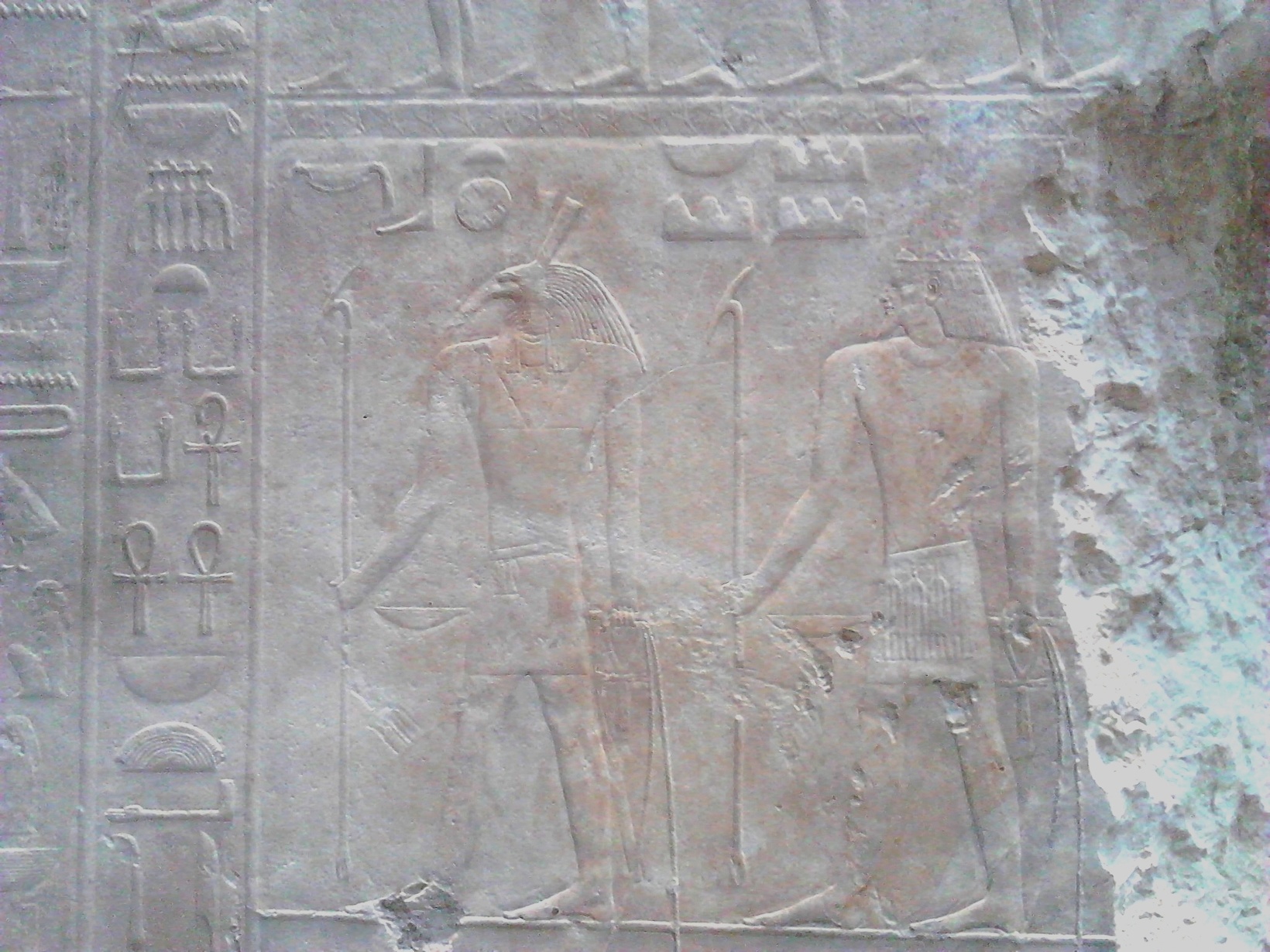
Sahure relief: Seth and Sopdu at the Neues Museum, Berlin
Large quantities of the engravings are clustered in places that Ikram has identified as makeshift shrines to the god, such as a site now known as Seth Rock. “These are concentrated sets of dedications where people are saying, ‘We are Seth’s people, we are under his protection, and he will care for us,’” she says. Ikram notes that these glyphs and shrines demonstrate that Seth’s significance in the region wasn’t limited to inhabitants of the oases. “If you lived in the oasis, you worshipped Seth,” she says. “And if you were from the Nile Valley, and you were going into the desert, you would worship Seth, too. Any sensible person would do just that.”
Image Sources: Wikimedia Commons
Text Sources: UCLA Encyclopedia of Egyptology, escholarship.org ; Internet Ancient History Sourcebook: Egypt sourcebooks.fordham.edu ; Tour Egypt, Minnesota State University, Mankato, ethanholman.com; Mark Millmore, discoveringegypt.com discoveringegypt.com; Metropolitan Museum of Art, National Geographic, Smithsonian magazine, New York Times, Washington Post, Los Angeles Times, Discover magazine, Times of London, Natural History magazine, Archaeology magazine, The New Yorker, BBC, Encyclopædia Britannica, Time, Newsweek, Wikipedia, Reuters, Associated Press, The Guardian, AFP, Lonely Planet Guides, “World Religions” edited by Geoffrey Parrinder (Facts on File Publications, New York); “History of Warfare” by John Keegan (Vintage Books); “History of Art” by H.W. Janson Prentice Hall, Englewood Cliffs, N.J.), Compton’s Encyclopedia and various books and other publications.
Last updated July 2024