
Home | Category: Desert Animals
FENNEC FOXES
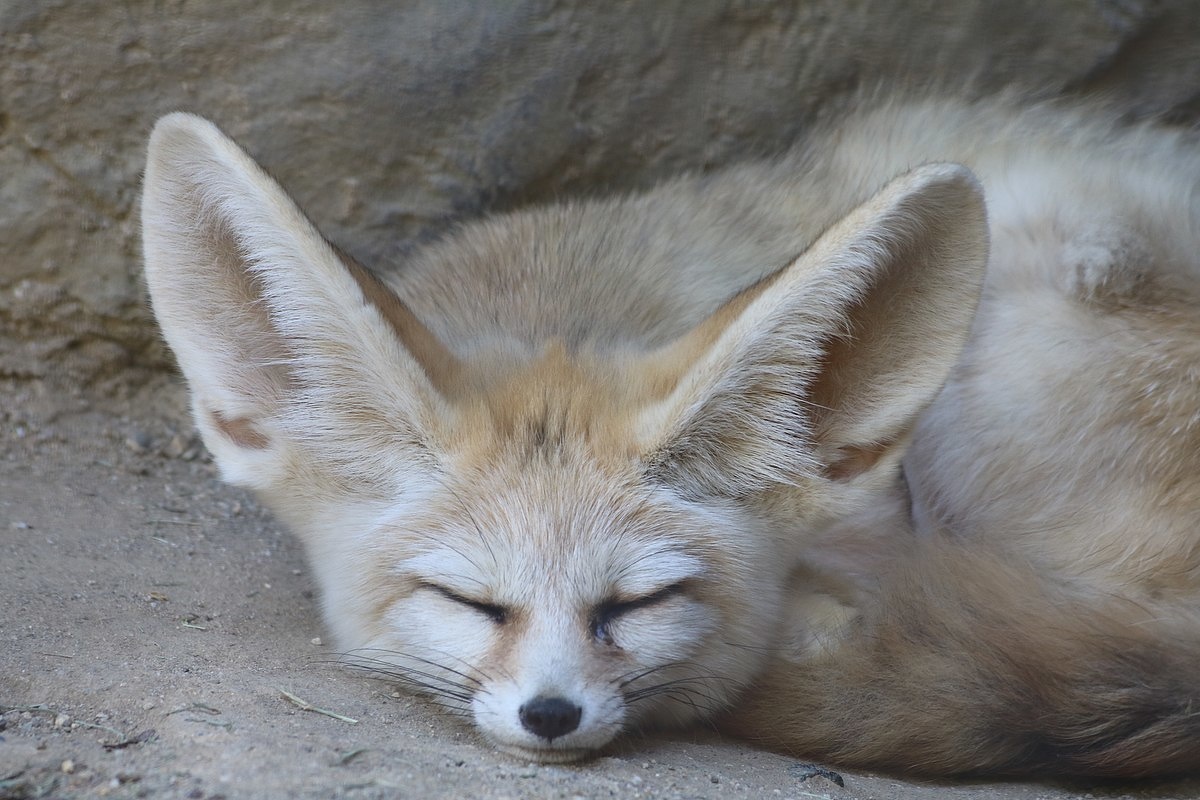
fennec fox
Fennec foxes (Vulpes zerda) are also called fennecs. They small foxes indigenous to the Sahara that have huge ears that allow them to hear the quiet shuffling across the sand of their prey — lizards (geckos and skinks), small rodents and insects. The ears also help them to dissipate heat. A dense network of tiny blood vessels run close to the surface of the skin in ears. Nearness to the air helps cool the blood.
Fennec foxes have thick fur on their foot pads that help keep their feet from being scorched by hot sand. Fennec often feed on gerbils and jirds which are located by scent and killed with a quick pounce. If there is a promise of food fennec foxes put their nose to the ground and search for scent trail. Fennec foxes can live for up to 10 years in the wild, which is common among African foxes. Captive fennec foxes have lived for up to 12 years. fennec foxes raised in the lab often dig or attempt to dig within their cages — evidence that this behavior is intuitive, rather than learned. [Source: Rebecca Adams, Animal Diversity Web (ADW) /=]
Fennec foxes are the smallest species of fox, with a body length of 36 to 41 centimeters (14 to 16 inches) and weigh 1.5 kilograms (3.3 pounds). This makes them about the size of a Chihuahua. Foxes are in the dog family. The huge ears of fennec foxes are about 15 centimeters (six inches) long. Bat-eared fox of eastern and southern Africa have ears are almost as large as fennec's. Ruppell’s foxes of North Africa and the Middle East also have large ears. [Source: Sascha Bos, HowStuffWorks, March 29, 2024]
Fennec foxes are regarded as one of the world’s cutest animals. Sascha Bos wrote in “HowStuffWorks”: What makes an animal cute? In a 2016 article published in "Trends in Cognitive Sciences," researchers found that cuteness plays an important role in the infant-caregiver relationship. The world's cutest animals have features that tug on their parents' heartstrings (and increase their brain activity). Animals with traits similar to human babies — such as big heads, big eyes, soft skin (or fur) and a pleasant smell — can trigger some of the same emotions we feel in the presence of a human infant.
RELATED ARTICLES:
FOXES OF THE MIDDLE EAST AND NORTH AFRICA: CHARACTERISTICS, BEHAVIOR, SPECIES africame.factsanddetails.com
FOXES: HISTORY, CHARACTERISTICS, BEHAVIOR, REPRODUCTION factsanddetails.com
CANIDS, CANINES AND CANIS: CHARACTERISTICS, BEHAVIOR AND REPRODUCTION factsanddetails.com
FOXES AND HUMANS: FOLKLORE, ATTACKS, PETS factsanddetails.com
RED FOX: CHARACTERISTICS, BEHAVIOR AND REPRODUCTION factsanddetails.com
FOXES OF CENTRAL ASIA: CHARACTERISTICS, BEHAVIOR, SPECIES factsanddetails.com
ARCTIC FOXES: CHARACTERISTICS, COLD, BEHAVIOR AND REPRODUCTION factsanddetails.com
DHOLES: CHARACTERISTICS, BEHAVIOR, HUNTING factsanddetails.com
GOLDEN JACKALS: CHARACTERISTICS, BEHAVIOR, ATTACKS africame.factsanddetails.com
DOGS: CHARACTERISTICS, BEHAVIOR AND INTELLIGENCE europe.factsanddetails.com
DOMESTICATION OF DOGS: THEORIES, EVIDENCE, WHY AND HOW europe.factsanddetails.com
WHEN AND WHERE DOGS WERE FIRST DOMESTICATED europe.factsanddetails.com
WOLVES: CHARACTERISTICS, HISTORY, SPECIES, NUMBERS factsanddetails.com
Fennec Fox Habitat and Where They Are Found
Fennec foxes are native to North Africa, ranging from Western Sahara and Mauritania in the east Egypt and the Sinai Peninsula in the east and from the Mediterranean Sea in the north to the Sahel in the south. The largest populations occur in desert of the central Sahara, though they species can be found in the mountains of northern Morocco (roughly 35 degrees N latitude) and south into northern Nigeria and Chad (15 degrees N latitude). [Source: Rebecca Adams, Animal Diversity Web (ADW) /=]
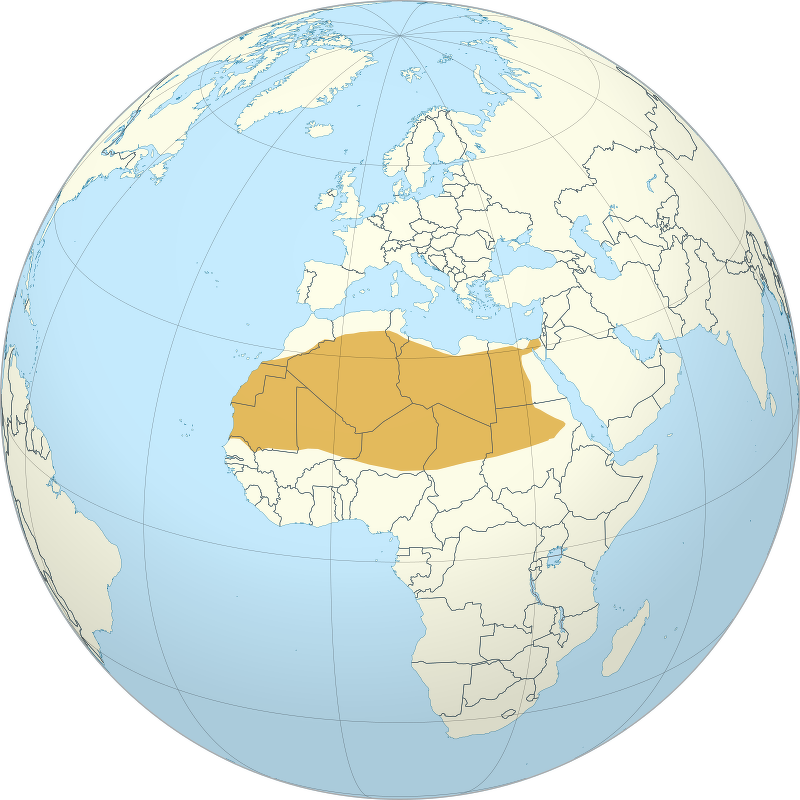
range fennec fox
Fennec foxes are highly specialized for life in the desert life. They are found almost exclusively in arid, sandy regions but they need access to desert grasses and light scrub vegetation, which are used to bolster, shelter, and line their dens. Fennec foxes are so well adapted to their Saharan climate that they do not need to drink. The get enough wate form the plants they eat and sometimes from dew that forms in the plants
Fennec foxes can be found in the deserts of Morocco, Algeria, Libya, Tunisia, Mauritania, western Sahara, Niger, Mali, northern Sudan and Egypt into the Sinai Peninsula. They inhabit small sand dunes and vast treeless sand areas with sparse vegetation such as grasses, sedges and small shrubs. In the northern part of their range annual rainfall is less than 10 centimeters a year, compared to 30 centimeters a year in their southern range. The fennec fox's range appears to overlap with that of other canines, namely golden jackal and Rüppell's fox. Compared to these canids, fennec foxes appear to inhabit areas with more extreme climate and are able to dig burrows in grainier surfaces, an adaptation that gives them an advantage over competitors. [Source: Wikipedia]
Fennec Fox Characteristics
Fennec foxes are the smallest of the canids — which includes domestic dogs, wolves, coyotes, foxes, jackals and dingoes. Smaller than an average house cat, fennec foxes range in weight from 0.8 to 1.5 kilograms (1.8 to 3.3 pounds), with their average weight being 1.5 kilograms (3.3 pounds). They have a head and body length that ranges from 30 to 40 centimeters (11.8 to 15.7 inches), with their average length being 30 centimeters (11.8 inches). Their average basal metabolic rate is 2.693 watts. Tail length is between 18 and 30 centimeters (7 and 12 inches) and is about 60 percent the length of their body and head. Standing only 18 to 22 centimeters (7 to and 8.7 inches) at the shoulder, fennec foxes are significantly shorter than other African foxes, which average a shoulder height of 30 centimeters (12 imches). [Source: Rebecca Adams, Animal Diversity Web (ADW) /=]
Sexual Dimorphism (differences between males and females) seems to be present: Males are a little larger than females. The smallest adult females weigh around 0.8 kilograms and the largest males weigh 1.5 kilograms. Not enough is known about fennec foxes to state conclusively whether sexual dimorphism. Sexual dimorphism in canids tends to be small but is common in of mostly monogamous species, which Fennec foxes are.
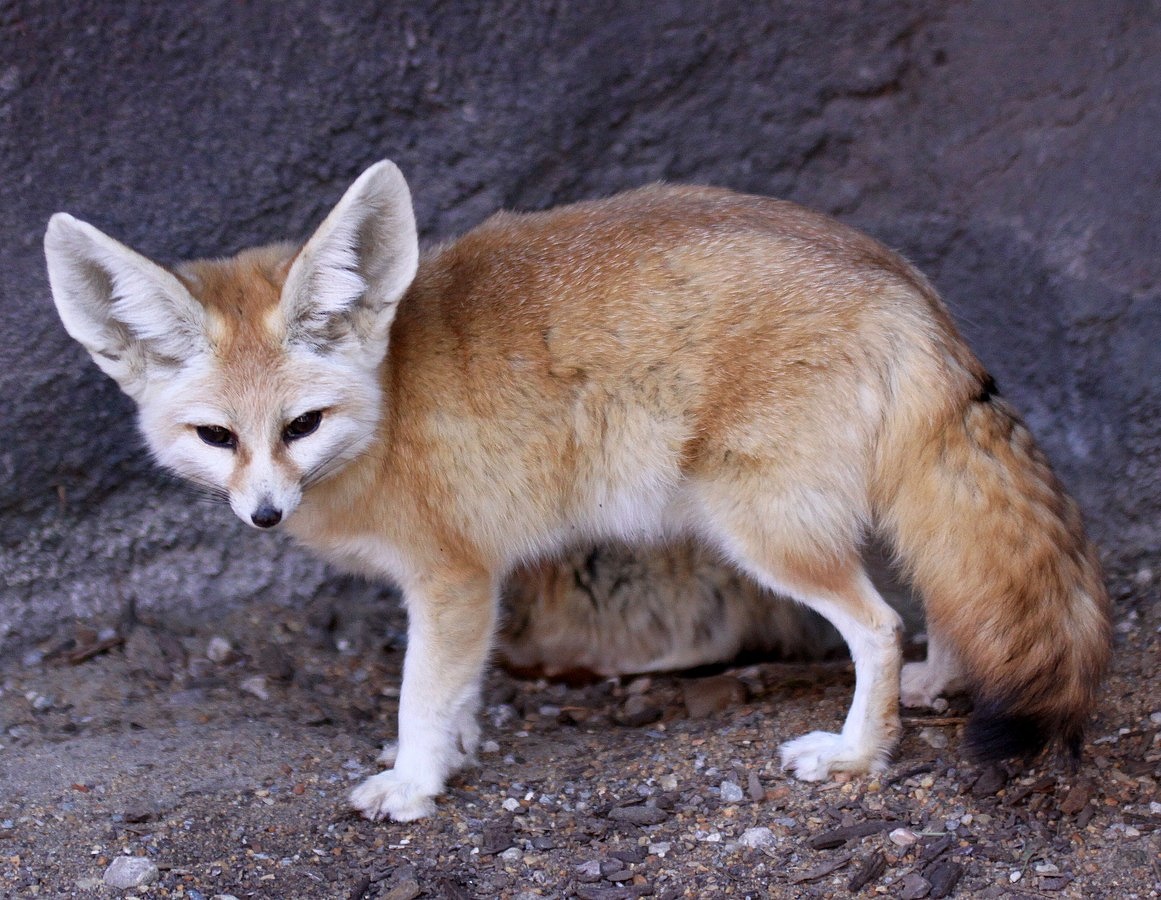
fennec fox
The fennec fox’s large ears are massive in proportion to their skull. Enlarged auditory bullae (hollow, bony structures in the skull that enclose the middle and inner ear) are indicators of their acute hearing, which helps them locate prey moving on or under the sand. The long ears have longitudinal reddish stripes on the back and are so densely haired inside that the external auditory meatus is not visible. The edges of the ears are whitish, but darker on the back. The ear to body ratio is the greatest in the canid family.
Fennec foxes have large, dense kidneys with somewhat compact medulla, which help store water in times of scarcity. Their feet are heavily furred, protecting the pads from the hot desert sand. The large eyes, nose, and vibrissae (whiskers) are all black. Dentition is weak, similar to that in bat-eared foxes The dental formula is 3.1.4.2, 3.1.4.3 × 2 = 42 with small and narrow canines.
Fennec foxes have sand-colored fur which reflects sunlight during the day and helps keep it warm at night. The fur of adults is thick and silky, buff-colored on the back and white along the animal’s legs, face, ear-linings and undersides. In contrast, juveniles are downy and almost exclusively white. The fur over the violet gland — found in all foxes, and of unknown function — is black or dark brown. The tapering tail has a black tip. There are dark streaks running from the inner eye to either side of the slender muzzle.
Fennec Fox Food, Eating Behavior and Predators
Fennec foxes are omnivores (eat a variety of things, including plants and animals). Animal foods include birds, mammals, reptiles, eggs, carrion. insects, and non-insect arthropods. Among the plant foods they eat are leaves, roots, tubers and fruit. They store and caches food. [Source: Wikipedia, Rebecca Adams, Animal Diversity Web (ADW) /=]
Fennec foxes small carnassial teeth. They obtain much of their food through digging, and, to survive in their harsh desert environment, will consume almost anything that is itself available. Small rodents, lizards, birds, eggs, and insects are common prey. Fruit, leaves and roots are not only important food items they also provide almost 100 percent of their water intake. Fennec foxes can go indefinitely — perhaps their entire lives — without free water.

Fennec fox in the Moroccan Sahara
Fennec foxes hunt alone and dig in the sand for most of their prey. Some individuals have been observed burying prey for later consumption and searching for food in the vicinity of human settlements. In the Algerian Sahara, 114 scat samples were collected that contained more than 400 insects, plant fragments, date palm fruits, remains of birds, mammals, scaled lizards, and insects.
African horned owl species such as the Pharaoh eagle-owl prey on fennec fox pups. Anecdotal reports exist about jackals and striped hyenas have preyed on fennec foxes. But according to nomads, fennec foxes are fast and change directions so well that even their greyhound-like Salukis rarely catch them. Additionally, fennec dens to make quick escapes, and their sand-colored fur offers ideal camouflage in their desert habitat. Their excellent hearing can alert them of animals stalking them.
Fennec Fox Behavior
Fennec foxes are terricolous (live on the ground), nocturnal (active at night),motile (move around as opposed to being stationary), sedentary (remain in the same area), territorial (defend an area within the home range), social (associates with others of its species; forms social groups), and have dominance hierarchies (ranking systems or pecking orders among members of a long-term social group, where dominance status affects access to resources or mates).[Source:Rebecca Adams, Animal Diversity Web (ADW) /=]
Fennec foxes are unusually agile for such a small animal. A full-grown adult can jump straight up up to 0.7 meters, and over one meter horizonattly from the standing position. This trait helps fennec foxes capture prey. Their predominate hunting method is to stalk-spring-pounce. They cache food for future use and remember and use these cache sites year after year.
Rebecca Adams wrote in Animal Diversity Web: Fennec foxes are highly social animals, living together in family groups which may contain up to 10 individuals. These kin-based clans usually include at least one breeding pair, a litter of immature pups, and perhaps a few of the pups’ older siblings. Territory is marked by both urine and scat. Dominant males urinate more at marking sites than their submissive fellows.
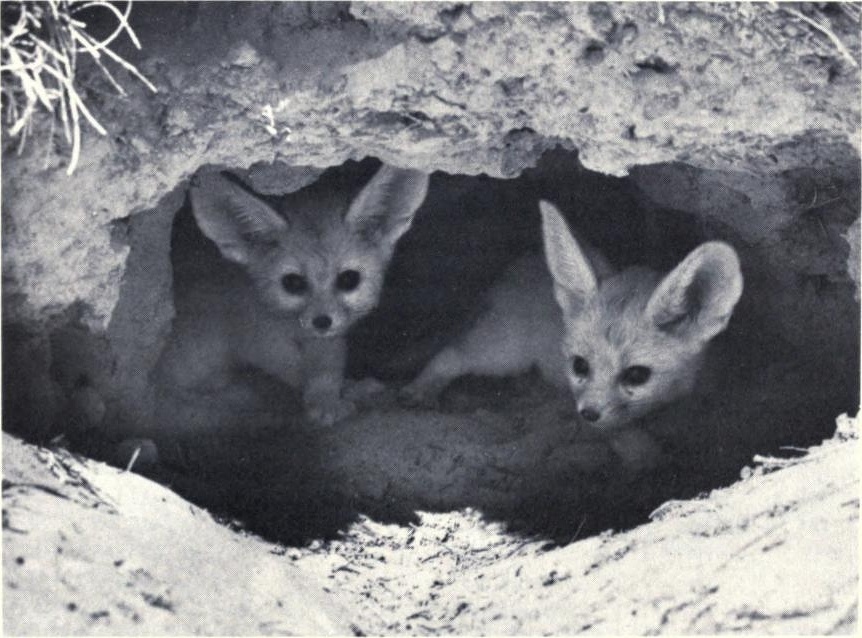
two fennec fox cubs in a burrow
Since they are mostly active at night, fennec foxes need places to sleep during the day that are be sheltered from the hot desert sun. This one of the main functions of their burrows, which also serve as dens for rearing pups. Often they become extensive tunnel systems and may posses several entrances from which the fennec foxes can flee should enemies arrive. Burrows are usually dug beneath desert bushes, allowiing the roots of the plants to provide support for tunnel walls. Leaves are used to line the vixen’s nesting chamber. In some instances several fennec families may live together, sharing a complex den. Even when this cohabitation occurs, fennec foxes, like other foxes, still prefer to hunt alone. Young and adults engage in play, perhaps to develop and sharpen their hunting skills.
Fennec Fox Senses and Communication
Fennec foxes sense and communicate with vision, touch, sound and chemicals usually detected by smelling. They also employ pheromones (chemicals released into air or water that are detected by and responded to by other animals of the same species) and scent marks produced by special glands and placed so others can smell and taste them. [Source: Rebecca Adams, Animal Diversity Web (ADW) /=]
Fennec foxes perceive their environment primarily through highly developed senses of hearing and smell. Their enormous ears are able to detect sound through many centimeters of sand, and can pick up subtle differences between whines and whimpers in the calls of other fennec foxes from far distances. Night vision is enhanced by a reflective retina called a tapetum. This adaptation creates the illusion of glowing eyes and is characteristic of nocturnal animals. /=\
The gregarious nature of fennec foxes is evident in their frequent and varied vocalizations. Both adults and pups whimper, chatter, growl, shriek and wail. Howls are brief and loud, descending in pitch and repeated many times. Social rank among fennec foxes is communicated mainly through play.
Fennec Fox Mating, Reproduction and Offspring
Fennec foxes are monogamous (having one mate at a time) and are cooperative breeders (helpers provide assistance in raising young that are not their own). They engage in seasonal breeding — breeding once yearly in January and February. The gestation period ranges from 50 to 53 days. The number of offspring ranges from one to 6, with the average number of offspring being two to three. [Source: Rebecca Adams, Animal Diversity Web (ADW) /=]
Fennec foxes have relatively slow reproductive rates and litters are relatively small, During the two month breeding season vixens are in estrus for only a few days. Little is known about how fennec foxes attract or defend their mates, though reproductive opportunity may be affected by social position. It is possible that only dominant males pair with females.
Fennec foxes mate for life. This monogamous pairing leads to a social structure in which each breeding couple have their own territory. Many breeding couples are parts of family groups that include older siblings that help care for young offspring) The breeding couple or family territory is bounded by urine and piles of fecal matter. Fennec foxes are vigorous defenders of both territory and pups.
Fennec Fox Offspring and Parenting
Fennec fox young are altricial, meaning they are relatively underdeveloped at birth.
During the pre-weaning and pre-independence stage of the young’s development provisioning and protecting are done by males and females. There is an extended period of juvenile learning. The post-independence period is characterized by the association of offspring with their parents. [Source: Rebecca Adams, Animal Diversity Web (ADW) /=]
At birth, the blind and helpless fennec fox offspring weigh 50 grams. Their mother attends them in the den for two weeks, until their eyes open. At four weeks the pups begin to play within the den. At five weeks play extends to the area just outside the den entrance. The pups of Fennec foxes suckle longer than those of most foxes, and weaning may not occur until nearly three months of age. Young may be licked, carried, and closely watched for up to 70 days.
The age in which young are weaned ranges from 30 to 90 days and the age in which they become independent ranges from six to nine months and the average time to independence is six months. Females and males reach sexual or reproductive maturity at six to nine months.
The low birth rate and slow reproductive recovery of declining fennec populations means that fennec parents have a high reproductive investment in their altricial pups. Father and mother work together during the prolonged rearing of the young. Males bring food to the family and watch for dangers to playing pups. The aggressive territorial defense of their young, may be be a reason fennec foxes maintain community structure.
Fennec Fox Humans and Conservation
On the International Union for Conservation of Nature (IUCN) Red List, fennec foxes are listed as a species of Least Concern. In CITES (Convention on International Trade in Endangered Species of Wild) they are in Appendix II, which lists species not necessarily threatened with extinction now but that may become so unless trade is closely controlled. [Source: Rebecca Adams, Animal Diversity Web (ADW) /=]
Fennec foxes once ranged broadly over northern Africa, but sport hunting and intrusion by humans has shrunk their habitat. Fennec foxes can be seen at many zoos and kept by some people as pets. Fennec foxes are bred commercially as exotic pets. Commercial breeders remove the pups from their mother and hand-raise them, as tame foxes are more valuable. A breeders' registry has been set up in the United States to avoid any problems associated with inbreeding. As of 2020, 15 US states authorized the ownership of foxes without the need for a document. Due primarily to their diet, captive foxes have been known to grow to abnormally large sizes. [Source: Wikipedia]
Fennec foxes are the national animal of Algeria and the nickname for the Algeria national soccer team — "Les Fennecs". The species was depicted in “The Little Prince”, the 1943 novella by Antoine de Saint-Exupéry about a pilot that crash-lands in remote part of the Sahara Desert. According to Martial's Roman-era Epigrams the "long-eared fox" was a popular pet,
Image Sources: Wikimedia Commons
Text Sources: Animal Diversity Web animaldiversity.org ; National Geographic, Live Science, Natural History magazine, CNTO (China National Tourism Administration) David Attenborough books, New York Times, Washington Post, Los Angeles Times, Smithsonian magazine, Discover magazine, The New Yorker, Time, BBC, CNN, Reuters, Associated Press, AFP, Lonely Planet Guides, Wikipedia, The Guardian, Top Secret Animal Attack Files website and various books and other publications.
Last updated May 2025