
Home | Category: Desert Animals
GOLDEN JACKALS
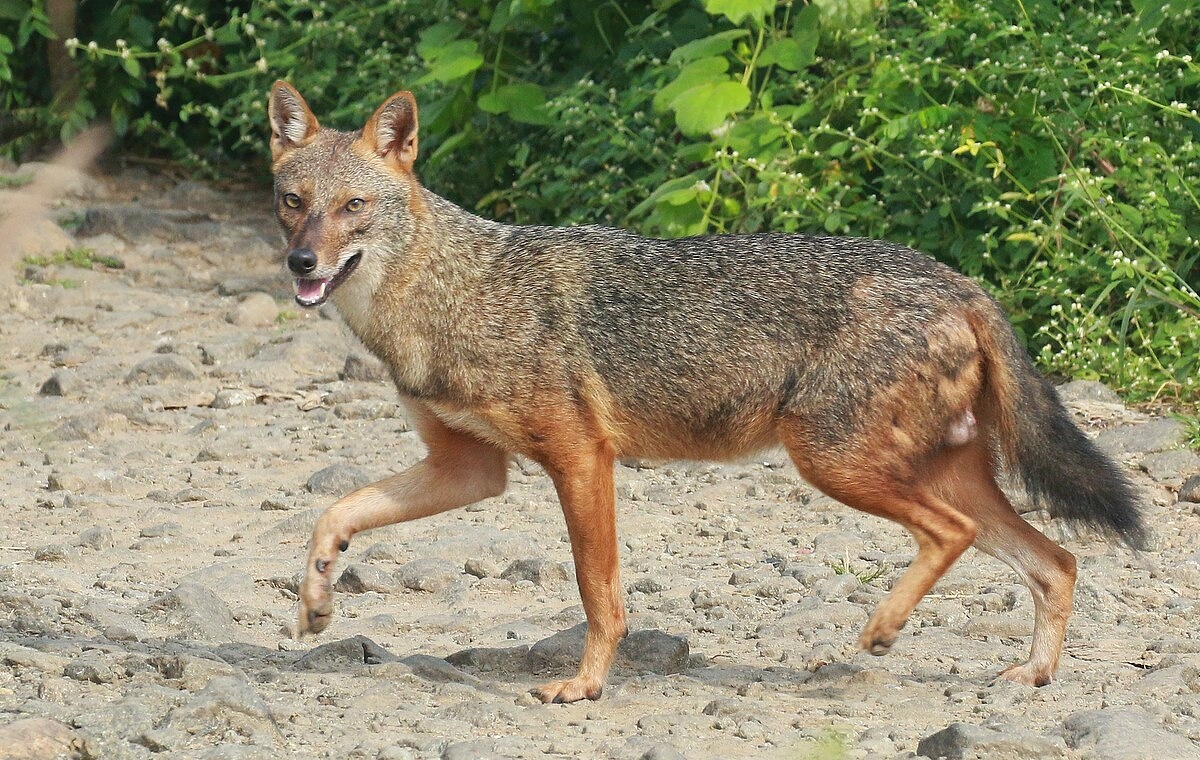
golden jackal in India
Golden jackals (Canis aureus) are also called common jackals. They are coyote-like or wolf-like canids native to Eurasia and found in Europe and Africa. Compared to Arabian wolves, which are a subspecies of gray wolves, golden jackals are smaller and have shorter legs, a shorter tail, a more elongated torso, a less-prominent forehead, and a narrower and more pointed muzzle. On the International Union for Conservation of Nature (IUCN) Red List, they are listed as a species of Least Concern due to its widespread distribution and high density in areas with plentiful food.
Golden jackals occur in North and East Africa, Southeastern Europe and are native to Sub-Sahara Africa, Eurasia and Asia. They are the most northerly jackal species, and also the most widely distributed. Their range overlaps with the ranges of black-backed jackals in East African savannas. Golden jackals live in deserts, dune areas, savannas, grasslands, forest scrub and forests in areas with an extended dry season. They prefer dry open country, arid short grasslands and steppe landscapes. [Source: Alicia Ivory, Animal Diversity Web (ADW) /=]
Golden jackals live eight to nine years in the wild and up to sixteen in captivity. Despite their name, golden jackals are not closely related to African black-backed jackals or side-striped jackals, which are part of the genus Lupulella. Instead they are more closely related to wolves and coyotes.
Golden jackals live eight to nine years in the wild and up to sixteen in captivity. They are omnivores (eat a variety of things, including plants and animals). One study found that golden jackals consume 54 percent animal food and 46 percent plant food. They are opportunistic foragers with a varied diet, that includes rodents, (especially during winter), young gazelles, ground birds, ground bird eggs, hares, reptiles, frogs, fish, insects and fruit. They eat carrion from time to time. /=\
Canids, Canines and Canis
Canidae is a biological family of caniform carnivorans ("dog-like" carnivores). It constitutes a clade (group of organisms composed of a common ancestor and all of its descendants) Members of this family are called canids. The family includes three subfamilies: Caninae, and extinct Borophaginae and Hesperocyoninae. Caninae are known as canines,and include domestic dogs, wolves, coyotes, raccoon dogs, foxes, jackals, African wild dogs and other species. [Source: Wikipedia]
The Canidae family is comprised of 13 genera and 37 species. Canids are widely distributed around the globe. They occur on all continents except Antarctica and are only member of the Order Carnivora that found in Australia (we’re talking about dingoes, introduced by humans during prehistoric times). Canidae fossils have been dated to the to the Oligocene Period (33 million to 23.9 million years ago) and Miocene Period (23 million to 5.3 million years ago), which makes them among the oldest extant groups of carnivores. Canids are probably an early offshoot of the caniform lineage (which includes mustelids (weasels),procyonids (raccoons and their relatives), ursids (bears), phocids and otariids (seals), and odobenids (walruses).[Source: Bridget Fahey and Phil Myers, Animal Diversity Web (ADW)]
Canis encompasses "dog like" canids. It is a diverse genera encompassing seven species of canids which include jackals, wolves, coyotes, and domesticated dogs. Canis means "dog" in Latin, "canine tooth" is also derived from Canis and refers due to the long fang-like teeth that all canids possess. Previously the Canis included foxes but they were removed and separated into their own Vulpes genera. African wild dogs are canids but not canis. They are classified into the genus Lycaon and are the only surviving member of this genus.[Source: Lydia Oliver, Animal Diversity Web (ADW) |=|]
See Separate Article: CANIDS, CANINES AND CANIS: CHARACTERISTICS, BEHAVIOR AND REPRODUCTION factsanddetails.com
Golden Jackal Characteristics
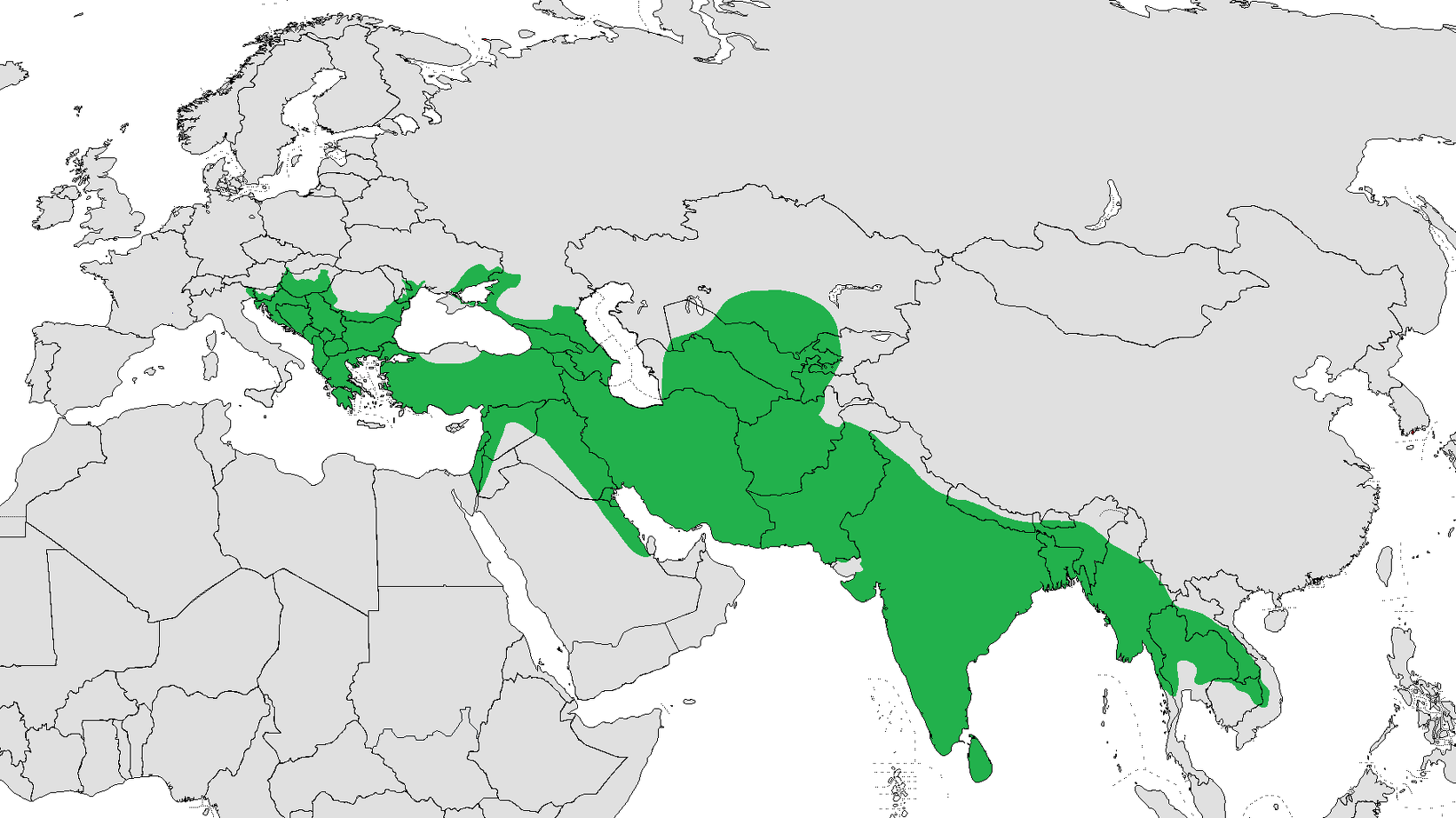
Golden jackal range
Golden jackals range in weight from eight to 10 kilograms (17.6 to 22 pounds). They stand approximately 40 centimeters (15.7 inches) at the shoulder and have a head and body length of 70 to 85 centimeters (27.5 to 33.5 inches), with a 25-centimeter (10-inch) tail. Sexual Dimorphism (differences between males and females) is present: Males are larger than females. Males have a head and body length of 71 to 85 centimeters (28 to 33 inches), while that of females is 69 to 3 centimeters (27 to 29 inches). Males weigh 6 to 14 kilograms (13–31 pounds) and females weigh 7 to 11 kilograms (15–24 pounds). [Source: Wikipedia, Alicia Ivory, Animal Diversity Web (ADW) /=]
Golden jackals look similar to gray wolves but are smaller, lighter weight and have shorter legs and tail, and a muzzle that is narrower and more pointed. Their legs are long in relation to their body, and their feet are slender with small pads. The skull of a golden jackal is most like the skull of a dingos, and closer to that of a coyote and a gray wolf than to that of the black-backed jackal of side-striped jackal.
The fur of golden jackals is generally coarse and not very long. Its coat is usually yellow to pale gold and brown-tipped, but the color can vary with season and region, often varying in color from a pale creamy yellow in summer to a dark tawny beige in winter.. Golden jackal moult twice a year, in spring and in autumn. In Transcaucasia and Tajikistan, the spring moult begins at the end of winter.
Golden Jackal Behavior
Golden jackals are diurnal (active during the daytime), nocturnal (active at night), motile (move around as opposed to being stationary), territorial (defend an area within the home range), social (associates with others of its species; forms social groups), and have dominance hierarchies (ranking systems or pecking orders among members of a long-term social group, where dominance status affects access to resources or mates). Golden jackals are strictly nocturnal in areas inhabited by humans, but may be partly diurnal elsewhere. They dig caverns for shelter, or use crevices in rocks, or caverns that were dug by other animals. They sense using touch and chemicals usually detected with smell. [Source: Alicia Ivory, Animal Diversity Web (ADW) /=]
Golden jackals behave in ways that are similar to the ways domesticated dogs and wolves behave. Males raise a hind leg when spraying their urine, and females squat at the site they pee. Males and females alike mark their territory by spraying, primarily during the mating season.. If strange jackals meet each other, most of the behavior expresses subordination, superiority, or readiness to attack. /=\
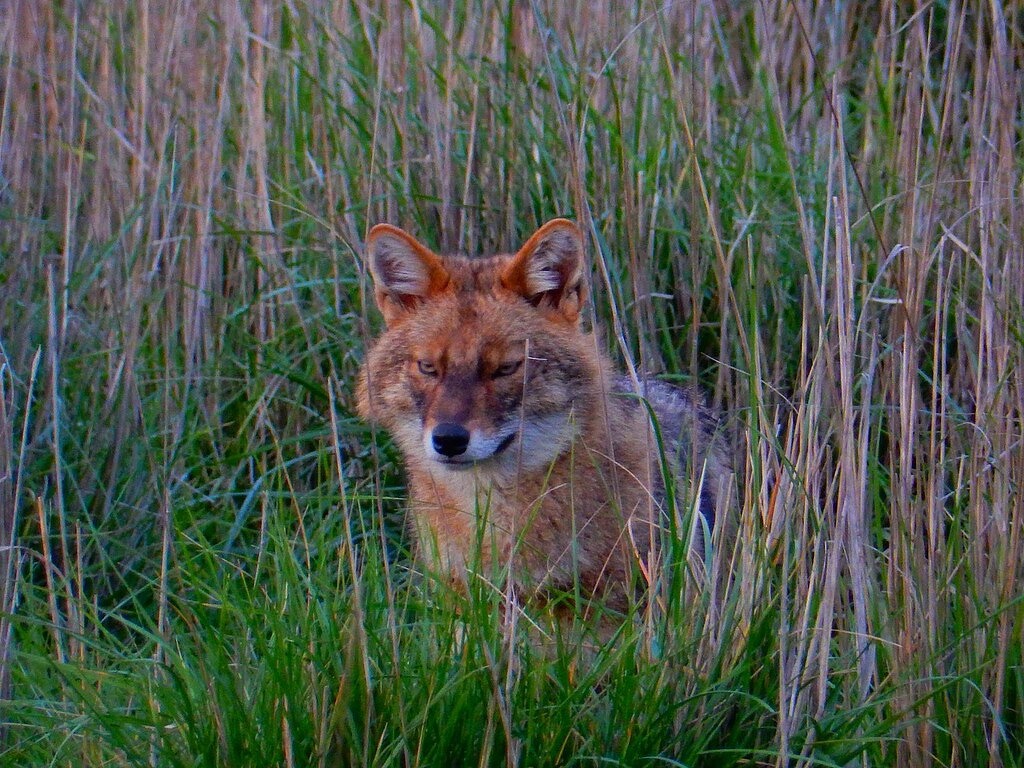
Syrian golden jackal
Golden jackals live in pairs and are friendly to one another, scratching their partners all over their bodies. Each jackal species communicates through its own repertoire of calls. Golden jackals use a wide inventory of howls to locate one another. By howling together, a pair shows that there is a bond between them, and thus the choral howling can be considered a kind of betrothal.
Though the golden jackal is a capable hunter, it normally does not attack larger animals. When the gazelles in the Serengeti give birth, every day several newborns are grabbed by the jackals and are taken to the dens to be eaten. Jackals also take part in the kills of larger animals, such as those of the lion. They howl when a lion makes a kill, which usually lures other jackals to the scene. If a sated lion leaves an unfinished carcass, the jackals rush in to devour the remains. Should other animals arrive at the scene, the jackals bury their pieces of meat. Using their forepaws, they dig a trench, lay the bits of quarry into it, and then close the trench using the ridge of the nose. /=\
Golden Jackal Social Behavior
Alicia Ivory wrote in Animal Diversity Web: The basic social unit of the golden jackal is a mated pair or a mated pair and its young. Golden jackal pairs forage and rest together. All of their behavior is highly synchronized. Cooperative hunting is important to the jackals. Pairs are three times more likely to be successful than individuals in hunting. Members of the same family also cooperate in sharing larger food items and transport food in their stomachs for later regurgitation to pups or to a lactating mother. Hunting families hold territories of two to three square kilometers throughout the year, portions of which are marked with urine, either by the male or the female jackal, to ward off intruders. [Source: Alicia Ivory, Animal Diversity Web (ADW) /=]
Both male and female members of a golden jackal pair have important roles in maintaining their territory and in raising the young. When one parent dies, it is unlikely that the rest of the family will survive. However, most jackel families have helpers. These helper associations are probably responsible for reports of large packs hunting together. Within the family, helpers are subordinate to parents. /=\
Helpers strengthen the family in several ways. The presence of a single adult at the den provides considerable protection: adults both "rumble growl" and "predator bark" to warn the pups to take refuge, and a single adult can successfully drive off large predators. Helpers also bring food to a lactating mother and improve the provisioning of the pups indirectly by allowing the parents to spend more time foraging alone or hunting as a pair. Families with helpers may be able to defend and exploit a carcass more successfully than an individual would be able to. Pup survival improves in the presence of helpers, though not as markedly in golden jackals as in other jackal species. /=\
The female golden jackal initiates all den changes. Though the males are predominantly monogamous, females reserve their aggression for female intruders, preventing the sharing of the male and his paternal investment. /=\
Golden Jackal Mating, Reproduction and Offspring
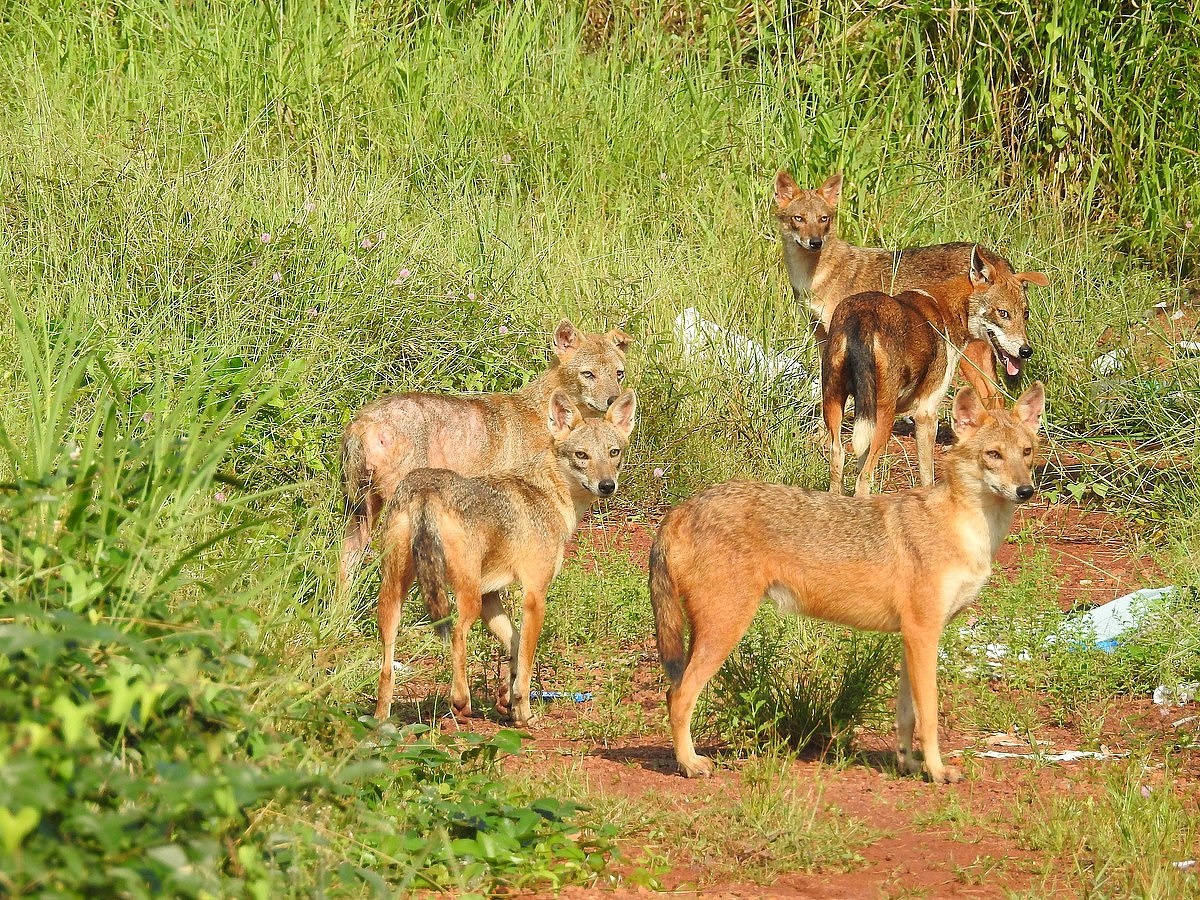
group of golden jackals
Golden jackals are monogamous (having one mate at a time) and are cooperative breeders (helpers provide assistance in raising young that are not their own). Golden jackals live in mated pairs. In most jackal families, there are one or two adult members called "helpers" — jackals who stay with the parents for a year after reaching sexual maturity, without breeding, to help take care of the next litter. .[Source: Alicia Ivory, Animal Diversity Web (ADW) /=]
The gestation period ranges from 60 to 63 days. The number of offspring ranges from one to 9, with the average number of offspring being three to 4.5. Young are altricial, meaning they are born relatively underdeveloped. There is an extended period of juvenile learning. The age in which they are weaned ranges from 50 to 90 days. The post-independence period is characterized by the association of offspring with their parents. On average males and females reach sexual or reproductive maturity at 11months
Births occur mainly in January-February in Africa; in April-May in Southeast Europe and take place throughout the year in Asia. Golden jackals in Africa court at the end of the dry season and produce pups during the rainy season. They have been observed to produce pups for at least eight years.
Young are born in a den within the parents' marked territory. Weight at birth is 200-250 grams. Pups' eyes open after about ten days. The pups are nursed for about eight weeks, and then weaned. The young are fed by regurgitation and begin to take some solid food at about three months. Both parents provide food and protection. /=\
Golden Jackals Humans and Conservation
Golden jackals are prevalent and is not threatened. On the IUCN Red List they are designated a species of Least Concern. They are threatened somewhat by loss of habitat but they seem to do okay in and around human-occupied areas, where they may scavenge carrion and eat garbage. They benefit agriculture by hunting rodents and lagomorphs. They are sometimes hunted for their fur and can be housebroken like domesticated dogs and kept as pets but are shy around strangers and generally do not allow themselves to be petted by them. [Source: Alicia Ivory, Animal Diversity Web (ADW) /=]
Jackals hold a place with the people of the Middle East. They show up repeatedly in fables and folklore, where they are often cast as sly creatures like foxes in European fables. Jackals are referred to in the Bible, particularly in association with descriptions of desolate places. /=\ Jackals also played a significant role in ancient Egypt. The jackal-headed god Anubis was was the god of the netherworld and weighed the heart of the deceased.
Golden jackal sometimes raid crops such as corn, sugarcane and watermelon. They preyed on sheep to such an extent that sheep-herders in many places have had to have had to make their pastures jackal-proof by putting fences around them or getting dogs. Golden jackals may be involved in the spread of rabies and have killed children.
Golden Jackal Attacks in Bangladesh
In 1979 in southern Bangladesh, two young children were attacked and killed by golden jackals on the edge of a village. There have been other attacks more recently. Sheikh Sabiha Alam of AFP wrote: Few in the Jahan family's remote Bangladeshi village had seen a jackal up close before the morning one stalked Musqan through the paddy fields, pounced on her, and maimed the four-year-old for life. Musqan is still recovering from the horrific injuries she sustained in the mauling in November 2024 by the rabid jackal. While she is rabies-free thanks to prompt treatment, her face is disfigured by bite wounds and one of her eyes remains swollen shut. [Source: Sheikh Sabiha Alam, AFP, December 14, 2024]
"It happened in broad daylight," her aunt Ishrat Jahan told AFP. "A jackal pushed her to the ground and blindly bit her. Other villagers later killed it, but they are still traumatised by what happened." Golden jackals like the one that maimed Musqan are found across Bangladesh. What made the attack on Musqan unusual was its timing — she was bitten in the daytime, but golden jackals are a nocturnal species.
While Bangladesh's health ministry does not maintain specific records on jackal bites, reports from hospitals indicate an alarming and possibly unprecedented frequency of attacks in 2024. The Munshiganj District Hospital, south of Dhaka, treated 20 people for bites on just a single day in September. "I have never seen so many people coming in with jackal bites on a single day before," hospital superintendent Dewan Nizam Uddin Ahmed told AFP.
Another hospital administrator in Dinajpur, on the other side of the country, told AFP there had been 12 cases in one day at his facility. "We are regularly getting bite patients," Dinajpur Hospital superintendent Mohammad Fazlur Rahman said. "The jackals are roaming freely through the farmland."
Golden jackals are by nature shy and usually avoid human contact unless they contract rabies, a disease that quickly turns them bold and aggressive as its symptoms take hold. Endemic across Bangladesh, rabies spreads quickly among canine species when infected animals bite and draw blood from other creatures. The disease is almost guaranteed to lead to a prolonged and painful death in humans once symptoms show. Prompt intervention is needed to stop the disease in its tracks.
After Musqan was bitten last month, she received treatment for three days to prevent a rabies infection, followed by a month in hospital for surgeries related to her wounds, and is still deeply traumatised by the attack. "We can prevent rabies with vaccines," Ariful Bashar, one of the doctors at the hospital treating Musqan, told AFP. "But most of the time, jackals rip out flesh, deforming their victims. Almost all of them then need reconstructive surgery."
Golden Jackal Attacks in Bangladesh Provoked by Habitat Loss?
Sheikh Sabiha Alam of AFP wrote: Violent and unprovoked attacks by rabid canines are rising around the South Asian nation due to rampant deforestation and habitat loss — a trend experts say has been worsened by climate change. Animal researcher Zoheb Mahmud of Independent University in Dhaka told AFP that his studies of golden jackals over eight years showed that the "gradual erosion of habitats" had altered their behaviour. "I found the once-shy creatures had begun staring at us," he said. "They are supposed to come out in the evening or at night, but we saw them during the day."[Source: Sheikh Sabiha Alam, AFP, December 14, 2024]
Urbanisation and logging have led to major human encroachment on the habitats where much of Bangladesh's jackal population resides. According to monitoring group Global Forest Watch, Bangladesh last year lost 17,800 hectares (44,000 acres) of forest cover — an area roughly three times the size of Manhattan. Mahmud warned that jackal attacks on humans "would not stop" if the habitat loss continued.
Bangladesh is one the countries ranked most vulnerable to climate change, and there are signs that more extreme weather is making attacks more likely. The country saw widespread flooding in September 2024 that displaced millions of people in the worst-hit areas for the second year running, with floodwaters coursing through forests and driving out their canine inhabitants. "Due to the flood, the jackals lost their dwellings and food," jackal bite victim Obaidul Islam told AFP from Nilphamari in the country's north. "So they came and bit more than a dozen people in our village."
Rakibul Hasan Mukul, executive director of civil society wildlife group Arannayk, told AFP that climate change was driving more extreme and frequent flooding in Bangladesh. He said changes to the weather were also eroding farmlands, displacing their human inhabitants and prompting them to cut down more forests. "The loss of land has also resulted in increased conflicts between humans and wildlife," he added. "People are cutting bushes around wetlands and their homesteads for farming. As a result, small mammals are in crisis, losing their habitats."
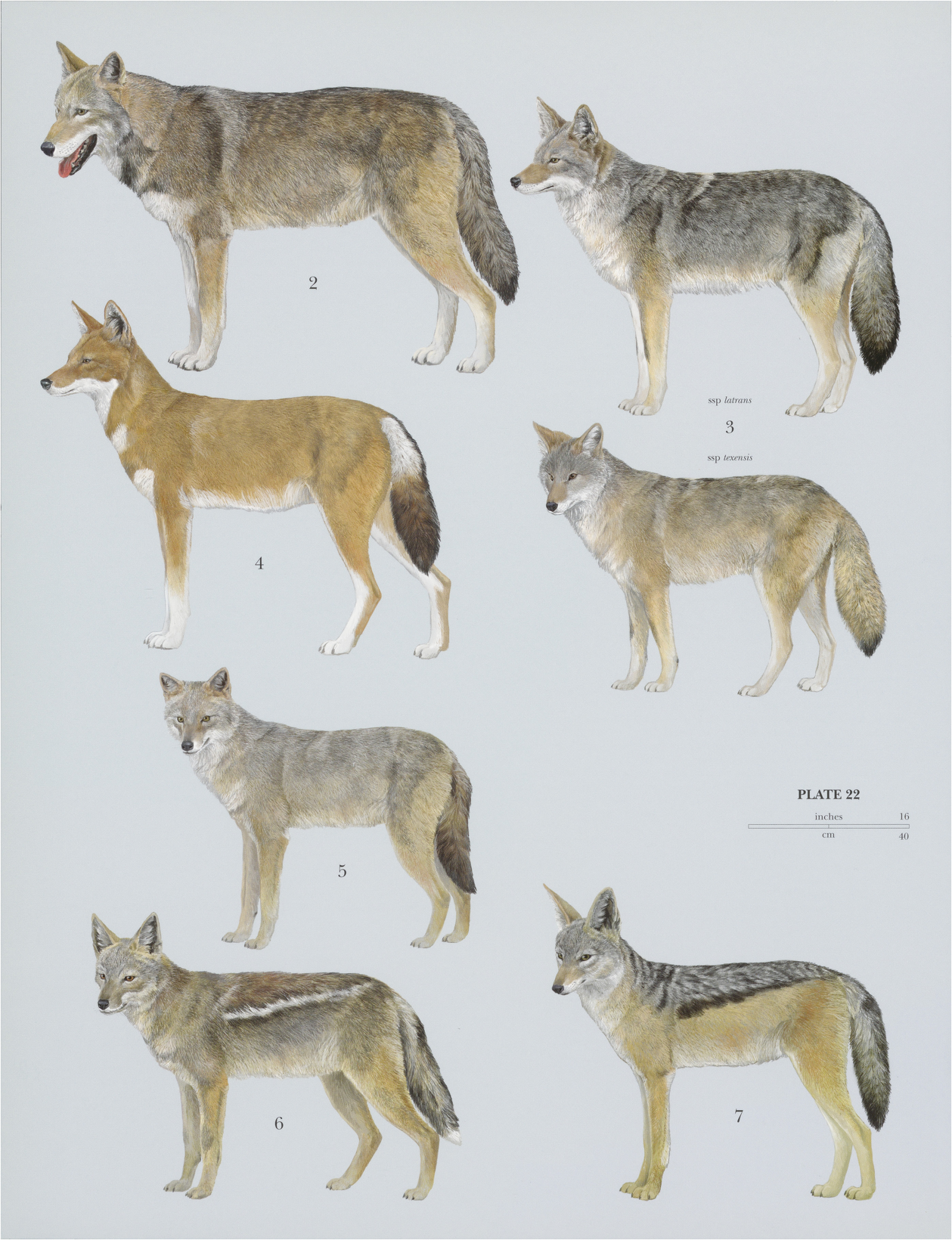
Some canis species: 2) Red Wolf (Canis rufus), 3) Coyote (Canis latrans), 4) Ethiopian Wolf (Canis simensis), 5) Golden Jackal (Canis aureus), 6) Side-striped Jackal (Canis adustus), 7) Black-backed Jackal (Canis mesomelas)
Image Sources: Wikimedia Commons
Text Sources: Animal Diversity Web animaldiversity.org ; National Geographic, Live Science, Natural History magazine, CNTO (China National Tourism Administration) David Attenborough books, New York Times, Washington Post, Los Angeles Times, Smithsonian magazine, Discover magazine, The New Yorker, Time, BBC, CNN, Reuters, Associated Press, AFP, Lonely Planet Guides, Wikipedia, The Guardian, Top Secret Animal Attack Files website and various books and other publications.
Last updated May 2025