
Home | Category: Life (Homes, Food and Sex)
ANCIENT EGYPTIAN WINE
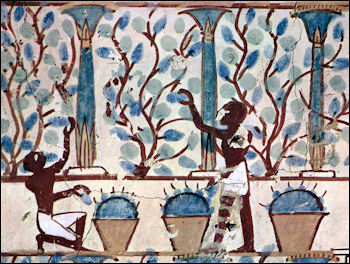
collecting grapes Although beer is regarded as primary drink in ancient Egypt, it seems like at all times wine was also widely consumed. Ancient Egyptian wine was made from a domesticated species of grape, “Vitis vinifera vinifera”. Early wine is believed to have been fermented by natural yeasts that blooms on the grape's skin. Some of it was sweetened with figs. Some of the best wines were produced in the Bahariya Oasis.
Patrick McGovern, and ancient wine expert and scientific director of the Biomolecular Archaeology Laboratory of the University of Pennsylvania Museum of Archaeology and Anthropology, said in ancient Egypt "you have illustrations inside the tombs showing how many jars of beer and wine from the Nile Delta are to be provided to the dead." New Kingdom tomb reliefs and paintings depicts rows of wine jars used in royal celebrations and elaborate wine cellars and storehouses in palaces and temples at Amarna and Thebes. The Great Papyrus Harris, one of the longest and best preserved manuscripts from ancient Egypt, shows Ramses III (1184-1153 B.C.) boasting of presenting 59,588 jars of wine to the chief Egyptian deity, Amun, at his temple in Thebes.
Much of ancient Egypt's wine appears to have been imported from the Jordan valley. Wine found in Abydos, dated to 3000 B.C., was produced in produced in the Jordan Valley and had evidence of an ancient customs seal. It also came from Nubia. Ancientsudan.org reported: “Pottery containing wine was contained in almost every grave. At Kerma, dating to about 1600 B.C., 250 jars of wine were found deposited in a ground depression.10 The jars were turned upside down to prevent the odor of alcohol from spreading. About fourteen vine presses for producing wine were discovered in Sudan. Although vines were not apt for growth in arid and semi-arid environments like that of Northern Sudan, a limited production is possible.” [Source: Ancientfoods, ancientsudan.org, May 13, 2011]
Under the New Kingdom, as in Greek and Roman times, it was a favorite custom to mix several sorts of wine together. One picture shows us how they filled a large vessel by siphons with three sorts of wine; the festive decoration of the vessels indicates that this mixing is taking place at the time of a feast.
Wine of Ancient Egypt wineofancientegypt.com A team led by Maria Rosa Guasch Jané of the Faculdade de Ciências Sociais e Humanas of the Universidade Nova in Lisbon (Portugal) has documented and analyzed the complete corpus of viticulture and winemaking scenes depicted on the walls of the ancient Egyptian tombs.
See Separate Articles:
EARLIEST WINES, WINEMAKING, WINERIES AND WINE GRAPES factsanddetails.com ;
WINE, DRINKING AND DRINKS IN ANCIENT GREECE europe.factsanddetails.com ;
WINE, DRINKS AND DRUGS IN ANCIENT ROME europe.factsanddetails.com
RECOMMENDED BOOKS:
“Wine & Wine Offering In The Religion Of Ancient Egypt” by Mu-chou Poo (2013) Amazon.com;
“Wine in Ancient Egypt: A Cultural and Analytical Survey” by Maria Rose Guasch Jane (2008) Amazon.com;
“Egyptian Food and Drink” by Hilary Wilson (2008) Amazon.com;
“Food Fit for Pharaohs: An Ancient Egyptian Cookbook”
by Michelle Berriedale-Johnson (2008) Amazon.com;
“The Ancient Egyptians’ Diet: The History of Eating and Drinking in Egypt by Charles River Editors (2022) Amazon.com;
“Ancient Egyptian Diet Reconstruction: The Elemental Analysis of Qubbet el Hawa Cemetery Bones” by Ghada Al-Khafif (2016) Amazon.com;
“Famine and Feast in Ancient Egypt” by Ellen Morris (2023) Amazon.com;
“Ancient Egypt: Food and Festivals” by Stewart Ross (2001) Amazon.com;
Nile Style: Egyptian Cuisine and Culture: Ancient Festivals, Significant Ceremonies, and Modern Celebrations” by Amy Riolo (2009) Amazon.com;
“Red Land, Black Land: Daily Life in Ancient Egypt” by Barbara Mertz Amazon.com;
“Village Life in Ancient Egypt: Laundry Lists and Love Songs” by A. G. McDowell (1999) Amazon.com;
“Daily Life in Ancient Egypt” by Kasia Szpakowska (2007) Amazon.com;
“Lives of the Ancient Egyptians: Pharaohs, Queens, Courtiers and Commoners” by Toby Wilkinson (2007) Amazon.com;
"The Ancient Egyptians: Life in the Old Kingdom" by Jill Kamil (1998) Amazon.com;
Wine in Ancient Egypt
Jennifer Taylor of Minnesota State University, Mankato wrote: “Egyptian wine has an extensive history within the history of Egyptian civilization. Grapes were not native to the landscape of Egypt, rather the vines themselves are hypothesized to have been imported from the Phoenicians, though the actual origins remain in dispute. What is known, is that by the third millenium B.C., Egyptian kings of the first dynasty had extensive wine cellars, and wine was used extensively in the temple ceremonies. The main consumption of wine in Egypt, took place between the king, nobles, and the priests in temple ceremonies, and is evidenced by numerous painted relief's, and other archeological evidence. [Sources: Minnesota State University, Mankato, De Blij, “Wine: A Geographic Appreciation.” Rowman & Allanheld: New Jersey, 1983; “Alexis Lichine's New Encyclopedia of Wines and Spirits”, Alfred A. Knopf: New York, 1984. ethanholman.com]
An ancient Egyptian proverb goes: “In water you see your own face, but in wine the heart of its garden”. Dr. Michael Poe wrote: “There is still considerable speculation about where “vitis vinifera” or the wine grape first originated. Some think it started south of the Caucasus and south of the Caspian sea; others believe in Egypt and traveled into the Middle East. According to William Younger in his book, ‘Gods, Men and Wine’ “It is in Egypt where we must go for our fullest knowledge of man’s early and deliberate growing of wine.” Plutarch said that he was told that Osiris was the first to drink wine and to teach men how to plant the vine.” [Source: Michael Poe, Phd, Touregypt.Net, 2004 ^=^]
“Wine was considered a particularly special offering to any of the ancient Egyptian gods and goddesses. But it was Renentet (also called Ernutet or Renen-utet) the goddess of plenty and harvests who invariably had a small shrine near the wine press and vat, as well as on the spout where the juices flows from the vat to the receiving tank. Osiris was also a god of wine as head honoree at the Ouag festival. the hieroglyphics making up the festival name include three wine jars on a table, and a fourth jar being offered by an outstretched hand. The goddess Hathor (Het-hor) was, among other things, the goddess of wine and intoxication. So while we constantly read of beer being the drink of the people and one of the chief staples of life of the ancient Egyptian, it is wine and the vineyard that holds a special place of honor as a Food of the Gods.” ^=^
Evidence of Early Wine-Making in Ancient Egypt
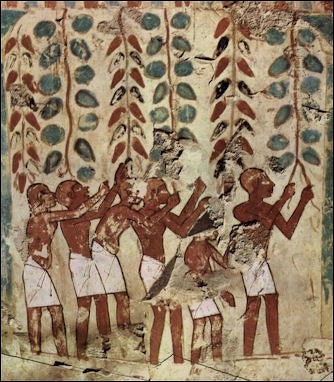
Jarrett A. Lobell wrote in Archaeology magazine: As early as the Predynastic period, beginning in the mid-fifth millennium B.C., the Egyptians placed wine jars in tombs as offerings to the dead. References to wine dating to the 1st and 2nd Dynasties have been identified on ceramic jar seals found in the burial grounds at Abydos and Saqqara, and the word for wine, “irp,” appears on 2nd Dynasty stelas. By the 4th Dynasty, in the mid-third millennium B.C., tomb designers had begun to illustrate viticulture and winemaking on tomb walls. For archaeologist Sofia Fonseca of the Autonomous University of Barcelona, such imagery offers valuable insights into the vintner’s entire process.[Source: Jarrett A. Lobell, Archaeology magazine, November-December 2020]
Dr. Michael Poe wrote: “First dynastic tombs of Abydos record the existence of vineyards including the earliest record of wine cellars and by the time of King Zoser, whose step pyramid was the first pyramid built there existed a partial list of vineyards including the famous vineyard “Horus on the Height of Heaven” which produced wine down into the Greek period.” [Source: Michael Poe, Phd, Touregypt.Net, 2004 ^=^]
According to the University of Pennsylvania: “The wild grape never grew in ancient Egypt. Yet a thriving royal winemaking industry had been established in the Nile Delta—most likely due to Early Bronze Age trade between Egypt and Palestine, encompassing modern Israel,the West Bank and Gaza, and Jordan—by at least Dynasty 3 (ca. 2700 B.C.), the beginning of the Old Kingdom period. Winemaking scenes appear on tomb walls, and the accompanying offering lists include wine that was definitely produced at vineyards in the Delta. By the end of the Old Kingdom, five wines—all probably made in the Delta—constitute a canonical set of provisions or fixed “menu,” for the afterlife. [Source: University of Pennsylvania, ancientfoods.com, July 26, 2010]
“The evidence for winemaking in the Delta during the preceding Early Dynastic Period (Dynasties 1 and 2) is more inferential. Rather than recording a large number of wine jars in an offering list, actual jars in large quantities were buried in the tombs of the pharoahs at Abydos and those of their families at Saqqara, the main religious centers. The jars are stoppered with a round pottery lid and a conical clay lump that was pressed over the lid and tightly around the rim. The clay stopper was generally impressed with multiple cylinder seal impressions giving the name of the pharoah.
“While chemical tests have yet to verify that the Dynasty 1 and 2 jars contained wine, less common seal impressions on the jar stoppers do include hieroglyphic signs for “grapevine/vineyard” and possible geographic locations (e.g., Memphis, the northern capital, near Saqqara), in addition to the king’s name. Such seals have been interpreted as a primitive kind of wine label, possibly giving the location of the winery and its owner. The impressions with only the king’s name might then be an abbreviated form of registration for jars that generally contained wine. Viniculture in Egypt must have taken some time to develop, and the Early Dynastic “wine jars” may well represent the first “fruits” of the nascent industry.
“Is it possible to know when the first grapevines were transplanted to the Nile Delta? The answer is vital for understanding the prehistory of an industry that eventually spread over the entire Delta, to the large western oases, and even to towns on the upper Nile where the climate would seem to preclude viniculture. The domesticated grapevine could only have come from some region of the Levant that was already exploiting it, and many specialists—farmers, horticulturists, traders, and above all, vintners—would’ve been involved in the establishment and success of the developing industry. The grapevine hieroglyphic itself, showing a grapevine trained to run along a trellis or arbor, indicates that the Early Dynastic viniculture was quite sophisticated.”
Lots of 5,000-Year-Old Wine Found in Egyptian Queen's Tomb
Queen Meret-Neith was most likely the most powerful woman of the eraliest periods of ancient Egyptian history and may have been the first female pharaoh. Her tomb was discovered by archaeologists well over a century ago, but there are still mysteries surrounding both her life and her burial site. A team of German and Austrian archaeologists organized by the University of Vienna are currently excavating her sprawling, complicated tomb. [Source: Jelisa Castrodale, Food & Wine, October 24, 2023]
In October 2023, the team revealed that they had unearthed “a huge amount of grave goods” that were buried with Queen Meret-Neith, including hundreds of well-preserved wine jars. Not only were many of the jars still sealed, but some actually contained the organic remnants of the now 5,000-year-old wine. “Considering that these are the remains of people’s lives and actions from 5,000 years ago, we are stunned every day at the amazing detail we encounter during our investigations, including the perfectly preserved grape seeds, craftwork, and even footprints in the mud,” University of Vienna archaeologist Christiana Köhler, who is leading the expedition, told Artnet.
"The discovery [. . . ] has the potential to significantly build our understanding of some of the earliest wine production, use and trade in the ancient Mediterranean and North Africa," Emlyn Dodd, an Institute of Classical Studies researcher who did not take part in the excavation, additionally told Newsweek. "Analysis of the residues left inside the jars, for example, could illuminate the chemical composition of the wine that was once inside, revealing its flavor profile and any additive ingredients that were used. "
Wine Culture in Ancient Egypt
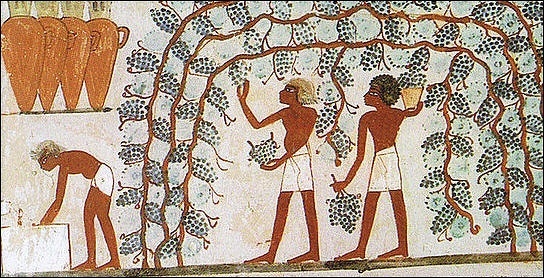
“We have this idea that viticulture and winemaking originated in the ancient Near East, and that European wine culture is a legacy from Greece and Rome,”archaeologist Sofia Fonseca of the Autonomous University of Barcelona, told Archaeology magazine. “But the truth is that, starting more than 4,500 years ago, and for the next two millennia of Egyptian history, we have images that show a traditional process similar to those winemakers in Mediterranean regions are still using. By studying these images, we can have a real change in the paradigm of wine history and bring awareness to the influence that Egyptian wine culture had on Mediterranean wine culture. ” [Source: Jarrett A. Lobell, Archaeology magazine, November-December 2020]
“While the Egyptians drank both red and white wine, only red wine is depicted in the tombs. “It’s interesting to see how the symbolism of wine is deeply related to the color red,” archaeologist Sofia Fonseca of the Autonomous University of Barcelona told Archaeology magazine. “This recalls the relationship between wine and the blood of Osiris, the god of death and resurrection, who is called the Lord of Wine in the late Old Kingdom Pyramid Texts. It also recalls the relationship between wine and the reddish color of the Nile during the annual flood, when iron-rich sediment flows into the river from the mountains of Ethiopia at just the time when the grape harvest begins. ”
Vineyards in Ancient Egypt
Jennifer Taylor of Minnesota State University, Mankato wrote: “The vineyards of ancient Egypt, were quite different from the modern methods of wine making today. As viticulture (or wine making), ceased to serve an exclusively ceremonial purpose, the Egyptians began to experiment with simple structures for their vines to train on, as well as found a way to train their vines so they were easy low maintenance bushes, and found ways for the soil to retain more moisture for the vines. [Sources: Minnesota State University, Mankato, ethanholman.com]
Dr. Michael Poe wrote: “There were several types of early Egyptian vineyards. The first grapevines incorporated into a formal garden for creating beauty as well as for utility. The second was a work of agriculture and existed in an orchard garden along with fruit trees and vegetables. The third was a formal vineyard as we know them today. The 3rd dynastic administrator of northern Egypt, Methen, had a garden-vine at his estate and a regular vineyard by itself in another area. In addition to nobles owning vineyards, temples had their own on their temples estates, and the pharaohs had theirs as well; Rameses III lists 513 vineyards belonging to the temple of Amon-Ra.” [Source: Michael Poe, Phd, Touregypt.Net, 2004 ^=^]
“In orchards grape vines were object of special attention and was one of the gardeners most important jobs. The hieroglyphic sign for vines is used in the writing of the words “orchard” and “gardener.” There were also specific jobs with titles like “Master of the Vineyard,” and “Master of the Vine-Dresser.” ^=^
“The best vineyards were in the Delta, followed by the Fayyum, Memphis, and then southern Egypt and the oasises. The major sources of information on the production of wine are the wall paintings and reliefs from tombs of the Old Kingdom (Saqqara) and the New Kingdom (at Thebes). The comments and recommendations of classical authors give us insight into the qualities and types of the various wines, vineyards and types. ^=^
“Many scenes from tombs gives us a fairly accurate picture of the Egyptian vineyards and the techniques of wine production. The best site to locate a vineyard was on a hill, but if there wasn’t one than the Egyptians made an artificially raised plot of land and planted the vines there. A wall generally enclosed the area and vegetables and fruit were planted with the grapes. They were watered by hand generally from a water basin. ^=^
“There were four ways to grow grape vines. One was to erect two wood pillars with the upper ends forked, and a wooden pole laid over the top where the vines were laid. This type of support also forms a hieroglyph which is used in the words meaning ‘garden,’ ‘wine,’ and ‘vine’. A second way is to train the grape vines to grow on trellis’s supported on transverse rafters that rested on columns. Occasionally the columns were carved and painted. A third way was to make vine arbors consisting of branches with the ends placed in the ground to form an arch. And lastly, some vines were grown and pruned to make low bushes and needed no support.” ^=^
Wine-Making in Ancient Egypt
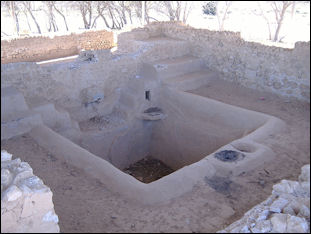
wine press Dr. Michael Poe wrote: “When the grapes ripened they were picked by hand and put into large rush baskets. These were carried on the shoulders, on the head, or slung on a yoke. The baskets of grapes were emptied into vats for crushing. These large vats were large enough to contain up to six men who crushed the grapes with their feet. The grape juice flowed through a hole in the side of the vat into a smaller vat, and then poured into pottery jars where it was fermented. [Source: Michael Poe, Phd, Touregypt.Net, 2004 ^=^]
“Secondary pressing was used to separate the rest of the juice form the stems, seeds and skin. The residue was put into a sack and was stretched, either on a frame with a pole at one end or between two poles. The pole was twisted to extract the juice that was then collected into a large vessel. ^=^
“Fermentation took place in open vessels then the wine was racked and transferred to other jars, being sealed with rush bung-stoppers and covered with mud capsules. Small holes were left near the tops of the caps to allow carbon dioxide that was produced in the secondary fermentation to escape. When fermentation finally stopped the holes were sealed. ^=^
“Although there is no evidence of the widespread use of this technique, wine was sometimes clarified by being racked from jar to jar. Sometimes it was strained (a form of decanting) before drunk, and occasionally the Egyptians would use a siphon (see illustration) to keep the wine dregs from mixing with the wine to be poured.” ^=^ Jennifer Taylor of Minnesota State University, Mankato wrote: “Egyptian wine making experiments included the use of different wine presses, adding heat to the must (the grape juice ready for fermentation) in order to make the wine sweet, and differences in vat types and materials. The final finished product of wine, was poured through a cloth filter, and then into earthenware jars, where they would be sealed with natural tar and left to ferment. The Egyptians kept accurate records of their vintages, and quality of their wines, each jar of wine was clearly labeled with it's own vintage, and quality. [Sources: Minnesota State University, Mankato, ethanholman.com]
Types of Wine in Ancient Egypt
Dr. Michael Poe wrote: “There are five basic groups of Egyptian wines; those from grapes, dates, palm, pomegranates, and other fruits. Palm wine was produced by tapping the trunk near its branches and collecting the juice and then fermenting the liquid. Date wine is produced by mashing dates and fermenting the resulting juice. Pomegranate wine was also produced. I have tasted a bottle of pomegranate wine (of recent vintage), and find that it has a fruity, sweet taste no unlike many ‘blush’ wines made today. Meads from honey were also made.” [Source: Dr. Michael Poe Phd, Touregypt.Net, 2004]
In the Old Kingdom they distinguished six sorts of wine, such as white, red, black, and northern wine. The latter corresponded to the various Delta wines, the Mareotic (from the Lake Mariout area), the Sebennytic (from Sebennytos Samannud), and the Teniotic (from Tenia) wines, which enjoyed such a high reputation in GraecoRoman times. [Source: Adolph Erman, “Life in Ancient Egypt”, 1894]
Jennifer Taylor of Minnesota State University, Mankato wrote: “The search for the recipes and wine types of the Egyptians, have yielded mixed results within the delta region of the Nile. Due to the climatic changes since the time of ancient Egypt, quests for the right vine, the right mixture of materials, and other factors, have left the modern renditions of ancient Egyptian wine, something to be desired. Nestor Gianaclis, set out in 1903 to find the mixtures of Egyptian wine, as well as growing conditions, which tasted the same as their primordial counterparts of ancient Egypt. Nestor searched out areas through out Egypt, looking for the right type of soil, moisture, and grape which could grow a wine worthy vine. With the aid of Egyptian ministries, seventy three conventional grape types were tried in addition to Nestor's twenty he himself had bred. Once the ideal soil type was found (similar to the soil of Champagne, France), it was not until 1931 the first modern rendition of ancient Egyptian wine, was produced. This rendition of the ancient wine, continues to be made in the present day, however many wine connoisseur consider it of poor taste. Regardless, the taste of the ancients is still present 3,500 years later. [Sources: Minnesota State University, Mankato, ethanholman.com]
Dr. Michael Poe wrote: “Egyptian wines were graded as good (nfr), twice good (nfr,nfr), three times good (nfr,nfr,nfr)as being the finest. There was also another type of grading; genuine, sweet, merrymaking (not so good), and blended. [Source: Michael Poe, Phd, Touregypt.Net, 2004 ^=^]
“Variations of wine from grapes or other products were “enhanced” occasionally by blending other wines with it, or the additions of herbs and other flavorings. There is also the possibility of adding honey to wine, and some wine labels indicated “sweet” wine which could indicate either a specific type of grape that makes sweet wine, such as a Muscat, or the addition of flavorings. And that brings us to one other matter.” ^=^
Analyzing Wine Types in Ancient Egypt Based on Color
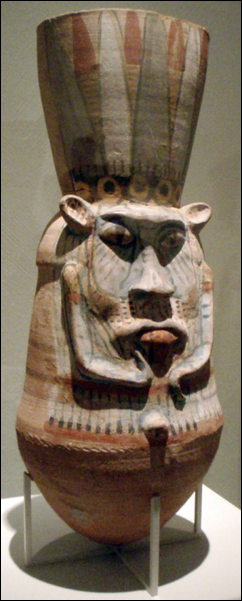
Wine vessel with mask of god Bes Maria Rosa Guasch Jané PhD wrote: “In order to study the kind (colour) of the wines that were made in ancient Egypt, we developed an analytical method for archaeological residues of wine was developed using the liquid chromatography mass spectrometry in tandem (LC/MS/MS) technique. [Source: Maria Rosa Guasch Jané, PhD form the University of Barcelona,"Wine of Ancient Egypt" (Irep en Kemet), wineofancientegypt.com/]
“Two compounds were identified in archaeological residue samples from Tutankhamun’s amphorae: tartaric acid, as grape marker, and syringic acid derived from malvidin, the latter being the main compound responsible for the red colour of grapes and wines, as red grape marker (Guasch-Jané, 2004; 2006a,b). The results of analysing residue samples from Tutankhamun’s amphorae revealed that in ancient Egypt red and white wines were given the name irp (Guasch-Jané, 2006b; 2008). The analytical results added new information to the inscription on the amphorae: about the type of wine they contained. Furthermore, the results of the analyses also confirmed that in Egypt, during the New Kingdom Period, three kinds of grape products were made (Guasch-Jané, 2008): red wine, white wine and the shedeh, a red wine with a different preparation./
“The origin and nature of the shedeh, which has no translation, was a mystery since a century ago, with pomegranates or grapes having been proposed as a raw material. According to Papyrus Salt 825 at the British Museum (BM 10051) of the Late Period (715-332 B.C.), the only text found so far that mentions the elaboration of the shedeh, it was filtered and heated; nevertheless, due to a damage in the Salt papyrus, the botanical source of shedeh remained unknown.The results of analysing a sample of a residue from the shedeh amphora found in Tutankhamun’s Burial chamber, bearing the inscription “Year 5, shedeh of very good quality of the Estate of Aten of the Western River, chief vintner Rer” confirmed that shedeh was a red grape wine. Recent research suggested the use of the three wine amphorae found in Tutankhamun’s Burial chamber (the western amphora containing a red wine, the eastern amphora a white wine and the southern amphora containing shedeh) were for the King’s three-step resurrection ritual.” /
Famous Wines in Ancient Egypt
Dr. Michael Poe wrote: “It appeared that ancient Egypt had the equivalent of the French ‘Appellation Controlee’ laws. There was a “Royal Sealer of Wine” who overlooked the honest labeling laws, and much of what you find on wine labels today were on the wine labels of ancient Egypt. These included: 1) Name of the Estate, 2) Location, 3) Type of wine, 4) Date of vintage, 5) Vintners Name, 6) Assessment of Quality.[Source: Dr. Michael Poe Phd, Touregypt.Net, 2004 ^=^]
“An example of such a wine label is Star of Horus on the Height of Heaven (this vineyard estate started around 2600 B.C. or the time of Zoser and lasted to 300 ce); Northern Xois District, Chassut Red (Chassut Red was reputed to be not ready to drink until it had aged 100 years!), Sekem-Ka, vintner; very, very fine grade. ^=^
“Keeping a wine for years to mature was not all that uncommon. In the annex of Tutankhamon’s tomb 36 wine jars were found and each bore a docket in heiratic giving the date, place, and vintage of the wine and showing the Aten Domain Vineyard wines to be maintained for at least 21 years. ^=^
“Something we don’t do today is to label the wine with the name of the vintner. It was important in ancient Egypt since if the vintner was famous for producing fine wines and moved to another vineyard, it would be a way that the Egyptian wine buyer could continue buying fine wine. Today we keep track to the movement of vintners through wine magazines and newsletters. We know that many nobles tombs have paintings of specially constructed storehouses in which the wine amphorae were stacked in rows on shelves, giving us a glimpse of the first true wine cellars. ^=^
“Other famous vineyards include Phoenix Estate on the Horizon of Kemet in the Sile district; the Vineyard Ways of Horus (Lake Menzalah district); Preserver of Kemet (royal estate in the Piramese/Tanis district); Estates on the Western River (on the Canopic branch of the Nile and highly thought of, this wine was found in cellars on the palace of Amenophis II at Tebes and Armana. It seems that it is possible that the ancient Egyptians also cut up Egypt into wine growing districts, much like France does today.
“The ancient Romans, who had quite a lot of vineyards of their own, also imported wines from Egypt. They considered the vineyards along the Canopic branch of the Nile to have some the best wines. Two writers during the Roman empire record the wine at Mareotis is white, fragrant, thin, but of good quality. They also record that the wine of Sebennytus in the central delta, ranked high in excellence. The Romans also were very impressed with wines grown around the lake Menzalah district, the Tanis district, northern Xois area and in the region of Sile.” ^=^
Wine in Ancient Egyptian Temple Rituals
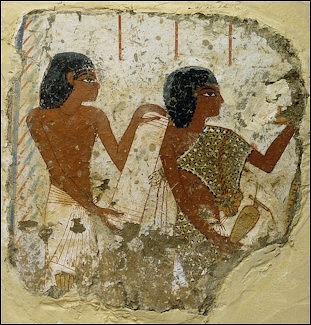
two priests, one holding a vase for libations
Mu-Chou Poo of the Chinese University of Hong Kong wrote: “Wine was often an important item in funerary and temple cults. From as early as the Old Kingdom, wine was regularly mentioned in offering lists as part of the funerary establishment . In temple rituals, wine was also often offered to various deities. In the pyramid temple of Fifth Dynasty king [Source: Mu-Chou Poo, Chinese University of Hong Kong, UCLA Encyclopedia of Egyptology 2010, escholarship.org ]
Sahura, for example, the king was shown offering wine to the goddess Sakhmet. Besides its general significance as an item that pleased the deities, the offering of wine took on certain specific religious and mythological associations. Already in the Pyramid Texts, Osiris was mentioned as the “Lord of Wine in the Wag Festival”. The Wag Festival was celebrated at the beginning of the inundation, on the 17th, 18th, or 19th of Thoth, the first month of inundation . The festival itself was a funerary feast that was probably aimed at the celebration of the resurrection of life that the inundation brought.
Since Osiris epitomized resurrection, there may be a certain connection between Osiris as the god of vegetation and rejuvenation and the symbolic coming to life of the grapevine. The fact that wine production depended upon the coming of the inundation might therefore have fostered the meaning of wine as a symbol of life and rejuvenation. A text in the Ptolemaic temple of Edfu contains the following sentence: “The vineyard flourishes in Edfu, the inundation rejoices at what is in it. It bears fruit with more grapes than [the sand of] the riverbanks. They [the grapes] are made into wine for your storage . . . .”. Thus the relationship between the inundation and the production of wine is clearly stated.
See Separate Article: WORSHIP AND RITUALS IN ANCIENT EGYPT africame.factsanddetails.com
Ancient Egyptian Medicinal Wines
The ancient Egyptians drank alcoholic beverages with medicinal herbs and other ingredients, according to a paper published in the Proceedings of the National Academy of Sciences in 2009.
The beverages, the oldest of which was an wine dated to 3150 B.C., were chemically analyzed to determine their ingredients, revealing the first direct chemical evidence of wines with organic medical additives. “The ancient Egyptians settled on adding herbs and other ingredients that had marked medicinal effects, probably just based on observational trial and error,” Patrick McGovern, an archaeochemist at the University of Pennsylvania Museum and lead author of the paper, told Discovery News. “Of course superstitions crept in too, such as when they would throw in a root because it resembled a certain body part, but we think there was some medical truth behind a lot of their wine additives.” [Source: Jennifer Viegas, Discovery News, April 14,2009]
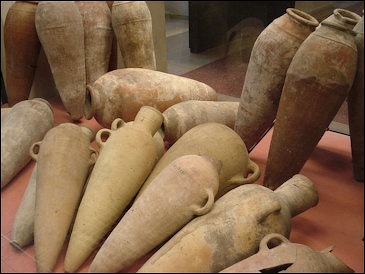
Ancient Egyptian wine amphoras
Jennifer Viegas wrote in Discovery News, “He and colleagues Armen Mirzoian and Gretchen Hall chemically analyzed residues found inside a jar excavated from the tomb of one of Egypt’s first pharaohs, Scorpion I. They also conducted chemical tests on a later amphora, dating to the 4the to 6th centuries A.D., from Gebel Adda in southern Egypt. Both containers tested positive for wine with medicinal additives. The scientists determined Scorpion I’s drink consisted of grape wine to which a sliced fig had been added, probably to start and sustain the fermentation process, while also adding flavor and sweetness. Terebinth, a tree resin known now for having antioxidant properties, was also found within a yellowish flaky residue scraped from the jar, which was decorated with swirling red paint “tiger stripes.”
“While McGovern and his team aren’t yet certain what herbs were in the drink, since many plants share similar chemical components, they suspect mint, coriander, savory, senna and sage were likely candidates. The researchers are confident, however, that the second, more recent Egyptian wine contained pine resin and rosemary. A previous study determined that an early beer-like fermented emmer wheat barley beverage from Spain contained rosemary, along with mint and thyme. All of these ingredients and more were outlined in Egyptian medical papyri dating to 1850 B.C.
“McGovern said the resin and herbal ingredients probably served three primary functions. “They helped to preserve the wines, while also adding flavor and medical benefits,” he said, explaining that the last two frequently went together, since flavor was, and still is, often linked to health effects. “Bitter flavors in nature can signal danger, but they can also sometimes have powerful medicinal properties,” he added.
Scorpion King Medicinal Wine
Researchers unearthed a collection of dozens of imported ceramic jars with a yellow residue consistent with wine in the tomb of Egyptian king Scorpion I, dated about 3150 BC, 1,000 years later than the Areni find. Grape seeds, grape skins and dried pulp also were found in the Egyptian tomb.
A tomb dated to 3150 B.C. of an Egyptian king, who may have been known as Scorpion I, contained three rooms full of 700 jars of wine, stacked up there or four levels. The jars contained grape pips. It was was reasoned they contained wine not grape juice or vinegar because grape juice (without modern preservatives) turns to wine very quickly in room temperature and the jars were sealed, which prevents it from becoming vinegar. Infrared spectrometry identified residues of alcohols, tannins, flavonals, aldehydes, acids, carbohydrates, esters, proteins and vitamins found in wine.
Brian Handwerk wrote in National Geographic News, “Deep inside the tomb of Scorpion I (no relation to the Rock), scientists discovered Egypt's oldest wines. And now it appears the 5,000-year-old wines were spiked with natural medicines — centuries before the practice was thought to exist in Egypt, researchers say. [Source: Brian Handwerk, National Geographic News, April 13, 2009, based on findings published in the journal PNAS. ]
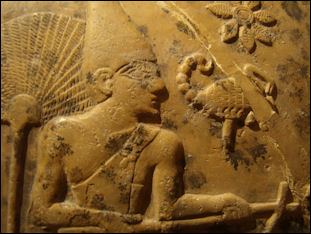
Scorpion king Archaeochemist Patrick McGovern and colleagues found chemical residues of herbs, tree resins, and other natural substances inside wine jars from the tomb, the previously discovered resting place of one of Egypt's first pharaohs (ancient Egypt time line).While the additives may have been flavorful, they were picked for their medical benefits, said McGovern, of the University of Pennsylvania Museum of Archaeology and Anthropology.
The early Egyptians "were living in a world without modern synthetic medicines, and they were very aware of the benefits that natural additives can have — especially if dissolved into an alcoholic medium, like wine or beer," which breaks down plant alkaloids.
Papyrus records from as long ago as 1850 B.C. detail how such medicinal tipples were made to treat a range of ailments. "Now this chemical evidence pushes that date back another 1,500 years," McGovern said. Scorpion I's wines predate the advent of Egyptian vineyards and were imports from the Jordan River valley. The wines suggest that imports from the southeastern Mediterranean contributed to the Egyptian pharmacopoeia, which laid the groundwork for Greek and Roman medical traditions.
The wine find is just one of several from ancient Egypt, China, and elsewhere that document ancient medicinal mixology. "Over thousands of years, humans were searching their environment and trying to find natural medicinal materials," McGovern said. "They were tested empirically over generations, but then many were lost."
Now, collaborating with researchers at Penn Medicine's Abramson Cancer Center, McGovern's team is using biomolecular analysis to uncover the ancient wine-medicine recipes and hopefully put them to the test. "We're trying to rediscover why ancient people thought these particular herbs were medically useful," he said, "and seeing if they are effective for the treatment of cancer or other modern diseases."
Image Sources: Wikimedia Commons
Text Sources: UCLA Encyclopedia of Egyptology, escholarship.org ; Internet Ancient History Sourcebook: Egypt sourcebooks.fordham.edu ; Tour Egypt, Minnesota State University, Mankato, ethanholman.com; Mark Millmore, discoveringegypt.com discoveringegypt.com; Metropolitan Museum of Art, National Geographic, Smithsonian magazine, New York Times, Washington Post, Los Angeles Times, Discover magazine, Times of London, Natural History magazine, Archaeology magazine, The New Yorker, BBC, Encyclopædia Britannica, Time, Newsweek, Wikipedia, Reuters, Associated Press, The Guardian, AFP, Lonely Planet Guides, “World Religions” edited by Geoffrey Parrinder (Facts on File Publications, New York); “History of Warfare” by John Keegan (Vintage Books); “History of Art” by H.W. Janson Prentice Hall, Englewood Cliffs, N.J.), Compton’s Encyclopedia and various books and other publications.
Last updated August 2024