
Home | Category: Life, Families, Women
MESOPOTAMIAN BEAUTY AND HAIRSTYLES

Assyrian man
There was evidence of manicuring among nobleman found in tombs in Ur. Based on images in sculptures and statuettes, Sumerian men had both shaved heads and long hair and beards. They also shaved their faces. On Sumerian sculpture hair looks the foam pads on which a carpets are laid. Sumerian women often had shorter hairstyles than the men or wore their hair in long elaborately- entwined braids.
Babylonians were making soap from animal fats around 2800 B.C., and similar techniques can be noted among ancient Egyptians and Phoenicians (the Phoenicians used goat’s tallow and wood ashes in theirs) before the turn of the millenium. [Source: Candida Moss, Daily Beast, December 23, 2017]
The use of cosmetics must have become widely spread, and many of the small stone vases in which they were kept and which have been found on the sites of Babylonian cities were doubtless intended for the hairdresser. The oil that was poured upon the hair made it bright and shining and it was worn long whether it grew on the head or on the face. The Babylonians had long been known as “the people of the black heads,” perhaps in contrast to the fairer inhabitants of the Kurdish mountains to the north, and the black hair, frizzled and curled, was now allowed to be visible. The working classes bound it with a simple fillet; the wealthier members of society protected it with caps and tiaras. But all alike were proud of it; the days were past when a beardless race had held rule in Western Asia. [Source: “Babylonians And Assyrians: Life And Customs”, Rev. A. H. Sayce, Professor of Assyriology at Oxford, 1900]
The Assyrians are regarded as the first true hair stylists. Their prowess at cutting, curling, dying and layering hair was admired by other civilizations on the Middle East. Hair and beards were oiled, tinted and perfumed. The long hair of women and the long beards of men were cut in symmetrical geometrical shapes and curling by slaves with curl bars (fire-hearted iron bars).
The Sumerians and Assyrians as well as Egyptians, Cretans, Persians and Greeks all wore wigs. In Assyria, hairstyles often defined status, occupation and income level. During important proceeding high-raking Assyrian women sometimes donned fake beards to show they commanded the same authority as men. Queen Hatshepsut, one of the few female pharaohs of Egypt, did the same thing.
RECOMMENDED BOOKS:
“Everyday Life in Ancient Mesopotamia” by Jean Bottéro (2001) Amazon.com;
“Handbook to Life in Ancient Mesopotamia” by Stephen Bertman (2002) Amazon.com;
“Ancient Mesopotamia: Life in the Cradle of Civilization” by Amanda H Podany (2018) Amazon.com;
“Daily Life in Ancient Mesopotamia” by Karen Rhea Nemet-Nejat (1998) Amazon.com;
“Society and the Individual in Ancient Mesopotamia” by Laura Culbertson, Gonzalo Rubio (2024) Amazon.com;
“Everyday Life in Babylon and Assyria” by Georges Contenau (1954) Amazon.com;
“The Babylonian World” by Gwendolyn Leick (2007) Amazon.com;
“Neo-Babylonian Letters and Contracts from the Eanna Archive” (Yale Oriental Series: Cuneiform Texts) by Eckart Frahm and Michael Jursa (2011) Amazon.com;
Facial Hair and Shave Heads in Ancient Mesopotamia
Great attention was paid to the hair of the head and beard. But this was more especially the case among the Semites, who liked to wear beards. The older Sumerian population had but little hair upon the face, and to the last the typical Babylonian was distinguished from the Assyrian by the greater absence of beard. The result was that while the Semite encouraged his hair to grow, the Sumerian shaved it except in the case of old men. Most of the Sumerian heads which have been discovered in the excavations of Tello have smooth faces and shorn heads.
The figures represented on the so-called Stela of the Vultures, one of the earliest examples of Chaldean art, are without beards, and on the early seal-cylinders the gods alone, as a rule, are permitted to wear them. We are reminded of the Egyptian custom which forbade the beard except to the King and the god. The barber, in fact, occupied an important position in ancient Babylonia, and the old Sumerian code of laws enjoins that a son who denies his father shall be shorn and sold as a slave.
With the rise of Semitic supremacy, however, there is a great change. Naram-Sin, in the bas-relief of Diarbekr, wears beard and whiskers and mustache like the Assyrians of a later day, and like them also his hair is artificially curled, though to a lesser extent. The same long beard also distinguishes Khammurabi in a piece of sculpture in which he is entitled “the king of the land of the Amorites.” The gods, too, now assume a mustache as well as a beard and take upon them a Semitic character.
Sumerian Eye Makeup, Conjunctivitis and the 'Evil Eye'
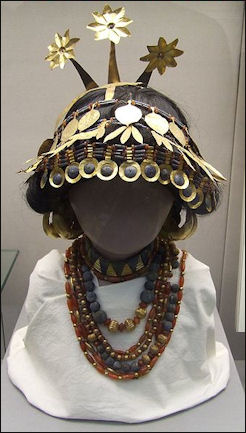
Reconstructed Sumerian
headgear necklaces John Alan Halloran wrote in sumerian.org: “The Sumerian language has preserved a record of their battles against conjunctivitis, also known as 'pink eye', an eye condition which the Sumerians called igi-hulu, 'evil eye'. Conjunctivitis is an inflammation of the mucous membrane that covers the eyeball, which can be brought on by bacteria, viruses, or inadvertent soap in the eye. You can read about this potentially dangerous condition here: [Source: John Alan Halloran, sumerian.org January 27, 2014 ***]
“There is a Sumerian expression that indicates that this condition had already become a subject of fear and superstition in Sumerian times — igi-hul...dim2: to put the evil eye (on someone) ('eyes/face' + 'evil' + 'to fashion'). In most traditional cultures there is an extreme fear of the 'Evil Eye'. They recite incantations, give signs, and will do everything possible to avoid its fateful curse. ***
“The Sumerians were like many other peoples in having traditions about the medicinal use of different plants and herbs, some of which have antiseptic properties. These traditions are preserved in the vocabulary of their language. When Logogram Publishing publishes the English-Sumerian index to my Sumerian Lexicon (2006) book, it will be easier for researchers to look up what are these plants and herbs. But the Sumerian natural remedies were largely the same as are used today among the inhabitants of Iraq and Arabia. ***
“The Sumerian vocabulary confirms that the practice of eye makeup originated for eye protection, not for cosmetic reasons. It also shows that the practice of applying protective eye makeup was not limited to the ancient Egyptians. Here are two entries from my Sumerian Lexicon (2006) book: 1) šembi, šimbi: kohl, i.e., a cosmetic, mascara, or eye-protection paste originally made from charred frankincense resin and later from powdered antimony (stibium) or lead compounds (cf., šem-bi-zi-da, 'kohl'; šim, 'perfumed resin'; šim-gig, 'frankincense'; im-sig7-sig7, 'antimony paste'). 2) šem-bi-zi-da: kohl; a paste originally made from charred frankincense resin and later from powdered antimony (stibium) or lead compounds; a darkening eye cosmetic with antibacterial properties - used as a protection against eye disease as well as giving relief from the glare of the sun ('kohl' + 'good; true' + nominative; Akk., guhlu, 'kohl' - cf., igi-hulu, 'evil-eye'). ***
“The etymology shows that Akkadian guhlu is a loanword from Sumerian, where it evolved through vowel harmony from the Sumerian term for 'evil-eye' into our word 'kohl'. Furthermore, according to Stephan Guth, Professor of Arabic at the University of Oslo, our word 'alcohol' "is derived from the Arabic al-kuhl, which means 'kohl'. When the Europeans became familiar with this substance in Andalusia, which was also used for medical purposes, they referred to it and gradually all other fine powders, and subsequently all kinds of volatile essences, as alcohol." So the etymology of 'alcohol' can now be traced through a circuitous path all the way back to ancient Sumerian igi-hulu, 'evil-eye'. ***
“Frankincense resin has such strong antibiotic properties that the ancient Egyptians used its oil to clean the body and organs during mummification, helping to prevent putrefaction. A Google search for "charred frankincense" returns almost a thousand results. Frankincense, however, was rare and expensive, having to be imported from Arabia, which explains why the Sumerians learned to substitute powdered antimony or lead compounds for it in their eye makeup.” ***
Mesopotamian Hygiene and Perfume
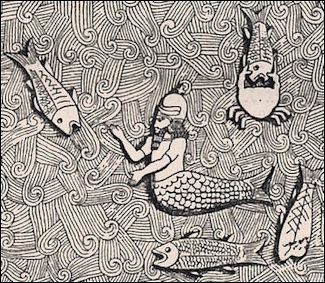
Dagon and the fishes
In the dry climate of Mesopotamia and Egypt, cleanliness, washing and bathing was not given a high priority. Sumerians washed themselves in alkali solutions while the Hittites cleaned themselves with ash of the soapwart plant suspended in water. Soaplike material has been found Babylonian clay jars dated at 2800 B.C. The first true soap, made of boiled goat fat water and ash with a lot of potassium carbonate, was developed by the Phoenicians around 600 B.C.
The ancient Mesopotamians used almond oil as a body moisturizer, perfume and hair conditioner. Sumerians are believed to have created the first deodorant about 3500 B.C.
The word "perfume," a Latin word meaning "through smoke" comes to use from the Mesopotamians and Egyptians, who used to burn the resin from desert shrubs such as myrrh, cassia, spikenard and frankincense for their aromatic fragrance or simply toss them in a fire.
The earliest perfumes were not used for cosmetic purposed but rather as offering to god. In some cases they were used as a kind of deodorizer for sacrificed animals. By 3000 B.C., Egyptians and Mesopotamians were using perfumes as body scents and bathing oils rather than incense. They were also used in exorcisms, healing treatments, and after sex.
Hittite Anointing Oil
Harry A. Hoffner, Jr wrote in “Oil in Hittite Texts”: “The toilet of the upper classes must be reflected in the treatment of the cult statues of the deities. One text tells how eight representations of the Sun goddess of Arinna-three statues and five solar disks-were bathed and then anointed with oil. In a letter of the Hittite king to his mother, he complains that he has no Ì.DÙG.GA for anointing himself. In the text of a legal deposition, a man named mdISTAR-LÚ gives testimony in which he mentions that a woman gave him oil and instructed him to anoint himself with it when he worshipped the deity.(15) In a letter from the Pharaoh to the King of Arzawa, written in Hittite, the Egyptian monarch speaks of having his servant anoint with oil the head of the woman chosen to become a wife of the king (VBoT 1 obv. 14). The Hittite king was also anointed with oil as part of the ritual of accession to the throne and the priesthood of the Sun goddess of Arinna. This custom is also reflected in the rite of the substitute king, who consequently is anointed with the "oil of kingship". Singer (1987) also quotes an Akkadian letter written by Hattusili III to the Assyrian king in which Hattusili complains that the Assyrian monarch failed to send him the traditional coronation gifts, which included ceremonial garments and fine oil for anointing (Goetze 1940:27ff.). [Source: Harry A. Hoffner, Jr., “Oil in Hittite Texts,” Internet Archive, from Emory/Biblical Archaeology /=/]
“An entry in a tablet catalogue describes a ritual performed by a woman physician named Azzari. On the occasion when a commander was going to lead troops into battle, the physician consecrated í.DôG.GA by pronouncing a spell over it and then used it to anoint the commander, his horses, his chariot(s), and all his weapons. In an oracle inquiry, it was determined that the deity was angry because the temple personnel had neglected or omitted to give to the deity í.GIS and í.DôG.GA.
“In the first tablet of the Kikkuli horse-training manual, trainers are described as anointing/rubbing horses with í.NUN (butter, ghee) on the fifth day, after four days of daily washing. The use of "butter" or "ghee" for this purpose seems strange. In the "Song of Ullikummi," a myth of the Kumarbi cycle, oil (Ì.DÙG.GA) is used to anoint the horns of the bulls which draw the cart of the god Teshub. Apparently the horns of male animals were also anointed with oil prior to sacrificing the animals. This practice is clearly documented in the case of goats and rams. “Similarly, in a ritual text, oil is brought to the deity so that he may lubricate his chariot with it. In a purification ritual, animal-shaped vessels16 are overturned in the river and washed, then oil is dripped into the river, and finally the washed vessels are anointed (isk-) with oil. Applying oil to the vessels after they have been washed is analogous to the practice of humans anointing themselves after bathing. In another text, oil is smeared on a door.
See Separate Article: HITTITE LIFE, FOOD, OIL, WATER AND POTTERY africame.factsanddetails.com
4,000-Year-Old Cosmetic From Iran — World’s Oldest Lipstick?
In February 2024, researchers reported in the journal Scientific Reports that a small stone vial found in southeastern Iran contained a red cosmetic that was likely used as a lip coloring nearly 4,000 years ago. The discovery is “probably the earliest” example of lipstick to be scientifically documented and analyzed, the scientists said. More than 80 percent of the analyzed sample was made up of minerals that produce a deep red color — primarily hematite. The mixture also contained manganite and braunite, which have dark hues, as well as traces of other minerals and waxy substances made from vegetables and other organic substances. “Both the intensity of the red coloring minerals and the waxy substances are, surprisingly enough, fully compatible with recipes for contemporary lipsticks,” the study authors noted. [Source: Katie Hunt, CNN, March 19, 2024]
Katie Hunt of CNN wrote: It’s not possible to exclude the possibility the cosmetic was used in other ways, say, as a blusher, according to lead study author Massimo Vidale, an archaeologist at the University of Padua’s Department of Cultural Heritage in Italy. But he said the homogenous, deep red color, the compounds used and the shape of the vial “suggested to us it was used on lips.” It’s one of the first examples of an ancient, red-colored cosmetic to be studied, he said, although it wasn’t clear why cosmetic preparations resembling lipstick were uncommon in the archaeological record.“We have no idea, for the moment. The deep red color we found is the first one we met, while several lighter-colored foundations and eye shadows had been identified before,” he said.
The use of hematite — crushed red ocher — had been documented on stone cosmetic palettes from the late Neolithic, as well as in ancient Egyptian cosmetic vessels, according to Joann Fletcher, a professor in the University of York’s department of archaeology. Whether the vial from Iran was the earliest lipstick, “all comes down to what this new discovery was actually used for,” she said. “It is possible the contents of the vial were used as a lip colour. But they could also have been applied to give colour to the cheeks, or for some other purpose, even if the vial looks like a modern lipstick tube,” said Fletcher, who was not involved in the research.
See Separate Article: LIFE IN THE NEOLITHIC AND BRONZE AGES: HOUSES, CLOTHES, ADORNMENTS africame.factsanddetails.com
World’s Oldest Toilet — From Mesopotamia
The world's oldest toilet was discovered in the ruins of Tell Asmar Eshuan'na (60 kilometers northeast of Baghdad, Diarra prefecture) which thrived as the city of Akkad dynasty around 2200 B.C. The toilet had a seat, was U-shaped and made with bricks.
According to Cambridge archeologist Augusta McMahon, the first simple toilets were Mesopotamian pits, about one meter in diameter, over which users would squat. The pits were lined with hollow ceramic cylinders that prevented excrement from escaping. Approximately 1000 years later the Minoans invented the flush. The first flushing toilet, excavated at the palace of Knossos in Crete, washed waste from the toilet to the sewer. By the Hellenistic period large-scale public latrines brought toilets to the effluent masses. [Source: Candida Moss, Daily Beast, November 20, 2016]
In October 2021, Israeli archaeologists announced that they had found a rare ancient toilet in Jerusalem that was 2,700 years old, when only the rich had private bathrooms. Associated Press reported: The Israeli Antiquities Authority said the smooth, carved limestone toilet was found in a rectangular cabin that was part of a sprawling mansion overlooking what is now the Old City. It was designed for comfortable sitting, with a deep septic tank dug underneath. “A private toilet cubicle was very rare in antiquity, and only a few were found to date,” said Yaakov Billig, the director of the excavation. “Only the rich could afford toilets.” [Source: Associated Press, October 5, 2021]
The toilet had a seat and a hole in the middle, "so whoever is sitting there would be very comfortable," Billig said. The toilet, which was situated above a septic tank, was found inside a rectangular cabin that would have served as the ancient bathroom. The bathroom also held 30 to 40 bowls, Billig told Haaretz. He speculated that the bowls may have been used to hold air freshener, in the form of a pleasant-smelling oil or incense. [Source: Yasemin Saplakoglu, Live Science, October 8, 2021]
Image Sources: Wikimedia Commons
Text Sources: Internet Ancient History Sourcebook: Mesopotamia sourcebooks.fordham.edu , National Geographic, Smithsonian magazine, especially Merle Severy, National Geographic, May 1991 and Marion Steinmann, Smithsonian, December 1988, New York Times, Washington Post, Los Angeles Times, Discover magazine, Times of London, Natural History magazine, Archaeology magazine, The New Yorker, BBC, Encyclopædia Britannica, Metropolitan Museum of Art, Time, Newsweek, Wikipedia, Reuters, Associated Press, The Guardian, AFP, Lonely Planet Guides, “World Religions” edited by Geoffrey Parrinder (Facts on File Publications, New York); “History of Warfare” by John Keegan (Vintage Books); “History of Art” by H.W. Janson Prentice Hall, Englewood Cliffs, N.J.), Compton’s Encyclopedia and various books and other publications.
Last updated July 2024