
Home | Category: Life, Families, Women
ANCIENT MESOPOTAMIAN HOMES

Terracotta model of a house from Babylon, 2600 BC
Houses in Mesopotamia tended to be small and crowded. They were often clustered around the central temple or on narrow lanes. Most Mesopotamians lived in mud-brick homes. The mud bricks were held together with plaited layers of reeds. They were made in molds, dried in the sun and fired in kilns. The houses of the poor were built of reeds plastered with clay. The Sumerians used bitumen mortar. The sticky black substance helped preserve structures such as the ziggurat of Ur. The tar was one of the first uses of southern Iraq's oil fields.
It was, of course, only the houses of the rich and noble which were artistically furnished or provided with a garden. The poorer classes lived in mud huts of conical form, which seldom contained more than one or two rooms. Air and light were admitted through the door or through small apertures in the walls. In the better class of houses, on the other hand, the windows were of large size, and were placed near the ceiling. [Source: “Babylonians And Assyrians: Life And Customs”, Rev. A. H. Sayce, Professor of Assyriology at Oxford, 1900]
Many houses consisted of more than one story, the upper stories being approached by a flight of steps which were open to the air. They were usually built against one of the sides of a central court, around which the rooms were ranged, the rooms on the upper floors communicating with one another by means of a covered corridor, or else by doors leading from one chamber to the other.
Claude Hermann and Walter Johns wrote in the Encyclopedia Britannica:“Houses were let usually for the year, but also for longer terms, rent being paid in advance, half-yearly. The contract generally specified that the house was in good repair, and the tenant was bound to keep it so. The woodwork, including doors and door frames, was removable, and the tenant might bring and take away his own. The Code enacted that if the landlord would re-enter before the term was up, he must remit a fair proportion of the rent. Land was leased for houses or other buildings to be built upon it, the tenant being rent-free for eight or ten years; after which the building came into the landlord's possession. [Source: Claude Hermann Walter Johns, Babylonian Law — The Code of Hammurabi. Eleventh Edition of the Encyclopedia Britannica, 1910-1911]
See Separate Article: MESOPOTAMIAN ARCHITECTURE africame.factsanddetails.com
RECOMMENDED BOOKS:
“Houses and Households in Ancient Mesopotamia”: Papers Read at the 40th Rencontre Assyriologique Internationale, Leiden, July 5-8, 1993 (Pihans) Paperback – Illustrated, December 31, 1996 by KR Veenhof Amazon.com;
“The Art of Earth Architecture: Past, Present, Future” by Jean Dethier (2020) Amazon.com;
“The Rental Houses in the Neo-Babylonian Period (VI-V Centuries BC)” by Stefan Zawadzki (2018) Amazon.com;
“Cuneiform Texts from Nimrud: Volume VI - Documents from the Nabu Temple and from Private Houses on the Citadel” by S Herbordt, R Mattila, et al. (2025) Amazon.com;
“Mesopotamia: The Invention of the City“ by Gwendolyn Leick (2001) Amazon.com;
“Cornerstone: The Birth of the City in Mesopotamia” by Pedro Azara and Jeffrey Swartz (2015) Amazon.com;
“Early Urbanizations in the Levant: A Regional Narrative” by Raphael Greenberg (2002) Amazon.com;
“Everyday Life in Ancient Mesopotamia” by Jean Bottéro (2001) Amazon.com;
“Handbook to Life in Ancient Mesopotamia” by Stephen Bertman (2002) Amazon.com;
“Ancient Mesopotamia: Life in the Cradle of Civilization” by Amanda H Podany (2018) Amazon.com;
“Daily Life in Ancient Mesopotamia” by Karen Rhea Nemet-Nejat (1998) Amazon.com;
“Society and the Individual in Ancient Mesopotamia” by Laura Culbertson, Gonzalo Rubio (2024) Amazon.com;
“Everyday Life in Babylon and Assyria” by Georges Contenau (1954) Amazon.com;
“The Babylonian World” by Gwendolyn Leick (2007) Amazon.com;
“Neo-Babylonian Letters and Contracts from the Eanna Archive” (Yale Oriental Series: Cuneiform Texts) by Eckart Frahm and Michael Jursa (2011) Amazon.com;
First Air Conditioning and Bedrooms
The first known bedrooms were in a Sumer palace, dated to 3500 B.C. In Sumerians homes there was usually only one bedroom irregardless of the size of the size of the family and household. The master of the house usually slept in the bedroom while family members and servants slept on couches and longues and on the floor in other rooms scattered around the house. There were pillows but they were usually made from wood, ivory or alabaster and they designed primarily to keep elaborate hairdos from getting messed up.
A wealthy Babylonian merchant used ice in 2000 B.C. to make the world's first air-conditioned house. The ice was made using a technique discovered by the Egyptian as early as 3000 B.C. that takes advantage of a natural phenomena that occurs in dry climates. Shallow trays of water left out at night in shallow clay trays on a bed of straw would freeze as a result of evaporation into the dry air and sudden temperatures drops even though the temperature was well above freezing. People also sprayed water on exposed walls and floors, with the evaporation producing a cooling effects.
The air was excluded by means of curtains which were drawn across them when the weather was cold or when it was necessary to keep out the sunlight.The apartments of the women were separate from those of the men, and the servants slept either on the ground-floor or in an outbuilding of their own. The furniture, even of the palaces, was scanty from a modern point of view. [Source: “Babylonians And Assyrians: Life And Customs”, Rev. A. H. Sayce, Professor of Assyriology at Oxford, 1900]
Construction of a Babylonian Houses
Babylonia was a land of bricks. Stone was not found nearer than the mountains of Elam on the one side or the desert plains of Northern Arabia on the other. Clay, on the contrary, was plentiful, and the art of making bricks and building a house by means of them must have been invented by the first settlers in the country. The bricks were dried in the sun, the heat of which was sufficient to harden them. The clay was further bound together by being mixed with chopped reeds, though the use of the latter was not universal, at all events in the earlier times. In the later days of Babylonian history, however, they were generally employed, and we learn from the contracts that a bed of reeds grown for the sake of the brick-makers' trade was by no means an unprofitable investment.[Source: “Babylonians And Assyrians: Life And Customs”, Rev. A. H. Sayce, Professor of Assyriology at Oxford, 1900]
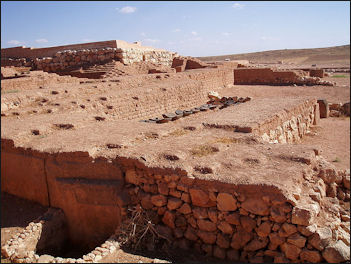 Either clay or bitumen took the place of mortar; the bitumen was procured from Hit or from the Kurdish hills, where there are still springs of naphtha; after the conquest of Canaan it may have been brought from the neighborhood of the Dead Sea. Some scholars have thought that this is referred to by Gudea, the priest-king of Lagas (2700 B.C.). The employment of brick had a very direct effect upon the character of Babylonian architecture. Thick walls, supported by buttresses and devoid of sculpture, were necessitated by it. The buildings of Babylonia were externally plain and flat; masses of brick were piled up in the form of towers or else built into long lines of wall of unbroken monotony. The roofs were made of the stems of palm-trees, which rested on the stems of other palm-trees, where the space between one brick wall and another was too great to be safely spanned. [Source: “Babylonians And Assyrians: Life And Customs”, Rev. A. H. Sayce, Professor of Assyriology at Oxford, 1900]
The temple and house were alike erected on a platform of brick or earth. This was rendered necessary by the marshy soil of Babylonia and the inundations to which it was exposed. The houses, indeed, generally found the platform already prepared for them by the ruins of the buildings which had previously stood on the same spot. Sun-dried brick quickly disintegrates, and a deserted house soon became a mound of dirt. In this way the villages and towns of Babylonia gradually rose in height, forming a tel or mound on which the houses of a later age could be erected.
Bricks and Brickmaking in Ancient Mesopotamia
While it became necessary to ornament the plain mud wall of the house, the clay brick itself, when painted and protected by a glaze, was made into the best and most enduring of ornaments. The enamelled bricks of Chaldea and Assyria are among the most beautiful relics of Babylonian civilization that have survived to us, and those which adorned the Persian palace of Susa, and are now in the Museum of the Louvre, are unsurpassed by the most elaborate productions of modern skill. [Source: “Babylonians And Assyrians: Life And Customs”, Rev. A. H. Sayce, Professor of Assyriology at Oxford, 1900]
Our enumeration of Babylonian trades would not be complete without mention being made of that of the brick-maker. The manufacture of bricks was indeed one of the chief industries of the country, and the brick-maker took the position which would be taken by the mason elsewhere. He erected all the buildings of Babylonia. The walls of the temples themselves were of brick. Even in Assyria, where stone was more plentiful than in Babylonians , the slavish imitation of Babylonian models caused brick to remain the chief building material of a kingdom where stone was plentiful and clay comparatively scarce.
The brick-yards stood on the outskirts of the cities, where the ground was low and where a thick bed of reeds grew in a pond or marsh. These reeds were an important requisite for the brick-maker's art; when dried they formed a bed on which the bricks rested while they were being baked by the sun; cut into small pieces they were mixed with the clay in order to bind it together; and if the bricks were burnt in a kiln the reeds were used as fuel. They were accordingly artificially cultivated, and fetched high prices.
Upper Class House in Ancient Mesopotamia
The Babylonian princes had themselves set the example of employing stone for the sake of decoration. Stone was fetched for the purpose from the most distant regions, regardless of cost. Gudea, the priest-king of Lagas, imported limestone from the Lebanon and from Samalum, near the Gulf of Antioch, while the statues which adorned his palace, and are now in the Louvre, are carved out of diorite from the Peninsula of Sinai. [Source: “Babylonians And Assyrians: Life And Customs”, Rev. A. H. Sayce, Professor of Assyriology at Oxford, 1900]
The diorite doubtless came by sea, but the blocks of hewn stone that were brought from “the land of the Amorites” must have been conveyed overland. Even more precious materials than stone were used for decorative purposes. Gold and silver, bronze and ivory, lapis-lazuli and colored glass, ornamented the cornices and other parts of the interior of the palace. Gudea tells us that he had sent to the deserts which bordered on Egypt for gold-dust and acacia-wood, to Arabia for copper, and to Mount Amanus for beams of cedar. The elephant was still hunted on the banks of the Euphrates near the city of Carchemish, and lapis-lazuli was furnished by the mountains of Persia.
Gardens in Ancient Mesopotamia
In Babylonia an estate was not considered complete without its garden, which almost invariably included a clump of palms. The datepalm was the staple of the country. It was almost the only tree which grew there, and it grew in marvellous abundance. Stem, leaves, and fruit were all alike turned to use. The columns and roofing-beams of the temples and houses were made of its stem, which was also employed for bonding the brick walls of the cities. Its fibres were twisted into ropes, its leaves woven into baskets. The fruit it bore was utilized in many ways. Sometimes the dates were eaten fresh, at other times they were dried and exported to foreign lands; out of some of them wine was made, out of others a rich and luscious sugar. It was little wonder that the Babylonian regarded the palm as the best gift that Nature had bestowed upon him. Palm-land necessarily fetched a higher price than corn-land, and we may conclude, from a contract of the third year of Cyrus, that its valuation was seven and one-half times greater. [Source: “Babylonians And Assyrians: Life And Customs”, Rev. A. H. Sayce, Professor of Assyriology at Oxford, 1900]
A garden was planted by the side of the house. The Babylonians were an agricultural people, and even the cities were full of the gardens attached to the houses of all who could afford to have them. Originally the garden was little more than a grove of palms. But herbs and vegetables soon began to be grown in it, and as habits of luxury increased, exotic trees and shrubs were transplanted to it and flowers were cultivated for the sake of their scent. Tiglath-pileser I. of Assyria tells us how he had “taken and planted in the gardens of his country cedars” and other trees “from the lands he had conquered, which none of the kings his predecessors had ever planted before,” and how he had “brought rare vines which did not exist in Assyria and had cultivated them in the land of Assyria.”
At a later date Sennacherib laid out a pleasure-garden or “paradise” by the side of the palace he erected, filling it with cypresses and other trees as well as fragrant plants, and digging a lake in the midst of it by means of which it could be watered. One of the bas-reliefs in the palace of Assur-bani-pal represents the King and Queen dining in the royal garden under the shadow of its palms, while an attendant drives away the insects with a fan. The Assyrians did but imitate their Babylonian neighbors, and in the gardens of Nineveh we must see many copies of the gardens that had been laid out in Babylonia long ages before. The very word “paradise,” which in the Persian age came to signify a pleasure-park, was of Babylonian origin. It is given in the exercise-book of a Babylonian school-boy as the name of a mythical locality, and an etymological pun attempts to derive it from the name of the god Esu.
Hammurabi's Code of Laws on Builders
The Babylonian king Hammurabi (1792-1750 B.C.) is credited with producing the Code of Hammurabi, the oldest surviving set of laws. Recognized for putting eye for an eye justice into writing and remarkable for its depth and judiciousness, it consists of 282 case laws with legal procedures and penalties. Many of the laws had been around before the code was etched in the eight-foot-highin black diorite stone that bears them. Hammurabi codified them into a fixed and standardized set of laws. [Source: Translated by L. W. King]
228) If a builder build a house for some one and complete it, he shall give him a fee of two shekels in money for each sar of surface. [Source: Translated by L. W. King]
229) If a builder build a house for some one, and does not construct it properly, and the house which he built fall in and kill its owner, then that builder shall be put to death.
230) If it kill the son of the owner the son of that builder shall be put to death.
231) If it kill a slave of the owner, then he shall pay slave for slave to the owner of the house.
232) If it ruin goods, he shall make compensation for all that has been ruined, and inasmuch as he did not construct properly this house which he built and it fell, he shall re-erect the house from his own means.
233) If a builder build a house for some one, even though he has not yet completed it; if then the walls seem toppling, the builder must make the walls solid from his own means.
Value and Tax Assessment of House-Properties in Ancient Mesopotamia
House-property was valuable, especially if it included shops. As far back as the reign of Eri-Aku, or Arisch, 2¼ shekels were given for one which stood on a piece of ground only 1 sar in area, the sar, if Dr. Reisner is right, being the eighteen-hundredths part of the feddan or acre. In the twentieth year of Assur-bani-pal, just after a war which had desolated Babylonia, a house was sold in the provincial town of Erech for 75 shekels (£11 5s.), and in the beginning of the reign of Nabonidos a carpenter's shop in Borsippa, the suburb of Babylon, which was not more than 7 rods, 5 cubits, and 18 inches in length, was bought by the agent of the Syrian Ben-Hadad-nathan and his wife for 11½ manehs, or £103 10s. On the other hand, in the reign of Cambyses, we hear of smaller prices being given for houses in Babylon, 4½ manehs for a house with a piece of land attached to it, and 2 manehs for one that had been the joint property of a man and his wife; while in the ninth year of Nergal-sharezer a house was sold for only 52½ shekels. [Source: “Babylonians And Assyrians: Life And Customs”, Rev. A. H. Sayce, Professor of Assyriology at Oxford, 1900]
The cadastral survey for purposes of taxation went back to an early period of Babylonian history. It was already at work in the age of Sargon of Akkad. The survey of the district or principality of Lagas (now Tello) which was drawn up in that remote epoch of history is in our hands, and is interesting on account of its reference to a “governor” of the land of the Amorites, or Canaan, who bears the Canaanitish name of Urimelech. The survey states that the district in question contained 39,694 acres, 1,325 sar, as well as 17 large towns and 8 subdivisions.
Another cadastral survey from Lagas, but of the period of Khammurabi, which was published by Dr. Scheil, tells us that the towns on the lower banks of “the canal of Lagas” had to pay the treasury each year 35 shekels of silver according to the assessment of the tax-collector Sin-mustal. One of the towns was that of the Aramean tribe of Pekod. Another is called the town of the Brewers, and another is described as “the Copper-Foundry.” Most of the towns were assessed at half a shekel, though there were some which had to pay a shekel and more. Among the latter was the town of Ninâ, which gave its name to the more famous Nineveh on the Tigris. The surveyor, it should be added, was an important personage in Babylonian society, and the contract tablets of the second Babylonian empire not unfrequently mention him. Assyria, like Babylonia, has yielded us a good many deeds relating to the sale and lease of houses and landed estate. We can estimate from them the average value of house-property in Nineveh in the time of the second Assyrian empire, when the wealth of the Eastern world was being poured into it and the Assyrian kings were striving to divert the trade of Phœnicia into their own hands.
Thus, in 694 B.C., a house with two doors was sold for 3 manehs 20 shekels, and two years subsequently another which adjoined it was purchased for 1 maneh “according to the royal standard.” The contract for the sale is a good example of what an Assyrian deed of sale in such a case was like. “The nail-marks of Sar-ludari, Akhassuru, and Amat-Suhla, the wife of Bel-suri, the official, the son of the priest, and owner of the house which is sold. The house, which is in thorough repair, with its woodwork, doors, and court, situated in the city of Nineveh and adjoining the houses of Mannu-ki-akhi and Ilu-ittiya and the street Sipru, has been negotiated for by Zil-Assur, the Egyptian secretary. He has bought it for 1 maneh of silver according to the royal standard from Sar-ludari, Akhassuru, and Amat-Suhla, the wife of Belduri. The money has been paid in full, and the house received as bought. Withdrawal from the contract, lawsuits, and claims are hereby excluded. Whoever hereafter at any time, whether these men or others, shall bring an action and claims against Zil-Assur, shall be fined 10 manehs of silver. Witnessed by Susanqu-khatna-nis, Murmaza the official, Rasuh the sailor, Nebo-dur-uzur the champion, Murmaza the naval captain, Sinsar-uzur, and Zidqa (Zedekiah). The sixteenth of Sivan during the year of office of Zaza, the governor of Arpad (692 B.C.).” It is noticeable that the first witness has a Syrian name. One of the characteristics of the Assyrian deeds is that so few of the parties who appear in them are able to write their names. Nail-marks take the place of seals even in the case of persons who hold official positions and who are shown by the contracts to have been men of property. In this respect Assyria offers a striking contrast to Babylonia, where “the nail-mark” seldom makes its appearance. Closely connected with this inability to write is the absence of the seal-cylinder, which was part of the ordinary dress of the Babylonian gentleman. In the Assyrian contracts, on the other hand, it is conspicuous by its absence. The use of it in Assyria was an imitation of Babylonian manners, and was confined for the most part to the scribes and higher official class, who had received a literary education.
Renting a House in Ancient Mesopotamia
Houses, however, were more frequently let than sold. Already, in the age of Khammurabi, we have the record of the lease of a house for eight years. At a later date contracts relating to the renting of houses are numerous. Thus in the sixth year of Cyrus a house was let at a yearly rent of 10 shekels, part of which was to be paid at the beginning of the year and the rest in the middle of it. The tenant was to renew the fences when necessary and repair all dilapidations. He was also expected to send a present to his landlord thrice a year in the months of Nisan, Tammuz, and Kisleu. [Source: “Babylonians And Assyrians: Life And Customs”, Rev. A. H. Sayce, Professor of Assyriology at Oxford, 1900]
Other houses in Babylon in the Persian age were let at yearly rents of 5 shekels, 5½ shekels, 7½ shekels, 9 shekels, 15 shekels, 20 shekels, 23 shekels, and 35 shekels, the leases running for two, three, five, and more years. The tenant usually undertook to keep the property in repair and to make good all dilapidations. Loss in case of fire or other accidents also fell upon him. Most of the houses seem to have been inhabited by single families; but there were tenements or flats as well, the rent of which was naturally lower than that of a whole house. Thus we find a woman paying only 2 shekels, or 6s., a year for a tenement in the reign of Cambyses. Any violation of the lease involved a fine, the amount of which was stated in the contract. A house, for instance, was let at Babylon in the first year of Cambyses for 5 shekels a year, the rent to be paid in two halves “at the beginning and in the middle of the year.” In this case a breach of the contract was to be punished by a fine of 10 shekels, or double the amount of the rent. In other cases the fine was as much as a maneh of silver. Occasionally the primitive custom was retained of paying the rent in kind instead of in coin. We even hear of “six overcoats” being taken in lieu of rent. The rent of a house might also take the place of interest upon a loan, and the property be handed over to the creditor as security for a debt.
In the second and last year of the reign of Evil-Marduk (560 B.C.), and on the fourth of the month Ab, the following agreement was drawn up at Babylon: “Four manehs of silver belonging to Nadin-akhi, the son of Nur-Ea, the son of Masdukku, received from Sapik-zeri, the son of Marduk-nazir, the son of Liu-Marduk. The house of Sapik-zeri, which is in the street Khuburru, and adjoins the houses of Rimut-Bel, the son of Zeriya, the son of the Egyptian, and of Zeriya, the son of Beledheru, shall be handed over as security to Nadin-akhi. No rent shall be paid for it, and no interest demanded for the debt. Sapik-zeri shall have it for three years. He must renew the fences and repair all injuries to the walls. At the end of the three years Sapik-zeri shall repay the money — namely, four manehs — to Nadin-akhi, and the latter shall vacate the house. The rent of the warehouse of the eunuch is included, of which Sapik-zeri enjoys the use. Whatever doors Nadin-akhi may have added to the house during his tenancy he shall take away.” Then come the names of three witnesses, one of them being the brother of the creditor, as well as of the clerk who drew up the document. A few years later, in the fifth year of Nabonidos (551 B.C.), we find the heir-apparent, Belshazzar, receiving house-property on similar terms. [Source: “Babylonians And Assyrians: Life And Customs”, Rev. A. H. Sayce, Professor of Assyriology at Oxford, 1900]
“The house of Nebo-akhi-iddin, the son of Sula, the son of Egibi,” we read, “which adjoins the house of Bel-iddin, the son of Birrut, the son of the life-guardsman, is handed over for three years as security for a loan of 1½ manehs to Nebo-kin-akhi, the agent of Belshazzar, the son of the king, on the following conditions: no rent shall be paid for the house, and no interest paid on the debt. The tenant shall renew the fences and make good all dilapidations. At the end of three years the 1½ manehs shall be paid by Nebo-akhi-iddin to Nebo-kin-akhi, and Nebo-kin-akhi shall vacate the house of Nebo-akhi-iddin. Witnessed by Kab-tiya, the son of Talnea, the son of Egibi; by Sapik-zeri, the son of Nergal-yukin, the son of Sin-karab-seme; by Nebo-zer-ibni, the son of Ardia, and the clerk, Bel-akhi-iqisa, the son of Nebo-balasu-ikbi, at Babylon, the 21st day of Nisam (March) and the fifth year of Nabonidos, King of Babylon.” This was not the only transaction of the kind in which Belshazzar appears, though it is true that his business was carried on by means of agents. Six years later we have another contract relating to his commercial dealings which has already been quoted above. It illustrates the intensely commercial spirit of the Babylonians, and we may form some idea of the high estimation in which trade was held when we see the eldest son of the reigning King acting as a wool merchant and carrying on business like an ordinary merchant.
Lawsuits Involving House in Ancient Mesopotamia
An interesting document, drawn up in Babylonia in the eleventh year of Sargon (710 B.C.), shortly after the overthrow of Marduk-Baladan, contains an account of a lawsuit which resulted from the purchase of two “ruined houses” in Dur-ilu, a town on the frontier of Elam. They had been purchased by a certain Nebo-liu for 85 shekels, with the intention of pulling them down and erecting new buildings on the site. In order to pay the purchase money Nebo-liu demanded back from “Bel-usatu, the son of Ipunu,” the sum of 30 shekels which he claimed to have lent him. Belusatu at first denied the claim, and the matter was brought into court. There judgment was given in favor of the plaintiff, and the defendant was ordered to pay him 45 shekels, 15, or half the amount claimed, being for “costs.” Thereupon Bel-usatu proposed: “ ‘Instead of the money, take my houses, which are in the town of Der.’ [Source: “Babylonians And Assyrians: Life And Customs”, Rev. A. H. Sayce, Professor of Assyriology at Oxford, 1900]
The title-deeds of these houses, the longer side of which was bounded to the east by the house of Bea, the son of Sulâ, and to the west by the entrance to a field which partly belonged to the property, while the shorter side was bounded to the north by the house of Ittabsi, and to the south by the house of Likimmâ, were signed and sealed by Nebousatu, who pledged himself not to retract the deed or make any subsequent claim, and they were then handed over to Nebo-liu.” The troubles of the latter, however, were not yet at an end. “Ilu-rabu-belsanât, Sennacherib, and Labasu, the sons of Rakhaz the [priest] of the great god, said to Nebo-liu: ‘Seventy-three shekels of your money you have received from our father. Give us, therefore, 50 shekels and we will deliver to you the house and its garden which belonged to our father.’
The house, which was fit only to be pulled down and rebuilt, along with a grove of forty date-bearing palms, was situated on the bank of the canal of Dûtu in Dur-ilu, its longer side adjoining on the north the house of Edheru, the son of Baniya, the priest of Â, and on the south the canal of Dûtu, while its shorter side was bounded on the east by the house of Nergal-epus, and on the west by the street Mutaqutu. Nebo-liu agreed, and looked out and gave Rakhaz and his sons 50 shekels of silver, together with an overcoat and two shekels by way of a bakshish to bind the bargain, the whole amounting to 52 shekels, paid in full.” The custom of adding a bakshish or “present” to the purchase-money at the conclusion of a bargain is still characteristic of the East. Other examples of it are met with in the Babylonian contracts, and prove how immemorially old it is. Thus in the second year of Darius, when the three sons of a “smith” sold a house near the Gate of Zamama, at Babylon, to the grandson of another “smith,” besides the purchase money for the house, which amounted to 67½ shekels, the buyer gave in addition a bakshish of 2½ shekels (7s. 6d.) as well as “a dress for the lady of the house.” Three shekels were further given as “a present” for sealing the deed. So too, the negotiations for the sale of some land in the second year of Evil-Marduk were accompanied by a bakshish of 5 shekels.
Lawsuits connected with the sale or lease of houses do not seem to have been uncommon. One of the documents which have come down to us from the ancient records of Babylon is a list of “the judges before whom Sapik-zeri, the son of Zirutu, and Baladhu, the son of Nasikatum, the slave of the secretary for the Marshlands,” were called upon to appear in a suit relating to “the house and deed which Zirutu, the father of Sapikzeri, had sealed and given to Baladhu,” who had afterward handed both of them over to Sapik-zeri. Among the judges we find the governor of the Marshlands, who acted as president, the sub-governor, the mayor of Erech, the priest of Ur, and one of the governors of the district “beyond” the Euphrates. The list is dated the 6th of Nisan or March, in the seventeenth year of Nebuchadnezzar. The value of land was proportionate to that of house-property. In the early days of Babylonia its value was fixed by the amount of grain that could be grown upon it, and it was accordingly in grain that the owner was paid by the purchaser or lessee. Gradually, however, a metal currency took the place of the grain, and in the later age of Babylonian history even the rent was but rarely paid in kind. We learn from a lawsuit decided in the reign of Samsu-iluna, the son of Khammurabi, that it was customary for an estate to be “paced round” by the rabianum or “magistrates” of the city. The ceremony was equivalent to “beating the bounds” of a parish in modern England, and it is probable that it was performed every year. Such at least is the custom in Egypt, where the limits of a piece of property are measured and fixed annually. The Babylonian document in which the custom is referred to relates to a dispute about a plantation of acacias which grew in the neighborhood of the modern Tel Sifr. The magistrates, before whom it was brought, are described as looking after not only the city but also “the walls and streets,” from which we may gather that municipal commissioners already existed in the Babylonian towns. The plaintiff made oath before them over the copper libation-bowl of the god of Boundaries, which thus took the place of the Bible in an English court of law.
Image Sources: Wikimedia Commons
Text Sources: Internet Ancient History Sourcebook: Mesopotamia sourcebooks.fordham.edu , National Geographic, Smithsonian magazine, especially Merle Severy, National Geographic, May 1991 and Marion Steinmann, Smithsonian, December 1988, New York Times, Washington Post, Los Angeles Times, Discover magazine, Times of London, Natural History magazine, Archaeology magazine, The New Yorker, BBC, Encyclopædia Britannica, Metropolitan Museum of Art, Time, Newsweek, Wikipedia, Reuters, Associated Press, The Guardian, AFP, Lonely Planet Guides, “World Religions” edited by Geoffrey Parrinder (Facts on File Publications, New York); “History of Warfare” by John Keegan (Vintage Books); “History of Art” by H.W. Janson Prentice Hall, Englewood Cliffs, N.J.), Compton’s Encyclopedia and various books and other publications.
Last updated July 2024