
Home | Category: Life, Families, Women
WHAT ANCIENT MESOPOTAMIANS LOOKED LIKE
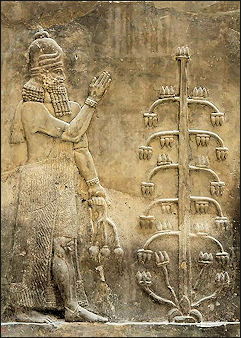
Genie poppy at
Dur Sharrukin There are images of people and descriptions of the them in ancient Mesopotamian texts and art works and it possible to get a sense of what people looked like at that time from them. But even with this information, it is impossible to know if we truly understand what the people of Mesopotamia looked like or exactly what they wore.
The statues made by sculptors offer simplified depictions of people and their clothing, making it difficult to know the type of fabric used in a particular garment. In addition, different cultures portrayed people in different ways. The Sumerians created statues and pictures of stocky, large-eyed people while the Assyrians depicted people as lean, strong, and hairy. It is impossible to know if these people actually looked different from one another or if these artifacts represent the idealized version of different cultures.
The artifacts left by Mesopotamian cultures include clay and stone statues, carvings on palace walls, carved ivory, some wall paintings, and jewelry. These items illustrate the clothing, hairdressing, and body adornment of these cultures as well as how these cultures idealized the human form. While these visual forms provide costume historians with a great deal of information, of even greater interest are the written tablets that have been discovered.
See Separate Article: LIFE IN THE NEOLITHIC AND BRONZE AGES: HOUSES, CLOTHES, ADORNMENTS africame.factsanddetails.com
RECOMMENDED BOOKS:
“Ancient Egyptian, Mesopotamian & Persian Costume” by Mary Galway Houston (1920) Amazon.com;
“Textiles of Ancient Mesopotamia, Persia, and Egypt” by Florence Eloise Petzel (1987) Amazon.com;
“Weavers, Scribes, and Kings: A New History of the Ancient Near East” by Amanda H Podany (2022) Amazon.com;
“History of Costume: From the Ancient Mesopotamians to the Twentieth Century” by Blanche, Payne (1997). Amazon.com;
“Prehistoric Textiles” by Elizabeth Wayland Barber (1991) Amazon.com;
“Women's Work: The First 20,000 Years” by Elizabeth Wayland Barber (1994) Amazon.com;
“Prehistoric Textiles: The Development of Cloth in the Neolithic and Bronze Ages with Special Reference to the Aegean” by E.J.W. Barber (1992) Amazon.com;
“Fabric of Civilization” by Virginia Postrel (2021) Amazon.com;
“The Golden Thread: How Fabric Changed History” by Kassia St. Clair (2021) Amazon.com;
“The Book of Looms: A History of the Handloom from Ancient Times to the Present” by Eric Broudy (2021) Amazon.com;
“Tools, Textiles and Contexts: Investigating Textile Production in the Aegean and Eastern Mediterranean Bronze Age” by Eva Andersson Strand and Marie-Louise Nosch (2015) Amazon.com;
“Ancient Textiles: Production, Crafts and Society” by Marie-Louise Nosch, C. Gillis (2007) Amazon.com;
“First Textiles: The Beginnings of Textile Production in Europe and the Mediterranean” by Małgorzata Siennicka, Lorenz Rahmstorf, et al. (2019) Amazon.com;
“The Competition of Fibres: Early Textile Production in Western Asia, Southeast and Central Europe (10,000–500 BC)” by Dr. Wolfram Schier and Prof. Dr Susan Pollock (2020) Amazon.com;
“Everyday Life in Ancient Mesopotamia” by Jean Bottéro (2001) Amazon.com;
“Handbook to Life in Ancient Mesopotamia” by Stephen Bertman (2002) Amazon.com;
“Ancient Mesopotamia: Life in the Cradle of Civilization” by Amanda H Podany (2018) Amazon.com;
“Daily Life in Ancient Mesopotamia” by Karen Rhea Nemet-Nejat (1998) Amazon.com;
“Society and the Individual in Ancient Mesopotamia” by Laura Culbertson, Gonzalo Rubio (2024) Amazon.com;
“Everyday Life in Babylon and Assyria” by Georges Contenau (1954) Amazon.com;
“The Babylonian World” by Gwendolyn Leick (2007) Amazon.com;
“Neo-Babylonian Letters and Contracts from the Eanna Archive” (Yale Oriental Series: Cuneiform Texts) by Eckart Frahm and Michael Jursa (2011) Amazon.com;
Ancient Mesopotamian Clothes
In ancient Mesopotamia, clothes were made from leather, wool and flax (linen). The Egyptians used linen to wrap mummies. Based on images in sculptures and statuettes, Sumerian men wore kiltlike skirts, and were naked above the waist. Based on images in reliefs, Babylonian and Assyrian men wore fringed robes, heavy make up and jewelry Gods. were often depicted wearing horned crowns. Sumerian women wore long dresses and left their right shoulder bare. Babylonian women in 1500 B.C. wore dog-collar necklaces, bracelets and rope-like belts.
The Babylonians must have been fond of variety in dress. The names of an immense number of different kinds of dress are given, and the monuments show that fashions changed from time to time. Thus the earliest remains of Chaldean art exhibit three successive changes in the head-dress, and similar changes are to be noticed in the dress of the Assyrian kings as it is represented in the bas-reliefs.[Source: “Babylonians And Assyrians: Life And Customs”, Rev. A. H. Sayce, Professor of Assyriology at Oxford, 1900]
Clothes and woven stuffs were naturally of all prices. In the time of Nebuchadnezzar a cloak or overcoat used by the mountaineers cost only 4½ shekels, though under Cambyses we hear of 58 shekels being charged for eight of the same articles of dress, which were supplied to the “bowmen” of the army. Three years earlier 7½ shekels had been paid for two of these cloaks. About the same time ten sleeved gowns cost 35 shekels. [Source: “Babylonians And Assyrians: Life And Customs”, Rev. A. H. Sayce, Professor of Assyriology at Oxford, 1900]
Herodotus wrote in 430 B.C.:“The dress of the Babylonians is a linen tunic reaching to the feet, and above it another tunic made in wool, besides which they have a short white cloak thrown round them, and shoes of a peculiar fashion, not unlike those worn by the Boiotians. They have long hair, wear turbans on their heads, and anoint their whole body with perfumes. Every one carries a seal, and a walking-stick, carved at the top into the form of an apple, a rose, a lily, an eagle, or something similar; for it is not their habit to use a stick without an ornament. I.196: [Source: Herodotus, “The History”, translated by George Rawlinson, (New York: Dutton & Co., 1862]
In the early Babylonian period the dress of all classes was naturally much more simple than that of a later date.To the last, however, the principal constituents of Babylonian dress remained the same. There were a hat or head-dress, a tunic or shirt, and a long robe which reached to the ankles, to which in cold weather was added a cloak. The hat or cap was made of some thick substance like felt and was sometimes quilted. Drawers were seldom used, though in the time of the second Assyrian empire the cavalry and heavy-armed bowmen wore tightly fitting drawers of plaited leather, but the custom was probably introduced from the north. A bilingual vocabulary, however, gives a Sumerian word for this article of dress, which may therefore have been occasionally adopted in pre-Semitic days. The long robe was usually sleeveless and ornamented with a fringe. It opened in front, and in walking allowed the left leg to be seen. The girdle was often tied around it instead of round the tunic.
Mesopotamia Footwear
Sandals were the primary form of footwear in ancient Mesopotamia, Egypt, Greece and Rome. Though the Babylonians, as a rule, went barefoot. So also did the lower classes among the Assyrians, as well as a portion of the army. The sandals were attached to the foot by leather thongs, and the heel was protected by a cap. Hebrews and Assyrians pledged a sandal as symbol of good faith when making a deal. Tossing a shoe onto a piece of land meant that you claimed it.
The first boots were developed by Assyrians around 1100 B.C. primarily for use in warfare. They came up to mid-calf, and had a laced leather front. The soles and were reinforced with metal. There is evidence that the Assyrians and Hittites made both right and left boots. The first boots were introduced from the colder regions of northern Mesopotamia.
At all events, Marduk-nadin-akhi is depicted as wearing soft leather shoes, and Sennacherib adopted a similar foot-covering. This was laced in front like the high-laced boots with which the Assyrian cavalry were provided toward the end of the reign of Tiglath-pileser III. [Source: “Babylonians And Assyrians: Life And Customs”, Rev. A. H. Sayce, Professor of Assyriology at Oxford, 1900]
Spotted Fawn Skin and the Clothing of Ancient Mesopotamian Priests

Sun god Shamash
Babylonian priests were distinguished by a curiously flounced dress, made perhaps of a species of muslin, which descended to the feet, and is often pictured on the early seals. Over their shoulders was flung a goat's skin, the symbol of their office, like the leopard's skin worn by the priests in Egypt. [Source: “Babylonians And Assyrians: Life And Customs”, Rev. A. H. Sayce, Professor of Assyriology at Oxford, 1900]
The custom of wearing the spotted fawn-skin seems to have been exported from Assyria into Greece. In Assyria, a spotted fawn was a sacred emblem, as we learn from the Nineveh sculptures, where we find a divinity bearing a spotted fawn or spotted fallow-deer
The origin of the importance attached to the spotted fawn and its skin had evidently come thus: When Nimrod, as "the Leopard-tamer," began to be clothed in the leopard-skin, as the trophy (Triumph) of his skill, his spotted dress and appearance must have impressed the imaginations of those who saw him; and he came to be called not only the "Subduer of the Spotted one" (for such is the precise meaning of Nimur — the name of the leopard), but to be called "The spotted one" himself.
In one illustration, a man on the left is carries a flute case which was from a leopard skin or a fawn skin — usually spotted to represent Nimrod. The little box on the right side of the flutecase is the "glossokomen" which was used of the bag Judas carried. A man on the right carries a crooked oxgoad which was the weapon of Shamgar. It also held up the musicians usually naked and always sipping from a new wineskin.
Royal Babylonian and Assyrian Clothes
The Babylonian King Marduk-nadin-akhi (1100 B.C.) is represented in a square cap which is ornamented with a row of feathers; below these is a band of rosettes. The Assyrian King is sometimes represented as wearing a sort of richly embroidered cape over the robe. The cape or cloak, however, was specially characteristic of the Babylonians, as the Assyrians found it inconvenient in war or active exercise, and accordingly preferred to discard it. Most of them wore it only on state occasions or when in full dress. [Source: “Babylonians And Assyrians: Life And Customs”, Rev. A. H. Sayce, Professor of Assyriology at Oxford, 1900]
The Assyrian King generally wore a lofty tiara; this was a survival of the tiara of the early Babylonians. Above his head was carried a parasol to protect him from the sun; but the use of the parasol was confined to the upper classes, if not to the royal family alone. The tunic was of linen, or more often of wool, which was manufactured in Babylonia on a large scale. It reached half-way down the knees and was fastened round the waist by a girdle. Under it a second tunic or vest was sometimes worn in cold weather.
The poor were contented with a short kilt, the King and his family with a long one. One of the early rulers of Lagas, for instance, is represented as wearing only a skull-cap and a kilt which reaches nearly to the ankles. It was under the Semitic empire of Sargon of Akkad that the long robe seems first to have become common. But it was worn over the left shoulder only, and as the tunic was not yet introduced into ordinary use, the right shoulder was left bare. Even Naram-Sin, the conqueror of Sinai, is depicted as clad in this simple costume in a bas-relief found near Diarbekr.
The robe is quilted, and on the King's head is a conical cap of felt. The statues of the age of Gudea also show no sign of the tunic. The development out of the kilt must belong to a later age. The costume of the women does not appear to have differed much from that of the men. Both alike adopted the long robe. But representations of women are unfortunately rare.
The Queen of Assur-bani-pal is dressed in a long, sleeveless robe, over which is a fringed frock reaching to the knees, and over this again a light cape, also fringed and embroidered with rosettes. This may, therefore, be regarded as the official dress of a grand lady in the closing days of the Assyrian empire.
Production of Textiles in Ancient Mesopotamia
Many of the 3900-year-old tablets found at Kanesh in Anatolia were written by women and deal in some way with the production of textiles, one of the most lucrative goods According to Archaeology magazine: Assyrians traded with Anatolians. Together with the enslaved people who lived in their households, women in Assur wove large textiles that their male relatives sold in Kanesh. [Source: Durrie Bouscaren, Archaeology magazine, November/December 2023]
Assyriologist Cécile Michel of the French National Center for Scientific Research has worked with researchers at the Center for Textile Research in Copenhagen to conduct experiments using replicas of ancient weaving tools uncovered at Kanesh, such as the whorl of a drop spindle, to determine how long it would have taken Assyrian weavers to make each textile. Tablets record that the standard size of textiles sold in Kanesh was approximately 13 by 15 feet. Each one would have required more than 22 miles of thread. The team determined that spinning the raw wool alone would have taken as much as three months of full-time labor for one person. Next, Assyrian weavers would have woven strips of the textile on vertical looms. Each weaver, the researchers estimate, would have been able to produce just two and a half standard-size textiles each year.
With these efforts in mind, it’s easy to imagine the anger that a weaver named Lamassi must have felt when she received a letter from her husband, Pushu-ken, complaining about the quality of the fabric she had sent. As she dashed off a letter in response, her words were laced with frustration. “Who is this man who lives in your house and who is criticizing the textiles when they get to him?” the tablet reads. “I try my best to make and send textiles to you!”
Jewelry in Ancient Mesopotamia
Beads of various kinds were worn on necklaces and other adornments. Over the years they evolved from mollusk shell lips drilled for pendants, found in 9th millennium B.C. Syria; stone stamp seals found in northern Syria, dated to 7000-4000 B.C.; tubular bone beads with loops found in northern Syria, dated to 3000 B.C.
Both men and women were fond of jewelry, and adorned themselves with rings, bracelets, ear-rings, and necklaces. The women also wore anklets, like many of the Oriental women of to-day. The men carried a stick in the street, and all who could afford it had a small engraved cylinder of stone attached to the wrist by a ring which passed through an orifice in the cylinder. The cylinder served the purpose of a seal, and was constantly required in business transactions. No deed was valid without the seal or mark of the contracting parties; when either of them was too poor to possess a seal, a nail-mark was impressed upon the clay of the contract tablet, and a note added stating to whom it was that the mark belonged. The seal-cylinder was a Babylonian invention. In a land where there were no stones every pebble was of value, and the Babylonians accordingly became expert gem-cutters at a very early period. [Source: “Babylonians And Assyrians: Life And Customs”, Rev. A. H. Sayce, Professor of Assyriology at Oxford, 1900]
Gem-cutting, in fact, was a highly developed art among them, and the seal-cylinder of Ibni-sarru, the librarian of Sargon of Akkad, which is now in a private collection in Paris, is one of the most beautiful specimens of the art that has ever been produced. The pebble was cut in a cylindrical shape, and various figures were engraved upon it. The favorite design was that of a god or goddess to whom the owner of the seal is being introduced by a priest; sometimes the King takes the place of the deity, at other times it is the adventures of Gilgames, the hero of the great Chaldean Epic, that are represented upon the stone.
Design of Mesopotamian Jewelry
The design on the is usually accompanied by a few lines of inscription, giving the name of the owner of the seal, as well as that of his father, and stating of what god or King he was “the servant.” The seals were often kept in stock by their makers, a blank space being left for the inscription, which was to be engraved upon them as soon as they had found a purchaser. Hence it is that at times the names have never been filled in. The style and pattern of the cylinder changed in the course of centuries, as well as the favorite materials of which it was made. Under the dynasty of Ur, which preceded that of Khammurabi, for instance, hæmatite was more especially in vogue; in the age of Nebuchadnezzar crystal became fashionable. At one period, moreover, or among the artists of a particular local school, the representation of a human sacrifice was common. [Source: “Babylonians And Assyrians: Life And Customs”, Rev. A. H. Sayce, Professor of Assyriology at Oxford, 1900]
Between the inscription on the cylinder, however, and the subjects engraved upon it there is seldom, if ever, any connection, except when a portrait is given of the god or King of whom the owner calls himself the servant. A hole was drilled through the length of the cylinder, and through this a string was passed. Instead of the string a rod of metal or ivory was often employed; this was fixed in a frame of gold or bronze, and the cylinder was thus able to turn upon it. When the seal was used it was rolled over the soft clay, leaving an indelible impression behind.
Among the objects found at Tello are balls of clay, which were attached to papyrus documents, like the seals of mediæval deeds, and sealed with the cylinders of the post-masters of Sargon and Naram-Sin. Above the seal comes the address, in one case to Naram-Sin, in another to the highpriest of Lagas. It is evident that a postal system had already been established between Lagas and Agade or Akkad, the capital of Sargon's empire. The impressions show that the seals must have been very beautiful specimens of workmanship. They all belonged to high officials; one to Dada, “the seer of the palace,” another to the high-priest of Lagas himself.
Image Sources: Wikimedia Commons
Text Sources: Internet Ancient History Sourcebook: Mesopotamia sourcebooks.fordham.edu , National Geographic, Smithsonian magazine, especially Merle Severy, National Geographic, May 1991 and Marion Steinmann, Smithsonian, December 1988, New York Times, Washington Post, Los Angeles Times, Discover magazine, Times of London, Natural History magazine, Archaeology magazine, The New Yorker, BBC, Encyclopædia Britannica, Metropolitan Museum of Art, Time, Newsweek, Wikipedia, Reuters, Associated Press, The Guardian, AFP, Lonely Planet Guides, “World Religions” edited by Geoffrey Parrinder (Facts on File Publications, New York); “History of Warfare” by John Keegan (Vintage Books); “History of Art” by H.W. Janson Prentice Hall, Englewood Cliffs, N.J.), Compton’s Encyclopedia and various books and other publications.
Last updated July 2024