
Home | Category: Neo-Babylonians
DECLINE OF THE NEO-BABYLONIANS AND THE RISE OF PERSIA
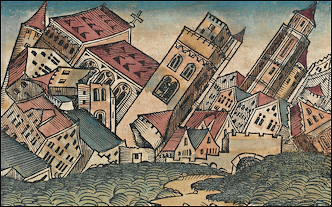
Fall of Babylon in the AD 15th century Nuremberg Chronicles
The great Neo-Babylonian ruler Nebuchadrezzar II died in 562. His long rule was followed by a period of social upheaval and in seven years four different monarchs sat on the Babylonian throne. Nabonidus emerged as the new king after a seven year power struggle but he alienated the priestly class by embracing the unpopular noon god Sin and was forced into exile in a remote desert town. Babylon grew weaker during all this.
The first king of Baby;on after Nebuchadrezzar II was Amel-Marduk (562-560), a son of Nebuchadrezzarand believed to be the Evilmerodoch (Evil-Merodach) of II Kings 25:27-30 who released King Joachim of Judah from prison and raised him above the other vassal kings at Babylon. His weak rule dIspleased the priestly caste, and they accused him of reigning lawlessly and extravagantly. After less than three years he was assassinated by Neriglissar (Nergal-sar-usur), his brother-in-law, who is possibly the Nergalsharezer present at the taking of Jerusalem (Jer. xxxix, 3-13). Neriglissar ruled for four years (560-556) and just prior to his death suffered defeat in a battle with the Medes. His infant son Labashimarduk (Labasi-Marduk,) reigned nine months and was assassinated. Nabonidus or Nabu-na'id, who was not of the same family, seized the throne in a rebellion supported by chief officials of state. [Sources: Gerald A. Larue, “Old Testament Life and Literature,” 1968, infidels.org; J.P. Arendzen, transcribed by Rev. Richard Giroux, Catholic Encyclopedia |=|]
Morris Jastrow said: “On the death of Nebuchadnezzar, in 561 B.C., the decline of the neo-Babylonian empire sets in and proceeds rapidly, as in Assyria the decline began after the death of her grand monargue. Internal dissensions and rivalries among the priests of Babylon and Sippar divided the land. The glory of the Chaldean revival was of short duration, and in the year 539 B.C., Nabonidus, the last native king of Babylon, was forced to yield to the new power coming from Elam. It was the same old enemy of the Euphrates Valley, only in a new garb, that appeared when Cyrus stood before the gates of Babylon. [Source: Morris Jastrow, Lectures more than ten years after publishing his book “Aspects of Religious Belief and Practice in Babylonia and Assyria” 1911 ]
“Nabonidus gave the weight of his influence to the priestly party of Sippar. In revenge, the priests of Babylon abetted the advance of Cyrus who was hailed by them as the deliverer of Marduk. With scarcely an attempt at resistance, the capital yielded, and Cyrus marched in triumph to the temple of Marduk. The great change had come so nearly imperceptibly that men hardly realised that with Cyrus on the throne of Babylon a new era was ushered in. In the wake of Cyrus came a new force in culture, accompanied by a religious faith that, in contrast to the Babylonian-Assyrian polytheism with its elaborate cult and ritual, appeared rationalistic—almost coldly rationalistic. Far more important than the change of government from Chaldean to Persian control of the Euphrates Valley and of its dependencies was the conquest of the old Babylonian religion by Mazdeism or Zoroastrianism, which, though it did not become the official cult, deprived the worship of Marduk, Nebo, Shamash, and the other gods of much of its vitality.
RECOMMENDED BOOKS:
“Nabonidus and Belshazzar: A Study of the Closing Events of the Neo-Babylonian Empire” by Raymond Philip Dougherty (1877-1933) Amazon.com;
“A History of Bab
“The Royal Inscriptions of Amēl-Marduk (561–560 BC), Neriglissar (559–556 BC), and Nabonidus (555–539 BC), Kings of Babylon” (Royal Inscriptions of the Neo-Babylonian Empire) by Frauke Weiershäuser and Jamie Novotny (2020) Amazon.com;
“Nabonidus and the Bible: Selected Essays” by Janet Tyson (2024) Amazon.com;
“Records from Erech, tTme of Nabonidus (555-538 B.C.), Vol. VI
by Raymond Philip Dougherty (1877-1933) Amazon.com;
“Legal and Administrative Texts from the Reign of Nabonidus” by Paul-Alain Beaulieu | (2000) Amazon.com;
“Late Babylonian Letters: Transliterations and Translations of a Series of Letters Written in Babylonian Cuneiform, Chiefly During the Reigns of Nabonidus, Cyrus, Cambyses, and Darius”
by Reginald Campbell Thompson (2020) Amazon.com;
ylon (2200 BC - AD 75" by Paul-Alain Beaulieu (2017) Amazon.com;
“The Babylonian World” by Gwendolyn Leick (2007) Amazon.com;
The Royal Inscriptions of Nabopolassar (625-605 BC) and Nebuchadnezzar II (604-562 BC)” by Jamie Novotny and Frauke Weiershäuser (2024) Amazon.com;
“Babylonia: A Very Short Introduction” by Trevor R. Bryce (2016) Amazon.com;
“Babylonia” by Costanza Casati (2025) Novel Amazon.com;
“Babylonians” by H. W. F. Saggs (1995) Amazon.com;
“The Greatness That Was Babylon” by H. W. F. Saggs (1962) Amazon.com;
“The Babylonian Empire” by Enthralling History (2022) Amazon.com;
“Civilizations of Ancient Iraq” by Benjamin R. Foster and Karen Polinger Foster ((2009) Amazon.com;
“A History of the Ancient Near East” by Marc Van De Mieroop (2003) Amazon.com;
“Nippur IV: The Early Neo-Babylonian Governor's Archive from Nippur (Oriental Institute Publications) by Steven W. Cole (1996) Amazon.com;
Nabonidus, the Last Ruler of Mesopotamia
Nabonidus, (Nabu-na'id, Nabonnedos, (555-539 B.C.) was the last King of Babylon and arguably the last ruler of Mesopotamia. According to the Catholic Encyclopedia: He was a royal antiquarian rather than a ruling king. From their foundations he rebuilt the great Shamash temple in Sippar and the Sin temple in Harran, and in his reign the city walls of Babylon "were curiously built with burnt brick and bitumen". But he resided in Tema, shunned the capital, offended the provincial towns by transporting their gods to Shu-anna, and alienated the priesthood of Babylon by what they would call misdirected piety.
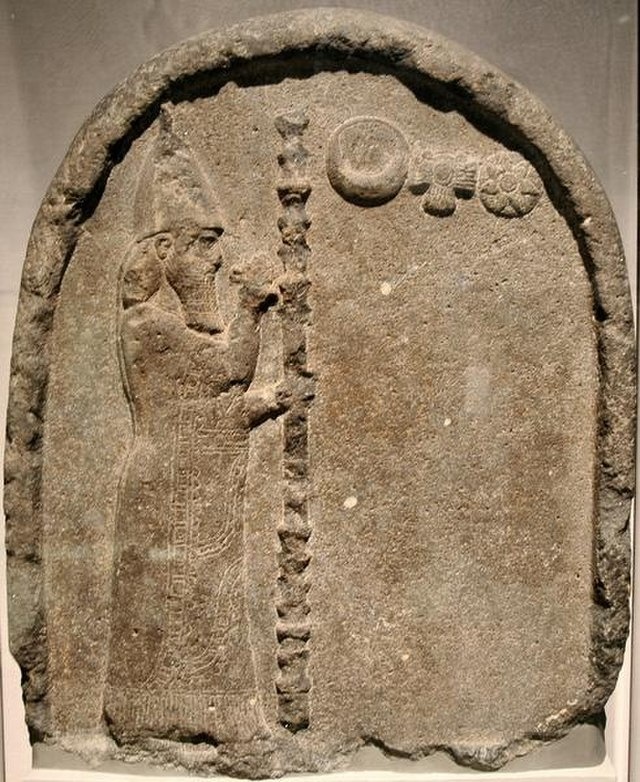
Nabonidus
Nabonidus succeeded to the throne of Babylon after the three brief reigns of Nebuchadnezzar's son, son-in-law, and grandson. Eric A. Powell wrote in Archaeology Magazine: Ever since Assyriologist first began to read Neo-Babylonian records excavated in the late nineteenth century, Nabonidus has stood out as an unusual ruler. While the record is fragmentary, cuneiform tablets and inscriptions have helped scholars trace Nabonidus’ unconventional career. [Source: Eric A. Powell, Archaeology Magazine, March/April 2022]
A palace courtier, Nabonidus came to power in his 50s or 60s by way of a coup that may have been orchestrated by his son Belshazzar, who plays a central role in the Bible’s Book of Daniel. In this biblical account, Nabonidus, who is mistakenly identified as his predecessor Nebuchadnezzar II (r. 605–562 B.C.), is described as a mad king obsessed with dreams. According to the Book of Daniel, the king leaves Babylon to live in the wilderness for seven years. This depiction overlaps somewhat with Nabonidus’ own inscriptions, in which he emphasizes that he was an especially pious man who paid heed to dreams as the divine messages of the gods. Nabonidus was also infamous in antiquity for abandoning Babylon for 10 years to live in the deserts of Saudi Arabia, where he established a kind of shadow capital at the oasis of Tayma. This was a strange and unprecedented move for a Mesopotamian ruler.
Nabonidus was also known for his near-fanatical devotion to the moon god, Sin, whom he raised to the status of the most important deity in the Babylonian pantheon. This came at the expense of Marduk, Babylon’s longtime patron god, whom earlier Neo-Babylonian kings had promoted as the empire’s chief deity. Some scholars believe that by elevating Sin, a god whose main temples lay outside the city of Babylon, Nabonidus was perhaps attempting to unite a large and diffuse empire under the worship of a god who held more appeal than Marduk to people throughout the realm. “Nabonidus was a new man, with a new vision of the Babylonian Empire,” says University of Toronto Assyriologist Paul-Alain Beaulieu.
Today, some scholars believe that, despite being variously portrayed in ancient texts as a mad usurper and a heretic whose apostasy doomed an empire, Nabonidus may, in fact, have simply been a difficult personality with a singular political vision whose reign was cut short before he could realize his ambitions. Nabonidus’ efforts to hold together his realm may have ultimately gone unrealized, but by exploring his reign, scholars can learn much about the final days of the Neo-Babylonian Empire. Nabonidus left behind some 3,000 cuneiform inscriptions, far more than any other Neo-Babylonian king. New readings of some of these tablets, findings from excavations at Tayma, and the recent discovery of additional inscriptions dating to Nabonidus’ reign are all giving scholars a chance to tease out the ambiguities that lay at the heart of the reign of Babylon’s last king.
Images of Nabonidus show him wearing a conical cap. One famous depiction on a 56-centimeter (22-inch-high) basalt stela shows him gripping a staff and praying to celestial symbols representing three deities: Sin; the goddess Ishtar, represented by a star symbol; and Shamash, the sun god.
Life of Nabonidus
Nabonidus was not related to the royal Chaldean house, although he was the namesake of a son of Nebuchadnezzar, whom he had served as a high diplomatic official as early as 585. Nabonidus' mother was a high-priestess of the moon god Sin and his father was a nobleman. From the Assyrians, the Neo-Babylonians captured northern Mesopotamia, including Harran, the home city of Nabonidus’ family. At that time, his mother, Adad-guppi, was brought to Babylon, perhaps with her son, whom she may have established at court in a position of influence.
Aaron Skaist wrote in the Encyclopaedia Judaica: The biography of his mother, Adad-guppi, is preserved on inscriptions from Haran, from which we learn that she lived for 104 years (650–547). Her long devotion to Haran and its deity may help to explain her son's similar, but more fateful, preoccupation. Virtually alone among the former Assyrian strongholds, Haran recovered some of its old glory under the neo-Babylonians and survived for many centuries thereafter as the center of successive forms of the worship of the moon-god Sin. [Source: Aaron Skaist, Encyclopaedia Judaica, 2005, Encyclopedia.com]
According to Adad-guppi's biography, Haran lay desolate (that is, in the possession of the Medes) for 54 years (610–556) until, at the very beginning of the reign of Nabonidus, a vision informed him, in words strangely reminiscent of Isaiah 44:28–45:1, that Marduk would raise up "his younger servant" Cyrus to scatter the Medes. In obedience to the divine injunction, Nabonidus presently rebuilt the great temple of Haran, and reconsecrated it to Sin. At the same time, he singled out the other centers of moon worship, at Ur in Babylonia and at the oasis of Temâ in Arabia, for special attention.
Eric A. Powell wrote in Archaeology Magazine: Some tablets dating to the reign of Nebuchadnezzar II mention an official named Nabonidus, which might refer to the future king. Some of these texts suggest Nabonidus was a contentious person with an abrasive manner. One states that he ordered the beating of a man who had made a seemingly innocuous inquiry about orders relating to the robe outfitting the statue of a god. But the future king was also, some sources report, a skilled diplomat. According to the fifth-century B.C. Greek historian Herodotus, Nabonidus may have negotiated a peace treaty between the Iranian people called the Medes and the Lydians of Anatolia. [Source: Eric A. Powell, Archaeology Magazine, March/April 2022]
Nabonidus Comes to Power

Verse Account of Nabonidus
Eric A. Powell wrote in Archaeology Magazine: After his lengthy reign, Nebuchadnezzar II was succeeded by his son-in-law Neriglissar (r. 560–556 B.C.), who sat on the throne for just four years. He in turn was eventually succeeded by his son Labashi-Marduk, who reigned for a mere two weeks before a coup deposed him and placed an already elderly Nabonidus on the throne. [Source: Eric A. Powell, Archaeology Magazine, March/April 2022]
The court records of the Neo-Babylonian kings have not been discovered. Thus, Assyriologists must use other texts, chiefly financial and real estate transactions, to piece together the political events of the day. For example, multiple tablets suggest that Nabonidus’ son Belshazzar seems to have taken over many of Labashi-Marduk’s real estate holdings, making him a prime suspect as the coup’s mastermind. But who helped him put his father on the throne has been an open question. In search of the identities of those who were in Nabonidus’ camp, University of Warsaw Assyriologist Małgorzata Sandowicz recently studied cuneiform tablets detailing real estate transactions that bear the king’s imprimatur.
Sandowicz has found that many men in these records held high titles and were the kind of palace officials one would expect to find in close proximity to the king. A smaller number of men without titles seem to have been Nabonidus’ more intimate associates. Some of them had held positions of power under Nebuchadnezzar II and Neriglissar. They seem to have retained the king’s special favor, suggesting that these companions of Nabonidus could have been critical allies in the coup that installed him as king. Quite a few members of this royal retinue were Aramaeans, an ethnic group whose tribes lived across the Neo-Babylonian Empire. A native of the northern city of Harran, where many Aramaeans lived, Nabonidus may well have been Aramaean himself. At this time, the Aramaeans’ Semitic language, Aramaic, was rapidly displacing Akkadian as the empire’s leading language. “Aramaeans are hard to identify in Babylonian records,” says Sandowicz. “They often managed their affairs in the framework of their own tribal institutions. So the fact that they appear here as associates of the king is significant.” If Nabonidus maintained close links with Aramaeans, that could indicate he might have been interested in keeping a power base outside the official Babylonian system.
Sandowicz notes that just as interesting as who is included in these real estate transactions is who is absent. She has found that those transactions bearing Nabonidus’ stamp of approval include very few names of men belonging to the old, distinguished Babylonian families who had long been associated with the city’s temples. Perhaps, she suggests, there was a power struggle between Nabonidus and these prominent temple families, one that foreshadowed a later religious schism.
Nabonidus’s Early Rule
Eric A. Powell wrote in Archaeology Magazine: In the first three years of his reign, Nabonidus consolidated his rule. His inscriptions proclaim that he campaigned to the west, leading armies to Anatolia and the Levant. He seems to have allied himself with the Persian king Cyrus the Great (r. 559–530 B.C.), whose realm was under control of the Medes when his reign began. Nabonidus encouraged Cyrus to revolt against the Medes, a decision that would eventually come back to haunt him. [Source: Eric A. Powell, Archaeology Magazine, March/April 2022]
During this first phase of his rule, Nabonidus claims to have rebuilt the walls of Babylon, a boast made by nearly every Babylonian king, and to have ordered the rebuilding of temples throughout Mesopotamia. As part of these temple renovations, he was particularly interested in recovering ancient religious cuneiform dedications and statues, and ordered special excavations to hunt for them. He was already making the worship of Sin the centerpiece of his rule. In the second year of his reign, he rededicated the temple of Sin in Ur during a lunar eclipse. He also established his daughter as the main priestess there, evidence of how much he valued his personal connection to the god. Perhaps he wanted to be sure he had a close relative keeping an eye on the priests of the god to whom he was so devoted.
Cuneiform texts make clear that the Neo-Babylonian king Nabonidus (r. 556–539 B.C.) elevated the status of the moon god Sin at the expense of Babylon’s long-time patron deity Marduk, who was the king of all Mesopotamian deities. Nabonidus’ own inscriptions record that he clashed with the powerful priests of Marduk, and compositions written after the king was deposed by the Persian ruler Cyrus the Great (r. 559–530 B.C.) claim that the people of Babylon were scandalized by Nabonidus’ treatment of the god. If the texts are to be believed, Babylonians were especially dismayed that Nabonidus failed to celebrate the New Year rituals that were central to Marduk’s cult and to maintaining Babylon’s role as Mesopotamia’s chief city. Cyrus is said to have restored Marduk to his rightful place, but it’s likely people in other ancient Mesopotamian cities such Nippur may have recalled a time when Marduk himself was an interloper among the gods. “We need to remember that Marduk wasn’t always the great deity he was known as in the Neo-Babylonian period,” says Heidelberg University Assyriologist Hanspeter Schaudig. “He himself was once a god-killer.”
Nabonidus — the Royal Antiquarian

Nabonidus stelae
Eric A. Powell wrote in Archaeology Magazine: All Neo-Babylonian kings revered Mesopotamia’s deep past, but Nabonidus’ obsession was particularly acute. “Usurpers often looked to the past for legitimacy,” says Heidelberg University Assyriologist Hanspeter Schaudig. “With no royal lineage, Nabonidus sought to associate himself with great ancient kings.” Tablets recovered throughout Babylonia, in modern-day Iraq, record that Nabonidus sponsored the renovation of temples and encouraged excavations to locate already-ancient artifacts. [Source: Eric A. Powell, Archaeology Magazine, March/April 2022]
One example of Nabonidus’ commitment to exploring the past comes from the sun god Shamash’s temple in the city of Sippar. Archaeologists digging there in 1881 recovered a small stone monument inscribed with archaic Akkadian writing. The text says that King Manishtushu (r. ca. 2269–2255 B.C.) renovated the temple of Shamash and substantially increased its revenues. Two inscribed clay cylinders found by archaeologists alongside the monument describe how it was discovered during a search of old storerooms ordered by Nabonidus.
Below the monument was a clay box containing an 11-inch-high schist object now known as the Sun-God Tablet, along with two clay impressions of the tablet. The tablet celebrates the discovery of an antique clay image of Shamash during the reign of King Nabu-apla-iddina (r. ca. 886–853 B.C.). It also established the ancient privileges of the Shamash priests.
Discovering a monument dating to some 1,700 years before his reign must have been a source of great satisfaction to Nabonidus. But in the 1940s, Assyriologists realized that the “ancient” Akkadian writing was actually a much later Neo-Babylonian forgery. The priests of Shamash seem to have produced the monument in secret, and then presented it as a new discovery from the distant past. It’s possible the image of Shamash whose discovery is described on the Sun-God Tablet was also a forgery. The priests were evidently not above faking antiquities to bolster their privileges. One tip-off to the cruciform monument’s true nature might be found at the end of its almost 350 lines of cuneiform text in the phrase “this is not a lie, it is indeed the truth.”
Nabonidus Abandons Babylon
After three years of rule, and without any clear explanation, Nabonidus abandoned Babylon. Leaving his son Belshazzar (from Daniel in the Bible) as regent, he disappeared for a decade to campaign in the wastes of northern Arabia. “We don’t know why he did this, at his age,” says Hanspeter Schaudig, a Heidelberg University Assyriologist. “It would have made much more sense for his son to lead the army and for him to stay at the capital to maintain power and oversee religious rites there.” It is possible that clashes with the priests of Marduk, and perhaps even with his son, impelled Nabonidus to quit Babylon. In his absence, the city’s New Year ceremony and the renewal of the king’s authority went uncelebrated for 10 years, and Marduk languished in the Esagila Temple. Later accounts may exaggerate the extent to which this troubled the Babylonians, but it probably was a source of great anxiety for many in the city. [Source: Eric A. Powell, Archaeology Magazine, March/April 2022]

Moon worship
Eric A. Powell wrote in Archaeology Magazine: Some 560 kilometers (350 miles) to southwest of Sela, a Saudi-German team now led by the German Archaeological Institute’s Arnulf Hausleiter has been excavating at Tayma since 2005. Before they began, Nabonidus’ presence at the oasis was only known from the literary record. In surveys and excavations, however, they have found structures and inscriptions dating to the period of Nabonidus’ residence there, and a number of artifacts bearing the king’s name. The formal cuneiform inscriptions discovered by the team, including a weathered stela excavated from the site, are largely fragmentary, but are similar to the monuments Nabonidus erected at Babylon. This came as a surprise to Schaudig, who translated the Neo-Babylonian texts found at Tayma. “I thought out in the desert he would have commissioned inscriptions that would have expressed more independent thinking,” says Schaudig. “But they repeat the form of ones from Babylonia.” [Source: Eric A. Powell, Archaeology Magazine, March/April 2022]
A royal inscription identified on a rock face in the summer of 2021 about 320 kilometers (200 miles) southeast of Tayma near the Saudi Arabian town of Al Hayit provides further evidence of Nabonidus’ activities in the area. The heavily weathered scene is similar to one found in the area in 2012 and shows Nabonidus paying homage to the symbols of Sin, Shamash, and Ishtar, as well as to a fourth symbol that resembles a snake. These two depictions are the only ones of Nabonidus that feature this symbol. It’s possible that the snakelike symbol had special significance for the local Arabian people whom Nabonidus boasts of conquering.
In 2022, Live Science reported: A 2,550-year-old inscription, written in the name of Nabonidus, was discovered carved on basalt stone in northern Saudi Arabia, the Saudi Commission for Tourism and National Heritage announced. An engraving at the top of the inscription shows Nabonidus holding a scepter alongside four other images that include a snake, a flower and a depiction of the moon. These engravings are followed beneath by about 26 lines of cuneiform text. This is the longest cuneiform inscription ever found in Saudi Arabia, the commission said in the statement. The inscription was found in Al Hait, known as Fadak in ancient times, in the Hail region of northern Saudi Arabia. [Source: Owen Jarus, Live Science, September 22, 2022]
Last Years of Nabonidus’s Reign
At the end of Nabonidus' reign, the Babylonian Empire came under attack by the Persian Empire, which was led by King Cyrus the Great; Babylon itself was captured by the Persians in 539 B.C. and the Babylonian empire collapsed. The fate of Nabonidus after the collapse is unclear.
Eric A. Powell wrote in Archaeology Magazine: In the last years of his reign, Nabonidus commissioned a series of stelas and other inscriptions that emphasized the primacy of Sin. Some of the most vivid examples of his devotion to the moon god are inscriptions on stelas that celebrate his restoration of the god’s temple in Harran and record the autobiography of Nabonidus’ mother Adad-guppi, who is said to have died at the age of 102, just before the end of her son’s reign. The inscriptions describe her service to the moon god, while at the same time taking the priests of Babylon to task for their alleged disrespect toward Sin. Nowhere do they mention Marduk. Instead, Nabonidus’ inscriptions suggest that Sin was on the rise, perhaps as the one god who could unite the diverse and far-flung peoples living under Babylonian rule. “The moon was worshipped everywhere,” says Beaulieu. “In the deserts where Nabonidus had just spent ten years, in his hometown to the north, and in the Levant.” [Source: Eric A. Powell, Archaeology Magazine, March/April 2022]
Documents from this time also suggest that Nabonidus was threatened by the rising power of Cyrus, who had by then bested the Medes and supplanted them as Babylon’s main rival. Some of these documents record that Nabonidus ordered statues of the patron gods of all the empire’s chief cities to be brought to Babylon for safekeeping as a precaution against a Persian invasion. Three cuneiform texts, the Verse Account of Nabonidus, the Nabonidus Chronicle, and the Cyrus Cylinder, give accounts of the last days of Nabonidus’ reign that are not generous to the king. They follow the march of Cyrus’ army into Babylonia and the entry of his general Gubaru into Babylon itself in 539 B.C. “It only took two weeks,” says Beaulieu. “It was probably the swiftest collapse of an empire in history.” According to these accounts, the people of Babylon were fed up with Nabonidus’ rule and welcomed the Persians with open arms. The texts say that Cyrus restored Marduk to his rightful status as Babylon’s most important deity and that Nabonidus was sent into exile.
In these Persian period cuneiform accounts, Nabonidus’ apostasy is invoked as an explanation for the fall of the city. They claim that Babylonians considered Nabonidus an utter failure as a ruler. But at least two rebel leaders who rose up against the Persians in the century after Babylon’s fall styled themselves as “sons of Nabonidus,” suggesting that the king’s memory still enjoyed some goodwill in the city. Perhaps some even remembered Nabonidus not as a mad king, an absent ruler, or a moon-god fanatic, but simply as a Babylonian trying to reinvent his empire to ensure its survival, and as a man who ran out of time.
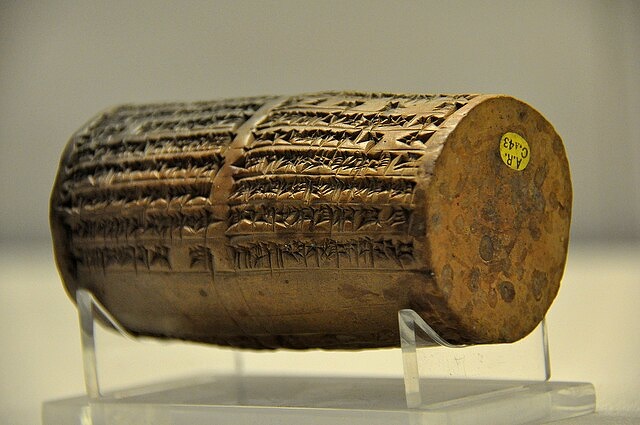
Cylinder of Nabonidus from the temple of God Sin at UR, Mesopotamia.
Nabonidus had come into conflict with the priests of Marduk, perhaps through his efforts to make Sin the chief god of the empire. A famine attributed to royal impiety, together with spiraling inflation, produced tension within the empire. Nabonidus moved to Arabia and established military and trade posts throughout the desert as far as Yatrib (later Medina) near the Red Sea. In Babylon, Belshazzar ruled as regent from 552-545. The absence of the monarch created serious religious problems, particularly for the annual Akitu or New Year festival. Finally the monarch returned to Babylon, perhaps to lead his forces against Elamite raiders in southern Babylonia. But forces in Persia were at work that were to deprive him of his crown and terminate the Neo-Babylonian empire.”
According to the Catholic Encyclopedia The move from Babylon was particularly fateful. Though it may have been inspired by reasonable strategic or even commercial considerations, it was regarded as an act of outright madness by the Babylonians and as a self-imposed exile of the king by later legend. The Book of Daniel associates this sojourn of seven years (or, in the cuneiform sources, ten years) in the desert with Nabonidus' more famous predecessor, Nebuchadnezzar, but new finds from Qumran show that other Jewish traditions linked it with the correct king. In any case, his sojourn in Arabia was resented by the population of Babylon, and the veneration of Sin there and at Haran and Ur was regarded as a veritable betrayal of Marduk, the national deity. Led by the Marduk priesthood, Babylon turned against Belshazzar, the son whom Nabonidus had left behind at the capital, and delivered the city into the waiting hands of Cyrus the Persian. In a bloodless conquest (539), he assumed control of all of Babylonia and rang down the curtain on the last native Akkadian state.
Eric A. Powell wrote in Archaeology Magazine: Archaeologists continue to study clues that might explain Nabonidus’ mysterious distant sojourn. One of the simplest explanations for Nabonidus’ 10-year absence from Babylon is that he was endeavoring to extend the might of the empire to the south and trying to gain control of the valuable trade routes of western Arabia. Other explanations offered by ancient sources — apart from the idea that the king was simply mad — include the suggestion that Nabonidus suffered from some ailment he hoped time in the desert might cure.
Parchment fragments of the Dead Sea Scrolls discovered in the Qumran caves of the West Bank offer a version of this story. These fragments preserve a literary work known as “The Prayer of Nabonidus,” which may have originally been composed by Judeans living in Babylon. Its author or authors suggest the king suffered from a severe skin condition and fled Babylon, perhaps to avoid polluting its sacred temples with his unclean body. Once in the desert, he prayed to the god of the Judeans for relief. The source of this story could have been an urban legend that arose in Babylon during Nabonidus’ absence and may have also helped inspire the account of the mad king in the Book of Daniel. Perhaps it was whispered that the king fled to the desert to pray to Sin, the moon god, for a cure to a leprosy-like malady. Other Babylonian works suggest the god, by virtue of the moon’s pitted surface, was able to cure diseases of the skin. Whether or not he had an illness that was relieved by his stay in Arabia, by 543 B.C. Nabonidus had returned to Babylon with his devotion to Sin undiminished.
Nabonidus in Saudi Arabia
At the start of Nabonidus' reign he conquered part of what is now Saudi Arabia and later chose to live at Tayma, an oasis town in what is now Saudi Arabia, until around 543 B.C. after he left Babylon. Why Nabonidus chose to live there for a long period of time is a matter of debate among historians, with some experts saying that conflicts between Nabonidus and Babylon's priests and officials is a likely reason. [Source: Owen Jarus, Live Science, September 22, 2022]
Overthrow of the Neo-Babylonians by the Persians
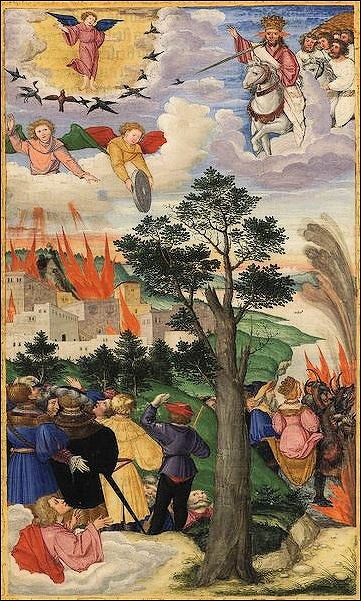
Fall of Babylon by Ottheinrich
The Neo-Babylonians gave up Babylon without a fight in October 539 B.C. to the Persian king Cyrus. Eric A. Powell wrote in Archaeology Magazine: The fall of an empire in antiquity was usually the result of complex, interconnected factors that lay beyond the scope of any one person’s control. Nonetheless, traumatized contemporaries and later historians alike have often laid the fault at the feet of a single individual. “It’s the last ruler who is usually blamed for an empire’s downfall,” says Beaulieu. Nabonidus seemed destined for just such a fate after the Persian armies of Cyrus the Great marched through Babylon’s gates. [Source: Eric A. Powell, Archaeology Magazine, March/April 2022]
By deposing Nabonidus the Persians ensured that he would be the last ruler of the Neo-Babylonian Empire (626–539 B.C.) and the last native-born Mesopotamian king. For some 2,500 years, Mesopotamian cities, states, and empires had been ruled by their own, or by outsiders who adopted their ways. But after Nabonidus (r. 556–539 B.C.), the region was conquered by a series of foreign empires before Mesopotamia’s great ancient cities such as Ur, Uruk, and Babylon finally withered away. Many sources from antiquity cast Nabonidus as the villain who brought about the downfall of Babylon, and by extension, Mesopotamia. “He was a controversial figure,” says Beaulieu, “and perhaps a tragic one.”
According to the Catholic Encyclopedia: ”Cyrus, the petty King of Anshan, had begun his career of conquest. He overthrew Astyages, King of the Medes, for which victory Nabonidus praised him as the young servant of Merodach; he overthrew Croesus of Lydia and his coalition; he assumed the title of King of the Parsu, and ha begun a new Indo-Germanic world power which replaced the decrepit Semitic civilization. At last Nabonidus, realizing the situation, met the Persians at Opis. Owing to internal strife amongst the Babylonians, many of whom were dissatisfied with Nabonidus, the Persians had an easy victory, taking the city of Sippar without fighting. Nabonidus fled to Babylon. Cyrus's soldiers, under the generalship of Ugbaru (Gobryas), Governor of Gutium, entered the capital without striking a blow and captured Nabonidus. This happened in June; in October Cyrus in person entered the city, paid homage at E-sagila to Marduk. A week later the Persians entered, at night, that quarter of the city where Belshazzar occupied a fortified position in apparent security, where the sacred vessels of Jehovah's temple were profaned, where the hand appeared on the wall writing Mane, Tekel Phares, and where Daniel was offered the third place in the kingdom (i.e. after Nabonidus and Belshazzar). That same night Belshazzar was slain and the Semitic Empire of Babylon came to an end, for the ex-King Nabonidus spent the rest of his life in Carmania. [Source: J.P. Arendzen, transcribed by Rev. Richard Giroux, Catholic Encyclopedia |=|]
“In one sense Babylonian history ends here, and Persian history begins, yet a few words are needed on the return of the Jewish captives after their seventy years of exile. It has long been supposed that Cyrus, professing the Mazdean religion, was a strict monotheist and released the Jews out of sympathy for their faith. But this king was, apparently, only unconsciously an instrument in God's hands, and the permission for the Jews to return was merely given out of political sagacity and a wish for popularity in his new domains. At least we possess inscriptions of him in which he is most profuse in his homage to the Babylonian Pantheon. As Nabonidus had outraged the religious sentiments of his subjects by collecting all their dogs in Shu-anna, Cyrus pursued an opposite policy and returned all these gods to their own worshippers; and, the Jews having no idols, he returned their sacred vessels, which Belshazzar had profaned, and gave a grant for the rebuilding of their Temple. The very phraseology of the decree given in I Esdras, i,2 sqq., referring to "the Lord God of Heaven" shows his respectful attitude, if not inclination, towards monotheism, which was professed by so many of his Indo-Germanic subjects. Darius Hystaspes, who in 521 B.C., after defeating Pseudo-Smerdis, succeeded Cambyses (King of Babylon since 530 B.C.) was a convinced monotheist and adorer of Ahuramazda; and if it was he who ordered and aided the completion of the temple at Jerusalem, after the interruption caused by Samaritan intervention, it was no doubt out of sympathy with the Jewish religion (I Esdr., vi, 1 sqq). It is not quite certain, however, that the Darius referred to is this king; it has been suggested that Darius Nothus is meant, who mounted the throne almost a hundred years later. Zerubabel is a thoroughly Babylonian name and occurs frequently on documents of that time; but we cannot as yet trace any connection between the Zerubabel of Scripture and any name mentioned in these documents.”
Image Sources: Wikimedia Commons
Text Sources: Internet Ancient History Sourcebook: Mesopotamia sourcebooks.fordham.edu , National Geographic, Smithsonian magazine, especially Merle Severy, National Geographic, May 1991 and Marion Steinmann, Smithsonian, December 1988, New York Times, Washington Post, Los Angeles Times, Discover magazine, Times of London, Natural History magazine, Archaeology magazine, The New Yorker, BBC, Encyclopædia Britannica, Metropolitan Museum of Art, Time, Newsweek, Wikipedia, Reuters, Associated Press, The Guardian, AFP, Lonely Planet Guides, “World Religions” edited by Geoffrey Parrinder (Facts on File Publications, New York); “History of Warfare” by John Keegan (Vintage Books); “History of Art” by H.W. Janson Prentice Hall, Englewood Cliffs, N.J.), Compton’s Encyclopedia and various books and other publications.
Last updated June 2024