
Home | Category: Neo-Babylonians
NEO-BABYLONIAN LIFE

Eric A. Powell wrote in Archaeology Magazine: Babylon’s New Year festival, held during the spring, was Marduk’s special holiday and the city’s most important rite. The god’s statue was carried from its home at the Esagila Temple to a series of other sanctuaries during 14 days of lavish rituals celebrated throughout the city. During this festival, the king’s sacred right to rule was renewed for another year. [Source: Eric A. Powell, Archaeology Magazine, March/April 2022]
RECOMMENDED BOOKS:
“Everyday Life in Babylon and Assyria” by Georges Contenau (1954) Amazon.com;
“The Babylonian World” by Gwendolyn Leick (2007) Amazon.com;
“The Ishtar Gate, The Processional Way, The New Year Festival of Babylon” by Joachim Marzahn (1995) Amazon.com;
“Neo-Babylonian Letters and Contracts from the Eanna Archive” (Yale Oriental Series: Cuneiform Texts) by Eckart Frahm and Michael Jursa (2011) Amazon.com;
“The Rental Houses in the Neo-Babylonian Period (VI-V Centuries BC)” by Stefan Zawadzki (2018) Amazon.com;
“Everyday Life in Ancient Mesopotamia” by Jean Bottéro (2001) Amazon.com;
“Handbook to Life in Ancient Mesopotamia” by Stephen Bertman (2002) Amazon.com;
“Ancient Mesopotamia: Life in the Cradle of Civilization” by Amanda H Podany (2018) Amazon.com;
“Society and the Individual in Ancient Mesopotamia” by Laura Culbertson, Gonzalo Rubio (2024) Amazon.com;
“Ancient Egyptian, Mesopotamian & Persian Costume” by Mary Galway Houston (1920) Amazon.com;
“Daily Life in Ancient Mesopotamia” by Karen Rhea Nemet-Nejat (1998) Amazon.com;
“A History of Babylon (2200 BC - AD 75" by Paul-Alain Beaulieu (2017) Amazon.com;
“Babylonia: A Very Short Introduction” by Trevor R. Bryce (2016) Amazon.com;
“Babylonia” by Costanza Casati (2025) Novel Amazon.com;
“The City of Babylon: A History, C. 2000 BC - AD 116" by Stephanie Dalley (2021) Amazon.com;
Herodotus on 5th Century B.C. Babylon
Herodotus wrote in “The History of the Persian Wars” ( c. 430 B.C.):“Assyria possesses a vast number of great cities, whereof the most renowned and strongest at this time was Babylon, where, after the fall of Nineveh, the seat of government had been removed.The following is a description of the place: The city stands on a broad plain, and is an exact square, a hundred and twenty furlongs in length each way, so that the entire circuit is four hundred and eighty furlongs. While such is its size, in magnificence there is no other city that approaches to it. It is surrounded, in the first place, by a broad and deep moat, full of water, behind which rises a wall fifty royal cubits in width, and two hundred in height. (The royal cubit is longer by three fingers' breadth than the common cubit.) I.179: [Source: Herodotus, “The History”, translated by George Rawlinson, (New York: Dutton & Co., 1862]
“And here I may not omit to tell the use to which the mold dug out of the great moat as turned, nor the manner wherein the wall was wrought. As fast as they dug the moat the soil which they got from the cutting was made into bricks, and when a sufficient number were completed they baked the bricks in kilns. Then they set to building, and began with bricking the borders of the moat, after which they proceeded to construct the wall itself, using throughout for their cement hot bitumen, and interposing a layer of wattled reeds at every thirtieth course of the bricks. On the top, along the edges of the wall, they constructed buildings of a single chamber facing one another, leaving between them room for a four-horse chariot to turn. In the circuit of the wall are a hundred gates, all of brass, with brazen lintels and side-posts.
“The bitumen used in the work was brought to Babylon from the Is, a small stream which flows into the Euphrates at the point where the city of the same name stands, eight days' journey from Babylon. Lumps of bitumen are found in great abundance in this river. I.180: The city is divided into two portions by the river which runs through the midst of it. This river is the Euphrates, a broad, deep, swift stream, which rises in Armenia, and empties itself into the Erythraean sea. The city wall is brought down on both sides to the edge of the stream: thence, from the corners of the wall, there is carried along each bank of the river a fence of burnt bricks. The houses are mostly three and four stories high; the streets all run in straight lines, not only those parallel to the river, but also the cross streets which lead down to the water-side. At the river end of these cross streets are low gates in the fence that skirts the stream, which are, like the great gates in the outer wall, of brass, and open on the water. I.181: The outer wall is the main defense of the city. There is, however, a second inner wall, of less thickness than the first, but very little inferior to it in strength. The center of each division of the town was occupied by a fortress.
Herodotus on the Great Temple in Babylon
Herodotus wrote in “The History of the Persian Wars” ( c. 430 B.C.): “In the one stood the palace of the kings, surrounded by a wall of great strength and size: in the other was the sacred precinct of Jupiter Belus [Bel], a square enclosure two furlongs each way, with gates of solid brass; which was also remaining in my time. In the middle of the precinct there was a tower of solid masonry, a furlong in length and breadth, upon which was raised a second tower, and on that a third, and so on up to eight. The ascent to the top is on the outside, by a path which winds round all the towers. [Source: Herodotus, “The History”, translated by George Rawlinson, (New York: Dutton & Co., 1862]
“When one is about half-way up, one finds a resting-place and seats, where persons are wont to sit some time on their way to the summit. On the topmost tower there is a spacious temple, and inside the temple stands a couch of unusual size, richly adorned, with a golden table by its side. There is no statue of any kind set up in the place, nor is the chamber occupied of nights by any one but a single native woman, who, as the Chaldaeans, the priests of this god, affirm, is chosen for himself by the deity out of all the women of the land. I.182: They also declare---but I for my part do not credit it---that the god comes down in person into this chamber, and sleeps upon the couch. This is like the story told by the Egyptians of what takes place in their city of Thebes, where a woman always passes the night in the temple of the Theban Jupiter [Amon-Ra].
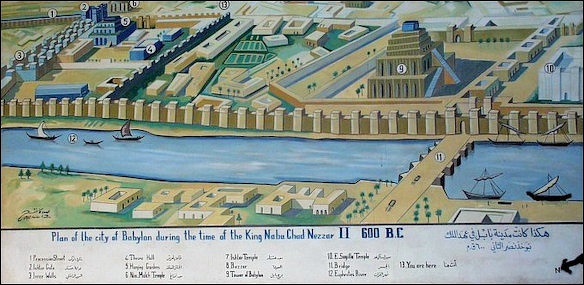
“In each case the woman is said to be debarred all intercourse with men. It is also like the custom of Patara, in Lycia, where the priestess who delivers the oracles, during the time that she is so employed — for at Patara there is not always an oracle — is shut up in the temple every night.I.183: Below, in the same precinct, there is a second temple, in which is a sitting figure of Jupiter [Marduk], all of gold. Before the figure stands a large golden table, and the throne whereon it sits, and the base on which the throne is placed, are likewise of gold.
“The Chaldaeans told me that all the gold together was eight hundred talents' weight. Outside the temple are two altars, one of solid gold, on which it is only lawful to offer sucklings; the other a common altar, but of great size, on which the full-grown animals are sacrificed. It is also on the great altar that the Chaldaeans burn the frankincense, which is offered to the amount of a thousand talents' weight, every year, at the festival of the God. In the time of Cyrus there was likewise in this temple a figure of a man, twelve cubits high, entirely of solid gold. I myself did not see this figure, but I relate what the Chaldaeans report concerning it. Darius, the son of Hystaspes, plotted to carry the statue off, but had not the hardihood to lay his hands upon it. Xerxes, however, the son of Darius, killed the priest who forbade him to move the statue, and took it away. Besides the ornaments which I have mentioned, there are a large number of private offerings in this holy precinct.” I.184:
Herodotus on Babylonian Economic Activity
Herodotus wrote in 430 B.C.:“Among many proofs which I shall bring forward of the power and resources of the Babylonians, the following is of special account. The whole country under the dominion of the Persians, besides paying a fixed tribute, is parceled out into divisions, which have to supply food to the Great King and his army during different portions of the year. Now out of the twelve months which go to a year, the district of Babylon furnishes food during four, the other of Asia during eight; by the which it appears that Assyria, in respect of resources, is one-third of the whole of Asia. Of all the Persian governments, or satrapies as they are called by the natives, this is by far the best. When Tritantaechmes, son of Artabazus, held it of the king, it brought him in an artaba of silver every day. The artaba is a Persian measure, and holds three choenixes more than the medimnus of the Athenians. He also had, belonging to his own private stud, besides war horses, eight hundred stallions and sixteen thousand mares, twenty to each stallion. Besides which he kept so great a number of Indian hounds, that four large villages of the plain were exempted from all other charges on condition of finding them in food. I.193: But little rain falls in Assyria, enough, however, to make the corn begin to sprout, after which the plant is nourished and the ears formed by means of irrigation from the river. For the river does not, as in Egypt, overflow the corn-lands of its own accord, but is spread over them by the hand, or by the help of engines. [Source: Herodotus, “The History”, translated by George Rawlinson, (New York: Dutton & Co., 1862]
“The whole of Babylonia is, like Egypt, intersected with canals. The largest of them all, which runs towards the winter sun, and is impassable except in boats, is carried from the Euphrates into another stream, called the Tigris, the river upon which the town of Nineveh formerly stood. Of all the countries that we know there is none which is so fruitful in grain. It makes no pretension indeed of growing the fig, the olive, the vine, or any other tree of the kind; but in grain it is so fruitful as to yield commonly two-hundred-fold, and when the production is the greatest, even three-hundred-fold. The blade of the wheat-plant and barley-plant is often four fingers in breadth. As for the millet and the sesame, I shall not say to what height they grow, though within my own knowledge; for I am not ignorant that what I have already written concerning the fruitfulness of Babylonia must seem incredible to those who have never visited the country. The only oil they use is made from the sesame-plant. Palm-trees grow in great numbers over the whole of the flat country, mostly of the kind which bears fruit, and this fruit supplies them with bread, wine, and honey. They are cultivated like the fig-tree in all respects, among others in this. The natives tie the fruit of the male-palms, as they are called by the Hellenes, to the branches of the date-bearing palm, to let the gall-fly enter the dates and ripen them, and to prevent the fruit from falling off. The male-palms, like the wild fig-trees, have usually the gall-fly in their fruit. I.194:
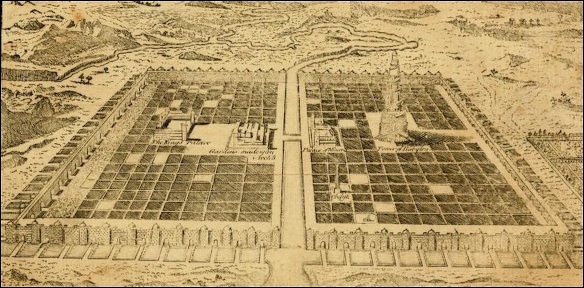
19th century European depiction of Babylon
“But that which surprises me most in the land, after the city itself, I will now proceed to mention. The boats which come down the river to Babylon are circular, and made of skins. The frames, which are of willow, are cut in the country of the Armenians above Assyria, and on these, which serve for hulls, a covering of skins is stretched outside, and thus the boats are made, without either stem or stern, quite round like a shield. They are then entirely filled with straw, and their cargo is put on board, after which they are suffered to float down the stream. Their chief freight is wine, stored in casks made of the wood of the palm-tree. They are managed by two men who stand upright in them, each plying an oar, one pulling and the other pushing. The boats are of various sizes, some larger, some smaller; the biggest reach as high as five thousand talents' burthen. Each vessel has a live ass on board; those of larger size have more than one. When they reach Babylon, the cargo is landed and offered for sale; after which the men break up their boats, sell the straw and the frames, and loading their asses with the skins, set off on their way back to Armenia. The current is too strong to allow a boat to return upstream, for which reason they make their boats of skins rather than wood. On their return to Armenia they build fresh boats for the next voyage. I.195:
Herodotus on Babylonian Customs
Herodotus wrote in 430 B.C.:“The dress of the Babylonians is a linen tunic reaching to the feet, and above it another tunic made in wool, besides which they have a short white cloak thrown round them, and shoes of a peculiar fashion, not unlike those worn by the Boiotians. They have long hair, wear turbans on their heads, and anoint their whole body with perfumes. Every one carries a seal, and a walking-stick, carved at the top into the form of an apple, a rose, a lily, an eagle, or something similar; for it is not their habit to use a stick without an ornament. I.196: [Source: Herodotus, “The History”, translated by George Rawlinson, (New York: Dutton & Co., 1862]
“Of their customs, whereof I shall now proceed to give an account, the following (which I understand belongs to them in common with the Illyrian tribe of the Eneti) is the wisest in my judgment. Once a year in each village the maidens of age to marry were collected all together into one place; while the men stood round them in a circle. Then a herald called up the damsels one by one, and offered them for sale. He began with the most beautiful. When she was sold for no small sum of money, he offered for sale the one who came next to her in beauty. All of them were sold to be wives. The richest of the Babylonians who wished to wed bid against each other for the loveliest maidens, while the humbler wife-seekers, who were indifferent about beauty, took the more homely damsels with marriage-portions. For the custom was that when the herald had gone through the whole number of the beautiful damsels, he should then call up the ugliest---a cripple, if there chanced to be one---and offer her to the men, asking who would agree to take her with the smallest marriage-portion. And the man who offered to take the smallest sum had her assigned to him. The marriage-portions were furnished by the money paid for the beautiful damsels, and thus the fairer maidens portioned out the uglier. No one was allowed to give his daughter in marriage to the man of his choice, nor might any one carry away the damsel whom he had purchased without finding bail really and truly to make her his wife; if, however, it turned out that they did not agree, the money might be paid back. All who liked might come even from distant villages and bid for the women. This was the best of all their customs, but it has now fallen into disuse. They have lately hit upon a very different plan to save their maidens from violence, and prevent their being torn from them and carried to distant cities, which is to bring up their daughters to be courtesans. This is now done by all the poorer of the common people, who since the conquest have been maltreated by their lords, and have had ruin brought upon their families. I.197:
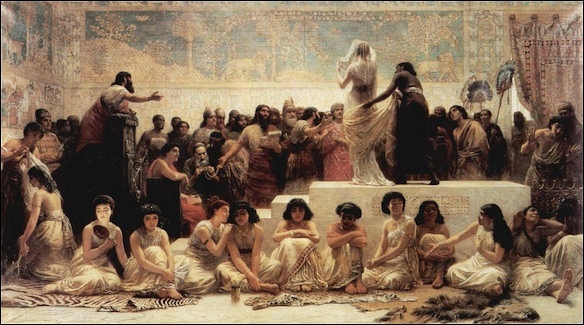
Babylon marriage market by Edwin Long
“The following custom seems to me the wisest of their institutions next to the one lately praised. They have no physicians, but when a man is ill, they lay him in the public square, and the passers-by come up to him, and if they have ever had his disease themselves or have known any one who has suffered from it, they give him advice, recommending him to do whatever they found good in their own case, or in the case known to them; and no one is allowed to pass the sick man in silence without asking him what his ailment is. I.198: They bury their dead in honey, and have funeral lamentations like the Egyptians. When a Babylonian has consorted with his wife, he sits down before a censer of burning incense, and the woman sits opposite to him. At dawn of day they wash; for till they are washed they will not touch any of their common vessels. This practice is observed also by the Arabians. I.199:
“The Babylonians have one most shameful custom. Every woman born in the country must once in her life go and sit down in the precinct of Venus [Ishtar], and there consort with a stranger. Many of the wealthier sort, who are too proud to mix with the others, drive in covered carriages to the precinct, followed by a goodly train of attendants, and there take their station. But the larger number seat themselves within the holy enclosure with wreaths of string about their heads---and here there is always a great crowd, some coming and others going; lines of cord mark out paths in all directions the women, and the strangers pass along them to make their choice. A woman who has once taken her seat is not allowed to return home till one of the strangers throws a silver coin into her lap, and takes her with him beyond the holy ground. When he throws the coin he says these words: "The goddess Mylitta prosper you" (Venus is called Mylitta by the Assyrians.) The silver coin may be of any size; it cannot be refused, for that is forbidden by the law, since once thrown it is sacred. The woman goes with the first man who throws her money, and rejects no one. When she has gone with him, and so satisfied the goddess, she returns home, and from that time forth no gift however great will prevail with her. Such of the women as are tall and beautiful are soon released, but others who are ugly have to stay a long time before they can fulfil the law. Some have waited three or four years in the precinct. A custom very much like this is found also in certain parts of the island of Cyprus. I.200: Such are the customs of the Babylonians generally. There are likewise three tribes among them who eat nothing but fish. These are caught and dried in the sun, after which they are brayed in a mortar, and strained through a linen sieve. Some prefer to make cakes of this material, while others bake it into a kind of bread. VII.63: The Assyrians went to war with helmets upon their heads made of brass, and plaited in a strange fashion which is not easy to describe. They carried shields, lances, and daggers very like the Egyptian; but in addition they had wooden clubs knotted with iron, and linen corselets. This people, whom the Hellenes call Syrians, are called Assyrians by the barbarians. The Chaldeans served in their ranks, and they had for commander Otaspes, the son of Artachaeus.”
Neo-Babylonian Legal Decisions, c. 555-427 B.C.
Judgment of False & Malicious Prosecution, First year of Nabonidus, 555 B.C.: It is clear from this case that a false suit did not, according to Babylonian law, result in a simple dismissal; a fine, equal to the sum unjustly sued for, was imposed on the plaintiff and paid to the defendant. This must have been a powerful deterrent to unjust claims, since they were likely to result in benefiting the defendant by as much as the plaintiff sought to injure him. [Source: George Aaron Barton, 'Contracts,' in Assyrian and Babylonian Literature: Selected Transactions, With a Critical Introduction by Robert Francis Harper (New York: D. Appleton & Company, 1904), pp. 276-281, Internet Ancient History Sourcebook: Mesopotamia]
“Belilit, daughter of Bel-ushezib, son of the road-master , deposed to the judges of Nabonidus King of Babylon, saying: "In the month Ab, of the first year of Neriglissar, King of Babylon, I sold Bazuzu, my slave, for half a mana five shekels of money to Nabu-akhi-iddin, son of Shula, son of Egibi; I took his note, but he has not paid the money." The judges of the king heard, and they summoned Nabu-akhi-iddin and set him before them. Nabu-akhi-iddin produced the receipt, which Belilit had given, that she had received the money, the price of Bazuzu, and showed it to the judges. Ziriya, Nabu-shum-lishir, and Ebilu had embezzled the money of Belilit, their mother; he established it before the judges. The judges deliberated and they took from Belilit one half mana five shekels of money, as much as he had paid, and gave it to Nabu-akhi-iddin. (This decision, which is signed by six judges and the clerk of the court, is dated) at Babylon, in the accession year of Nabonidus.”
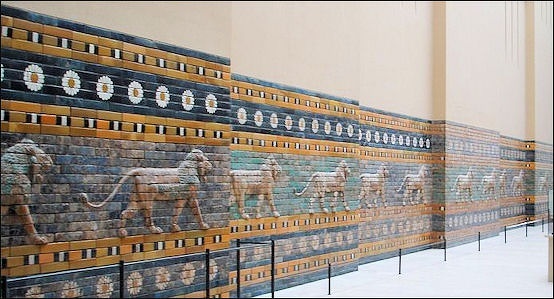
Ishtar Processional Way
Judgment of an Estate in Borsippa, Ninth year of Nabonidus, 546 B.C. The record of this suit, which bears the date of the ninth year of Nabonidus, received the signatures of six judges and two clerks. None of the judges are the same as those who signed the record of Belilit's suit except Nergal-banunu, who was then clerk of the court, but at the time of Bunanit's suit become chief justice.
“Bunanit, daughter of the Kharizite, deposed to the judges of Nabonidus, King of Babylon, saying: "Ben-Hadad-natan, son of Nikbata, took me as his wife, and received three manas of money as my dowry. I bore him one daughter. I and Ben-Hadad-natan, my husband, gained by selling and buying with the money of my dowry, and we bought eight gin of an estate, land not far beyond the midst of Borsippa, for nine and two-thirds manas of money, including two and a half manas of money which was borrowed from Iddin-Marduk, son of Basha, son of Nur-sin; we added to the other, and paid for the price of that estate; and we traded together in the fourth year of Nabonidus, King of Babylon. Since my dowry was with Ben-Hadad-natan my husband, I asked for it, and Ben-Hadad-natan in the kindness of his heart, sealed and devised to me for the future the eight gin of that estate which is in Borsippa, and declared it on my tablet, saying: "Two and a half manas of money which Ben-Hadad-natan and Bunanit from Iddin-Marduk borrowed was paid toward the price of that estate; they transacted it together.' That tablet he sealed, and wrote upon it the curse of the great gods. In the fifth year of Nabonidus, King of Babylon, I and Ben-Hadad-natan, my husband, adopted Ben-Hadad-amara. We wrote the tablet of his adoption, and we announced the dowry of Nubta, my daughter, two manas ten shekels of money, and the furniture of a house. Fate took my husband, and now Iqbi-ilu, the son of my father-in-law, has laid a claim to the estate and all which he had sealed and devised to me and upon Nabu-nur-ilani, whom we purchased through the agency of Nabu-akhi-iddin. I have brought it before you; make a decision. The judges heard their complaint; they discussed the tablets and documents which Bunanit brought before them and they granted Iqbi-ilu no power over the house in Borsippa, which instead of her dowry had been devised unto Bunanit, over Nabu-nur-ilani, whom she and her husband had bought for silver, nor over anything belonging to Ben-Hadad-natan. To Bunanit and Ben-Hadad-amara they established them in consequence of their tablets. Iddin-Marduk is paid and receives his two and a half manas of money, which they paid on the price of that estate. Afterward Bunanit shall receive the three and a half manas of her dowry, and besides her share Nubta shall receive Nabu-nur-ilani, according to the will of her father.”
Judgment for Breach of Contract, Twelfth year of Nabonidus, 543 B.C.: “Three manas fifty shekels of money, which the judges wrote on the tablet and gave to Bel-rimanni, son of Labashi-Marduk, son of Ina-Ramman-takallal, and concerning the tablet of Arad-gula and Damqana, his wife, and concerning the slaves and house which he pledged, Bel-rimanni asked. Nergal-uballit the full claim against Arad-Gula allowed, saying: "I grant the full claim, all of it, which Arad-Gula has not met, to Bel-rimanni. Upon the slaves and house, which were pledged. Bel-rimmani has brought before the judges of the king Ana-Tashmit-atkal, Amtiya, Nana-ana-biti-shu, and Zamama-iddin, the people of the house of Arad-Gula, the house which was pledged, the slaves which they had mortgaged to Bel-rimanni, according to his tablet, instead of three manas fifty shekels money, the full price, are given, received, taken; there is nothing further." And in order that there may be renewal and an appeal be made concerning those slaves to the judges, they have written a tablet, sealed it with seals, and have given it to Bel-rimanni. (The names of the judges follow, together with the date:) Babylon, Shebat twenty-sixth, twelfth year of Nabonidus.”
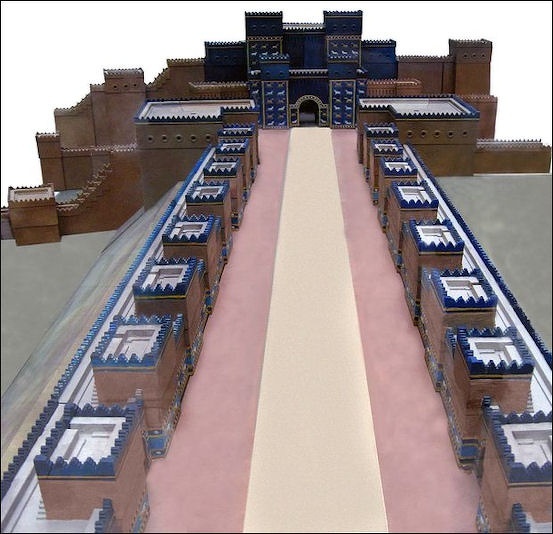
Ishtar Processional Way
A Case of Battery, Breaking & Entering, and Robbery, Eighth year of Cyrus, 529 B.C. This document bears the names of four witnesses and a scribe; it is dated Adar twenty-eighth, eighth year of Cyrus. This was not the end of the matter, as the next tablet will show. Nabu-Akhi-Uballit, son of Shu-, the inspector of the city Shakhrin-, on the twenty-eighth day of Adar, in the eighth year of Cyrus, King of Babylon, king of countries, deposed to Bel-uballit, the notary of Sippar, saying: 'I took Nana-iddin, son of Bau-ulid, into my house, saying: 'Am I the brother of your father and the inspector of the city? Why have you raised your hand against me? ' Ramman-sharra-usur, son of Nabu-ushezib; Lulgiya and Irba, his brothers; Kutka-ili, son of Bau-ulid; Bel-uballit, son of Bariki-ili; Bel-akhi-uqur, son of Ramman-ushallim; and Iqisha-apla, son of Shamash-sharra-usur, have broken open my door like demons; and from my house, when they had forced an entrance, they took one mana of my money.' The judges came and they saw the fracture of the door and the rending of the threshold. Shamash-iddin, son of Ziriya, assembled the elders of the city, and then he placed Nana-iddin under bonds to Nabu-akhi-bullit, together with Nabu-iddin, son of Pir'a, Nabu-etir-nap-shati, son of Rimut, son of , Iqibu, son of Pir'a, son of the priest of Gula, Shamash-lama', son of Submadu, Bel-ushallim, son of Bel-akhi-iddin, son of Shigua, Nabu-ushezib, son of Nabu-ukin-akhi, Ramman-sharra-usur, son of Abu-nu-epish, , son of _____. (Their hands) against him they raised, (the door of his house) (they broke), into his house (they entered). (Under the law concerning the house) they are gui(lty). Shamash-iddin, son of Ziriya, when he was rigorously examining them concerning the house, declared, saying — also Ramman-sharra-usur, son of Nabu-ushezib, Nabu-uballit, son of Bariki-ili, Irba, son of Bau-ulid, Lulgia, son of Nabu-ushezib, Bel-akhi-uqur, son of Ramman-ushallim, declared, saying — also Kutka-ili, son of Bau-ulid, Bel-Uballit, son of Bariki-ili, declared, saying: 'I was there when we drew near the door.' Ramman-sharra-usur, son of Nabu-ushezib, also declared, saying: 'I . Adar thirtieth, eighth year of (Cyrus, King of Babylon).
Pledge of Surety, Thirty-seventh year of Artaxerxes, 427 B.C.: This is clearly the record of a bond by which a man went bail for his nephew. “Bel-akhi-iddin, son of Bel-na'id, of his own free-will spoke to Bel-shum-iddin, son of Murashu, saying: 'Deliver unto me Nidintum-Bel, son of Eshi-etir, my brother, who is held in prison. I will become his surety that he does not go from Nippur to another place.' Whereupon Bel-shum-iddin, son of Murashu, hearkened to him, and delivered unto him Nidintum-Bel, son of Eshi-etir, his brother, who was held in prison. On the day when Nidintum-Bel, son of Eshi-etir, shall go without the judge's permit from Nippur to another place, Bel-akhi-iddin shall pay to Bel-shum-iddin ten manas of money. (Dated) at Nippur in the thirty-seventh year of Artaxerxes I.”
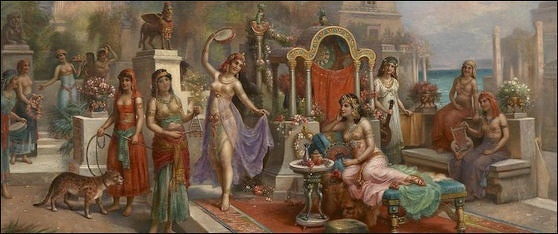
life in the Hanging Gardens
Akitu Festival
Gerald A. Larue wrote in “Old Testament Life and Literature”: “The most important religious celebration of Babylon and one that provides a background for understanding II Isaiah was the Akitu festival1 observed annually from the first to twelfth of Nisanu (Hebrew Nisan: March-April). The festal origins may lie in Sumerian times; the rites continued to be observed into the Persian-Greek period. The chief figure in the cult during the Neo-Babylonian era was Marduk, god of Babylon and supreme deity in the empire. His temple, called Esagila ("House of the Uplifted Head"), stood near the great ziggurat. [Source: Gerald A. Larue, “Old Testament Life and Literature,” 1968, infidels.org ]
“Rituals of preparation occupied the first days and included lustration rites, the carving of images of wood, which were then overlaid with gold and ornamented with jewels and semi-precious stones (Isa. 40:18-20; 41:7), and prayers for blessing. The temple was ceremonially cleansed and wiped down with the body of a sacrificed sheep and with oils.
“The recitation of the Enuma Elish,2 the creation myth of Babylon, was also part of the ritual. This myth relates the story of the birth of the gods, the battle between Marduk, champion of order, and Tiamat, symbol of chaos, and the creation of man in a god-ordered universe. Opening verses describe a time when there was neither heaven nor earth but only the watery abyss ruled by Apsu, symbol of fresh water, and his consort Tiamat, the sea. Out of the first principle, water, came heavenly beings, created in pairs. With the arrival of many offspring came noise so upsetting that Apsu and Tiamat planned to kill their grandchildren. The plot, overheard by the wise earth god Ea, was foiled with the killing of Apsu. But Tiamat was still alive. Mustering her creative powers, she formed frightful monsters and over this array placed one of her children, Kingu, pinning on his breast the tablets of destiny, symbolic of control of the future. The stage was now set for a dramatic, cosmic encounter of gods.
“When none among the gods of order was able to stand up to Tiamat and Kingu, Marduk, son of Ea and his wife Damkina, entered the arena having been promised supreme kingship should he defeat the enemy. Kingu was overcome and the tablets of destiny became the property of Marduk. Tiamat was killed and split in two, like an oyster. With one half of the dead goddess, Marduk formed the arch of the heavens and with the other half, the earth. In the realm above he set Ann the sky god, in the realm below Ea, the earth god, and between the two the air god, Enlil. Other gods were given abodes in the heavens and the stars were formed in their likeness, with constellations to mark the passage of time. The sun, moon and stars were heavenly bodies with special courses to run.
“Marduk was acknowledged as king by the other gods. To serve the needs of the deities, Marduk created man, moulding the human form out of clay mingled with the blood of the dead Kingu. A shrine was built to Marduk where the gods might visit and pay homage, and his city was called Bab-ilu or Babylon, "gate of gods."
“On the days of the Akitu festival following the recitation of the Enuma Elish the king was ritually deposed, deprived of symbols of office and compelled to make a negative confession before Marduk. Subsequently he was restored to office in a ceremony in which his face was slapped until the tears ran, a symbol that Marduk was friendly. A human scapegoat, usually a condemned prisoner, was paraded through the streets.3 Scapegoat rituals are communal purgation rites in which the sins of the community are placed upon the victim. The expulsion and destruction of the scapegoat rendered the community cleansed of taint and ready to begin the new year.4
“The next day the god Nabu (Nebo in Isa. 46:1) arrived from Borsippa, then, subsequently, the other gods. For a time Marduk disappeared later to reappear, suggesting some form of a death-resurrection emphasis. On the eleventh day, at the divine assembly held in the chamber of destiny, the fate of the nation for the coming year was determined, possibly by sacred oracles or by magic. To ensure fertility, a sacred marriage was performed. On the final day, at a great banquet accompanied by much sacrificing, the unity of the nation was cemented in commensality rites enjoyed by gods, king, priests and people. On this day the king took the right hand of the god, perhaps in a ritual in which the god was led to his throne but certainly as a symbol of divine favor and blessing (cf. Isa. 45:1). At the close of the ritual, the various gods returned to their own cities.
Ancient Tablets Reveal Life of Jews in Nebuchadnezzar's Babylon
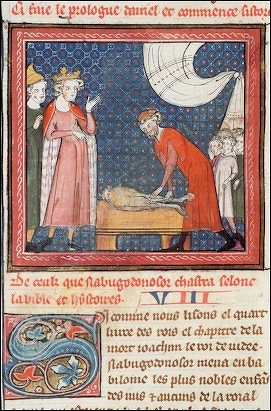
Middle Ages depiction of Nebuchadnezzar ordering the castration of Jewish youths
Ancient clay tablets discovered in Iraq and shown to the public for the first time at an exhibition in Jerusalem in 2015 revealed information for the first time on the daily life of Jews exiled to Babylon some 2,500 years ago. Luke Baker of, Reuters wrote: “The exhibition is based on more than 100 cuneiform tablets, each no bigger than an adult’s palm, that detail transactions and contracts between Judeans driven from, or convinced to move from, Jerusalem by King Nebuchadnezzar around 600 BC. [Source: Luke Baker, Reuters, February 4, 2015 -]
“Archaeologists got their first chance to see the tablets — acquired by a wealthy London-based Israeli collector — barely two years ago. They were blown away. “It was like hitting the jackpot,” said Filip Vukosavovic, an expert in ancient Babylonia, Sumeria and Assyria who curated the exhibition at Jerusalem’s Bible Lands Museum. “We started reading the tablets and within minutes we were absolutely stunned. It fills in a critical gap in understanding of what was going on in the life of Judeans in Babylonia more than 2,500 years ago.” -
The tablets, each inscribed in minute Akkadian script, detail trade in fruits and other commodities, taxes paid, debts owed and credits accumulated. The exhibition details one Judean family over four generations, starting with the father, Samak-Yama, his son, grandson and his grandson’s five children, all with Biblical Hebrew names, many of them still in use today. “We even know the details of the inheritance made to the five great-grandchildren,” said Vukosavovic. “On the one hand it’s boring details, but on the other you learn so much about who these exiled people were and how they lived.” -
Vukosavovic describes the tablets as completing a 2,500-year puzzle. While many Judeans returned to Jerusalem when the Babylonians allowed it after 539 BC, many others stayed and built up a vibrant Jewish community that lasted two millennia. “The descendants of those Jews only returned to Israel in the 1950s,” he said, a time when many in the diaspora moved from Iraq, Persia, Yemen and North Africa to the newly created state.” -
Development of The Bible During the Babylonian, Exile and Persian Periods
Gerald Larue wrote in “Old Testament Life and Literature”: “In the development of the history of Israel we have been able to see how the Torah gradually took form and reached completion in the late Persian period. The beginning of the canonization of this portion of the Bible may go back to the ancient belief that the law of the land was a divine promulgation, an idea prevalent throughout the Near East.1 The Bible bears ample evidence that the Hebrews believed that Yahweh himself wrote some of the laws (Exod. 24:12; 31:18; 32:16-16; 34:1), and that those written by Moses were dictated by Yahweh (Exod. 34:27). The formularies of the Shechem covenant were labeled "the book of the law of God" and were deposited in Yahweh's sanctuary (Josh. 24:26). The first clear move toward canonization can be seen in Deuteronomy. The Deuteronomists stated that their law was complete, with nothing to be added or removed (Deut. 4:2; 12:32); that the laws were revealed by Yahweh and were binding on all generations (Deut. 29:29); that they were designed for public proclamation (Deut. 27:4-8) but as holy writings were to be given special treatment (Deut. 31:24-26). The curses and blessings, the covenant setting, the attribution of the laws to Moses and Yahweh, make Deuteronomy the equivalent of a divinely revealed national constitution, completely removed from the sphere of ordinary literature. The use of the book in cultic settings further enhanced its unique status. During the Exile, Ezekiel's teaching that disobedience to Yahweh's will had brought divine punishment underscored the importance of those laws that purported to reveal what Yahweh demanded. [Source: Gerald A. Larue, “Old Testament Life and Literature,”1968, infidels.org ]
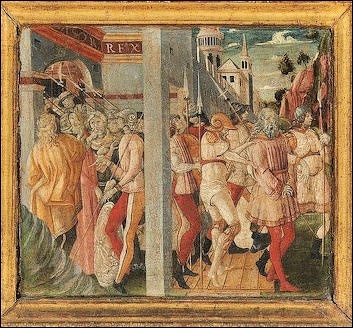
Nebuchadnezzar
“Perhaps the most important step toward canonization is recorded in the Ezra tradition. During the New Year festival, Ezra read publicly from "the book of the law" and instructed the people in the law (Neh. 7:73b-8:18). What this "law" embraced cannot be determined from the account.2 It is possible that the scroll included Deuteronomy and those parts of P compiled by Babylonian Jews during the Exile. It is unlikely that the bulk of the Pentateuch was read, although this document must have been nearing its final form. Ezra's law could not have been completely new to the listeners, and it is clear that the Chronicler is suggesting that the structure of the new community was to be determined by this law which was, therefore, automatically recognized as possessing divine authority.
“About this same time, the Samaritan canon (see below), which includes the complete Torah, came into being, and in the third century the LXX translation was made. The Law had reached its final form and had attained canonical status, but the details of this process lie hidden in the obscure history of the Exilic and early post-Exilic periods. “The oracles of the prophets were preserved by disciples (Isa. 8:16; Jer. 36) and perhaps by the temple cult. Knowledge of what the prophets had said was not restricted to the cultus or to the inner circle of disciples. Micah's words were quoted by an elder in Jeremiah's time (Jer. 26:17 ff.), and it is possible that prophetic utterances enjoyed much wider circulation than we have been willing to admit. Hosea's portrayal of Israel as an unfaithful wife and Isaiah's parable of the vineyard became standard illustrations of apostasy during the Exile.
“The fulfillment of some predictions, such as those forecasting the fall of Syria and Israel, gave eighth century prophecy special significance.3 If a prophet had foreseen events that had occurred, there was good reason to heed warnings concerning that which was yet to happen.4 When Judah collapsed in the sixth century, there could be little doubt that prophetic predictions had, once again, demonstrated their inspired basis, for only Yahweh could know and make manifest the future.”
One of the writers of Lamentations commented:
Yahweh has done what he purposed,
has carried out his threat;
as he ordained long ago,
he has demolished without pity. -Lam. 2:17
Bricks Baked from the Nebuchadnezzar II Era Absorbed a Power Surge from Earth’s Magnetic Field
Mindy Weisberger of CNN wrote: Thousands of years ago, Earth’s magnetic field underwent a significant power surge over a part of the planet that included the ancient kingdom of Mesopotamia. People at the time probably never even noticed the fluctuation, but signs of the anomaly, including previously unknown details, were preserved in the mud bricks that they baked, new research has found. [Source: Mindy Weisberger, CNN. December 27, 2023]
When scientists recently examined bricks dating from the third to the first millennia B.C. in Mesopotamia — which encompassed present-day Iraq and parts of what is now Syria, Iran and Turkey — they detected magnetic signatures in those from the first millennium, indicating that the bricks were fired at a time when Earth’s magnetic field was unusually strong. Stamps on the bricks naming Mesopotamian kings enabled researchers to confirm the time range for the magnetic spike.
Their findings corresponded with a known magnetic surge called the “Levantine Iron Age geomagnetic Anomaly,” which took place between 1050 and 550 B.C. It had previously been documented in artifacts from the Azores, Bulgaria and China using archaeomagnetic analysis — examining grains in pottery and ceramic archaeological objects for clues about Earth’s magnetic activity, scientists reported December 18 in the journal Proceedings of the National Academy of Sciences. “It is really exciting that ancient artifacts from Mesopotamia help to explain and record key events in Earth history such as fluctuations in the magnetic field,” said study coauthor Mark Altaweel, a professor of Near East archaeology and archaeological data science at the University College London’s Institute of Archaeology.
When an ancient artifact contains organic matter, such as bone or wood, scientists can learn how old it is through radiocarbon dating, which compares ratios of decay preserved in carbon isotopes. But for inorganic artifacts — pottery or ceramic objects — archaeomagnetic analysis is necessary to reveal their age, said lead study author Matthew Howland, an assistant professor in the department of anthropology at Wichita State University in Kansas.
Earth is surrounded by a magnetosphere — an invisible bubble of magnetism generated by the powerful churning of molten metals at Earth’s core. It prevents our atmosphere from being stripped away by solar winds blasting it from the sun. While the magnetosphere has been a constant presence for billions of years, its strength waxes and wanes over time. (Human health is not directly affected by magnetic field fluctuations, according to the US Geological Survey.)
Clay artifacts that were baked at high temperatures retain a “fingerprint” of Earth’s magnetism at the time in minerals such as iron oxide affected by magnetism. Retrieving that fingerprint involves a series of magnetic experiments that repeatedly heat and cool the object, exposing it to magnetic fields and then removing them. This process creates a series of new fingerprints, which are compared with the object’s original magnetic intensity.
Image Sources: Wikimedia Commons
Text Sources: Internet Ancient History Sourcebook: Mesopotamia sourcebooks.fordham.edu , National Geographic, Smithsonian magazine, especially Merle Severy, National Geographic, May 1991 and Marion Steinmann, Smithsonian, December 1988, New York Times, Washington Post, Los Angeles Times, Discover magazine, Times of London, Natural History magazine, Archaeology magazine, The New Yorker, BBC, Encyclopædia Britannica, Metropolitan Museum of Art, Time, Newsweek, Wikipedia, Reuters, Associated Press, The Guardian, AFP, Lonely Planet Guides, “World Religions” edited by Geoffrey Parrinder (Facts on File Publications, New York); “History of Warfare” by John Keegan (Vintage Books); “History of Art” by H.W. Janson Prentice Hall, Englewood Cliffs, N.J.), Compton’s Encyclopedia and various books and other publications.
Last updated June 2024