
SHIA RELIGIOUS OBLIGATIONS
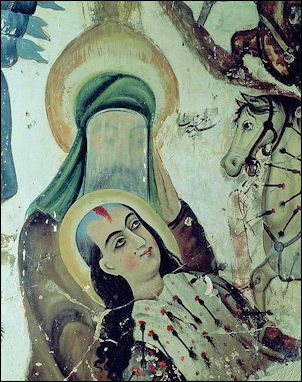
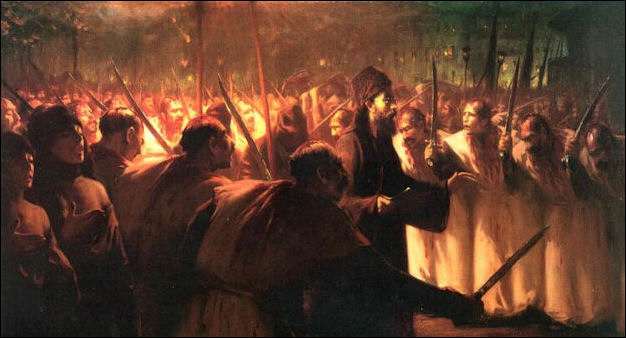
ali Tailb-Muhammad In addition to the seven principal tenets of faith, there are also traditional religious practices that are intimately associated with Shia Islam. These include the observance of the month of martyrdom, Moharram, and pilgrimages to the shrines of the Twelve Imams and their various descendants. The Moharram observances commemorate the death of the Third Imam, Husayn, who was the son of Ali and Fatima and the grandson of Muhammad. He was killed near Karbala in modern Iraq in A.D. 680 during a battle with troops supporting the Umayyad caliph. Husayn's death is commemorated by Shia with passion plays and is an intensely religious time. [Source: Library of Congress, December 1987 *]
Pilgrimage to the shrines of Imams is a specific Shia custom. The most important shrines in Iran are those for the Eighth Imam in Mashhad and for his sister Fatima in Qom. There are also important secondary shrines for other relatives of the Eighth Iman in Rey, adjacent to south Tehran, and in Shiraz. In virtually all towns and in many villages there are numerous lesser shrines, known as imamzadehs, which commemorate descendants of the imams who are reputed to have led saintly lives. Shia pilgrims visit these sites because they believe that the imams and their relatives have power to intercede with God on behalf of petitioners. The shrines in Iraq at Karbala and An Najaf are also revered by Shia. *
Twelver Shia reverence for the Imams has encouraged distinctive rituals. The most important is Ashura, the commemoration of the death of Husayn. Other practices include pilgrimages to shrines of Ali and his relatives. According to strict Wahhabi Sunni interpretations of Islam, these practices resemble the pagan rituals that the Prophet attacked. Therefore, observance of Ashura and pilgrimages to shrines have constituted flash points for sectarian problems between the Saudi Wahhabis and the Shia minority in the Eastern Province. [Source: Helen Chapin Metz, ed. Saudi Arabia: A Country Study, U.S. Library of Congress, 1992 ]
Websites on Shia Muslims (Shiites) Divisions in Islam archive.org ; Shi’a History and Identity shiism.wcfia.harvard.edu ; What is Shi'a Islam? iis.ac.uk ; History of Shi'ism: From the Advent of Islam up to the End of Minor Occultation al-islam.org ; Shafaqna: International Shia News Agency shafaqna.com ; Roshd.org, a Shia Website roshd.org/eng ; The Shiapedia, an online Shia encyclopedia web.archive.org ; Imam Al-Khoei Foundation (Twelver) al-khoei.org ; Official Website of Nizari Ismaili (Ismaili) the.ismaili ; Official Website of Alavi Bohra (Ismaili) alavibohra.org ; The Institute of Ismaili Studies (Ismaili) web.archive.org ; Four Sunni Schools of Thought masud.co.uk
RECOMMENDED BOOKS:
“An Introduction to Shia Islam: Belief system, leadership and history” by Den Väntades Vänner Amazon.com ;
“Shi'i Islam: An Introduction (Introduction to Religion) Amazon.com ;
An Introduction to Shi`i Islam: The History and Doctrines of Twelver Shi'ism
by Moojan Momen Amazon.com ;
“Shia'ism From Qur'an” by Sayed Jawad Zaidi Amazon.com ;
“The Caliph and the Imam: The Making of Sunnism and Shiism” by Toby Matthiesen Amazon.com ;
“Sunnis and Shi'a: A Political History” by Laurence Louër and Ethan Rundell Amazon.com ;
“After the Prophet: The Epic Story of the Shia-Sunni Split in Islam” by Lesley Hazleton and Blackstone Amazon.com ;
“The Prophet's Heir: The Life of Ali ibn Abi Talib” by Hassan Abbas Amazon.com ;
“The Sayings and Wisdom of Imam Ali” by Shaykh Fadhlalla Haeri, Asadullah Ad-Dhakir Yate Amazon.com ;
“The Virtues of Ali ibn Abi Talib”
by Luqman Al-Andalusi Amazon.com ;
“Ali Ibn Al-Husayn: A Critical Biography” by Abdullah Al-Rabbat Amazon.com ;
“Husayn: The Saga of Hope” by Jalal Moughania Amazon.com ;
“A Historical Research on the Lives of the 12 Shia Imams” by Dr. Mahdi Maghrebi Amazon.com ;
“The Shia Revival” by Vali Nasr Amazon.com ;
“The Shia: Identity. Persecution. Horizons” by Riyadh Al-Hakeem , Elvana Hammoud, et al. Amazon.com
Shia Customs, Laws and Practices
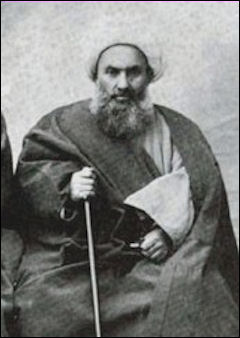
Sheikh Fazlollah Noori Shia Islam has a long association with mysticism, poetry and ritual. While Sunni Islam is known largely for its austerity and emulation of the prophet’s simple way of life, Shia Islamic is known more for its blood-letting festivals, hypnotic music and poetry and use of images, acts that are regarded as idolatrous and heretical by some Sunnis. In predominately-Sunni Egypt, which has a rich cultural tradition and lively nightlife, people say they may be Sunni in mind but they are Shia in heart. In Cairo, Sunnis fill the streets to celebrate the birthdays of Shia saints and pay their respects to the head of Hussein in Cairo’s Shrine of Imam Hussein.
"Khite"is ancient custom practiced by Shia in which hair is removed from the cheeks and eyebrows using twists of cotton thread. Under Shia law, women get a larger share of inheritance than Sunnis. In some places there is tradition of Sunnis converting to Shia Islam so their daughters can receive a larger inheritance share.
Some have argued that Shia Islam is more compatibly with democracy than Sunni Islam because it isn’t so tied to the Qur’an. One of the leading liberal Muslim scholars is Abdolkarim Soroush, an Iranian Shia. But on the other hand a lot of anti-American and anti-West vitriol has come out of mouths of Shia leaders, a trend popularized by Ayatollah Khomeini after the Iranian Revolution in 1979. The Lebanese Shia group Hezbollah is widely respected in the Muslim world for standing up to the Israelis.
Shia have their own legal school of Sharia law that defines ways of doing prayer actions, going about personal relations and treating criminals that are different than those of Sunnis. Legal precedents are reached on the basis of decisions made with imam rather than made by the Muslim community, which is the case with the four main Sunni Sharia schools. The primary schools of law for Shia are the Jafari and Zaydi schools.
Sunni judges are known following Islamic law to the letter. Shia judges are known for being more lenient in interpreting the law. Sufis are known for taking an even more relaxed view on sharia. Shia law refuses to accept traditions not transmitted through Ali or one of his descendants. It rejects the doctrine of ijma (coming to a decision by consensus), and says Muslim law can only be interpreted by the Imams of the House of Ali.
Shia Mosques and Homes
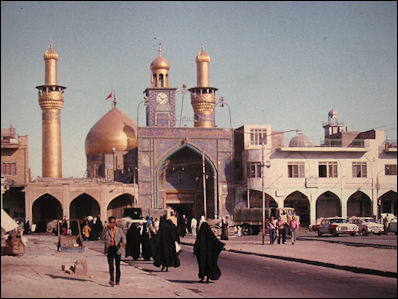
Kerbala Mosque in Iraq Sunni mosques tend to have domes and minarets. Shia often worship at Huseiniyas, which combine the functions of a mosque and community center and don’t necessarily have domes. In Iraq, Shia places of worships are often draped with traditional green and black flags and are decorated with portraits of Ali and sometimes Hussein. Sunni mosques tend to be more austere; portraits of any kind are regarded as forms of idolatry. [Source: Time magazine, March 15. 2007]
Shia fondness of portraits often extends to their homes. An image of Ali is often hung on the walls of their living rooms. Sunnis tend to favor calligraphy with quotations from the Qur’an. During important religious occasions Shia may unfurl colorful flags on their roof. Sometimes Sunnis display a white flag when they have returned from the Hajj.
Shia fondness of portraits also extends to their vehicles. Shia often have pictures or stickers of Ali in their cars, especially in their rear windows. The also like to hang religious amulets (like a strip of green called am “Alek”) from the rear view mirrors. In Iraq, such markers can be dangerous. In the mid 2000s, it was not uncommon for Sunni militias to pull over cars with Ali stickers and murder the passengers,
Shia Prayers and Prayer Positions
Shia and Sunnis hold their hands in different positions when they pray. Shia tend to hold their arms straight down and with their hands in front them with their palms touching the body or facing downwards. Sunnis cross their arms just over the rib cage. A Shi'a at prayer can often be identified by a small tablet of clay from a holy place (often Karbala), on which they place their forehead whilst prostrating. [Source: BBC, Time magazine, March 15. 2007]
During prayers members of both sects kneel, bend and touch their foreheads to the ground. Devout Shia touch their heads to a small clay disc, known as a “turba”, made in to the holy city of Najaf. Over time the “turba” can make a small callus on the forehead. Some Sunnis develop calluses from rubbing their forehead against their prayer mats.
All Muslims are required to pray five times a day. Sunnis have five separate prayer times. Shia have the option of doubling up their prayers and praying at three prayer times (before sunrise and twice in the afternoon at one's discretion). On the call to prayer Shia add “Come to the best deed” after “Come to security” and add Ali’s name to those of God and the Prophet Muhammad. Shia also have a special ritual ablution and their call to prayer is typically a couple minutes behind those of Sunnis.
During Ramadan, Sunnis and Shia often break the fast at different times and observe their celebrations a day or two apart. In Iraq, the Shia-dominated government angered Sunnis when it decided to hang Saddam Hussein on the first day of Sunni Eid in 2006. The festival started the next day for Shia.
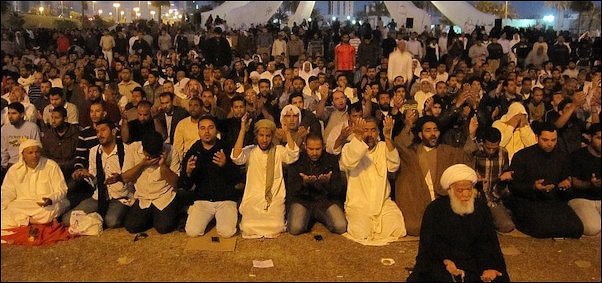
Shia prayers
Shia Holy Sites
The two holiest sites in Shia Islam after Mecca and Medina are the Imam Ali Mosque in Najaf and the Imam Husayn shrine in Karbala. A significant practice of Shia Islam is that of visiting the shrines of Imams in Iraq and in Iran. In Iraq, these include the tomb of Imam Ali in An Najaf and that of his son, Imam Husayn, in Karbala, because both are considered major Shia martyrs. Before the Iran-Iraq War (1980-88), tens of thousands made the visits each year. Other principal pilgrimage sites in Iraq are the tombs of the Seventh Imam and the Ninth Imam at Kazimayn near Baghdad. In Iran, pilgrimage sites include the tomb of the Eighth Imam in Mashhad and that of his sister in Qom. Such pilgrimages originated in part from the difficulty and the expense of making the hajj to Mecca in the early days. [Source: Library of Congress *]
Pilgrimage to the shrines of Imams is a specific Shia custom. The most important shrines in Iran are those for the Eighth Imam in Mashhad and for his sister Fatima in Qom. There are also important secondary shrines for other relatives of the Eighth Iman in Rey, adjacent to south Tehran, and in Shiraz. In virtually all towns and in many villages there are numerous lesser shrines, known as imamzadehs, which commemorate descendants of the imams who are reputed to have led saintly lives. Shia pilgrims visit these sites because they believe that the imams and their relatives have power to intercede with God on behalf of petitioners. The shrines in Iraq at Karbala and An Najaf are also revered by Shia. [Source: Library of Congress, December 1987]
See Separate Article: SHIA (SHIITE) HOLY SITES africame.factsanddetails.com
Shia Festivals
In addition to the seven principal tenets of faith, there are also traditional religious practices that are intimately associated with Shia Islam. These include the observance of the month of martyrdom, Muharram, and pilgrimages to the shrines of the Twelve Imams and their various descendants. The Muharram observances commemorate the death of the Third Imam, Husayn, who was the son of Ali and Fatima and the grandson of Muhammad. He was killed near Karbala in modern Iraq in A.D. 680 during a battle with troops supporting the Umayyad caliph. Husayn's death is commemorated by Shia with passion plays and is an intensely religious time. [Source: Library of Congress, December 1987 *]
Ashura, a festival that marks the the Martyrdom of Imam Hussein, is the most important Shia event, one that is not observed by Sunnis. Held on Tenth Day of Muharram (the 1st Lunar Month), it commemorates the murder of Hussein, the grandson of the Prophet Muhammad, who was slaughtered with thousands of others at the battle of Karbala in A.D. 680 between supporters of Hussein ibn Ali and troops supporting the Umayyad caliph. During the days leading to the battle, there were by some accounts only 72 companion (warriors) vs thousands on other side. The first nine days of Muharram solemnly recount the tragedy. On the tenth morning, the day on which Hussein was murdered, people form barefoot processions in the streets of Karbala and carry black and green banners and models of the martyr's mausoleum. Similar processions are held in other Shia areas.
Arba'een is a Shia festival that marks the end of the 40 day mourning period of Iman Hussein, the prophet Muhammad’s grandson and the martyr killed near Karbala. Many mark the event by making a pilgrimage to Karbala, with some walking the entire distance from Baghdad to Karbala. Many wear black and carry flags. Little tents and open air kitchen are set up along the route to offer rice and soups in keeping with the Shia custom to offering food and drink to pilgrims.
See Separate Article: SHIA (SHIITE) FESTIVALS OF ASHURA AND ARBA'EEN factsanddetails.com
Shia Hadith, Sunnah and Mahdi
According to the BBC: “Initially the difference between Sunni and Shi'a was merely a question of who should lead the Muslim community. As time went on, however, the Shi'a began to show a preference for particular Hadith and Sunnah literature. [Source: BBC, August 19, 2009 |::|]
“Interpretation of the Hadith and Sunnah is an Islamic academic science. The Shi'a gave preference to those credited to the Prophet's family and close associates. The Sunnis consider all Hadith and Sunnah narrated by any of twelve thousand companions to be equally valid. Shi'as recognise these as useful texts relating to Islamic jurisprudence, but subject them to close scrutiny. Ultimately this difference of emphasis led to different understandings of the laws and practices of Islam. |::|
“The concept of the Mahdi is a central tenet of Shi'a theology, but many Sunni Muslims also believe in the coming of a Mahdi, or rightly guided one, at the end of time to spread justice and peace. He will also be called Muhammad and be a descendant of the Prophet in the line of his daughter Fatima (Ali's wife). The idea has been popular with grassroots Muslims due to the preaching of several Sufi or mystical trends in Islam.
Muharram
“Over the centuries a number of individuals have declared themselves the Mahdi come to regenerate the Muslim world, but none has been accepted by the majority of the Sunni community. However, some more Orthodox Sunni Muslims dispute the concept of the Mahdi because there is no mention of it in the Qur'an or Sunnah. |::|
Shia Marriage and Divorce Practices
One distinctive and frequently misunderstood Shia practice is mutah, temporary marriage. Mutah is a fixed-term contract that is subject to renewal. It was practiced by the first community of Muslims at Medina but was banned by the second caliph. Mutah differs from permanent marriage in that it does not require divorce to terminate it. It can be for a period as short as an evening or as long as a lifetime. The offspring of such an arrangement are the legitimate heirs of the man. [Source: Helen Chapin Metz, Library of Congress, 1988 *]
Shia practice differs from that of the Sunnis concerning both divorce and inheritance in that it is more favorable to women. The reason for this reputedly is the high esteem in which Fatima, the wife of Ali and the daughter of the Prophet, was held.
Shia Music in Iraq
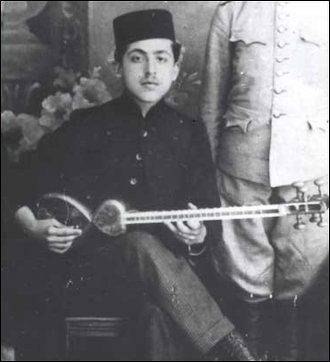
Moteza Neydavoud, a Jewish musician, who became a master of Persian music
Alissa J. Rubin wrote in the Los Angeles Times: “The heart of Baghdad's Shia life is in Kadhimiya, one of the city's oldest neighborhoods. Cantilevered windows lean out from wooden houses over the narrow dirt streets; the outdoor market is so thick with merchants' booths that each awning touches the next. Small wooden doorways lead into warrens of tiny shops, apothecaries, barbers and cloth sellers. At the very back of one of these dark hallways is a small jewelry store no more than 6 feet across and perhaps 8 or 9 feet deep. On a February afternoon, four men are inside, two of them chatting and the other two etching religious messages in fine calligraphy onto gold jewelry. A small boy rushes in periodically with trays of heavily sugared tea. Portraits of revered Shia leaders watch over the proceedings: Muhammad Sadeq Sadr, with his snow-white beard, and his darker-bearded brother, Muhammad Bakr Sadr. Both are believed to have been assassinated on Hussein's orders. [Source: Alissa J. Rubin, Los Angeles Times, May 8, 2005]
“The hunched jewelers are more than craftsmen. They are the "poets of the Husseini pulpit," singers from a tradition stretching back more than 10 centuries. They sing the story of the martyrdom of Imam Hussein, in versions ancient and contemporary, urban and Bedouin. It is a form of a cappella music that strikes a chord in almost every Shia who hears it, seeming at once ancient and utterly current. The men in the shop are reciters, or singers; generally, the poems have been handed down through an oral tradition or are written by contemporaries."Most of my thinking is spiritual. I go deeper and deeper into each word I utter and also have before my eyes the image of the death of Imam Hussein," Haider abu Ameer, 23, says as he pauses in his engraving. Then, he lays down his tools and begins to sing.
The melody is lilting, yet carries a sadness so eloquent it brings many listeners to tears. The sound fills the small shop and seeps out under the door. It draws neighborhood children who, their noses pressed to the glass, listen from outside. Ameer closes his eyes as his voice rises and falls by half and quarter tones. Much more than a jewelry shop, this is a gathering place for Husseini pulpit singers. Many of them work the two jobs — engraver and singer. "There have been attempts over the centuries to extinguish the tradition of the Husseini pulpit," says the singer Talib, 33, sitting in the shop listening to the conversation, a white shawl covering his head. "But it has been around for 1,400 years. There is no end to such a school. Saddam's regime tried to diminish us as well, but we were able to continue."
“The Kadhimiya neighborhood has two flourishing schools that teach the art of Husseini pulpit singing. There are more in other Shia areas of Baghdad as well as in Najaf and Karbala. Some graduates of the four-year schools become professionals and sing at religious festivals; others confine their performances to their own families. Some become teachers or travel to start Husseini pulpit schools in other places. The singers, in demand for weddings and funerals, are almost always present on the Shia' high holidays, when corps of men walk in formation, alternately clapping their hands, beating their chests and hitting themselves with ropes or chains, as poets of the pulpit sing Imam Hussein's story. "The suffering which we have 'lived under is part of a cycle of actions and reactions," Talib says. "And our suffering is rewarded by God."”
Shia Islamic Education in Iraq

Mustansiriya University (founded as a madrassah) in Baghdad
Alissa J. Rubin wrote in the Los Angeles Times: “The signs began to appear in the Shia neighborhoods of Baghdad and in the larger cities across southern Iraq just a few months after Saddam Hussein's disappearance from the capital. "Classes in Qur’an, Tuesdays, Thursdays and Saturdays," and then, "Classes for Girls and Boys." By the fall of 2003, announcements blared from mosque loudspeakers. One proclaimed, "We are calling all women to join religious school. Secondary school certificates necessary. They will have to pass an exam. Classes start Saturday. Registration is at the Kadhimiya hospital." [Source: Alissa J. Rubin, Los Angeles Times, May 8, 2005]
“And women came. At first in small groups, then dozens, then scores. The clerics who ran some of the schools puzzled over how to accommodate them. In strict Islamic settings, men and women must attend separate classes, sometimes even at different times of the day. "We started out just meeting once a week. Right away, we had to go to twice a week. Now we are trying to add a third class because the women want it," Salah Ubaidi says at a low-slung, modern Arab house in Kadhimiya donated by a wealthy Shia from the United Arab Emirates for use as a religious school. In Iraq, Shia clerics, including Grand Ayatollah Ali Sistani, encourage women to take part in politics and pursue an education, although they expect them to wear head scarves and abayas. In the domestic sphere, women are expected to allow their rights to be governed by Sharia — Islamic law.
“On that particular day, the instruction is for men. In the classrooms for theology lessons, students sit on rugs, and instead of desks there are rows of low wooden Qur’an holders that — like the stands on which preachers place the Bible — allow the book to stay open. Other classrooms have rows of computers, and just before lunch a class gets underway in how to use the Internet for research.
“In another Shia neighborhood, a 100-year-old school that had been used by the Baath Party as a neighborhood headquarters is searching for a female teacher. Sheik Hassan Tuaima, who teaches women twice a week in two-hour sessions, needs the help. In a neon-lighted classroom, about 25 women ranging from their late teens to their 40s, one or two quieting children they have brought along, listen closely to Hassan's lecture. Several interrupt him with questions, and Hassan looks away as he answers. In Iraqi Muslim culture, it is considered rude for a man to look a woman in the eye when he is speaking to her.
“After class, as they drink juice with Hassan, the students turn to a reporter and several talk animatedly about the hijab controversy in France, where the head covering was banned from public schools. "You need to write very clearly about this," admonishes Fatima, 25, who studied engineering at college. "This is about religious freedom. The hijab is a sign of our faith, like Christians wearing a cross. Why shouldn't we be allowed to wear it?"”
Image Sources: Wikimedia Commons
Text Sources: Internet Islamic History Sourcebook: sourcebooks.fordham.edu ; Arab News, Jeddah; “Islam, a Short History” by Karen Armstrong; “A History of the Arab Peoples” by Albert Hourani (Faber and Faber, 1991); “World Religions” edited by Geoffrey Parrinder (Facts on File Publications, New York); “Encyclopedia of the World’s Religions” edited by R.C. Zaehner (Barnes & Noble Books, 1959); Metropolitan Museum of Art, Encyclopedia.com, National Geographic, BBC, New York Times, Washington Post, Los Angeles Times, Smithsonian magazine, The Guardian, Al Jazeera, The New Yorker, Time, Newsweek, Reuters, Associated Press, AFP, Library of Congress and various books and other publications.
Last updated April 2024