
SHIA IMAMATE

Iman Reza shrine in Mashhad, Iran
Shia Muslims hold the fundamental beliefs of other Muslims. In addition to these tenets, however the distinctive dogma and institution of Shia Islam is the Imamate, which includes the idea that the successor of Muhammad be more than merely a political leader. The Imam must also be a spiritual leader, which means that he must have the ability to interpret the inner mysteries of the Quran and the shariat. In Sunni Islam an imam is the leader of congregational prayer. Among the Shia of Iran the term imam traditionally has been used only for Ali and his eleven descendants. [Source: Library of Congress *]
The Shia doctrine of the Imamate was not fully elaborated until the tenth century. The Imamate began with Ali, who is also accepted by Sunni Muslims as the fourth of the "rightly guided caliphs" to succeed the Prophet. Shia revere Ali as the First Imam, and his descendants, beginning with his sons Hasan and Husayn (also seen as Hosein), continue the line of the Imams. *
Shia believe that their imam are infallible leaders like a pope who disclosed the true meaning of the Qur’an and provided in guidance for daily life. Various groups of Shia recognize different numbers of “imams” . The largest sect acknowledges 12 and they are known as the Ithnasharo ("Twelver") sect. They believe the 12 imans are descendants of the Prophet and perfect teachers, who were inspired by God to provide authoritative guidance and guide the faithful from paradise.
Websites on Shia Muslims (Shiites) Divisions in Islam archive.org ; Shi’a History and Identity shiism.wcfia.harvard.edu ; What is Shi'a Islam? iis.ac.uk ; History of Shi'ism: From the Advent of Islam up to the End of Minor Occultation al-islam.org ; Shafaqna: International Shia News Agency shafaqna.com ; Roshd.org, a Shia Website roshd.org/eng ; The Shiapedia, an online Shia encyclopedia web.archive.org ; Imam Al-Khoei Foundation (Twelver) al-khoei.org ; Official Website of Nizari Ismaili (Ismaili) the.ismaili ; Official Website of Alavi Bohra (Ismaili) alavibohra.org ; The Institute of Ismaili Studies (Ismaili) web.archive.org ; Four Sunni Schools of Thought masud.co.uk
RECOMMENDED BOOKS:
“Rationale of Shia Beliefs: From The Qur’an, Prophet’s Traditions And History” Book 1 of 3: Shia Islam | by Dr. Mahmood Yoosuf Abdulla Amazon.com ;
“An Introduction to Shia Islam: Belief system, leadership and history” by Den Väntades Vänner Amazon.com ;
“Doctrines of the Twelver Shiite” by Abdurrahman bin Sa’d bin Ali Al-Shathri Amazon.com ;
“Shi'i Islam: An Introduction (Introduction to Religion) Amazon.com ;
An Introduction to Shi`i Islam: The History and Doctrines of Twelver Shi'ism
by Moojan Momen Amazon.com ;
“Shia'ism From Qur'an” by Sayed Jawad Zaidi Amazon.com ;
“The Caliph and the Imam: The Making of Sunnism and Shiism” by Toby Matthiesen Amazon.com ;
“Sunnis and Shi'a: A Political History” by Laurence Louër and Ethan Rundell Amazon.com ;
“After the Prophet: The Epic Story of the Shia-Sunni Split in Islam” by Lesley Hazleton and Blackstone Amazon.com ;
“The Prophet's Heir: The Life of Ali ibn Abi Talib” by Hassan Abbas Amazon.com ;
“The Sayings and Wisdom of Imam Ali” by Shaykh Fadhlalla Haeri, Asadullah Ad-Dhakir Yate Amazon.com ;
“The Virtues of Ali ibn Abi Talib”
by Luqman Al-Andalusi Amazon.com ;
“Ali Ibn Al-Husayn: A Critical Biography” by Abdullah Al-Rabbat Amazon.com ;
“Husayn: The Saga of Hope” by Jalal Moughania Amazon.com ;
“A Historical Research on the Lives of the 12 Shia Imams” by Dr. Mahdi Maghrebi Amazon.com ;
“The Shia Revival” by Vali Nasr Amazon.com ;
“The Shia: Identity. Persecution. Horizons” by Riyadh Al-Hakeem , Elvana Hammoud, et al. Amazon.com
Shia Beliefs

Ayatollah Khomeini expounded the doctrine of velayat-e faqih
All Shia Muslims believe there are seven pillars of faith, which detail the acts necessary to demonstrate and reinforce faith. The first five of these pillars are shared with Sunni Muslims. They are shahada, or the confession of faith; namaz, or ritualized prayer; zakat, or almsgiving; sawm, fasting and contemplation during daylight hours during the lunar month of Ramadan; and hajj, or pilgrimage to the holy cities of Mecca and Medina once in a lifetime if financially feasible. The other two pillars, which are not shared with Sunnis, are jihad — or crusade to protect Islamic lands, beliefs, and institutions, and the requirement to do good works and to avoid all evil thoughts, words, and deeds. [Source: Library of Congress *]
One distinctive and frequently misunderstood Shia belief is taqiyah, religious dissimulation. Taqiyah, condemned by the Sunnis as cowardly and irreligious, is the hiding or disavowal of one's religion or its practices to escape the danger of death from those opposed to the faith. Persecution of Shia Imams during the Umayyad and Abbasid caliphates reinforced the need for taqiyah. A further belief of Shia Muslims concerns divine justice and the individual's responsibility for his acts, which are judged by a just God. This contrasts with the Sunni view that God's creation of man allows minimal possibility for the exercise of free will. [Source: Helen Chapin Metz, Library of Congress, 1988 *]
A characteristic of Shia Islam is the continual exposition and reinterpretation of doctrine. The most recent example is Khomeini's expounding of the doctrine of velayat-e faqih , or the political guardianship of the community of believers by scholars trained in religious law. This has not been a traditional idea in Shia Islam and is, in fact, an innovation. The basic idea is that the clergy, by virtue of their superior knowledge of the laws of God, are the best qualified to rule the society of believers who are preparing themselves on earth to live eternally in heaven. The concept of velayat-e faqih thus provides the doctrinal basis for theocratic government, an experiment that Twelver Imam Shia had not attempted prior to the Iranian Revolution in 1979.
Shia, Miracles and Saints
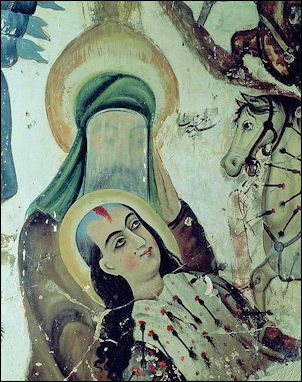
ali Tailb-Muhammad Shia have a stronger belief in miracles than Sunnis. The Jamkaran shrine in Qom has been a destination for pilgrims seeking miracle cures for a thousand years. A cleric at the shrine told the Los Angeles Times, “A prayer in the Jamkaran Mosque is almost like going to Mecca...If someone comes each week, 40 times in 40 weeks, he can be worthy to meet the Mahdi when he returns.”
One worker at the shrine told the Los Angeles Times that she saw a 13-year-old who was very ill suddenly stand up cured. “People were crying, You could not hear the loudspeaker,” she said. In 1998, the Registry of Divine Acts of Mercy was set up at Jamkaran shrine to investigate reported miracle cures. As of 2002, six miracles out 270 claims had been authenticated.
Describing the scene at Jamakran, John Daniszewski wrote in the Los Angeles Times, “Thousands of people arrive her by car and bus. Beneath the twinkling lights of the blue-tiled mosque, they sit on the carpets, following prayers broadcasts over loudspeakers: families, pilgrims from distant provinces, young men frantic was expectation, women hoping for cures...The devout make their way to the back of the shrine. There, they write their hopes, dreams and prayers onto slips of paper that they drop into two wells — one for men, one for women. The pray, eyes squeezed shut, until politely moved along by mosque workers.”
Sunnis have traditionally frowned upon the worship of saints and shrines as a distraction from the worship of Allah that borders on the worship of idols. Shia and Sufis look upon on visits to shrines as meritorious forms or religious worship. Visiting the shrines of important Imam is central to the Shia faith.
The worship of saints has been part of Islam since the very beginning. The Qur’an speaks of friends of God (“awilya’ Allah” ). Among this those have attracted a great deal of attention are Fatimah, Muhammad’s favorite daughter, and Ali, his cousin and son-in-law. Muslims who honor local saints and holy men worship their relics and invoke their names for protection and blessings. Many Sunni Muslims look down upon these activities as forms of idolatry.
According to the BBC: “The Wahabi movement within Sunni Islam views the Shi'a practice of visiting and venerating shrines to the Imams of the Prophet's Family and other saints and scholars as heretical. Most mainstream Sunni Muslims have no objections. Some Sufi movements, which often provide a bridge between Shi'a and Sunni theologies, help to unite Muslims of both traditions and encourage visiting and venerating these shrines. |[Source: BBC, August 19, 2009 |::|]
Shia Free Will
Predetermination is primarily a Sunni belief. Shia affirm man's free will. Some Muslims believe “God determines all things, but humans are responsible for acquiring the possibilities God creates for them." There are a number of Qur’anic verses that proclaim human responsibility and declare that men will be rewarded or punished on the Judgment Day depending on the deeds they perform in their life.
The Shia belief is essentially as follows: “Human reason is competent to determine good and evil, except in such matters as religious obligation. Men do not themselves possess the power to create actions which belongs to God alone, but they are invested by God with volition whereby they can chose to do good or evil actions, and thus everyone is liable to reward or punishment in future life." [Source: Encyclopedia of the World's Religion, H.A.R. Gibb]

Shia prayers
The beliefs that free will and reasoning have a place in Islam were advocated by scholars influenced by Greek philosophy. Some of their ideas — such as reasoning contradicts revelation — undermined the very foundation of Islam. Conservative Muslims argue against free will, stating that to do so is second guessing Allah and reckoning that someone other than God is involved in the act of Creation. Some go even farther and say that anything that comes into existence as a “consequence” of human action is an allusion and the consequence exists only because God allows it. In doing this God creates beliefs and non-beliefs, piety and impiety as well as concrete things like people and animals. These beliefs remain at the heart of Sunni beliefs today. Tied in to these argument is a suspicion of applying reasoning to the Qur’an and matters of faith.
Image Sources: Wikimedia Commons
Text Sources: Internet Islamic History Sourcebook: sourcebooks.fordham.edu ; Arab News, Jeddah; “Islam, a Short History” by Karen Armstrong; “A History of the Arab Peoples” by Albert Hourani (Faber and Faber, 1991); “World Religions” edited by Geoffrey Parrinder (Facts on File Publications, New York); “Encyclopedia of the World’s Religions” edited by R.C. Zaehner (Barnes & Noble Books, 1959); Metropolitan Museum of Art, Encyclopedia.com, National Geographic, BBC, New York Times, Washington Post, Los Angeles Times, Smithsonian magazine, The Guardian, Al Jazeera, The New Yorker, Time, Newsweek, Reuters, Associated Press, AFP, Library of Congress and various books and other publications.
Last updated April 2024