
Home | Category: Islam, Muslims, God and Religion
MUSLIM AMERICANS
According to Pew Research Center there are about 3.45 million Muslims in the U.S., and they make up about 1.1 percent of the U.S. population. This is based on an analysis of census statistics and data from a 2017 survey of U.S. Muslims. Based on the same analysis, Pew Research Center also estimates that there are 2.15 million Muslim adults in the country, and that a majority of them (58 percent) are immigrants.[Source: Michael Lipka, Pew Research Center, August 9, 2017]
Pew’s demographic projections estimate that Muslims will make up 2.1 percent of the U.S. population by the year 2050, surpassing people who identify themselves as Jewish on the basis of religion. This would mean that at that time Islam would be the second faith in the U.S. after Christianity (not including people who say they have no religion). A 2013 Pew Research Center report estimated that the Muslim share of immigrants granted permanent residency status (green cards) increased from about 5 percent in 1992 to roughly 10 percent in 2012, representing about 100,000 immigrants in that year.
By some estimates Islam is the fastest growing religion in the United States. . In 1960, there were 100,000 Muslim. Today there are more numerous than Presbyterians, Episcopalians and Mormons outnumber Quakers, Unitarians, Seventh-Day Adventists, Mennonite, Jehovah's Witnesses and Christian scientists combined. According to some sources (a lot of using data from place or origin and including all family members of people identified as Muslim) there are over 2 million Muslims now in the U.S. and they are more numerous than Jews.
As of 2001, there were 1,209 mosques in the United States. About 2 mullion American Muslims were associated with these mosque. Of those who attended regularly 75 percent were male, 25 percent were of Arab descent and 30 percent were African-Americans. The number Muslims associated with each mosque rose from 485 on 1994 to 1,625 in 2000. Mosques often have members from two dozen or so nationalities. At that time about 15,000 Muslims served in the U.S. military. In 2015, there were approximately 5,896 American Muslims serving in the United States military Because Muslims are so diverse and many are newcomers and small minorities where they live they lack political power.
For the complete article from which most of the material here is derived see “ Demographic portrait of Muslim Americans” by Pew Research Center pewresearch.org/religion
Websites and Resources: Islam IslamOnline islamonline.net ; Institute for Social Policy and Understanding ispu.org; Islam.com islam.com ; Islamic City islamicity.com ; BBC article bbc.co.uk/religion/religions/islam ; University of Southern California Compendium of Muslim Texts web.archive.org ; Encyclopædia Britannica article on Islam britannica.com ; Islam at Project Gutenberg gutenberg.org ; Muslims: PBS Frontline documentary pbs.org frontline
RECOMMENDED BOOKS:
“American Muslims in an Emerging World” by Bilal Irfan Amazon.com ;
“The Autobiography of Malcolm X” Amazon.com ;
“American Muslim: An Immigrant's Journey” by Saima Adil Sitwat Amazon.com ;
“All-American Muslim Girl” by Nadine Jolie Courtney Amazon.com ;
“Muslims of the World: Portraits and Stories of Hope, Survival, Loss, and Love” by Sajjad Shah , Iman Mahoui, et al. Amazon.com ;
“A History of the Muslim World: From Its Origins to the Dawn of Modernity”
by Michael A. Cook, Ric Jerrom, et al. Amazon.com ;
“Beyond Belief: Islamic Excursions Among the Converted People” by V.S. Naipul (1998) Amazon.com ;
“Islam Explained: A Short Introduction to History, Teachings, and Culture” by Ahmad Rashid Salim Amazon.com ;
“No God but God” by Reza Aslan Amazon.com ;
“Welcome to Islam: A Step-by-Step Guide for New Muslims” by Mustafa Umar Amazon.com ;
“The New Muslim's Field Guide” by Theresa Corbin, Kaighla Um Dayo Amazon.com ;
“Islam, a Short History “ by Karen Armstrong Amazon.com ;
“Muhammad: A Prophet for Our Time” by Karen Armstrong Amazon.com ;
“The Messenger: The Meanings of the Life of Muhammad” by Tarqi Ramadan Amazon.com ;
“The Holy Quran” Arabic Text English Translation (English and Arabic Edition) Leather Bound
Amazon.com ;
“The Holy Qur'an with English Translation and Commentary” by Maulana Muhammad Ali Amazon.com
American Muslims Income, Age, Birth Rate and Education
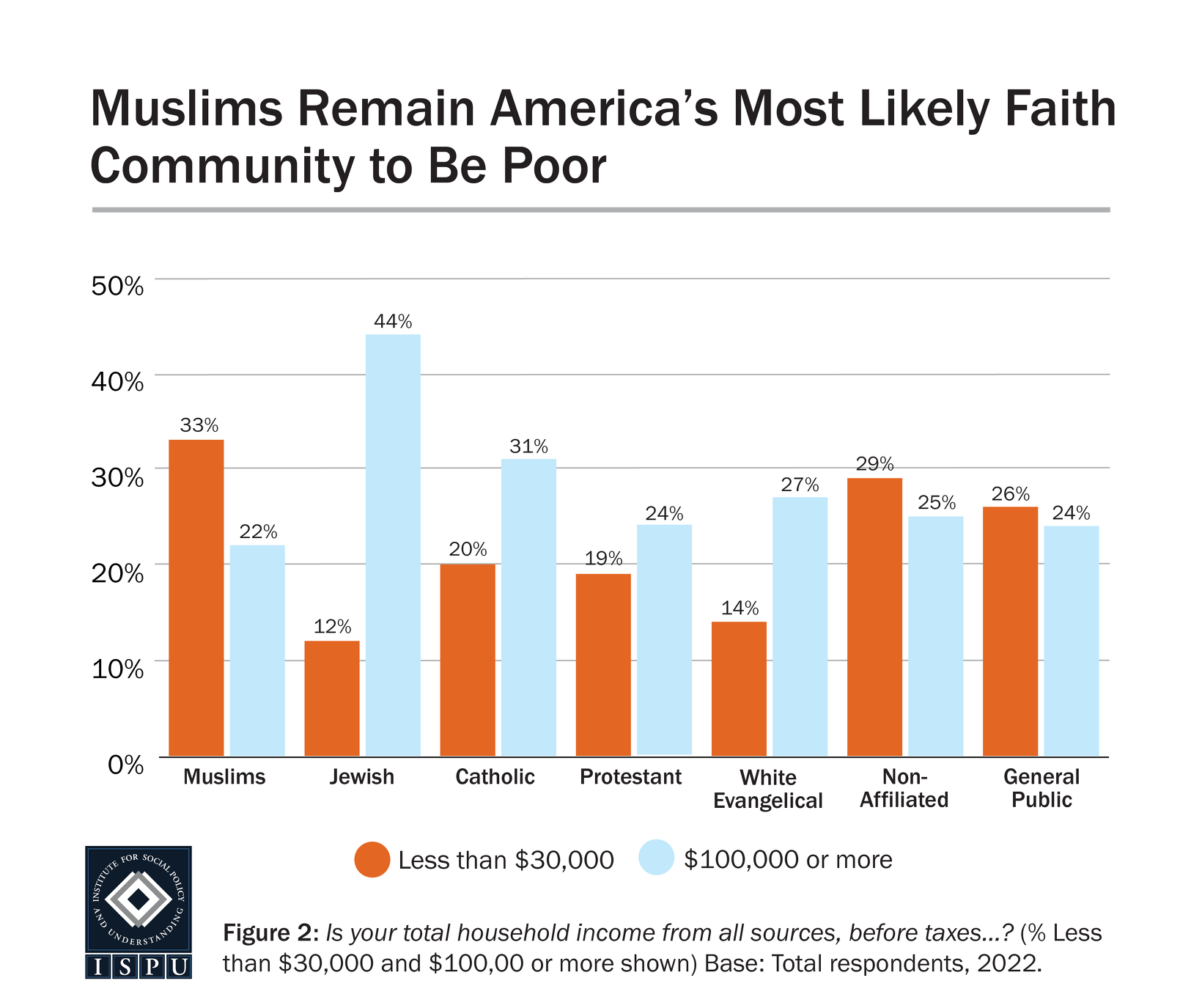
At one time the average income of Muslim Americans was higher than that of total American population but maybe that s no longer the case. According to Pew: Financially, Muslims are about as likely as Americans in general to have a household income over $100,000. At the same time, they are more likely than Americans in general to have an income under $30,000. The survey also finds that Muslims are three times as likely as other Americans to be without a job and looking for work. [Source: Pew Research Center, July 26, 2017]
In their educational attainment levels, Muslims closely resemble the general public. About three-in-ten (31 percent) U.S. Muslims are college graduates, including 11 percent who have a postgraduate degree. On average, Muslim immigrants are more highly educated than U.S.-born Muslims.
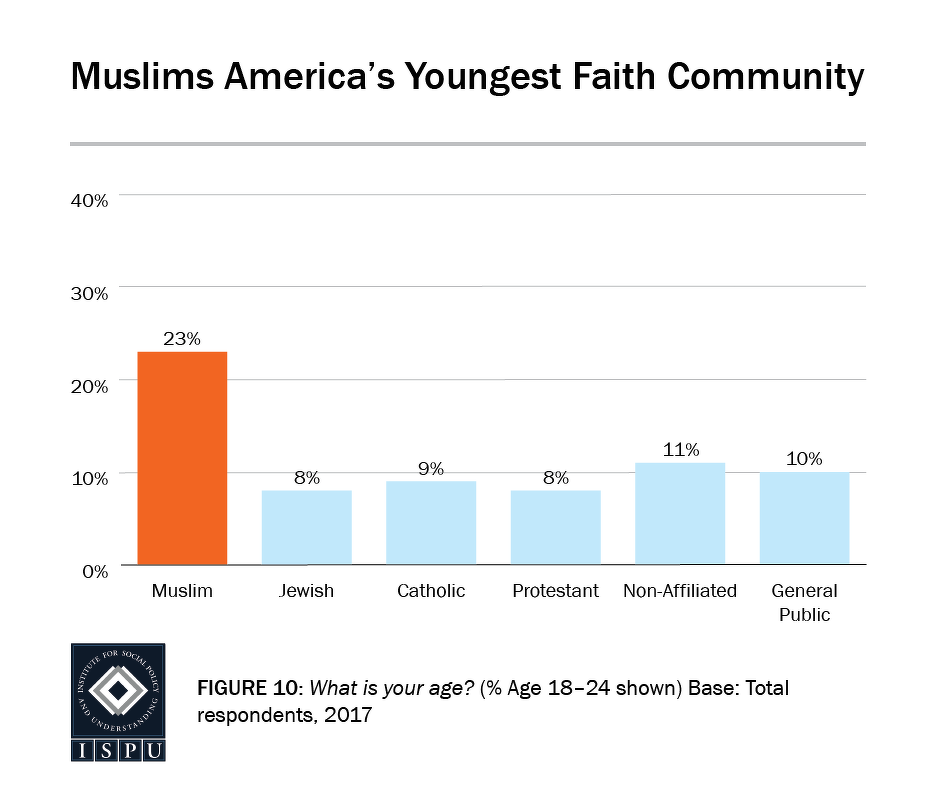
The American Muslim adult population is considerably younger than the overall U.S. adult population. About a third (35 percent) of Muslim American adults are between 18 and 29 years old, which is a far higher percentage than the share of the general population that falls in that age bracket (21 percent). Similarly, adults ages 18 to 39 make up 60 percent of the Muslim American adult population, compared with 38 percent of the U.S. adult population as a whole. Meanwhile, at the other end of the age spectrum, adults ages 55 and over make up just 14 percent of Muslim Americans, while people in this older age bracket comprise 36 percent of the overall U.S. adult population. Another way to compare how old or young a group is within a broader population is to calculate its median age, which for Muslim adults in the U.S. is 35. In the U.S. population as a whole, the median age of adults is 47.
The survey results indicate that among adults ages 40 to 59, Muslim Americans report having an average of 2.4 children over the course of their lives. Americans overall average 2.1 children.18 This is in line with previous Pew Research Center research suggesting that, worldwide, Muslims have higher fertility rates than any other major religious group.
Where American Muslims Originate From
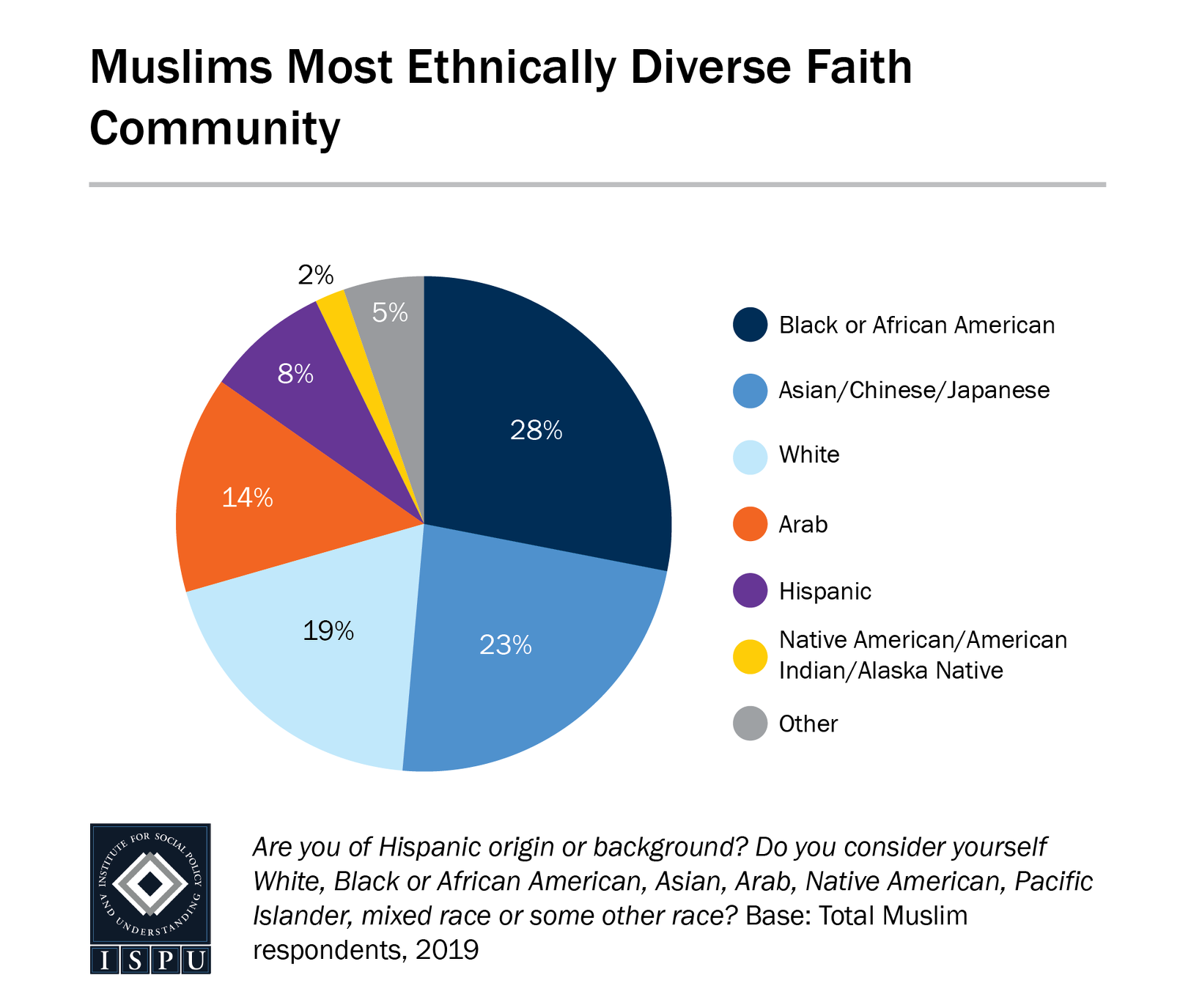
Most Muslims in the United States are not Arabs. Place of origin of Muslims in the United States in the 2000s (percentage of the American Muslim community): 1) South Asian (34 percent, with 56 percent of these Pakistanis); 2) Middle Eastern Arabs (26 percent, with 37 percent of these Lebanese); 3) African-Americans (20 percent); 4) Africans (7 percent); 5) Others, including Bosnians, Indonesians, Malays, and Uyghurs from China. (12 percent); and 6) Unknown (1 percent). Getting an exact count is difficult because law prohibits asking questions about religion.
According to Pew in 2017: Among U.S. Muslim adults who were born abroad, more come from South Asia (35 percent) than any other region. An additional 23 percent were born in other parts of the Asia-Pacific region (such as Iran, Indonesia, etc.); 25 percent come from the Middle East-North Africa region, 9 percent come from sub-Saharan Africa, 4 percent were born in Europe and 4 percent come from elsewhere in the Americas. No single country accounts for more than 15 percent of adult Muslim immigrants to the United States (15 percent are from Pakistan). The countries with the next-highest totals are Iran (11 percent of Muslim immigrants), India (7 percent), Afghanistan (6 percent), Bangladesh (6 percent), Iraq (5 percent), Kuwait (3 percent), Syria (3 percent) and Egypt (3 percent). [Source: Pew Research Center, July 26, 2017]
Nearly six-in-ten U.S. Muslims adults (58 percent) are first-generation Americans, having been born in another country. An additional 18 percent are second-generation Americans – people who were born in the U.S. and who have at least one parent who was an immigrant. About a quarter (24 percent) of U.S. Muslims are U.S. natives with U.S.-born parents (i.e., they are from families who have been in the U.S. for three generations or longer), which is the case for nearly three-quarters of U.S. adults overall (73 percent).
Three-in-ten Muslim immigrants have arrived in the U.S. since 2010. An additional 26 percent arrived between 2000 and 2009, and roughly one-in-five (19 percent) Muslim immigrants arrived in the 1990s. One-in-ten immigrated in the 1980s, 6 percent arrived in the 1970s and just 2 percent of Muslim immigrants say they arrived in the U.S. before 1970. The survey also finds that the vast majority of Muslims living in the U.S. (82 percent) are American citizens, including 42 percent who were born in the U.S. and 40 percent who were born abroad but who have naturalized. The remainder are not U.S. citizens (18 percent). Looked at another way, 69 percent of all foreign-born U.S. Muslim adults have become naturalized U.S. citizens.
Muslim Americans in Michigan and Minnesota
There are sizable communities of Muslims near Detroit in Michigan and the Minneapolis-St-Paul area of Minnesota as made clear the Muslim American Congress representatives for those areas Democract Ilhan Omar, of Somalian ancestry, in Minnesota’s District 5 and Democrat Rashida Tlaib, of Palestinian ancestry, in District 13 of Michigan.
In an article about schools accommodating fasting Muslim students during Ramadan, Associated Press reported from Dearborn, Michigan. “While Muslim students remain a rarity in many U.S. school districts, they are a major presence in some communities, prompting public schools to be more attentive to their needs during the holy month of Ramadan when dawn-to-sundown fasting is a duty of Islam. For example, in Dearborn, Michigan — where nearly half the 110,000 residents are of Arab descent — public school teachers and staff strive to make things easier for students observing Ramadan. “We allow students on their own to practice their faith as long as it’s not a disruption to the school day,” said Dearborn Schools spokesperson David Mustonen. “We also try to find other spaces or activities in the school during lunch for those students who may be fasting.” But he stressed that these students are still required to complete all assignments.[Source: Corey Williams, Giovanna Dell'orto, Mariam Fam and Darren Sands, Associated Press. March 16, 2024]
Minnesota has been home to growing numbers of refugees from war-torn Somalia since the late 1990s. Several school districts have recently made Eid a holiday. In St. Paul, Minnesota, East African Elementary Magnet School has set aside space in the library where students who are fasting and don’t want to be in the cafeteria can spend the break doing other supervised activities like reading, said principal Abdisalam Adam. The 220-student school opened last fall as part of St. Paul’s public schools system, and shares that curriculum, but it also aims to reinforce cultural and linguistic connections with Somalia and other East African countries. Adam said about 90 percent of the students are Somali Muslims. Adam, who has worked with the district for nearly 30 years, said he tells his staff that accommodating observance of Ramadan fits in with an overall goal of caring for students. At the East African magnet school in St. Paul, Marian Aden — who trains other teachers there — makes it a priority to encourage Ramadan-related accommodations for fasting students.
Views by American Muslims on Religion and Science
In 2011, the Pew Research Center conducted its second nationally representative survey of Muslims in the United States. About six-in-ten Muslims living in the U.S. (63 percent) say there is no tension between being religiously devout and living in a modern society, compared with a median of 54 percent of Muslims worldwide. American Muslims also are more likely than Muslims in other parts of the world to say that many religions can lead to eternal salvation (56 percent vs. global median of 18 percent). Additionally, U.S. Muslims are much less likely than Muslims worldwide to say that all or most of their close friends are Muslim (48 percent vs. global median of 95 percent). [Source: Pew Research Center, April 30, 2013]
Muslims in the U.S. are about as likely as Muslims in other countries to view science and religion as fully compatible. In the U.S., 59 percent of Muslims say there generally is not a conflict between science and religion, compared with a median of 54 percent globally among Muslims. However, American Muslims are somewhat less likely to believe in evolution than are Muslims in other parts of the world (45 percent vs. global median of 53 percent). Indeed, when it comes to evolution, U.S. Muslims are closer to U.S. Christians (46 percent of whom say they believe in evolution) than they are to fellow Muslims elsewhere in the world.
American Muslims are even more likely than Muslims in other countries to firmly reject violence in the name of Islam. In the U.S., about eight-in-ten Muslims (81 percent) say that suicide bombing and similar acts targeting civilians are never justified. Across the globe, a median of roughly seven-in-ten Muslims (72 percent) agrees.
Views by American Muslims on Discrimination and Politics
The 2017 Pew survey of U.S. Muslims found that Muslims in the United States perceive a lot of discrimination against their religious group. A majority of U.S. Muslims are leery of Donald Trump and think their fellow Americans do not see Islam as part of mainstream U.S. society. At the same time, however, Muslim Americans overwhelmingly say they are proud to be Americans, believe that hard work generally brings success in this country and are satisfied with the way things are going in their own lives. [Source: Michael Lipka, Pew Research Center, August 9, 2017]
Half of Muslim Americans in 2017 said it has become harder to be Muslim in the U.S. in recent years. And 48 percent said they have experienced at least one incident of discrimination in the past 12 months. But alongside these reports of discrimination,49 percent of Muslim Americans said someone had expressed support for them because of their religion in the past year. And 55 percent think Americans in general are friendly toward U.S. Muslims, compared with just 14 percent who say they are unfriendly.
Living in a religiously pluralistic society, Muslim Americans are more likely than Muslims in many other largely Muslim-majority nations to have a lot of non-Muslim friends. Only about a third (36 percent) of U.S. Muslims say all or most of their close friends are also Muslims, compared with a global median of 95 percent in the 39 countries we surveyed.
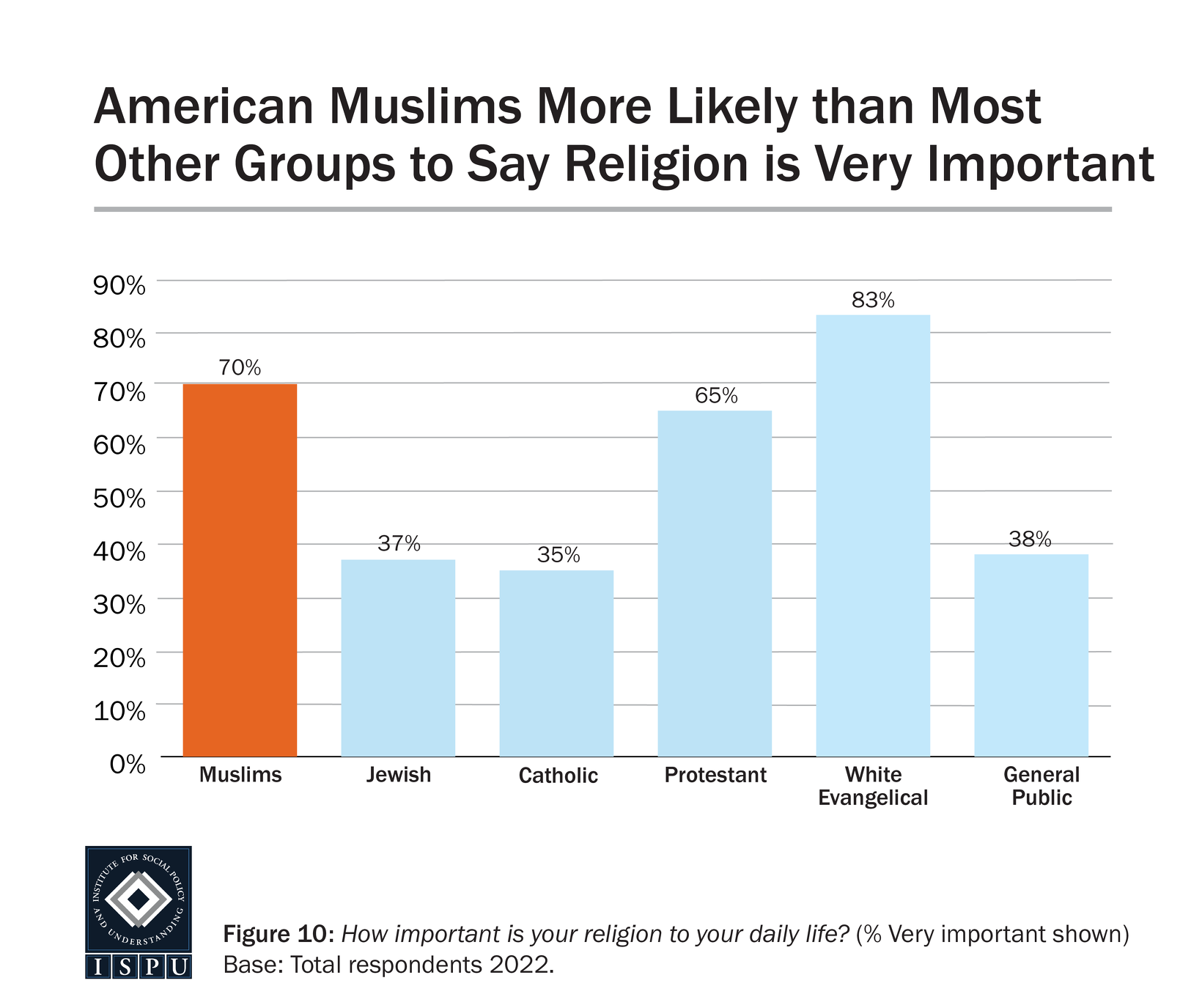
Roughly two-thirds of U.S. Muslims (65 percent) say religion is very important in their lives. About six-in-ten (59 percent) report praying at least daily and 43 percent say they attend religious services at least weekly. By some of these traditional measures, Muslims in the U.S. are roughly as religious as U.S. Christians, although they are less religious than Muslims in many other nations.
When it comes to political and social views, Muslims are far more likely to identify with or lean toward the Democratic Party (66 percent) than the Republican Party (13 percent) and to say they prefer a bigger government providing more services (67 percent) over a smaller government providing fewer services (25 percent). And about half of U.S. Muslims (52 percent) now say homosexuality should be accepted by society, up considerably from 2011 (39 percent) and 2007 (27 percent).
American Muslims and American and Muslim Culture
American Muslim women sometimes wear head scarves to the indicate their identity. Some have compared it with blacks wearing Afros in the 1970s. In the 2000s, according to U.S. media reportes American Muslim teenagers listened to Nirvana, wore Guess! Jeans and read Jack Keroak. You can still buy “Praise Allah” bumper stickers, “I ❤ Allah” cups, toothpaste made with halal ingredients, interactive computer programs on the Qur’an.
American Muslims are not always greeted so warmly by other Muslims. Describing his experience on the Hajj in Mecca in the 2000s, Washington D.C. area resident Suhaib Albarzinji wrote in the Washington Post: “When they learned I was American, they would scowl and mutter a prayer. Then they would elaborate on the evils of America: the greed, the immorality of its people; the arrogance and hypocrisy of its foreign policy, President Bush’s crusade against Islam, the self-righteous wars launched in the name of liberation. They spoke of special interests and multinationals that bring death and misery in a quest for a better bottom line.” When he described American as a land of freedom and opportunity, “They stared at me in pity: I was the product of media brainwashing, no doubt.”
Views by Americans Towards Muslims
According to Pew: A Pew Research Center survey conducted in 2017 asked Americans to rate members of nine religious groups on a “feeling thermometer” from 0 to 100, where 0 reflects the coldest, most negative possible rating and 100 the warmest, most positive rating. Overall, Americans gave Muslims an average rating of 48 degrees, similar to atheists (50). [Source: Michael Lipka, Pew Research Center, August 9, 2017]
Americans view more warmly the seven other religious groups mentioned in the survey (Jews, Catholics, mainline Protestants, evangelical Christians, Buddhists, Hindus and Mormons). But views toward Muslims (as well as several of the other groups) are now warmer than they were in 2014, when U.S. adults gave Muslims an average rating of 40 degrees in a similar survey. [Source: Michael Lipka, Pew Research Center, August 9, 2017]
Republicans and those who lean toward the Republican Party gave Muslims an average rating of 39, considerably cooler than Democrats’ rating toward Muslims (56). This partisan gap extends to several other questions about Muslims and Islam. Indeed, Republicans and Republican leaners also are more likely than Democrats and those who lean Democratic to say they are very concerned about extremism in the name of Islam, both around the world (67 percent vs. 40 percent) and in the U.S. (64 percent vs. 30 percent). In addition, a December 2016 survey found that more Republicans than Democrats say Islam is likelier than other religions to encourage violence among its believers (63 percent vs. 26 percent of Democrats). And while most Americans (69 percent) believe there is a lot of discrimination against Muslims in the U.S. today, views are again split by party: 85 percent of Democrats and those who lean Democratic and 49 percent of Republicans and GOP leaners hold this view. Republicans also are more likely than Democrats to say that Islam is not part of mainstream American society (68 percent vs. 37 percent) and that there is a natural conflict between Islam and democracy (65 percent vs. 30 percent).
About half of Americans (49 percent) think at least “some” U.S. Muslims are anti-American, greater than the share who say “just a few” or “none” are anti-American, according to a January 2016 survey. Views on this question have become much more partisan in the last 14 years (see graphic). But most Americans do not see widespread support for extremism among Muslims living in the U.S., according to a February 2017 survey. Overall, 40 percent say there is not much support for extremism among U.S. Muslims, while an additional 15 percent say there is none at all. About a quarter say there is a fair amount of support (24 percent) for extremism among U.S. Muslims; 11 percent say there is a great deal of support.
Views by Europeans and Westerners Towards Muslims
In spring 2016, Pew asked residents of 10 European counties for their impression of how many Muslims in their country support extremist groups, such as ISIS. In most cases, the prevailing view is that “just some” or “very few” Muslims support ISIS, but in Italy, 46 percent say “many” or “most” do. [Source: Michael Lipka, Pew Research Center, August 9, 2017]
According to Pew: The same survey asked Europeans whether they viewed Muslims favorably or unfavorably. Perceptions varied across European nations: Majorities in Hungary, Italy, Poland and Greece say they view Muslims unfavorably, while negative attitudes toward Muslims are much less common in France, Germany, the United Kingdom and elsewhere in Northern and Western Europe. People who place themselves on the right side of the ideological scale are much more likely than those on the left to see Muslims negatively.[Source: Michael Lipka, Pew Research Center, August 9, 2017]
Image Sources: Institute for Social Policy and Understanding
Text Sources: Pew Research Center, “ National Geographic, BBC, New York Times, Washington Post, Los Angeles Times, Smithsonian magazine, The Guardian, Al Jazeera, The New Yorker, Time, Reuters, Associated Press, AFP, Library of Congress, and various books and other publications.
Last updated March 2024