
Home | Category: Muslim Groups / Shiites
SUNNIS
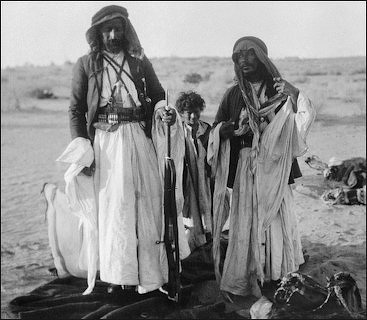
Sunnis in Arabia in the 1910s
Sunnis are members of the largest Muslim sect. In the early days of Islam, they held that the successor (caliph) to Muhammad as leader of the community should be elected whereas their rivals, the Shias (Shiites) believed in the hereditary succession of Ali, the cousin and son-in-law of Muhammad, to lead the community. Although originally political in nature, the differences between Sunni and Shia interpretations rapidly took on theological overtones.
Sunnis make up 84.6 percent of the global Muslim population of 1.57 billion (2009). Shia make up 15.4 percent. Sunnis make up 62.5 percent of the Muslim population of 253 million (2006) in the Middle East; Shia make up 37.5 percent. In the early days of Islam, Sunnis believed the heirs of Abu Bakr, Muhammad's father in law, were best suited to carry on Islam after the prophet’s death while Shia believe that Ali, Muhammad's cousin and son-in-law, was anointed for the task.
Sunni means "orthodox." The name comes from the word Sunnah, or "traditions," referring to writings that contain Muhammad's teachings. Sunnis are so named because they obey the Sunna of the Prophet. “Sunna” is sometimes used to refer to the “customs of Muhammad.” When people talk about Islam in a general way they are usually talking about Sunni Islam.
Websites on Muslim Divisions Divisions in Islam archive.org ; Four Sunni Schools of Thought masud.co.uk Shi’a History and Identity shiism.wcfia.harvard.edu; History of Islam: An encyclopedia of Islamic history historyofislam.com ; Oxford Encyclopedia of the Islamic World oxfordislamicstudies.com ; Sacred Footsetps sacredfootsteps.com ; Internet Islamic History Sourcebook fordham.edu/halsall/islam/islamsbook ; Islam IslamOnline islamonline.net ; Institute for Social Policy and Understanding ispu.org; Islam.com islam.com ; BBC article bbc.co.uk/religion/religions/islam ; Islam at Project Gutenberg gutenberg.org
See Separate Article: DIFFERENCES BETWEEN SUNNI AND SHIA (SHIITE) MUSLIMS africame.factsanddetails.com
RECOMMENDED BOOKS:
“The Sunni Path” by Ahmed Cevdet Pasha Amazon.com ;
“Saladin: The Triumph of the Sunni Revival” by A. R. Azzam Amazon.com ;
“The Caliph and the Imam: The Making of Sunnism and Shiism” by Toby Matthiesen Amazon.com ;
“Sunnis and Shi'a: A Political History” by Laurence Louër and Ethan Rundell Amazon.com ;
“After the Prophet: The Epic Story of the Shia-Sunni Split in Islam” by Lesley Hazleton and Blackstone Amazon.com ;
“An Introduction to Shia Islam: Belief system, leadership and history” by Den Väntades Vänner Amazon.com ;
“Shi'i Islam: An Introduction (Introduction to Religion) Amazon.com ;
“The Prophet's Heir: The Life of Ali ibn Abi Talib” by Hassan Abbas Amazon.com ;
“Ali Ibn Al-Husayn: A Critical Biography” by Abdullah Al-Rabbat Amazon.com ;
“Husayn: The Saga of Hope” by Jalal Moughania Amazon.com
Muslim Sects
There are a number Islam sects and groups. Sunnis make up the overwhelming majority of Muslims. Shia are the second largest group. They are divided by the Hanafi, Shafe’i, Maleki and Hanbali schools. Wahhabis are a conservative Sunni sect most active in Saudi Arabia. Sufis practice a mystical form of Sunni Islam. Ismaelis are a Shia sect led by Aga Khan. The views of some groups are radically different from those others. Members of some groups regard members of rival groups as heretics.
Early leadership controversies within the Muslim community led to divisions that still have an impact on the body of believers. When Muhammad died, leadership fell to his father-in-law, Abu Bakr, who became the first caliph (khalifa , or successor), a position that combined spiritual and secular power. A separate group advocated the leadership of Ali, the cousin and son-in-law of the Prophet, who had married his daughter Fatima. Leadership could have fallen to Ali's son Husayn, but, in the power struggle that followed, in 680 Husayn and seventy-two followers were murdered at Karbala (now in modern Iraq). [Source: Library of Congress *]
The leadership dispute over who would be caliph after Ali formed the most crucial dividing point in Islamic history: the victorious party went on to found the Umayyad Dynasty (661-750), which had its headquarters at Damascus, leading the majority of Muslims in the Sunni path. The disaffected Shiat Ali (or Party of Ali) viewed only his line as legitimate and continued to follow descendants of Husayn as their leader.
Power Struggle That Resulted in the Sunni-Shia Split

Shia arc. Sunnis are dominant outside the arc Following the death of the Prophet in 632, the Muslim community failed to reach consensus on who should succeed him as the caliph. A majority of Muhammad's close followers supported the idea of an elected caliph, but a minority believed that leadership, or the imamate, should remain within the Prophet's family, passing first to Muhammad's cousin, son-in-law, and principal deputy, Ali ibn Abu Talib, and subsequently to Ali's sons and their male descendants. The majority, who believed they were following the sunna of the Prophet, became known as Sunni Muslims. To them, the caliph was the symbolic religious head of the community; however, caliphs would also rule as the secular leaders of a major empire for six centuries. [Source: Library of Congress *]
The first four caliphs — Abu Bakr, Omar, Osman, and Ali — were chosen by a consensus of Muslim leaders. Subsequently, however, the caliphate was converted by its holders into a hereditary office, the first two dynasties being the Umayyad, which ruled from Damascus, and the second being the Abbasid, which ruled from Baghdad. After the Mongols captured Baghdad and executed the Abbasid caliph in 1258, a period of more than 250 years followed when no one was recognized as caliph by all Sunni Muslims. During the sixteenth century, the Ottoman Dynasty resurrected the title, and gradually even Muslims outside the Ottoman Empire came to accept the Ottoman sultan as the symbolic leader — caliph — of Sunni Islam.*
According to Encyclopedia.com: The chief division, between Sunni and Shiite Muslims, rose over the question of who would succeed Muhammad. When he died in 632, Muhammad left no instructions about who would follow him. Shiite Muslims believed that Muhammad's successor needed to be a direct descendant of the Prophet. Sunni Muslims did not share that belief. This central difference led to the split. The majority of Muslims are Sunni. [Source: Encyclopedia.com]
What followed the election of Abu Bakr — Muhammad's good friend, father-in-law, successor and first caliph — was a long period of conflict in Islam. When the second caliph, Umar, was murdered in 644, a power struggle developed among several possible successors. Out of this struggle Uthman (d. 656), an early convert to Islam, became the third caliph. Uthman, though, came from a powerful, aristocratic Meccan clan called the Umayyads and was resented by the Shiites. Their resentment grew when he moved the capital of the Islamic empire from Mecca to Damascus, Syria. When Uthman was assassinated by Shiites in 656, ʾAli finally became the fourth caliph.
The disputes between Sunnis and Shiites, however, were not put to rest. After a civil war between the two parties, ʾAli was assassinated in 661. This allowed the Umayyads, whom the Shiites believed were corrupt and unfaithful to the teachings of Muhammad, to regain control of the empire. Civil war broke out again in 680, when ʾAli's son, Hussain ibn Ali, led the Shiites against the Umayyads. The war ended when he and his family were killed in a historic battle at Karbala, south of Baghdad (in present-day Iraq).
See Separate Article: HISTORY OF SUNNI-SHIA DIVISIONS africame.factsanddetails.com
Sunni Expansion and Leadership
According to the BBC: “As Islam expanded from the deserts of the Arabian Peninsula into the complex and urban societies of the once Roman and Persian empires, Muslims encountered new ethical dilemmas that demanded the authority of religious answers. Sunni Islam responded with the emergence of four popular schools of thought on religious jurisprudence (fiqh). These were set down in the 7th and 8th centuries CE by the scholars of the Hanbali, Hanafi, Maliki and Shaafii schools. Their teachings were formulated to find Islamic solutions to all sorts of moral and religious questions in any society, regardless of time or place and are still used to this day. [Source: BBC, August 19, 2009 |::|]
“The Ummayad dynasty was followed by the Abbasid dynasty (c. 758-1258 CE). In these times the Caliphs, in contrast to the first four, were temporal leaders only, deferring to religious scholars (or uleama) for religious issues. |Sunni Islam continued through the Umayyad and Abbasid dynasties to the powerful Mughal and Ottoman empires of the 15th to 20th centuries. It spread east through central Asia and the Indian sub-continent as far as the Indonesian archipelago, and west towards Africa and the periphery of Europe. The Sunnis emerged as the most populous group and today they make up around 85% of the one billion Muslims worldwide. |::|
Sunni Beliefs and Practices
Most of the beliefs and practices associated with Islam and Muslims are those of Sunnis or all or most Muslim groups. Therefore most of things you read about Islam or Muslims in this website are believed or practiced by Sunnis.
In principle, a Sunni approaches God directly: there is no clerical hierarchy. Some duly appointed religious figures, such as imams, however, exert considerable social and political power. Imams usually are men of importance in their communities, but they need not have any formal training. Committees of socially prominent worshipers usually are responsible for managing major mosque-owned lands. In most Arab countries, the administration of waqfs (religious endowments) has come under the influence of the state. Qadis (judges) and imams are appointed by the government. [Source: Helen Chapin Metz, Persian Gulf States: A Country Study, Library of Congress, 1993 *]
The Muslim year has two religious festivals: Id al Adha, a sacrificial festival held on the tenth day of Dhu al Hijjah, the twelfth, or pilgrimage, month; and Id al Fitr, the festival of breaking the fast, which celebrates the end of Ramadan on the first day of Shawwal, the tenth month. To Sunnis these are the most important festivals of the year. Each lasts three or four days, during which time people put on their best clothes and visit, congratulate, and bestow gifts on each other. In addition, cemeteries are visited. Id al Fitr is celebrated more festively because it marks the end of Ramadan. Celebrations also take place, although less extensively, on the Prophet's birthday, which falls on the twelfth day of Rabi al Awwal, the third month, and on the first of Muharram, the beginning of the new year. *
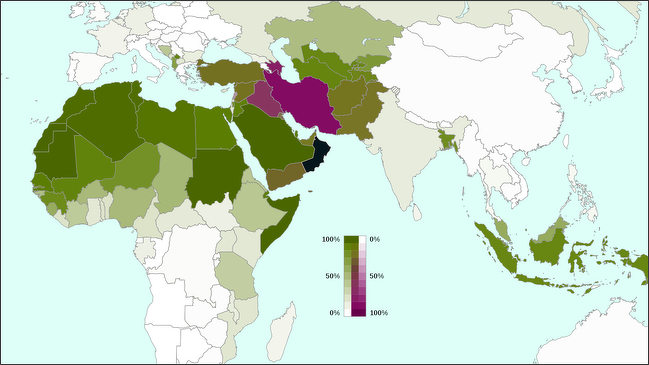
Islam by country: Sunni (Green); Shia (Shiite, Purple), Ibadi (blackish green)
Sunni Schools
The four main Sunni schools developed in the first 200 years of Islam. They include the Hanafi, Maliki, Shafai and Hanbali — all of which are still active. Saudi Wahhabis belong to the Hanbali school, while the rest of Arabian, Egyptian, and Iranian Sunnis belong Shafai school. Hanafi school is more liberal than other schools. It is active in Turkey, Iran and Afghanistan. The Maliki school is active in Egypt and other North African countries.
With regard to legal matters, Sunni Islam has four orthodox schools that give different weight in legal opinions to prescriptions in the Quran, to the hadith, to the consensus of legal scholars, to analogy (to similar situations at the time of the Prophet), and to reason or opinion. Named for their founders, the earliest Muslim legal schools were those of Abd Allah Malik ibn Anas (ca. 715-95) and An Numan ibn Thabit Abu Hanifa (ca. 700-67). The Maliki school was centered in Medina, and the lawbook of Malik ibn Anas is the earliest surviving Muslim legal text, containing a systematic consensus of Medina legal opinions. The Hanafi school in Iraq stressed individual opinion in making legal decisions. Muhammad ibn Idris ash Shafii (767-820), a member of the tribe of Quraysh and a distant relative of the Prophet, studied under Malik ibn Anas in Medina. He followed a somewhat eclectic legal path, laying down the rules for analogy that were later adopted by other legal schools. The last of the four major Sunni legal schools, that of Ahmad ibn Muhammad ibn Hanbal (780-855), was centered in Baghdad. The Hanbali school, which became prominent in Arabia as a result of Wahhabi influence, gave great emphasis to the hadith as a source of Muslim law but rejected innovations and rationalistic explanations of the Quran and the traditions.*
Named for their founders, the Hanafi school of Imam Abu Hanifa, born in Kufa, Iraq about A.D.700, is the major school of Iraqi Sunni Arabs. It makes considerable use of reason or opinion in legal decisions. The dominant school for Iraqi Sunni Kurds is that of Imam Abu Abd Allah Muhammad Shafii of the Quraysh tribe of the Prophet, born in A.D.767 and brought up in Mecca. He later taught in both Baghdad and Cairo and followed a somewhat eclectic legal path, laying down the rules for analogy that were later adopted by other legal schools. The other two legal schools in Islam, the Maliki and the Hanbali, lack a significant number of adherents in Iraq. [Source: Helen Chapin Metz, Library of Congress, 1988]
Image Sources: Wikimedia Commons
Text Sources: Internet Islamic History Sourcebook: sourcebooks.fordham.edu ; Arab News, Jeddah; “Islam, a Short History” by Karen Armstrong; “A History of the Arab Peoples” by Albert Hourani (Faber and Faber, 1991); “World Religions” edited by Geoffrey Parrinder (Facts on File Publications, New York); “Encyclopedia of the World’s Religions” edited by R.C. Zaehner (Barnes & Noble Books, 1959); Metropolitan Museum of Art, Encyclopedia.com, National Geographic, BBC, New York Times, Washington Post, Los Angeles Times, Smithsonian magazine, The Guardian, Al Jazeera, The New Yorker, Time, Newsweek, Reuters, Associated Press, AFP, Library of Congress and various books and other publications.
Last updated April 2024