
Home | Category: Passion, Death and Resurrection of Jesus / Basic Christian Beliefs
HOW THE RESURRECTION SHAPED CHRISTIANITY
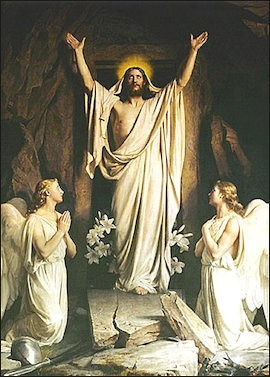
Resurrection refers to the rising of Jesus Christ from the dead three days after his Crucifixion, or death on a cross. Christians regard resurrection as a fate that awaits all Christian faithful. They believe that the crucified Jesus was resurrected by God, and that by submitting to death, Jesus destroyed death’s power and made eternal life available to everyone, unlike other religions which said immortality was something that was available only to Gods. Consequently, death became a phase that people passed through rather than something that was feared.
Partly through the Resurrection, Christianity introduced “eternal life,” something that clearly appealed to new converts. Instead of worshiping the spirit of a dead hero, Christians worship a living Christ that was resurrected in the flesh and ascended to heaven as a living person. The burial rite and safekeeping of the tomb for early Christians was important because it was believed the soul would rise to heaven just as Jesus's had done during resurrection.
Paul wrote in Corinthians: “If Christ had not been raised, then our preaching is empty, and your faith is empty.” This seems say in part that one reason the Resurrection is important is that Jesus said he would rise from the dead. If he didn’t he would have been branded a liar and his credibility on other issues would be questioned.
The idea of a resurrection was somewhat new. In other religions such as Hinduism and Greek paganism, the soul and the body were viewed as distinct and the afterlife was seen in terms of separation of the soul and body rather than resurrection of the dead.
See Separate Article: RESURRECTION OF JESUS africame.factsanddetails.com
Websites and Resources: Jesus and the Historical Jesus Britannica on Jesus britannica.com Jesus-Christ ; PBS Frontline From Jesus to Christ pbs.org ; Life and Ministry of Jesus Christ bible.org ;
Jesus Central jesuscentral.com ; Catholic Encyclopedia: Jesus Christ newadvent.org ;
Christianity BBC on Christianity bbc.co.uk/religion/religions/christianity ; Sacred Texts website sacred-texts.com ; Candida Moss at the Daily Beast Daily Beast
Christian Answers christiananswers.net ; Bible: Bible Gateway and the New International Version (NIV) of The Bible biblegateway.com ; King James Version of the Bible gutenberg.org/ebooks
RECOMMENDED BOOKS:
“The Resurrection of Jesus: Apologetics, Polemics, History” by Dale C. Allison Jr, Jim Denison, et al. Amazon.com ;
“The Case for the Resurrection of Jesus” by Michael R. Licona, Gary R. Habermas, et al. Amazon.com ;
“The Crucifixion of Jesus: A Medical Doctor Examines the Death and Resurrection of Christ” by Joseph Bergeron M.D. Amazon.com ;
“The Crucifixion of Jesus, Completely Revised and Expanded: A Forensic Inquiry”
by Frederick T. Zugibe Amazon.com ;
“The Crucifixion: Understanding the Death of Jesus Christ” by Fleming Rutledge Amazon.com ;
“The Crucifixion of the King of Glory: The Amazing History and Sublime Mystery of the Passion” by Eugenia Scarvelis Constantinou PhD, Eugenia Scarvelis Constantinou, et al. Amazon.com ;
“Trial and Crucifixion of Jesus, The: Texts and Commentary Paperback” by David W. Chapman, Eckhard J. Schnabel Amazon.com ;
“What Christ Suffered: A Doctor's Journey Through the Passion” by Thomas W McGovern MD Amazon.com ;
“Jesus of Nazareth: Holy Week: From the Entrance into Jerusalem to the Resurrection”
by Pope Benedict XVI, Matthew Arnold, et al. Amazon.com ;
“The Mystery of the Last Supper: Reconstructing the Final Days of Jesus” by Colin J. Humphreys Amazon.com ;
“The Church of the Holy Sepulchre: The History of Christianity in Jerusalem and the Holy City’s Most Important Church” by Kosta Kafarakis Amazon.com ;
“The Architectural History of the Church of the Holy Sepulchre at Jerusalem” by Robert Willis Amazon.com
Impact of the Resurrection
The resurrection of Jesus is the defining moment in the history of Christianity. The gospels claim that because he executed and was physically resurrected, Jesus had to be the Son of God. Michael Symmons Roberts wrote for the BBC: “And on the back of that belief, a great world religion was built. Without the feeding of the five thousand or the walking on water, we'd still have Christianity. But without the resurrection, it would be just a minor cult in first-century Judaism. This one miracle - more than any other - changed the world, and if the miracles are signs, then the resurrection is the most important sign of all. To understand it, we need to examine its effects. [Source: Michael Symmons Roberts, BBC, September 18, 2009. Roberts is author the book“The Miracles of Jesus”. |::|]
“It begins with a young man's body hanging from a cross. His followers are leaderless and aimless. Their new movement which promised so much is now on the verge of extinction. Yet, days later, the belief began to spread that this man had risen from the dead. Not only does this idea take hold among his followers, it explodes into a movement that wins converts across the Roman empire. |::|
“Its missionaries are persecuted without mercy, but to the amazement of onlookers they seem unafraid of death, so strong is their belief in the resurrection of their leader. These Christians become martyrs in ever increasing numbers. Yet all the time their movement grows and grows, until it finally becomes the official religion of the Roman empire, sanctioned and nurtured by an emperor - Constantine - who becomes a Christian himself. What could account for that extraordinary transformation? What turned a tiny Jewish sect into a worldwide religion? |::|
Resurrection Story: Why Was It So Deeply Embraced
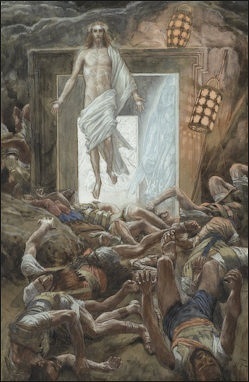
Professor L. Michael White told PBS: “How did the resurrection story get started? We have to remember that the gospels themselves and their full account of the life and death and resurrection of Jesus came a good bit after the fact, a full generation, in some cases perhaps even sixty years, two generations later. So those stories had a long time to evolve and develop. But we can see that they're based on some smaller units of oral tradition that had been circulating for many years before. We see this even in Paul's letters. Paul himself, remember, doesn't write a gospel. He actually doesn't tell us much about the life of Jesus at all. He never once mentions a miracle story. He tells us nothing about the birth. He never tells us anything about teaching in parables or any of those other typical features of the gospel tradition of Jesus. What Paul does tell us about is the death, and he does so in a form that indicates that he's actually reciting a well-known body of material. So when he tells us, "I received and I handed on to you," he's referring to his preaching, but he's also telling us that what he preaches, that is the material that he delivers, is actually developed through the oral tradition itself. [Source: L. Michael White, Professor of Classics and Director of the Religious Studies Program University of Texas at Austin, Frontline, PBS, April 1998 ]
“Now one of the most important examples of this comes in the First Corinthian Letter. On two separate occasions in First Corinthians, he actually gives us snippets of early pieces of oral material which he repeats in a way, so as to remind his audience of what they've already heard. In other words, it presupposes that they will recognize this material. And because we can isolate it out of his letters, the way he describes, we then are able to reconstruct...what that early body of material would have looked like at a time before it's ever written down.Now one of these is First Corinthians 11 where Paul describes Jesus instituting the last supper. And that's one of the early pieces of oral material. The other one is First Corinthians 15 where Paul describes the story of the death, burial and resurrection. In First Corinthians 15, Paul's description of the death, burial and resurrection of Jesus is the earliest account that we have in any written form. And it's clearly what Paul himself had heard and learned over a period of several years. So it's one of those little blocks of material in Paul's letters that pushes us that much farther back toward the historical time of Jesus.
“Now here's what he tells us, he says that Jesus died, was buried, was raised on the third day in accordance with the scriptures, he relates it to prophecy. Then he says, "Jesus appeared". He doesn't tell us about the empty tomb. There's no reference to that part of the story at all. Instead he tells us Jesus appeared, first to Peter and then the twelve, next to 500 people, some of whom had already died by the time Paul heard the story.
“Now in each of these two cases it's interesting that we have information that we don't get anywhere else in the gospels tradition. So it's a unit of oral material that is very important to the development of the tradition....
Did Early Christians Make Up the Resurrection
Michael Symmons Roberts wrote for the BBC: ““Did the early Christians, in their despair and disappointment, simply imagine it? Or were they witnesses to a genuine and unprecedented event in human history? Well, theologians set about the task in much the same way that we examine any remarkable or contentious event in our own time: by scrutinizing the motives and accounts of eyewitnesses who were there at the right place and time, and the reporters who mediate the eyewitness accounts to us. Did the eyewitnesses or the reporters make the story up? Who can we believe? [Source: Michael Symmons Roberts, BBC, September 18, 2009. Roberts is author the book“The Miracles of Jesus”. |::|]
According to Y-Jesus: “Jesus’ followers wrote that he appeared alive to them after his crucifixion and burial. They claim not only to have seen him but also to have eaten with him, touched him, and spent 40 days with him. So could this have been simply a story that grew over time, or is it based upon solid evidence? The answer to this question is foundational to Christianity. For if Jesus did rise from the dead, it would validate everything he said about himself, about the meaning of life, and about our destiny after death.” [Source: Y-Jesus]
Many skeptics have attempted to disprove the resurrection. Josh McDowell was one such skeptic who spent more than seven hundred hours researching the evidence for the resurrection. McDowell stated this regarding the importance of the resurrection: “I have come to the conclusion that the resurrection of Jesus Christ is one of the most wicked, vicious, heartless hoaxes ever foisted upon the minds of men, OR it is the most fantastic fact of history. McDowell later wrote his classic work, “The New Evidence That Demands A Verdict,” documenting what he discovered.”
Sermon for the Resurrection of the Lord by Pope Innocent III:
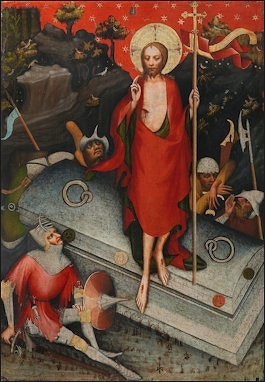
Pope Innocent III (reigned 1198 to 1216) wrote: “Maria Magdalene, and Mary the mother of James, and Salome, bought spices, so that they might go and anoint Jesus" (Mark 16:1). Since we should carry out spiritually what we read that these women did corporeally, we should first consider what was done morally: these three women, what spices they bought, from whom they bought them and at what price, what they did then, and how they then anointed Jesus. [Source: Sermon of Pope Innocent III (No. 27 in Vat. lat. 700, 35vo-36vo), edited and translated by John C. Moore, "The Sermons of Pope Innocent III," Römische Historische Mitteilungen 36 (1994) 81-142), translated by Prof. John C. Moore of Hofstra University, sourcebooks.fordham.edu]
“These three women signify the three lives: lay, regular, and clerical. The life of laymen is active and secular; the life of religious is contemplative and spiritual; the life of clergy- men is rather mixed and shared, partly secular inasmuch as they possess worldly things and partly spiritual inasmuch as they administer divine things.
“These three lives are signified elsewhere in the gospel where it is said, there are two in the field, two at the mill, and two in bed, "One will be taken and the other left" (Luke 17:34-35). The mill, which turns constantly, signifies the world, which is always changing. One at the mill--these are the laity, who use worldly things, with great labor and difficulty. The bed signifies rest. Hence, in bed are the religious, who, having abandoned secular occupations, take delight in the leisure of contemplation. And in the field are the clerics who
“These three lives, however, are also signified by the three men whom the prophet Ezechiel saw in a vision as saved, namely, Noah, Daniel, and Job (Ezechiel 14:14). Noah, who guided the ark in the flood, signifies the clergy who rule the church in this world. Daniel, who as a man in contemplation was free of all desires, signifies the religious who with total desire cling to the contemplation of heavenly things. Job, who had wife, off-spring, flocks, arms, servants and handmaidens, signifies the laity, who possess such things in this world.
“The spices, however, are the good works that sweetly perfume the heavens with the fragrance of virtues. Solomon speaks of these in the canticles: "Awake, O north wind, and come, O south wind! Blow upon my garden, let its fragrance be wafted abroad" (Song of Songs 4:16). For the north wind, which is a cold wind, signifies the devil, who has been frozen in evil. It is also written that every evil is revealed by the north wind. The south wind, however, which blows warm, symbolizes the Holy Spirit, who inflames the minds of the faithful to love. For love has been poured out into our hearts through the Holy Spirit, who has been given to us. The garden, however, is the soul, in which virtues have been planted like fruitful grasses. He says, therefore, that the north wind flees and the south wind comes, inasmuch as the devil departs and the Holy Spirit approaches; he blows upon the garden and inspires the soul, and so spices flow and good works come forth.
“These spices are bought from him of whom James the apostle says, "Every best endowment and every perfect gift is from above, coming down from the Father of lights" (James 1:17). "Apart from me," he says, "you can do nothing" since "the branch cannot bear fruit by itself, unless it abides in the vine" (John 15:4-5). Further, since he is not in want of our goods, as he is rich above all and in all things, it should be said that he demands and requires from us this set price alone, that in return for his benefactions, we offer him thanks and praise. If these proceed from a pure heart, from a good conscience, and from genuine faith, he accepts them over gold and silver and precious gems. Beware, therefore, Christian, lest you believe that you have bought from him any good whatsoever at any other price, because if perchance you ascribe any good thing, whatever it may be, to your own merits and virtues, you do injury to him from whom all goods proceed. Rather, for all the good things received, offer praise and thanks to him from whom, in his mercy, you have received them. For what do you have that you will not have received? Consequently, you have completely discarded the arrogance of those who say, "Our lips are with us; who is our master?" (Psalm 11 [12]:5); since if perchance you should say this, you would return an indignity for every good thing.
“But as there are diverse women, so they make diverse ointments with which they anoint Jesus in different ways. Laymen should indeed take six kinds of spices to make the ointment, that is, the six works of piety that Christ will commend in judgment. "I was hungry and you gave me food, I was thirsty and you gave me drink, I was a stranger and you welcomed me, I was naked and you clothed me, I was sick and you visited me, I was in prison and you came to me (Matt. 25:35-36). These sweet-smelling perfumes having been offered, Jesus himself shows how much he delights in their fragrance: "Come," he says, "O blessed of my Father, inherit the kingdom prepared for you from the foundation of the world" (Matt. 25:34). And for making this ointment from these spices, the oil of mercy is necessary. It is the same oil that the Samaritan poured on the wounds of the injured man so that he might cool the hot pain and sooth the tumors. If therefore you feel the heat of anger, the pain of hatred, or the tumor of pride, anoint Jesus with this ointment so that you may be healed, since nothing works better for avoiding the vices of the mind than good works.
“But Religious, who have renounced all possessions, although they do not have anything with which to make this ointment, should buy other perfumes from which to make their own ointment, namely prayer, meditation, and reading. Hence, the ingredients of devotion having been mixed, the unguent of contemplation may be made. However sweet it is, so much more fully does he pray who makes it. You secular men, however, are able to listen but cannot yet hear, since the animal-like man does not perceive those things that are in divine scripture just as another hears a song but does not perceive the melody. "O how abundant," he says, "is thy sweetness, which thou hast laid up for those who fear thee" (Psalm 30 [31]:20 [19]). That sweetness is partly tasted already by those who, although in the body on earth, are to some degree already in heaven in the spirit, saying with Paul, "Our conversation in heaven" (Phil. 3:20) is that manna hidden (Heb. 9:4) in the savoring of reading, meditation, and prayer.
“From these two ointments, however, the clergy should make a third ointment, so that now they sit at the feet of the Lord with Mary and listen to his word, now, with Martha, they are busy with many things (Luke 10:40) as they perform the works of charity.

Rafael's Ressureicao Cristo
“Moreover, the lay life should anoint the feet of Jesus, the regular life the head, and the clerical life the body. For the feet of Christ are the poor, the head is the divinity, and the body is the church, as is shown in many instances in scripture. Indeed, Jesus himself sits in heaven and his feet walk the earth. The poor of Christ are those whom the lay life, following the example of Mary Magdalene, should anoint with works of piety, as the prophet says, "Share your bread with the hungry and bring the homeless poor into your house, etc." (Isaiah 58:7). If you have done this, you have anointed the feet of Christ. The head of Jesus is understood to be his divinity, since according to the apostle, man is the head of woman, Christ is the head of man, and God is the head of Christ (I Cor. 11:3). This head, which is the principle of all things, the regular life should anoint with the ointment of contemplation so that, earthly things set aside, it may fly to heavenly things, ascending from virtue to virtue until it sees the God of gods in Zion. It asks, therefore; it seeks; and it knocks (cf. Luke 11:9). It asks by praying, it seeks by meditating, and it knocks by reading, so that it may learn the way, so that it may discover the life, and so that the truth may be opened to it. That very Jesus, our lord, who is your truth and life, is the way to those asking in humble and devout prayer, the life to those seeking in simple and discreet meditation, the truth to those knocking in faithful and diligent study.
“Moreover, the clerical life should anoint the body of Jesus, that is the church, supporting her equally with word and example (cf. Luke 24:19) so that it may imitate him who began to act and to teach. The man who has so acted and taught, he will be called great in the kingdom of heaven.
“Jesus wishes to be anointed with these ointments, Jesus who is for this very reason called Christ; that is, he is anointed not only by the father, who anoints him with oil, but [...?] also by his faithful, so that all may come together in the fragrance of their ointments. In the preeminent one who is blessed above all things, world without end. Amen.
Image Sources: Wikimedia, Commons except last picture, Boston.com
Text Sources: Internet Ancient History Sourcebook: Christian Origins sourcebooks.fordham.edu “World Religions” edited by Geoffrey Parrinder (Facts on File); “ Encyclopedia of the World’s Religions” edited by R.C. Zaehner (Barnes & Noble Books, 1959); King James Version of the Bible, gutenberg.org; New International Version (NIV) of The Bible, biblegateway.com; Christian Classics Ethereal Library (CCEL) ccel.org , Frontline, PBS, “Encyclopedia of the World Cultures” edited by David Levinson (G.K. Hall & Company, 1994); Wikipedia, BBC, National Geographic, New York Times, Washington Post, Los Angeles Times, Smithsonian magazine, The New Yorker, Time, Live Science, Encyclopedia.com, Archaeology magazine, Reuters, Associated Press, Business Insider, AFP, Library of Congress, Lonely Planet Guides, Compton’s Encyclopedia and various books and other publications.
Last updated March 2024