
Home | Category: David and Solomon / David and Solomon
KING SOLOMON'S RICHES
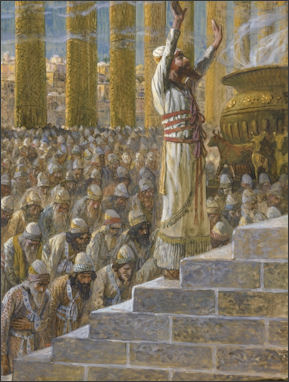
Solomon Dedicates the
Temple at Jerusalem by Tissot Solomon (961-922 B.C.) was David's and Bath-sheba’ss son. He united the Hebrews in a kingdom that briefly dominated the area and was the third king of Israel. Solomon became king when he was still a young man. According to the Bible, God came to Solomon in a dream at the beginning of his rule and asked him if there was anything he desired. Solomon said he only wanted knowledge so that could rule wisely and judiciously.
Israel was very rich under Solomon's rule. According to the Bible, Solomon “exceeded all the kings...in riches." He once hosted a feast featuring the sacrifice of 22,000 oxen. Some 12,000 horsemen were employed to look for "victual to feed all who came of Solomon’s table." Hartebeest, gazelle and wild goat were also most likely served.
It is Solomon’s kingdom grew rich in gold and precious stones brought in with Phoenician ships from the legendary King Solomon's mines in the lost biblical city of Ophir. A number of places claim to be the home of Ophir. They include Zimbabwe, the state of or Kerala in India, Israel and Jordan. Horses, linen, ivory and silver came in from other places.
For all his wisdom and riches, Solomon could not hold his kingdom together. He had many foreign wives and they brought their gods to the Jewish kingdom, undermining Solomon’s religious authority. In order to build the Temple and his palace he levied large taxes on his subjects. Resentment grew. After his death the Jewish kingdom split up.
Websites and Resources: Virtual Jewish Library jewishvirtuallibrary.org/index ; Judaism101 jewfaq.org ; torah.org torah.org ; Chabad,org chabad.org/library/bible ; Bible and Biblical History: ; Biblical Archaeology Society biblicalarchaeology.org ; Bible History Online bible-history.com Bible Gateway and the New International Version (NIV) of The Bible biblegateway.com ; King James Version of the Bible gutenberg.org/ebooks ; Jewish History: Jewish History Timeline jewishhistory.org.il/history Jewish History Resource Center dinur.org ; Center for Jewish History cjh.org ; Jewish History.org jewishhistory.org ; Internet Jewish History Sourcebook sourcebooks.fordham.edu ; Christianity: BBC on Christianity bbc.co.uk/religion/religions/christianity ; Christian Classics Ethereal Library www.ccel.org ; Sacred Texts website sacred-texts.com
RECOMMENDED BOOKS:
“King Solomon's Mines” (Tor Classics)by H. Rider Haggard Amazon.com ;
“In Search of King Solomon’s Mines” by Tahir Shah. Amazon.com ;
“The Wisdom of Solomon” (Bible Apocrypha) a Amazon.com ;
“King Solomon's Empire: The Rise, Fall, and Modern-Day Influence of an Iron-Age Ruler”
by Archie W. N. Roy PhD and Margaret P. Roy Amazon.com ;
“The Temple of Solomon” by Kevin J. Conner Amazon.com ;
“Why the Bible Began: An Alternative History of Scripture and its Origins” by Jacob L. Wright Amazon.com ;
“The History of Saul, David and Solomon: Israel's Greatest Kings” by James Allen Moseley
Amazon.com ;
“The Making of a Man of God: Lessons from the Life of David”by Alan Redpath Amazon.com ;
“The Bible Unearthed” by I. Finkelstein and N. Asher Silberman Amazon.com ;
“Zondervan Handbook of Biblical Archaeology: A Book by Book Guide to Archaeological Discoveries Related to the Bible” by J. Randall Price and H. Wayne House Amazon.com ;
“NIV, Cultural Backgrounds Study Bible (Context Changes Everything) by Zondervan, Craig S. Keener Amazon.com ;
“Oxford Companion to the Bible” by Bruce M. Metzger and Michael David Coogan Amazon.com ;
“Historical Atlas of the Holy Lands” by K. Farrington Amazon.com ;
“A History of the Jews” by Paul Johnson, Amazon.com ;
King Solomon’s Mines
“King Solomon’s Mines” are not a product of The Bible but rather of the 1885 novel “King Solomon’s Mines” by British writer H. Rider Haggard. The book was a sensation — a bestseller in its day and still read and still mined for myths and film material today. Matti Friedman wrote in Smithsonian magazine: The book is set not in the Holy Land but in the fictional African kingdom of Kukuanaland. The protagonist is the adventurer Allan Quatermain, whose search for the mines leads him to the African interior and into a cathedral-size cavern, where he finds a trove of diamonds as large as eggs and gold ingots stamped with Hebrew letters. After much peril, including a near-drowning in a subterranean river, Quatermain lives to tell the tale. [Source: Matti Friedman, Smithsonian magazine, December 2021]
The colonialist politics and ethnic stereotypes of King Solomon’s Mines wouldn’t cut it today, but the story entranced generations of readers and was eventually adapted for the screen no fewer than five times, from a 1919 silent version to a 2004 TV miniseries with Patrick Swayze. For kids of the 1980s, like me, the memorable version is from 1985, with the newly minted star Sharon Stone in the role of the expedition’s blond and breathy damsel in distress, wearing a khaki outfit whose designer seemed oddly unconcerned with protecting her from scratches or malarial mosquitoes. There was also a guy who played Quatermain, but for some reason he made less of an impression.
In the Bible, King Solomon is said to have been rich in precious metals, and to have used vast quantities of copper for features of his Jerusalem temple, such as the “molten sea,” a giant basin that rested on the backs of 12 metal oxen. But the phrase “King Solomon’s mines” actually appears nowhere in the Bible. It was coined by the novelist.
Was Slave Hill, a Biblical-Era Copper Mine, Solomon’s Mine?
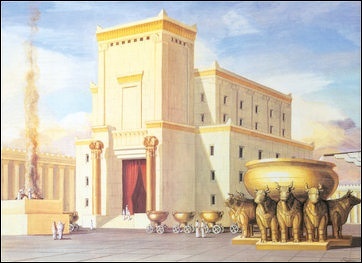
Solomon's Temple
Since 2012, Erez Ben-Yosef, an archaeologist from Tel Aviv University, has been overseeing an archaeological expedition in the heart of Israel’s Timna Valley, the second biggest source of copper in the southern Levant region. (The biggest is Faynan, farther north in Jordan.) Megan Gannon wrote in Live Science: “People have taken advantage of the copper deposits at Timna for millennia. There are dozens of smelting sites and thousands of primitive mining pits clearly visible in the region today. And the area is still used for copper production; the Mexican mining giant AHMSA has a stake in the region. [Source: Megan Gannon, Live Science, November 25, 2014 |~|]
“Recently, the Timna Valley team has taken a crack at Slaves’ Hill, a smelting factory on top of a mesa that was in operation during the 10th century B.C., the biblical era of King Solomon. Today, there are traces of ancient furnaces at the site and lots of slag, which is the rocky material that’s left over after metal is extracted from its ore. (Essentially, it’s manmade lava.). Nelson Glueck explored the region in the 1930s, he named this hilltop site Slaves’ Hill, assuming that its fortification walls were intended to keep enslaved laborers from running off into the desert. When he saw this very harsh environment, he assumed that the labor force had to be slaves,” Ben-Yosef told Live Science. |~|“The site has a complicated scholarly history. When Glueck first explored the region, he thought he was looking at Iron Age mines that fueled King Solomon’s fabled wealth. Later research then cast doubt on Glueck’s interpretation. In 1969, an Egyptian temple dedicated to the goddess Hathor was discovered in Timna Valley. Archaeologists at the time took this as evidence that mining in the area was controlled by Egypt’s New Kingdom during the Bronze Age, a few centuries earlier than the supposed reign of King Solomon. |~|
“When Ben-Yosef’s team revisited the site, they took carbon dates at Slaves’ Hill, and found that most artifacts date to the 10th century B.C., when the Bible says King Solomon ruled. Still, there is no evidence linking Solomon or his kingdom to the mines (and little evidence outside of the Bible for Solomon as a historical figure). One theory is that the mines were controlled by the Edomites, a semi-nomadic tribal confederacy that battled constantly with Israel. |~|
“In 2011, the team’s research at Timna Valley added another layer of nuance to the biblical narrative. Ben-Yosef and Sapir-Hen published an analysis of camel bones at Slaves’ Hill and other surrounding sites. The age of the earliest bones supports the theory that camels were not introduced to the region until at least the early Iron Age — in contradiction to the Old Testament, which refers to camels as pack animals as far back as the Patriarchal Age, which is thought to be around 2000 B.C. |~|
“The latest findings of the Central Timna Valley Project were detailed in the September issue of the journal Antiquity and were presented here last week at the annual meeting of the American Schools of Oriental Research. The team will return to Timna Valley in February 2015. Ben-Yosef said that the researchers will investigate the smelting technology of the Egyptians who worked in the region during the Bronze Age, and will explore the actual Iron Age mines.” |~|
“Discovery” of "King Solomon’s Mine"
Matti Friedman wrote in Smithsonian magazine” On the afternoon of March 30, 1934, a dozen men stopped their camels and camped in the Arava Desert [in present-day Jordan]. At the time, the country was ruled by the British. The leader of the expedition was Nelson Glueck, an archaeologist from Cincinnati, Ohio, later renowned as a man of both science and religion. In the 1960s, he would be on the cover of Time magazine and, as a rabbi, deliver the benediction at John F. Kennedy’s inauguration. Glueck’s expedition had been riding for 11 days, surveying the wastes between the Dead Sea and the Gulf of Aqaba. [Source: Matti Friedman, Smithsonian magazine, December 2021]
In the desert of the Timna Valley near an oddly-placed Ancient Egyptian temple Gluek stopped with Bedouin guide. An expert on ancient pottery, Glueck picked up sherds that were lying around and dated them back 3,000 years... the time of Solomon.... And if the archaeologist’s dating of the sherds was correct, he knew exactly where he was standing: King Solomon’s Mines. Strewn about were piles of black slag, fist-size chunks left over from extracting copper from ore in furnaces. The site, Glueck wrote in his original report from 1935, was no less than “the largest and richest copper mining and smelting center in the entire ‘Arabah.’” It had been abandoned for millennia, but for Glueck it sprang to life.
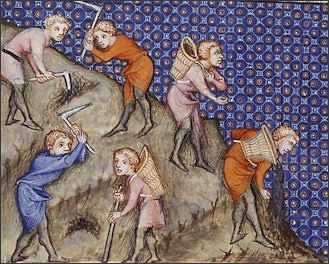
The identification stuck for 30 years, until Beno Rothenberg, who’d once been Glueck’s assistant and photographer, returned in the 1950s at the head of his own archaeological expedition. While Glueck had identified black slag left over from copper smelting (as had the Welsh explorer John Petherick nearly a century before him), it was Rothenberg who found the actual copper mines — warrens of twisting galleries and some 9,000 vertical shafts sunk into the ground, visible from the air like polka dots. The ancient miners toiled underground to harvest the greenish ore from rich veins around the edge of the valley, chiseling it from the rock and hauling it to the surface. At the mouth of the shaft, workers loaded the ore onto donkeys or their own backs and bore it to the charcoal-burning furnaces, knee-high clay urns attached to bellows that sent up plumes of smoke from the center of the mining complex. When the smelters smashed the furnace and the molten slag flowed out, what remained were precious lumps of copper.
In 1969, Rothenberg and his crew began to excavate near a towering rock formation known as Solomon’s Pillars — ironic, because the structure they uncovered ended up destroying the site’s ostensible connection to the biblical king. Here they found an Egyptian temple, complete with hieroglyphic inscriptions, a text from the Book of the Dead, cat figurines and a carved face of Hathor, the Egyptian goddess, with dark-rimmed eyes and a mysterious half-smile. Not only did the temple have nothing to do with King Solomon or Israelites, it predated Solomon’s kingdom by centuries — assuming such a kingdom ever existed. “There is no factual and, as a matter of fact, no ancient written literary evidence of the existence of ‘King Solomon’s Mines,’” Rothenberg wrote.
Egyptians, Edomites and the History of “King Solomon’s Mine”
Matti Friedman wrote in Smithsonian magazine”.”Having assumed they were working at an older, Egyptian site, Ben-Yosef and his team were taken aback by the carbon-dating results of their first samples: around 1000 B.C. The next batches came back with the same date. At that time the Egyptians were long gone and the mine was supposed to be defunct — and it was the time of David and Solomon, according to biblical chronology. “For a moment we thought there might be a mistake in the carbon dating,” Ben-Yosef recalled. “But then we began to see that there was a different story here than the one we knew.” [Source: Matti Friedman, Smithsonian magazine, December 2021]
“In the past decade, Ben-Yosef and his team have rewritten the site’s biography. They say a mining expedition from Egypt was indeed here first, which explained the hieroglyphics and the temple. But the mines actually became most active after the Egyptians left, during the power vacuum created by the collapse of the regional empires. A power vacuum is good for scrappy local players, and it’s precisely in this period that the Bible places Solomon’s united Israelite monarchy and, crucially, its neighbor to the south, Edom.
The elusive Edomites dominated the reddish mountains and plateaus around the mines. In Hebrew and other Semitic languages, their name literally means “red.” Not much is known about them. They first appear in a few ancient Egyptian records that characterize them, according to the scholar John Bartlett in his authoritative 1989 work Edom and the Edomites, “as bellicose by nature, but also as tent-dwellers, with cattle and other possessions, able to travel to Egypt when necessity arose.” They seem to have been herdsmen, farmers and raiders. Unfortunately for the Edomites, most of what we do know comes from the texts composed by their rivals, the Israelites, who saw them as symbols of treachery, if also as blood relations: the father of the Edomites, the Bible records, was no less than redheaded Esau, the twin brother of the Hebrew patriarch Jacob, later renamed Israel. With the Egyptian empire out of the picture by 1000 B.C., and no record of Israelite activity nearby, “The most logical candidate for the society that operated the mines is Edom,” says Ben-Yosef.
Archaeologists had found so few ruins associated with the Edomites that many doubted the existence of any kingdom here at the time in question. There were no fortified cities, no palaces, not even anything that could be called a town. Scholars like Finkelstein maintain that Edom did not emerge until two centuries later.) But the existence of a such a large mining and smelting operation implies at least a complex economic activity at the exact time that David and Solomon reigned. "It's possible that this belonged to David and Solomon," Levy says of his discovery. "I mean, the scale of metal production here is that of an ancient state or kingdom." [Source: Robert Draper, National Geographic, December 2010]
“King Solomon’s Mine” Under The Edomites
“King Solomon’s Mine” was in an area controlled by the Edomites. According to the Bible, Edomites were one of the Hebrew’s enemies at the time of David and Solomon. At Khirbat en Nahas, about 50 kilometers miles south of the Dead Sea in Jordan, University of California, San Diego professor Thomas Levy has spent more than a decade excavating a large copper-smelting operation that dates to 10 century B.C., when copper production was an important industry in the region and, according to the Bible, the Edomites dwelled in this region,
Matti Friedman wrote in Smithsonian magazine” The dig at the Faynan copper mines, which were also active around 1000 B.C., was already producing evidence for an organized Edomite kingdom, such as advanced metallurgical tools and debris. At Timna, too, the sophistication of the people was obvious, in the remains of intense industry that can still be seen strewn around Slaves’ Hill: the tons of slag, the sherds of ceramic smelting furnaces and the tuyères, discarded clay nozzles of the leather bellows, which the smelter, on his knees, would have pumped to fuel the flames. These relics are 3,000 years old, but today you can simply bend down and pick them up, as if the workers left last week. (In an animal pen off to one corner, you can also, if so inclined, run your fingers through 3,000-year-old donkey droppings.) The smelters honed their technology as decades passed, first using iron ore for flux, the material added to the furnace to assist in copper extraction, then moving to the more efficient manganese, which they also mined nearby. [Source: Matti Friedman, Smithsonian magazine, December 2021]
Their mining operation, in Ben-Yosef’s interpretation, reveals the workings of an advanced society, despite the absence of permanent structures. That’s a significant conclusion in itself, but it becomes even more significant in biblical archaeology, because if that’s true of Edom, it can also be true of the united monarchy of Israel. Biblical skeptics point out that there are no significant structures corresponding to the time in question. But one plausible explanation could be that most Israelites simply lived in tents, because they were a nation of nomads. In fact, that is how the Bible describes them — as a tribal alliance moving out of the desert and into the land of Canaan, settling down only over time. (This is sometimes obscured in Bible translations. In the Book of Kings, for example, after the Israelites celebrated Solomon’s dedication of the Jerusalem Temple, some English versions record that they “went to their homes, joyful and glad.” What the Hebrew actually says is they went to their “tents.”) These Israelites could have been wealthy, organized and semi-nomadic, like the “invisible” Edomites. Finding nothing, in other words, didn’t mean there was nothing. Archaeology was simply not going to be able to find out.
Interesting Finds at “King Solomon’s Mine”
Matti Friedman wrote in Smithsonian magazine” The archaeologists found the bones of fish from, astonishingly, the Mediterranean, a trek of more than 100 miles across the desert. The skilled craftsmen at the furnaces got better food than the menial workers toiling in the mine shafts: delicacies such as pistachios, lentils, almonds and grapes, all of which were hauled in from afar. [Source: Matti Friedman, Smithsonian magazine, December 2021]
A key discovery emerged in a Jerusalem lab run by Naama Sukenik, an expert in organic materials with the Israel Antiquities Authority. When excavators sifting through the slag heaps at Timna sent her tiny red-and-blue textile fragments, Sukenik and her colleagues thought the quality of the weave and dye suggested Roman aristocracy. But carbon-14 dating placed these fragments, too, around 1000 B.C., when the mines were at their height and Rome was a mere village.”
The color of the material was royal purple, the most expensive dye in the ancient world. Known as argaman in the Hebrew Bible, and associated with royalty and priesthood, the dye was manufactured on the Mediterranean coast in a complex process involving the glands of sea snails. People who wore royal purple were wealthy and plugged into the trade networks around the Mediterranean. If anyone was still picturing disorganized or unsophisticated nomads, they now stopped. “This was a heterogeneous society that included an elite,” Sukenik told me. And that elite may well have included the copper smelters, who transformed rock into precious metal using a technique that may have seemed like a kind of magic.
More pieces of the puzzle appeared in the form of copper artifacts from seemingly unrelated digs elsewhere. In the Temple of Zeus at Olympia, Greece, a 2016 analysis of three-legged cauldrons revealed that the metal came from the mines in the Arava Desert, 900 miles away. And an Israeli study published this year found that several statuettes from Egyptian palaces and temples from the same period, such as a small sculpture of Pharaoh Psusennes I unearthed in a burial complex at Tanis, were also made from Arava copper. The Edomites were shipping their product across the ancient world.
Workers at Slave Hill, Seemed to Have Lived Pretty Well
Metalworkers at Slave Hill appear to have been compensated for their work with fairly good meals. Megan Gannon wrote in Live Science: “The metalworkers’ diet included good cuts of sheep and goat, as well as pistachios, grapes and fish brought to the middle of the desert from the Mediterranean, according to an analysis of ancient leftovers at “Slaves’ Hill”...The findings imply that “Slaves’ Hill” might be a misnomer; the people who manned the furnaces probably weren’t slaves, but rather, they held a higher status because of their craft, archaeologists say. ▪ “Somebody took care that these people were eating well,” said Erez Ben-Yosef, an archaeologist from Tel Aviv University. [Source: Megan Gannon, Live Science, November 25, 2014 |~|]
“Ben-Yosef and his colleague Lidar Sapir-Hen, another archaeologist at Tel Aviv University, looked at animal remains from Slaves’ Hill and found mostly sheep and goat bones, many with butchery marks. This supports the idea that this mining camp relied on livestock for food. Bones from the meatiest parts of the sheep and goats were found near the smelting furnaces. |~|
“The archaeologists also found the remains of 11 fish, including catfish, which would have come from the Mediterranean Sea, at least 125 miles (200 kilometers) away. The researchers found pistachios and grapes, too, which would have come from the Mediterranean region. The team also discovered a sea snail known as a cowrie, which would have come from a more local water source, the Red Sea, at least 19 miles (30 kilometers) to the south. |~|
“The archaeologists said they think that whoever was running this mining camp was importing food and saving the best cuts of meat for the metalworkers, not the people who were doing auxiliary tasks, such as cooking the food, crushing the ore and preparing the charcoal, nor slaves who might have been working in the actual mines.“What we found was that the guys working at the furnace, which is supposedly very hard work with very high temperatures above 1,200 degrees Celsius [above 2,200 degrees Fahrenheit], these people were treated the best,” Ben-Yosef said. “They were highly regarded. It goes together with the need for them to be highly specialized and very professional.” |~|
“Metalworkers had to be multitaskers. They controlled nearly 40 different variables, from the temperature to the amount of air to the amount of charcoal in the furnace, Ben-Yosef said. “If they had mistaken something, the entire process would fail,” Ben-Yosef said. “On the other hand, if they do succeed, they are the guys who know how to make metal from rock.” |~|
Pools of Solomon?
The Pools of Solomon is the name given to complex of three large reservoirs located eight kilometers (five kilometers) to the southwest of Bethlehem. The discovery of a hidden underground complex at the site shows that the claim that is connected with Solomon — let alone anything in the Bible, ancient Judaism or ancient Christianity ---is simply not correct. The insistence that the Pools of Solomon do have no connection to biblical kings, the Bible, or Judaism is rooted more in politics and land grabbing than religion. [Source:Candida Moss, Daily Beast, May 3, 2020]
Candida Moss wrote in the Daily Beast: Then “Pools of Solomon” “first appear in passing in a 10th century travelogue by the medieval Arab geographer al-Muqaddasi. One of these pools, the Lower Pool, holds enough water to fill 46 Olympic sized swimming pools. Popular Zionist opinion maintains that the pools were built by the 10th century BCE monarch King Solomon, and they are believed to be the subject of a verse in Ecclesiastes, which tradition maintains was written by Solomon himself, “I made myself pools from which to water the forest of growing trees.”
Scholars, however, don’t buy it. Al-Muqaddasi only mentions two pools and, as a result, people have tended to assume that the upper two pools are early medieval while the lower pool was built in the sixteenth century by Sultan Suleiman the Magnificent, when he renovated the structure. New archaeological work reveals that all these opinions are wrong... Rather the whole complex, including dams, that embraces the pool was set up by the Romans.
For the complete article from which the material here is derived see “ The Secrets of Bethlehem’s Controversial Pools of Solomon Have Been Unlocked” by Candida Moss in the Daily Beast thedailybeast.com
Image Sources: Wikimedia, Commons, Schnorr von Carolsfeld Bible in Bildern, 1860
Text Sources: Internet Jewish History Sourcebook sourcebooks.fordham.edu “World Religions” edited by Geoffrey Parrinder (Facts on File Publications, New York); “ Encyclopedia of the World’s Religions” edited by R.C. Zaehner (Barnes & Noble Books, 1959); “Old Testament Life and Literature” by Gerald A. Larue, New International Version (NIV) of The Bible, biblegateway.com; Wikipedia, Live Science, Archaeology magazine, National Geographic, BBC, New York Times, Washington Post, Los Angeles Times, Smithsonian magazine, Times of London, The New Yorker, Reuters, AP, AFP, Lonely Planet Guides, and various books and other publications.
Last updated March 2024