
Home | Category: David and Solomon / David and Solomon
SOLOMON'S TEMPLE

Solomon's Temple
About 230 years after the Israelites made their way of way to the Promised Land from Egypt, they built the Temple in Jerusalem. This was the central site of Jewish prayer and pilgrimage. Sacrifices were made here as an expression of submission to God, as thanksgiving, and as atonement for sins. The Temple rites were presided over by a hereditary priesthood. [Source: Paul Mendes-Flohr Worldmark Encyclopedia of Religious Practices, 2000s Encyclopedia.com]
The First Jewish Temple — also known as "the First Temple," the Temple of Solomon and Solomon's Temple — was built on Mt. Moriah on the present-day Temple Mount in the 10th century B.C. by Solomon around a stone altar to thank the Lord for leading the Jews to the Promised Land. The stone altar, which is called the Foundation Stone, is where Jews believe God collected dust to make Adam, Abel was killed by Cain, and Abraham almost sacrificed Isaac.
"Behold, I purpose to build a house unto the name of the Lord my God," King Solomon declared. The Temple itself was believed to be the center of the universe, the holiest place in the world, the destination of prayers, and the place where God lived. It’s focal point was the Holy of Holies, a central sanctuary that only the high priest could enter once a year on the Day of Atonement.
The Holy of Holies contained important treasure including, it is said, the Ark of the Covenant. The Ark of the Covenant is a wood-and-gold chest that housed the tablets on which the Ten Commandments were written. The Ark had been built by Moses and recaptured from the Philistines by David.
Solomon's Temple was partly destroyed and the Ark of the Covenant was lost when Nebuchadnezzar and the Babylonians sacked Jerusalem in 587 B.C. In a Babylonian chronicle Nebuchadnezzar boasted that he “captured the city and...took heavy tributes and brought it back to Babylon.” The Bible has a similar account except that the “tributes” are referred to as “all the treasures of the Temple and the royal palace.” The fate of the Ark is not known. According to one legend it was stolen by the illegitimate son of Solomon and Sheeba and taken to Ethiopia and placed in a church in Aksum, where only a guardian monk has access to it.
After The Temple was destroyed, most of the Israelite nobility and leadership was exile to Babylon. It has been suggested that during the Babylonian Exile the institution of the synagogue as a house of prayer began to emerge. A modest Second Temple was built in 539 B.C.
Websites and Resources: Virtual Jewish Library jewishvirtuallibrary.org/index ; Judaism101 jewfaq.org ; torah.org torah.org ; Chabad,org chabad.org/library/bible ; Bible and Biblical History: ; Biblical Archaeology Society biblicalarchaeology.org ; Bible History Online bible-history.com Bible Gateway and the New International Version (NIV) of The Bible biblegateway.com ; King James Version of the Bible gutenberg.org/ebooks ; Jewish History: Jewish History Timeline jewishhistory.org.il/history Jewish History Resource Center dinur.org ; Center for Jewish History cjh.org ; Jewish History.org jewishhistory.org ; Internet Jewish History Sourcebook sourcebooks.fordham.edu ; Christianity: BBC on Christianity bbc.co.uk/religion/religions/christianity ; Christian Classics Ethereal Library www.ccel.org ; Sacred Texts website sacred-texts.com
RECOMMENDED BOOKS:
“The Temple of Solomon” by Kevin J. Conner Amazon.com ;
“King Solomon's Empire: The Rise, Fall, and Modern-Day Influence of an Iron-Age Ruler”
by Archie W. N. Roy PhD and Margaret P. Roy Amazon.com ;
“Why the Bible Began: An Alternative History of Scripture and its Origins” by Jacob L. Wright Amazon.com ;
“The History of Saul, David and Solomon: Israel's Greatest Kings” by James Allen Moseley
Amazon.com ;
“The Making of a Man of God: Lessons from the Life of David”by Alan Redpath Amazon.com ;
“King Solomon's Mines” (Tor Classics)by H. Rider Haggard Amazon.com ;
“The Bible Unearthed” by I. Finkelstein and N. Asher Silberman Amazon.com ;
“Zondervan Handbook of Biblical Archaeology: A Book by Book Guide to Archaeological Discoveries Related to the Bible” by J. Randall Price and H. Wayne House Amazon.com ;
“NIV, Cultural Backgrounds Study Bible (Context Changes Everything) by Zondervan, Craig S. Keener Amazon.com ;
“Oxford Companion to the Bible” by Bruce M. Metzger and Michael David Coogan Amazon.com ;
“Historical Atlas of the Holy Lands” by K. Farrington Amazon.com ;
“A History of the Jews” by Paul Johnson, Amazon.com ;
Solomon
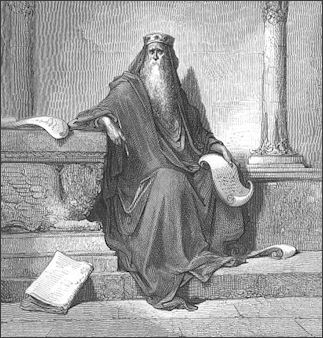 Solomon (961-922 B.C.) was David's and Bath-sheba’ss son. He united the Hebrews in a kingdom that briefly dominated the area and was the third king of Israel. Solomon became king when he was still a young man. According to the Bible, God came to Solomon in a dream at the beginning of his rule and asked him if there was anything he desired. Solomon said he only wanted knowledge so that could rule wisely and judiciously.
Solomon was known for his judicial wisdom and knowing all things. He was able to ferret out the truth in questionable court cases, it was said, due to his deep understanding of human nature. Once when two women claimed to be mother of the same child he suggested that the baby be cut in half and divided among the women. One of the women cried out and begged that the baby be given to the other mother, showing that she was the true mother.
Solomon’s story is featured in The United Kingdom of Israel, II Samuel 5-8; I Kings 4-6, 9-11. Solomon ruled for some 40 years. His reign was characterized by brutality, building projects, wealth and class warfare. According to the Bible, Solomon’s empire stretched from Sinai to the Euphrates. There is no evidence of this claim. It seems that if indeed Solomon’s empire was this powerful, there would be some evidence in the Egyptian or Mesopotamian records. The kingdom was more likely of modest size.
Getting The First Temple Off The Ground
David was anointed king in 1010 B.C. and reigned until 970 B.C.. He captured Jerusalem, declared it the capital of his kingdom, and had the Ark of the Covenant, containing the tablets of the Law given by God to Moses, taken there. His plan to build a great temple to house the ark was thwarted by the prophet Nathan, who claimed that God viewed David, a man of war, unsuitable for the sacred project. [Source: Paul Mendes-Flohr Worldmark Encyclopedia of Religious Practices, 2000s, Encyclopedia.com]
The mantle of building The Temple was passed on by David to his son Solomon. Solomon’s rule reign was marked by peace, prosperity, and good relations ties with the surrounding kingdoms But Solomon taxed the people heavily to finance the construction of the Temple and an opulent palace and to strengthen his army.
Solomon’s Temple was built on Mt. Moriah on on a “threshing floor” on the mountain purchased by David for 50 shekels of silver from the Araunah the Jebusite in 1000 B.C. The temple was designed by Hiram, a Phoenician architect, who is believed to have modeled it after the Ball Melqart in Tyre, which Heredotus said has one pile of "gold, the other of emerald." Solomon’s people were nomads and shepherds and they lacked experience building monuments, which is why he sought the assistance of his ally Hiram.
Solomon paid for the building with wheat and olive oil, 20 cities in Galilee and 120 tenets of gold. Next to the temple, Solomon built a great palace. According to the Old Testament 22,000 oxen and 120,000 sheep were sacrificed at the dedication of temple. So much money was spent on the temple that it drained money from the treasury which presumably could have been used to beef up the military and keep the kingdom from splitting apart.
Construction of Solomon’s Temple

Solomon's Temple plan
Dedicated to Jehovah, the temple took seven years to build and required hundred sof workmen and laborers to complete. According to the Bible’s Book of Kings temple was comprised of a series of courtyards, each one more holy than the one outside it, with holy sanctuary with the Ark in the middle. The main building was made from cut stone and Lebanon cedar timber, and was veiled in purple cloth and overlaid with gold. The doors were gilded olive wood. The entrance was marked by two great pillars of bronze.
Gerald A. Larue wrote in “Old Testament Life and Literature”: “Solomon's palace was a major building operation, requiring thirteen years to complete, as compared to seven for the temple. Standing near the temple, the royal complex must have somewhat overshadowed the building designed for the deity. A construction program of this magnitude required money, some of which Solomon raised by taxation (4:7-19) and some of which came from business profits. Horses were imported and resold at a profit to other nations (10:28). [Source: Gerald A. Larue, “Old Testament Life and Literature,” 1968, infidels.org ]
“Simultaneously a strong force of war-chariots and cavalrymen were developed for national security (10:26 and following verses; compare with 4:28), and these forces were stationed throughout the empire in strategically located chariot cities. The excavation of Megiddo has uncovered a stable of five units, each capable of sheltering thirty horses, which was at one time dated in the time of Solomon but is now believed to come from the ninth century. It has been suggested that the House of the Forest of Lebanon (7:2-5) may have been a stable for horses and chariots although the biblical description does not provide support for this idea.
“Additional evidence of Solomon's business activities has been discovered in the Negeb, east of the Arabah, where ancient copper mines and primitive smelters that may belong to his time have been found. Ezion-geber, at the head of the Gulf of Aqabah, was a fortified storehouse and a port which gave Solomon access to the Arabian peninsula, African cities on the Red and Arabian Seas, and possibly also to India if "Ophir" (I Kings 9:28) can be equated with Suppara, India.
Details and Biblical Descriptions of Solomon’s Temple
The Building of the First Temple is described in I Kings 6-7; 2 Chronicles 3-4. The Byt Yhwh Ostracon (9th-7th century B.C.) is the oldest mention of Solomon's temple outside the Bible.
Gerald A. Larue wrote in “Old Testament Life and Literature”: “Construction details are set forth in I Kings 6, and the manufacture of the accoutrements is recorded in I Kings 7:9-50. From his sources the editor drew information concerning the trade agreements between Solomon and Hiram, King of Tyre. Twenty Galilean cities, plus Hebrew grain and oil, were exchanged for timber and gold (5:1, 6-12; 9:10-14). Labor was recruited through the corvée or forced labor policy. [Source: Gerald A. Larue, “Old Testament Life and Literature,” 1968, infidels.org ]
“By modern standards the temple was small - ninety by thirty feet and forty-five feet in height.6 The building was modeled after Phoenician-Canaanite temples and was divided into three sections. The porch or ulam served as an entrance hall. Two bronze, free-standing pillars named Jachin and Boaz stood "within" this area. Through "folding doors" entrance was gained to the central chamber or hekal, a room about sixty feet long decorated with pomegranates, lilies and palms. Here were numerous cult objects, such as the incense altar, the table of shew bread, the ten golden candlesticks (five on the right and five on the left), basins, cups, goblets, etc. Beyond this room was "the most holy place" or the "holy of holies" or debir. This cubical room, thirty by thirty by thirty feet, was probably a raised section approached by stairs (although stairs are not mentioned). In this room the sacred ark was placed between two guardian cherubim. Here was the dwelling place of the deity. The appearance of the cherubim is not known. They may have resembled the winged beasts with bearded human faces that acted as guardians in Mesopotamian cities, or the winged sphinx-like figures found in the carved ivories at Megiddo or depicted in the portrait of the king of Byblos. A three-story complex of rooms was constructed against the side and back walls of the temple, but just how these rooms were used is not indicated. It is possible that they were for storage.

From the Jewish Encyclopedia “All reconstructions of temples are, of necessity, hypothetical.” One floor plan “suggests that the two free-standing pillars named "Jachin" and "Boaz" stood in front of the temple proper, although it would have been just as feasible to place them within the porch or ulam as in the Tainat shrine. The cross-section (a) portrays the innermost room or debir (described as a perfect cube in I Kings 6:20) with a floor level above that of the rest of the temple. The debir might just as well have been on the same level as the rest of the building and the roof in this part of the building may have been lower. The recessed windows are styled after stone frames found in the excavation at Ramat Rahel, Israel. The crenelations on the roof are based on remnants of structures found at Megiddo and utilized in the Stevens reconstruction of the temple (cf. G. E. Wright, Biblical Archaeology, p. 139), but no one knows if such battlements were used on shrines. The capitals are styled after one found at Megiddo. The temple faced the east.
“Details of the temple appearing in Chapters 40 to 42 of Ezekial do not parallel in every detail the description of Solomon's temple in II Kings 6 f. The temple stood at the center of the new theocratic state. Ministrants were to be Levitical priests of Zadokite lineage. Now Yahweh's glory ( kabod) returned (43:1-5), symbolizing the restoration of covenant relationships. The picture is idyllic, and paradisiac aspects are emphasized by references to sacred trees and waters reminiscent of the J story of Eden. Springing from beneath the temple was a river with purifying waters so potent that the saline Great (Dead) Sea could be made to sustain marine life and give nourishment to trees whose fruits would never fail and whose leaves would heal (47:1-12). The book closes with the division of land among the tribes and the announcement of a new name for Jerusalem: "Yahweh-shammah," meaning "Yahweh is there."
Idea of a Temple in the Babylonian Era
Morris Jastrow said: “The modem and occidental view of a temple as a place of worship gives only a part of the picture when we come to regard the sanctuaries of the gods in Babylonia and Assyria. Throughout antiquity, the sanctuary represents, first and foremost, the dwelling of a god. Among the Semites it grows up around the sacred stone, which, originally the god himself, becomes either, in the form of an altar, a symbol of his presence, or is given the outlines of an animal or human figure (or a combination of the two), and becomes a representative of the deity — his counterfeit. Stone, altar, and image are merely phases of the primitive animistic conception. Without differentiating sharply between the various manifestations of life in the universe, primitive man sought to localise the unseen Powers; and, through an instinct, forming part of his meagre equipment at the outset of his strange and miraculous career, he dimly felt that they should be propitiated, since at times he clearly perceived that they controlled his welfare, and apparently intervened at critical moments in his own life, or in that of the group to which he belonged. [Source: Morris Jastrow, Lectures more than ten years after publishing his book “Aspects of Religious Belief and Practice in Babylonia and Assyria” 1911 ]
“The charming legend of Jacob’s dream, devised to account for the sanctity of an ancient centre of worship — Luz, — illustrates this development of the temple, from an ancient and more particularly from a Semitic point of view. The “place” to which Jacob comes is a sacred enclosure formed by stones. His stone pillow is the symbol of the deity, and originally the very deity himself. The god in the stone “reveals” himself, because Jacob by direct contact with the stone becomes, as it were, one with the god, precisely as a sacred relic — an image, or any sacred symbol — communicates a degree of sanctity to him who touches it, whether by kissing it or by pressing against it. When Jacob awakes he realises that Jahweh is the god of the sacred enclosure, which he designates as “the house of the Lord” (Elohim) and “gate of heaven.” He sets up the stone as an altar, anoints it (thus doing homage to the deity represented by the stone,) precisely as one anoints a king or a priest. He changes the name of the sacred place to Bethel, i.e., “house of God,” and declares his intention on his return to his father’s house to convert the stone into a “house of the Lord.” The stone becomes the house, and the sanctuary is the home of the god represented by the stone.
“When later on the temple at Jerusalem was built, the name given to it was the “holy house,” and it is commonly spoken of as the “house of Jahweh” in which he was supposed to dwell. “I have built a lofty house for Thee,” says Solomon, “a place for Thy dwelling for all times.” To this day the central sanctuary of Islamism, the Caaba at Mecca, is known as the “house of Allah”; and such is the intimate character of the relation between Allah and his worshippers that the latter regard the mosque not merely as a place for prayer, but as a paternal mansion into which they can wander at any time of the day for rest and recreation. It is not uncommon in the Orient to see a worshipper taking a siesta in a mosque, and even performing his toilet there. The temple thus becomes a home for the worshipper as well as for the deity. In a recent address, Prof. Flinders Petrie has shown that the interior arrangement of an Egyptian temple was planned after the mansions of the nobles, and that the cult in its general features followed the daily routine observed in large households. The room containing the image of the deity was swept and prepared for the day’s duties. A fire was lit, the god washed, anointed, and food was placed before him; thereafter the god was ready to receive his worshippers, just as the grand seigneur receives in the morning the homage of his clients and the visits of the members of his household.

Activities at Solomon’s Temple
Dr Edward Kessler at Cambridge wrote for the BBC: “The reason there was a Temple was that people need something tangible. We all need something tangible. Just look at my walls - I have pictures on my children on them. It's a tangible reminder of people who are important in my life. And so for the Children of Israel, the Temple gave them something tangible. The act of sacrifice in a temple was a physical act. It wasn't just a mental or a spiritual act. This is part of our progression as people, moving towards a monotheism, and then moving away from sacrifice and temple cults because that in itself is not necessarily what God wants. It may have been what we thought God wanted thousands of years ago, but once the temple was destroyed, we realised that actually there are other ways to serve God and the service of God may be through the heart rather than through the sacrifice of animals.” [Source: Dr Edward Kessler, executive director and lecturer at the Centre for Jewish Christian Relations, Cambridge, BBC June 25, 2009 |::|]
Gerald A. Larue wrote in “Old Testament Life and Literature”: “The temple should not be thought of in terms of a modern church or synagogue. For the most part the people of the land continued to worship at local shrines. The temple was the royal chapel, the center of the national cult of Yahweh. The public did not enter the building, although presumably certain rituals performed within the hekal could be witnessed through the open doors. Public ceremonies were associated with the altar for burnt offerings in the open courtyard before the temple proper. It is clear from Babylonian temple records and from the responsibilities of the priestly class as set forth in Lev. 5, 6, 13, 15, that temples were as much administrative centers for the nation as places of worship. Present-day responsibilities of departments of health, sanitation and social welfare were included in the duties of the priesthood. The fact that Solomon acted as a priest and that he was able to depose Abiathar and appoint individuals of his own choice suggests a bureaucratic administrative pattern (cf. 4:1-2, 5). [Source: Gerald A. Larue, “Old Testament Life and Literature,” 1968, infidels.org ]
“How ritual for temple services developed is not known. Possibly certain rites from local Hebrew and Canaanite shrines were adopted. Festivals accompanying seasonal changes found in Canaanite worship may have become part of the Hebrew agricultural interpretation of religion. The structural design of the temple, planned by Phoenician artisans, was most likely designed to accommodate rituals familiar to Phoenicians and Canaanites, for the Hebrews had had no such building prior to this time. It also seems likely that, having been in the land for more than a century, the Hebrews had developed religious rituals associated with their own sacred symbols. Such a psalm as 24:7-12 may have been sung in a ritual in which the ark was taken into the temple. In addition to the temple for Yahweh, Solomon built shrines for other deities (11:7).
Archaeological Evidence of Solomon's Temple
There is no direct archaeological evidence of the existence of Solomon's reign. But in 1997, archaeologists discovered a 13-word scrap of Old Hebrew script on an inscription that mentioned the payment of three shekels of silver to King Solomon's Temple in Jerusalem. Dated between the 7th and 9th centuries, its is the oldest non-Biblical reference to Solomon's temple ever recorded. The inscription was found on a pottery fragment in a private collection and its source is not known.A shekel was a measure of weight equal to around 11 grams.
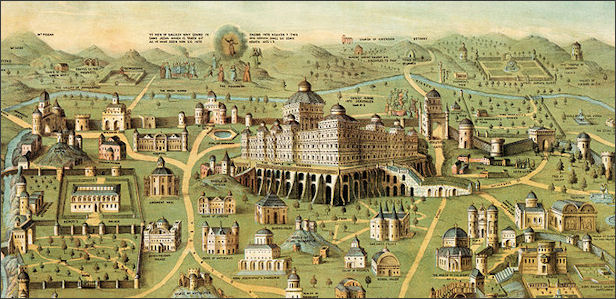
Jerusalem with Solomon's Temple
In January 2003, the existence a legal-pad-size stone tablet with inscription on running the Jewish Temple was revealed. Dated to the 9th century B.C. and called the Jehoash tablet or Yoash stone, it was heralded as “the most significant archaeological find in Jerusalem and in the land of Israel.” The tablet was inscribed with ancient Hebrew letters and named after a king who ruled Judea from 835 to 796 B.C. and listed repairs needed at the temple and how a person named Jehoash planned to pay for them. Later it was determined that the Yoash stone was a fake based on word usage and the way the letters were inscribed and the composition of the patina.
One of the most important pieces to Jews at the Israel Museum for many was an insignificant-looking ivory pomegranate bearing an ancient Hebrew inscription. Described as the only relic ever recovered from King Solomon's treasures, the thumb-sized piece was said to have topped a scepter carried by a Temple priest. It bears the inscription "Belonging to the Temple of the Lord, holy to the priests" and dates from the mid-8th century B.C., the time of Solomon's Temple. Later it was revealed that ivory pomegranate was a fake.
In December 2004, four antiquities dealers, collectors and dealers were indicted on charges of fraud and forgery in connection with the forged treasures such as the James’ ossuary, the ivory pomegranate from Solomon’s temple and the Yoash stone (Jehoash Tablet), a stone tablet with inscription on running the First Temple of Jerusalem . According to the indictment the men charged took genuine artifacts and added inscriptions and painted the items with a special coating designed duplicate the patina found on very old objects and falsely increase their importance and value.
The fraud was so well executed it fooled many experts and earned the forgers millions of dollars. Many of the object the group forged are believed to be in the collections of private collectors and still regarded as genuine. Among those charged were Israeli collector Oded Golan and Robert Deutsch, an inscriptions expert ay Haifa University.
Digging is forbidden at the site of Solomon’s Temple out of fear it would cause tensions to rise between Jews and Muslim. In 1986, archaeologists discovered a eighth-century B.C. gate in Jerusalem that may have led to Solomon's Temple.
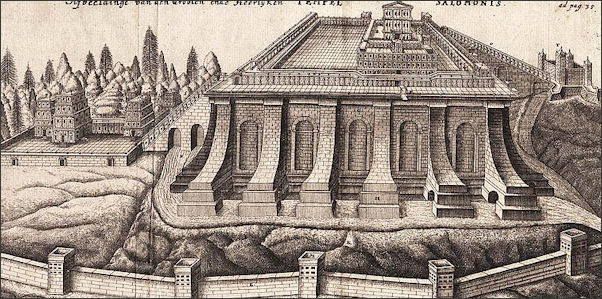
Archeology Sites Associated with Solomon’s Temple
John R. Abercrombie, University of Pennsylvania, Solomon is credited with building the Millo, a terrace system in Jerusalem, and reconstructing three cities (1 Kings 9:15-17). Excavations at Hazor, Megiddo, and Gezer have uncovered a tantalizing, tangible suggestion about this biblical passage. Yigael Yadin understood, the verse to refer to the gate and wall systems around the three sites. With some shrewd sleuthing, particularly with the older site report from Gezer, Yadin showed that the tenth-century construction at the three sites follow the "same" plan. Yadin conjectured that this construction was Solomonic. “Since his original idea, some scholars have questioned the credibility of the Solomonic identification due in part to the discovery of more gates at Ashdod and Lachish. The Lachish gate may date to the tenth century if one concludes that Stratum IV falls in this period, though other archaeologists favor dating the gate to the ninth century. [Sources: James B. Pritchard, Ancient Near Eastern Texts (ANET), Princeton, Boston University, bu.edu/anep/MB.html |*|]
Gerald A. Larue wrote in “Old Testament Life and Literature: The Tainat Shrine is an eighth or ninth century shrine found at Tainat (ancient Hattina) between A1eppo and Antioch in Syria. The drawing is based on a sketch appearing in The Biblical Archaeologist, IV (1941). The shrine was built next to the royal palace. Two free-standing pillars stood in the porch area and a raised pediment occupied the inner room. [Source: Gerald A. Larue, “Old Testament Life and Literature,” 1968, infidels.org ]
"Solomon's Pillars" refers to massive stone outcroppings above are in the Negeb about sixteen miles north of the ancient port city of Ezion-Geber on the Gulf of Aqabah. They have been called "Solomon's pillars" because some scholars believe that copper was mined here in Solomon's time. Smelting furnaces and heaps of slag have been found nearby. The aridity of the area, the burning heat of the summer sun, the distance from central Palestine and the problem of transporting food and equipment necessary for sustaining life in this barren area must have resulted in a high mortality rate.
Image Sources: Wikimedia, Commons, Schnorr von Carolsfeld Bible in Bildern, 1860
Text Sources: Internet Jewish History Sourcebook sourcebooks.fordham.edu “World Religions” edited by Geoffrey Parrinder (Facts on File Publications, New York); “ Encyclopedia of the World’s Religions” edited by R.C. Zaehner (Barnes & Noble Books, 1959); “Old Testament Life and Literature” by Gerald A. Larue, New International Version (NIV) of The Bible, biblegateway.com; Wikipedia, Live Science, Archaeology magazine, National Geographic, BBC, New York Times, Washington Post, Los Angeles Times, Smithsonian magazine, Times of London, The New Yorker, Reuters, AP, AFP, Lonely Planet Guides, and various books and other publications.
Last updated March 2024