
Home | Category: Genesis and the Early Parts of Bible / Genesis and the Early Parts of Bible
ANCIENT FLOOD STORIES
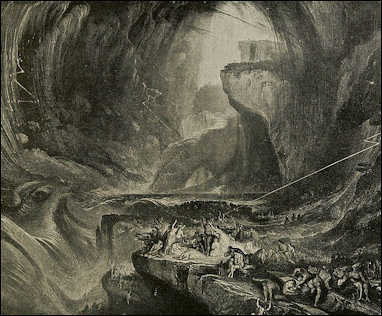
A number of flood stories are found in the oral histories of different tribes and ethnic groups around the world. Live Science reports; According to historical documents, Noah's flood is a retelling of older stories, and it's likely allegorical rather than a literal recounting of an event. Ira Spar, professor of ancient studies at Ramapo College of New Jersey, told Live Science that the biblical stories in the Old Testament, which were written down between 800 B.C. and 500 B.C., likely came from older oral traditions and multiple sources.
There are slightly different accounts of Noah's flood story in other religious books, such as the Quran, while earlier versions of a cataclysmic flood stem from ancient Mesopotamian texts. Spar noted that there's a Sumerian flood story recorded in fragments that dates back to the late third millennium B.C. "Who knows how far back the story goes?" Spar said. [Source: Patrick Pester, Live Science, May 14, 2023]
Many Indigenous American stories in the Pacific Northwest involve floods that sound a lot like tsunamis, with great waves crashing onto the shore. The same is true for stories from the seismically active coasts of South America and the South Pacific islands.
See Separate Articles: FLOOD STORIES FROM ANCIENT MESOPOTAMIA africame.factsanddetails.com ; NOAH: HIS ARK, FAMILY AND STORY IN GENESIS AND THE QUR'AN africame.factsanddetails.com
Websites and Resources: Bible and Biblical History: Bible Gateway and the New International Version (NIV) of The Bible biblegateway.com ; King James Version of the Bible gutenberg.org/ebooks ; Bible History Online bible-history.com ; Biblical Archaeology Society biblicalarchaeology.org ; Judaism Virtual Jewish Library jewishvirtuallibrary.org/index ; Judaism101 jewfaq.org ; torah.org torah.org ; Chabad,org chabad.org/library/bible ; Internet Jewish History Sourcebook sourcebooks.fordham.edu Christianity: BBC on Christianity bbc.co.uk/religion/religions/christianity ; Christian Classics Ethereal Library www.ccel.org ; Sacred Texts website sacred-texts.com ; Internet Ancient History Sourcebook: Christian Origins sourcebooks.fordham.edu ; Biblical Images: Bible in Pictures creationism.org/books ; Bible Blue Letter Images blueletterbible.org/images ; Biblical Images preceptaustin.org
RECOMMENDED BOOKS:
“Ancient Near Eastern Texts Relating to the Old Testament” by James B. Pritchard Amazon.com ;
“The Lost Book of Noah: Christian Apocrypha” by Noah Amazon.com ;
"Noah" (the film with Russell Crowe) Amazon.com ;
“The Book of Genesis Illustrated by R. Crumb” Amazon.com ;
“Genesis: Translation and Commentary” by Robert Alter (1997) Amazon.com ;
“As It Is Written: The Genesis Account Literal or Literary?” by Kenneth Gentry Jr ( Amazon.com ;
“Reading Genesis” by Marilynne Robinson Amazon.com ;
“Genesis: A New Translation of the Classic Biblical Stories” by Stephen Mitchell (1996) Amazon.com ;
“Genesis: A Living Conversation” by Bill Moyers 1996) Amazon.com ;
“In the Beginning, New Interpretation of Genesis” by Karen Armstrong(Knopf, 1999) Amazon.com ;
“The Torah: The Five Books of Moses, the New Translation” by the Jewish Publication Society Inc. (Editor) Amazon.com ;
“Commentary on the Torah” by Richard Elliott Friedman Amazon.com ;
“The Torah: A Modern Commentary” by Gunther Plaut Amazon.com ;
“The Holy Bible in English easy to read version” Amazon.com ;
“A History of the Bible: The Story of the World's Most Influential Book”
by John Barton, Ralph Lister, et al. Amazon.com ;
“Who Wrote the Bible?” by Richard Friedman, Julian Smith, et al.
Amazon.com ;
“The Complete Guide to the Bible” by Stephen M. Miller Amazon.com
Noah Story and Mesopotamia
One of the oldest known flood stories is found in the Mesopotamian Gilgamesh story. According to that Gilgamesh tells of Utnapishtim who was warned by the water god Enki to build a boat for himself, his family, animals and artisans from a great flood. The Greeks and Romans had a similar story about Deucalion and Pyrra, who saved the children and a collection animals from a great flood. A passage on Noah’s flood in Genesis Bible reads: "And the water prevailed exceedingly upon the earth; and the all the high hills...were covered." The flood in the “Epic of Gilamesh” : "Swiftly it mounted up; the water reached the mountains."
Gerald A. Larue wrote in “Old Testament Life and Literature”: “The source of the flood story can be traced to Mesopotamia and the eleventh tablet of the Gilgamesh Epic, which in turn rests upon an older Sumerian flood legend. It is unlikely that such a story would develop within Palestine where the Jordan flows below sea level. The obvious marks of literary borrowing and the discovery of a fragment of the Gilgamesh Epic at Megiddo from the fourteenth-century level suggests that the story was known in Canaan prior to the Hebrew invasion, and would have come into the Bible material from Canaanite sources. [Source: Gerald A. Larue, “Old Testament Life and Literature,”1968, infidels.org]
“Certain noteworthy differences between the Mesopotamian versions and the Bible account can be discerned. When the Hebrews borrowed the story, they related it to their own deity, Yahweh, discarding the polytheistic pattern of the Gilgamesh account. Furthermore, the flood in the Hebrew story came as a judgment resulting from Yahweh's regret that he had made man because of the latter's continued evil action, while in Gilgamesh mankind was to be destroyed by vote of the gods with no real reason provided.16 Finally, the hero of the Gilgamesh flood story, Utnapishtim, is rewarded with immortality for himself and his wife, while Noah and his family die as all mortals must. What the Hebrew writers borrowed they transformed in the light of their own theological convictions.
Mesopotamian Flood Story
Floods were a constant concern for people living along the Tigris and Euphrates in Mesopotamia. One of the most famous Sumerian tablets contained a story about a great flood that destroyed Sumer that is virtually the same story as the Noah story in the Old Testament. It describes a man named Utnapishtim who is warned by the water god Enki to build a boat to save himself, his family, animals and artisans from a great flood.

Flood Tablet of Gilgamesh
One passage goes:
All the windstorms, exceedingly powerful attacked as one.
The deluge raged over the surface of the earth.
After, for seven days and seven nights.
The deluge had raged in the land.
And the huge boat had been tossed about on great waters.
Utu came forth, who sheds light on heaven and earth.
Ziusudra opened a window of the huge boat.
Ziusudra, the king.
Before Utu prostrated himself.”
According to the Mesopotamia tale: "Swiftly it mounted up; the water reached the mountains." The Bible reads: "And the water prevailed exceedingly upon the earth; and the all the high hills...were covered."
The passage with the reference to the flood was discovered in 1867 by an amateur linguist named George Smith who spent his free time at the British Museum rummaging through cuneiform tablets. Smith made his discovery from a fragment of a tablet that contained details of the flood, a ship caught on a mountaintop and a bird sent out to search for dry land. It was the first conformation of a flood story in ancient Mesopotamia , complete with a Noah-like figure and an ark.
See Separate Articles: FLOOD STORIES FROM MESOPOTAMIA: africame.factsanddetails.com
Archaeological Evidence of a Great Ancient Mesopotamian Flood
How plausible is the Biblical flood story? The Mesopotamian landscape is essentially a flood plain. Historian Irving Finkel told The Telegraph: “In that landscape, mankind’s vulnerability to flooding is explicit,” he says. “There must have been a heritage memory of the destructive power of flood water, based on various terrible floods. And the people who survived would have been people in boats. You can imagine someone sunbathing in a canoe, half asleep, and waking up however long later and they’re in the middle of the Persian Gulf, and that’s the beginning of the flood story.” There are, he says, geological and archaeological suggestions that there was an especially cataclysmic flood around 5,000BC.
Gerald A. Larue wrote in “Old Testament Life and Literature”: “During the excavation of ancient Ur and nearby Al 'Ubaid, Sir Leonard Woolley uncovered evidence of what he interpreted as a major flood which occurred in the middle of the fourth millennium, and which covered an existing culture with a deposit of sediment to depths varying from eight to eleven feet. Similar deposits were found in other Mesopotamian sites, but these were from different periods. It has been argued that the Mesopotamian and biblical flood traditions may have their origin in a flood of unprecedented proportions. [Source: Gerald A. Larue, “Old Testament Life and Literature,”1968, infidels.org
Woolley's interpretation of the evidence has been challenged and there are those who argue that what Woolley and others interpreted as river sediment is, in fact, a great layer of sand deposited by the dreaded idyah, a dust storm which occurs in the spring and summer in Mesopotamia, and which may lay down a thick layer of sand particles to form what is known as an "aeolian formation." The aeolian formation is quite different from river sediment. But this re-interpretation cannot be accepted as final, as the rebuttal from supporters of the Woolley hypothesis has demonstrated. We can only conclude that Mesopotamian floods did occur, that there is ample literary evidence of the disaster they brought to some settled areas and that it is quite possible that the flood traditions rest in an actual experience or series of experiences of the destruction wrought by these high waters.
Ancient Chinese Flood Story

Noah Great Flood
There is a famous flood story in ancient China during the period of the Legendary Emperor in the Xia Dynasty ( (2200-1700 B.C) . According to legend, backed up by some geological evidence, a great flood on the Yellow River caused enormous disruption and hardships and led to birth of the Xia dynasty and modern Chinese civilization about 4,000 year. Emperor Yu, the legendary Chinese Emperor, made a name for himself by controlling the flood waters and devising the dredging scheme that directed the flood waters back into their channels. Restoring order after chaos earned "him the divine mandate to establish the Xia dynasty, the first in Chinese history," Wu Qinglong, professor in the department of geography at Nanjing Normal University, wrote in Science magazine.[Source: Kerry Sheridan, AFP, August 5, 2016]
Great Flood of Gun-Yu, also known as the Gun-Yu myth, was a major flood event that continued for at least two generations, resulting in many deaths, great population displacements and associated disasters, such as storms and famine. According to mythological and historical sources, it is traditionally dated to the third millennium B.C., during the reign of Emperor Yao, and people left their homes to live on the high hills and mounts, or nest on the trees. Emperor Yao, as quoted in the Book of History, said: “Like endless boiling water, the flood is pouring forth destruction. Boundless and overwhelming, it overtops hills and mountains. Rising and ever rising, it threatens the very heavens. How the people must be groaning and suffering! “ [Source: Wikipedia +]
See Separate Article: XIA DYNASTY (2200-1700 B.C.): SHIMAO AND THE GREAT FLOOD africame.factsanddetails.com
Miao Flood Myth
The Miao, a tribal minority that lives in southern China, have many versions of a Noah-like flood story. The version told to H. J. Hewitt by the Hua Miao goes: Two brothers ploughed a field one day, and next morning found the soil all replaced and smoothed over as if it had never been disturbed. This happened four times, and being greatly perplexed they decided to plough the field over once more and observe what happened. In the middle of the night while the brothers were watching, one on one side of the field and the other on the other side, they saw an old woman descend from heaven with a board in her hand, who, after replacing the clods of earth, smoothed them with the board. The elder brother at once shouted to the younger one to come and help him to kill the old woman who had undone all their work. [Source: “Among the Tribes of South-west China” by Samuel R. Clarke (China Inland Mission, 1911)]
But the younger brother suggested that they should first ask her why she did this and put them to so much trouble. So they asked the old woman why she had acted so, and made them labour in vain. She then told them it was useless for them to waste time in ploughing land as a great flood was coming to drown the world. She then advised the younger brother, because he had been kind to her and prevented the elder brother killing her, to save himself in a huge wooden drum. He was to cut down a tree, hollow it out from the bottom upwards, and nail a piece of skin over the opening. She told the elder brother, because he had wished to kill her, to make for himself an iron drum. They were each to retire into their respective drums when the flood came.
When the flood came and the waters rose, the younger brother invited his sister to take refuge in his drum, and she did so. The elder brother was drowned in his iron drum, but the younger brother and his sister were safely preserved in the wooden one. The waters rose half-way up to heaven, and so high were the brother and sister carried in the hollow tree. With the rush of water they were carried hither and thither, and the tree at length was seen by one of the Genii of heaven, who thought it was some huge creature with as many horns as the tree had branches. He was very much alarmed, and said: “I have only twelve horns, but this thing has many more: whatever shall I do? “ Thereupon he cried out for the dragon, lizards, tadpoles, and eels to clear out the channels and make holes for the waters of the flood to recede, and thus deliver him from the monster with so many horns.
For the complete my See MIAO CULTURE, FOLKLORE, MUSIC AND CLOTHES africame.factsanddetails.com
Young-Earth Creation Says Grand Canyon Proves Noah’s Flood Really Happened
Dr. Andrew Snelling believes the Grand Canyon contains proof of the biblical Flood. Candida Moss wrote in the Daily Beast: Snelling is what is known as a young-earth creationist, someone who, following the biblical book of Genesis and the biblical timeline of events, holds the position that the earth is only a few thousand years old. His motivation is to demonstrate the biblical Flood story happened, and happened just as the Bible says it did. His research, if it panned out, would have the additional bonus of grounding the scientific evidence for the flood in the United States. And for fundamentalist Americans the only thing better than a Bible story is an American Bible story. [Source: Candida Moss, Daily Beast, June 11, 2017]
In order to prove the historical accuracy of the biblical Flood story, Dr, Snelling, a geologist educated at the University of Sydney, is currently suing the National Park Service for the right to remove 60 half-pound rocks from the Grand Canyon National Park. His formal request was denied in July 2016 and, he is being represented by the conservative Christian legal group Alliance Defending Freedom. Senior counsel Gary McCaleb told the New York Times that the proposal was denied not “on the quality of the proposal” but on “what [Snelling] might do with [the data].”
No Geological Evidence of a Noah-Scale Flood
"The one thing we know for sure from geology is that a global flood never happened," said David Montgomery, a professor of geomorphology at the University of Washington in Seattle told Live Science "If you look at it as literally a global flood that covered the world's highest mountains, I'm sorry, there's just not enough water on Earth to do that." If the "heavens" opened and all of the water in the atmosphere came down at once as rain, the planet would be submerged only to a depth of about 2.5 centimeters (1 inch), according to the U.S. Geological Survey.[Source: Patrick Pester, Live Science, May 14, 2023, Montgomery is the author of "The Rocks Don't Lie: A Geologist Investigates Noah's Flood" (W. W. Norton & Company, 2012).]
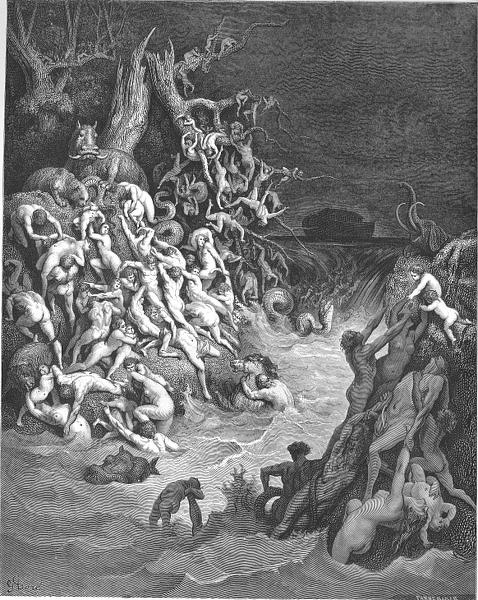
Noah's world destroyed by water
Even if all the world's glaciers and ice sheets melted sea levels would rise about 60 meters (195 feet) according to NASA. That’s a lot but certainly not enough to cover most of the Earth’s land. A 2016 study published in the journal Nature Geoscience estimated that there's 22.6 million cubic kilometers (5.4 million cubic miles) of groundwater stored in the upper two kilometers (1.2 miles) km) of Earth's crust, which is enough to cover the land to a depth of 180 meter (590 feet). That' too is a lot of water, but there are hundreds of cities cities higher than, Additionally, there is no evidence for a global flood in the geological rock record.
A regional flood inspiring the Noah's flood story is much less far-fetched. Montgomery said that some "geologically plausible" floods could have occurred that inspired the story.
One Explanation of Noah's Flood
Traditionally, it was believed that Noah myth arose from the seasonal flooding of the Tigris and Euphrates. But now many think it was inspired by a great flood involving the Black Sea. The Black Sea was created around 5000 B.C. when water levels in the Mediterranean Sea rose at end of a long ice age and broke through a natural dam at the Bosporus and poured into the Black Sea, at that time a fresh water lake whose surface was as much as 450 feet below the surface of the Mediterranean. An earthquake may have caused the natural dam to fracture.
When the water poured through at its peak it produced a roar that could be heard 300 miles away and unleashed 10 cubic miles of water a day.Water flowed at rate equivalent of 200 Niagra Falls and caused the Black Sea to rise about six inches a day and covered an area the size of Florida after two years. Archaeologists speculate that villagers who lived on the Black that were forced to flee the rising waters were the source of the Noah's and other flood stories. Some flood victims stories no doubt found their way to Mesopotamia, where the first known flood stories originated.
For example, in the late 1990s, oceanographers William Ryan and Walter Pitman hypothesized at an American Geophysical Union meeting that around 7,500 years ago, the Mediterranean Sea started flowing into the then-isolated Black Sea, causing massive flooding around the Black Sea, which could be the origins of Noah's flood, the journal Science reported in 1998. The archaeological evidence was a series of submerged beaches at a depth of a around of 500 feet with the youngest freshwater marine creatures radiocarbon dated at an age of between 6,900 and 7,500 years. The beaches are evidence of an ancient shoreline and the freshwater creatures are seen as proof that the Black Sea was a freshwater lake around 7,000 years ago. Evidence of human habitation before the Great includes a 7,500-year-old structure discovered in the Black Sea found by explorer Robert Ballard. "That would have been a disruptive event that flooded the whole known world to the people who were living there, and that could have gone on to seed the story of Noah's flood with some of the survivors who fled to Mesopotamia," Montgomery told Live Science.
A 2009 study published in the journal Quaternary Science Reviews argued that the flooding would have been much more minor than what Ryan and Pitman proposed, if it happened at all. [Source: Patrick Pester, Live Science, May 14, 2023]
Revising the Story of Noah, the Ark and the Flood

Noah's ark at sea
Dr Irving Finkel, a leading revisionist historian of the Flood at the British Museum, has found an account of the Flood and the Ark that significantly different from that told in the Bible, Nick Fraser wrote in The Guardian, ““In 1985, an ordinary-looking clay tablet inscribed in cuneiform script was brought into the British Museum. The Ark Tablet, as Finkel calls it, was written in Akkadian, a Sumerian dialect. It gave details of the Flood significantly different from those in the Old Testament and other accounts. Finkel can’t tell us whether Noah, who was probably called Atrahasis, actually survived a flood, but he does, intriguingly, list the animals of southern Mesopotamia that he might have taken with him. (Wild boar, known as sah api, would have been present, as would the humble dormouse, for which three different names exist in Akkadian.) He also suggests that the compilers of the Old Testament, written in Hebrew, came across the story after learning cuneiform script while in exile in Babylon. This contradicts the notion that the Bible is of sacred inspiration, but I find it wholly convincing. [Source: Nick Fraser, The Guardian, November 9, 2014 /+/]
“All societies retell stories of catastrophe and Atrahasis’s is one of the best. It differs from the Bible’s account in not having an angry God eager to chastise; Atrahasis gets news of the impending waters because he listens to a voice outside his wall of reeds telling him to expect the worst. Those who lived in Mesopotamia were in many respects like us. They could see how fragile all life was and they wanted to know whether it was possible to sail away in the event of disaster. Atrahasis got the message: be clever, listen to your voices, survive. A message of this terrific book is that we too, modern as we may consider ourselves, should do the same. /+/
Tom Chivers wrote in The Telegraph, “Finkel gave me the tablet to hold. It’s almost exactly the size of a modern smartphone, and the shape of a pillow; terracotta-coloured, tightly covered, almost every last millimetre, in a strange pattern of carvings that look more like the arbitrary patterns on a Christmas jumper than anything we might recognise as writing; it’s cracked and glued back together, like an old vase, with some of the writing obscured by the worst bits of damage. I would like to announce that there is a sense of mystical awe that overwhelms me as I hold this 4,000-year-old artefact, this thing carved when the Egyptians were still building pyramids. But there isn’t, just a vague sense of terror that I’ll drop it and shatter it. “That would be the end of the world, for me,” confirms Finkel, unhelpfully. [Source: Tom Chivers, The Telegraph, January 19, Jan 2014]
Book: “The Ark Before Noah: Decoding the Story of the Flood” by Irving Finkel, 2014]
Noah’s Ark Looks Different Than We Picture It

traditional view of Noah's Ark
Nick Fraser wrote in The Guardian, “The ark didn’t look boxy, with a raised prow and a wide gangplank for the animals. It is more likely to have been circular, made out of massive reeds waterproofed with bitumen. These are the craft that until recently were rowed up and down the Euphrates. How to build one without perishing is one of the many delightful features of this account of the Flood story. (The answer is that you get your servants to do the work, organising a feast for them as the floodwaters rise.) [Source: Nick Fraser, The Guardian, November 9, 2014 /+/]
The tablet describes a huge vessel, two-thirds the size of a soccer field, with high walls and made with so much rope that “stretched out in a line would reach from London to Edinburgh.” Finkel said that a circular vessel would be a “perfect thing,” because it “never sinks, it’s light to carry.” He also contends that his discovery does not provide evidence supporting the Biblical story of Noah’s ark, instead saying the tale was likely passed down from Babylon. “I’m sure the story of the flood and a boat to rescue life is a Babylonian invention,” he said. “I don’t think the ark existed — but a lot of people do. “It doesn’t really matter. The Biblical version is a thing of itself and it has a vitality forever.” [Source: Oliver Darcy, The Blaze, January 25, 2014]
Tom Chivers wrote in The Telegraph, The most interesting revelation from the Simmonds tablet is that the Ark, as originally conceived, was not how we picture it. “We all know what Noah’s Ark looked like – a boat, with a house on it, and a high prow and a high stern,” says Finkel. “You could sail to New York in it if you liked. But the Ark didn’t have to go in a direction, it just had to survive the flood.” In essence, it would have been a giant life raft: circular, and almost impossible to sink. “It was a coracle,” says Finkel: a kind of round boat of rope around a wood frame. “Half the people in Mesopotamia were professional boat people, so when someone told them this story, and said, imagine the biggest boat you ever saw, they must have asked: what did it look like?” What is incredible is that the tablet has detailed instructions how to build this enormous coracle, 70ft across, six yards high, even down to the length of rope required. “It’s about the distance from London to Edinburgh,” says Finkel, who had a mathematician check the working and found that it was correct to within one per cent. [Source: Tom Chivers, The Telegraph, January 19, Jan 2014]
Image Sources: Wikimedia, Commons, Schnorr von Carolsfeld Bible in Bildern, 1860
Text Sources: Internet Jewish History Sourcebook sourcebooks.fordham.edu “World Religions” edited by Geoffrey Parrinder (Facts on File Publications, New York); “ Encyclopedia of the World’s Religions” edited by R.C. Zaehner (Barnes & Noble Books, 1959); “Old Testament Life and Literature” by Gerald A. Larue, New International Version (NIV) of The Bible, biblegateway.com; Wikipedia, National Geographic, BBC, New York Times, Washington Post, Los Angeles Times, Smithsonian magazine, Times of London, The New Yorker, Reuters, AP, AFP, Lonely Planet Guides, and various books and other publications.
Last updated March 2024