
Home | Category: Muslim Food, Sex and Drugs
ADULTERY AND MUSLIM LAW

an adulterous man and his lover butted by a ram
Islam prohibits sex outside of marriage. Premarital and extramarital sex are sternly frowned upon. On the subject of adultery Muhammad said: "The adultery of the eye is to look with an eye of desire on the wife of another; and the adultery of the tongue is to utter what is forbidden.”
According to Muslim law men committing adultery are supposed to be publicly flogged and women who commit adultery are supposed to be stoned to death. In accordance with the law for a person to be convicted of adultery four male witnesses have to have observed the adulterous act.
In some places a husband has the right to injure or even kill his wife if she commits adultery. A wife can not do the same thing to her husband if he commits adultery. In other places — namely Saudi Arabia and Afghanistan — women accused of adultery have been stoned to death or buried up to their waists and pelted with shoes or stones.
The 1986 book “Anomilies and Curiosities” described an Arab family in which all members had six fingers on each hand and six toes on each foot. The family, the al-Foldis, intermarried to keep the characteristic. If a child was born with 10 fingers and toes it was regarded a product of adultery and killed.
Websites and Resources: Islam “Sexuality in Islam” by Heba G. Kotb M.D at Archive for Sexology sexarchive.info IslamOnline islamonline.net ; Institute for Social Policy and Understanding ispu.org; Islam.com islam.com ; Islamic City islamicity.com ; BBC article bbc.co.uk/religion/religions/islam ; University of Southern California Compendium of Muslim Texts web.archive.org
RECOMMENDED BOOKS:
“Sex And Allah” by Christian Prince Amazon.com ;
“The Muslimah Sex Manual: A Halal Guide to Mind Blowing Sex” by Umm Muladhat Amazon.com ;
“Sex Education in Islam: Upholding Our Values and Principles” by Yasir Uqdah Amazon.com ;
“Sex Matters: Sex, Sunnah, and Love in the Ummah by MuslimMatters, Yasir Qadhi, et al. Amazon.com ;
“Halāl Sex and Intimacy” by Abdullateef Lanre Abdullahi , Prof Gafar Abiodun Jimoh, et al. Amazon.com ;
“Marriage in Islam: A short guide to basic Islamic marriage teachings plus tips for a healthy and happy marriage” by Layal Husni Amazon.com ;
“The Muslim Marriage Guide” by Ruqayyah Waris Maqsood Amazon.com ;
“Secrets Of Successful Muslim Wives: Muslima Coaching Wife Tips Series” by Naielah Ackbarali and Muslima Coaching Amazon.com ;
“Before the Wedding: Questions for Muslims to Ask Before Getting Married” by Munira Lekovic Ezzeldine Amazon.com ;
“The Sex Talk: A Muslim's Guide to Healthy Sex & Relationships”
by HEART to Grow, Nadiah Mohajir, et al. Amazon.com ;
“Marriage and Sexuality in Islam” by Imam Al-Ghazali Amazon.com ;
“Polygamy in Islam: A Muslim Marriage Guide to Fostering Harmony and Fairness with Multiple Wives” by Muhammad Zakari Amazon.com ;
“Polygamy in Islam” by Abu Ameenah Bilal Philips and Jameelah Jones Amazon.com
Adultery in Islam
According to “Human Sexuality: An Encyclopedia” Muslims are particularly cautioned against adultery, which is regarded as ruinous and as a deviant way of releasing sexual energy that has serious repercussions. It may bring venereal diseases, cause destruction of the family, create uncertainty of parental lineage, and result in suspicion, tension, and animosity. It is the duty of the family and society to protect individuals from such actions by giving advice and even scolding. If these methods fail, then punishment is meted out according to strict limitations and considerations. Unless the individuals are caught in the act or for some reason confess to committing adultery, proving adultery in the Islamic world is almost impossible, since it requires four unimpeachable eyewitnesses to testify to the act. [Source: “Human Sexuality: An Encyclopedia”, Haeberle, Erwin J., Bullough, Vern L. and Bonnie Bullough, eds., sexarchive.info]

False accusation is viewed with grave concern. The Qur'an report that "those who launch charges against chaste women and produce not four witness, flog them with eighty stripes and reject their testimony ever after, for such people are wicked transgressors." In addition, "Those who slander chaste women are cursed in this life and the hereafter, for them there is a grievous penalty," and on the Day of Judgment their tongues, hands, and feet will bear witness to their deeds (Holy Qur'an, XXIV, No. 4).
Dr. Heba G. Kotb wrote: God says in the Allah, “Do not go near to adultery. Surely it is a shameful deed and evil, opening roads (to other evils)” (17:32). “Say, ‘Verily, my Lord has prohibited the shameful deeds, be it open or secret, sins and trespasses against the truth and reason”’ (7:33). “Women impure are for men impure, and men impure are for women impure and women of purity are for men of purity, and men of purity are for women of purity” (24:26).
Prophet Muhammad (PBUH) has said in many situations that adultery is one of the four major sins. However the most interesting story is that of a young man who went to the Prophet and asked for permission to fornicate because he could not control himself. The Prophet dealt with him with reasoning and asked him if he would approve of someone else having illegal sex with his mother, sister, daughter or wife. Each time the man said ‘no’. Then the Prophet replied that the woman with whom you plan to have sex is also somebody’s mother, sister, daughter or wife. The man understood and repented. The Prophet prayed for his forgiveness. [Source: “Sexuality in Islam” by Heba G. Kotb M.D., A dissertation presented to Maimonides University, 2004]
Adultery is a crime not against one person but against the whole of society. It is a violation of marital contract. A very high percentage of all first time marriages worldwide result in divorce in two years and the main reason for divorce are the adultery of one of the partners. Adultery, which includes both pre-marital and extra marital sex, is an epidemic, especially in the western society. Nobody seems to listen to the Bible, which says frequently, “Thou shall not commit adultery.” The Qur’anic approach is, “Do not approach adultery.”
For the complete article from which the material here is derived see IX. Concept of Adultery in Islam Under “Sexuality in Islam” by Heba G. Kotb M.D at Archive for Sexology sexarchive.info
Prostitution in the Middle East
Many Middle Eastern cities have exclusive brothels, often featuring young foreign girls and local university students, that are patronized by members of the elite and government officials. They usually receive a degree of high level government protection. Prostitution rings in India and Latin America provide children for clients abroad, particularly in the Middle East.
Most of the prostitutes in the United Arab Emirates are from Russia, Azerbaijan and Tajikistan. Every year large numbers of men from the rich Persian Gulf states come to Egypt, marry a young village girl, have sex with her, sometimes get her pregnant, and then abandon her. A member of an Egyptian women’s group told the New York Times, “There are brokers who the Saudi men go to and say, I want a girl, I want her fat, I want her blonde, I want her young.”
In Iraq, under Saddam Hussein, there were reports of public killings of prostitutes to earn brownie points with Islamists. Destitute women there have turned to prostitution. In some places, teenage girls in red turbans and black dresses gather on the highways and twirl around and ask passing male driver to “Come buy our fish,” a reference to buying sex. Many of their customers are truck drivers. Temporary marriages are seen as a kind of prostitution.
Prostitutes in Turkey
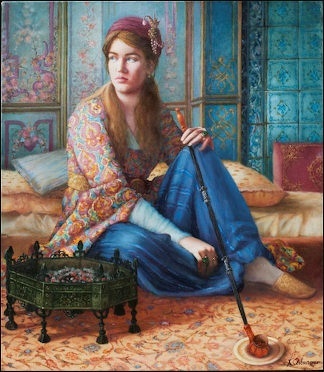
presumed portrait of Hurrem Kadinefendi, forth wife of Sultan Ahmed III
Brothels are legal in Turkey. The prostitutes are examined regularly by doctors who certify that they are healthy. Most of Istanbul's brothels are located off of a cobblestone street near Galata Tower. At the entrance gate there is a small police station, and among the maze of alleys there are perhaps a hundred brothels. I visited the area on a Friday night with a friend just to see what it like, and I must say I never saw anything quite like it before. Most of the prostitutes were topless and in pretty sad shape. Nonetheless, hundreds of men leered over them.
When writer Paul Theroux visited Istanbul in the 1970s he was warned that most of the prostitutes on Iştiklâl Caddesi were transvestites who worked during the day as crew members on the Bosporus ferries. He met one Turkish man who slept with one of these prostitutes and made love to "her" four times before he woke up the next morning to find her "wig" had fallen off, exposing an enormous penis.
In the 1990s, Mathilde Manukyan, a 76 year-old Armenian madam with four grandchildren, earned about $4 million a year from her chain of brothels in Istanbul, and was said to be Turkey's largest taxpayer (over $1.2 million a year). Her career began as fashion designer and her first brothel was given to her by a client who couldn't pay her bill. The prostitutes pay Manukyan $14 for every trick and everything over that they get to keep. In 1993, Manukyan employed about 1,000 people, owned 70 properties and had a Rolls Royce, several Mercedes and a Cadillac. [Simon Sebag Montefiore, New Republic, July 1993 ¤]
Manukyan said she never the visited the brothels herself; she has managers who run them. She claims her business has a therapeutic role in society. "Visiting my houses save marriages," she told journalist Simon Sebag Montefiore. "When husbands visit them their morale is boosted: sometimes a marriage gets caught in a rut and this improves it. Brothels are necessary and healthy. I believe that for a young man they are requirement of nature and of God."¤
Russian and Eastern European Prostitutes in Turkey
Laleli is the street walking prostitute district of Istanbul. Most of the prostitutes here in the 1990s were Romanian women who have come to Turkey to earn hard currency. After the collpase of the Soviet Union, Russian women started intruding on their territory. Many of these women were professionals in other fields back home. One prostitute women arrested in Antalya, was an economics professor with a Ph.D.
The prostitutes from Russia and the other Soviet Republics were called "Natashas." They entered Turkey with month-long tourist visas and, like the Romanian women, many came to Turkey to earn money to take care of their children back home. Some Natashas had steady clients who put them up in hotels. Some were street walkers. Others cruised the highways near Turkish military compounds.
A pair of twin Bulgarian prostitutes seduced and stole the truck of Turkish driver who was carrying a shipment of lingerie at a flea market in Romania. The police easily found the women after they had been told to look for two identical woman having difficulty driving a truck.
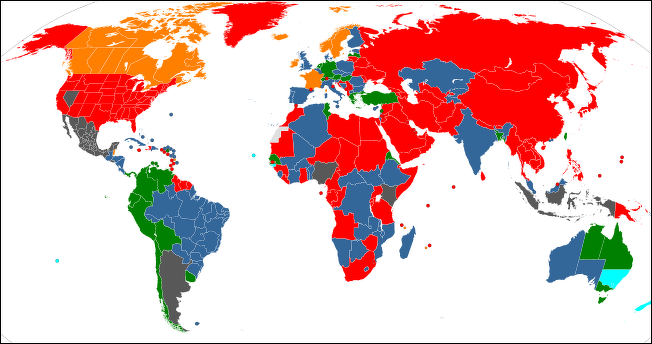
Prostitution laws of the world : 1) Decriminalization - No criminal penalties for prostitution (light blue); 2) Legalization -prostitution legal and regulated (green); 3) Abolitionism - prostitution is legal, but organized activities such as brothels and pimping are illegal; prostitution is not regulated (blue); 4) Neo-abolitionism illegal to buy sex and for 3rd party involvement, legal to sell sex (orange); 5) Prohibitionism - prostitution illegal (red); 6) Legality varies with local laws (gray)
Prostitution in Iran
In the Shah era prostitution was tolerated. Brothels were often established in groups in separate neighborhoods. Under the ayatollahs, prostitution became a crime punishable by lashing and brothels were destroyed. Even so, Iran has a surprising number of prostitutes and the government has raised the idea of legalizing prostitution, under the name of “chastity houses,” as a means of controlling prostitution.
In the early 2000s, there were around 300,000 prostitutes in Tehran alone. Many of them were young girls escaping abusive families, drug addicts who turned to prostitution as a way of supporting their habit, or were the wives of drug addicts who were forced by their husbands to take up prostitution to support their husband’s habit. [Source: Nazila Faithi, New York Times, August 28, 2002]
One 26-year-old prostitute, who been in the streets since she was 16, told the New York Times, “This is the only job I know.” She said she was forced into prostitution by her brutal, drug-addicted husband but continued to with it after she left her husband to pay for the private school fees for her 10-year-old son. “I’ll do anything to give him a different life.” she said.
In the early 2000s, a serial killer or killers, dubbed the Spider by the press, killed 21 prostitutes mostly in the city of Mashhad. The victims were strangled with a scarf and were found along roadsides or in open sewers wrapped in their chadors that had been knotted to serve as body bags. The murder was called the Spider because the victims looked like they were wrapped in a web ready to be devoured. Religious conservatives called the Spider a hero and praised him for carrying out a moral cleansing campaign. All the victims had police records for drug use or prostitution. This raised suspicion that the killer may have been getting support from authorities.
A construction workers named Saeed Hanaei confessed to 16 of the murders. He said he began the campaign after a bus driver mistook his wife for a prostitute and carried out the murders at his house while his wife and children were doing their prayers. He was caught after one prostitute escaped after scratching him with here long naisl and punching him in the stomach and then led police to his house. Hanaei said he had no regrets. He also had sex with them and boasted that killing them was as easy as “breaking open a melon.” He was executed in April 2002.
Temporary Marriage, a Shia Practice
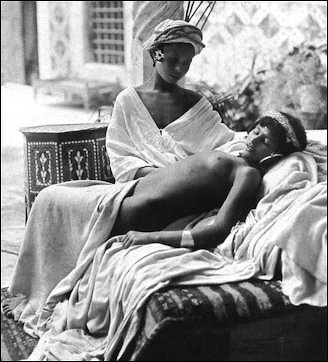
Lehnert and Landrock photo: Rudolf Lehnert (1878-1948) and Ernst Landrock (1878-1966) were famous producers of early 20th century European photographs of the Near East
Temporary marriage, “mutah”, is distinctive and frequently misunderstood custom found in Shia Islam. Mutah is a fixed-term contract that is subject to renewal. It was practiced by the first community of Muslims at Medina but was banned by the second caliph. Mutah differs from permanent marriage in that it does not require divorce to terminate it. It can be for a period as short as an evening or as long as a lifetime. The offspring of such an arrangement are the legitimate heirs of the man. [Source: Helen Chapin Metz, Library of Congress, 1988 *]
Temporary marriages can last for a few minutes or 99 years and are sanctified with an oral or written contract and by reciting some verses from the Qur’an. Women usually receive money for entering into such a union The contract states the agreed-upon period of time of the marriage and the amount of money paid.
Nancy Trejos wrote in the Washington Post, “Shia clerics and others who practice mutaa say such marriages are keeping young women from having unwed sex and widowed or divorced women from resorting to prostitution to make money. They say a mutaa marriage is not much different from a traditional marriage in which the husband pays the wife's family a dowry and provides for her financially. "It was designed as a humanitarian help for women," said Mahdi al-Shog, a Shia cleric. According to Shia religious law, a mutaa relationship can last for a few minutes or several years. A man can have an unlimited number of mutaa wives and a permanent wife at the same time. A woman can have only one husband at a time, permanent or temporary. No written contract or official ceremony is required in a mutaa. When the time limit ends, the man and woman go their separate ways with none of the messiness of a regular divorce. [Source: Nancy Trejos, Washington Post, January 20, 2007]
See Separate Article: TEMPORARY MARRIAGES AMONG SHIA (SHIITE) MUSLIMS africame.factsanddetails.com
Muslim Youth and Pornography
"There is no room for anyone to say pornography is not Haram (forbidden). It’s absolutely Haram," notes Shaykh Muhammad Nur Abdullah. He is the Imam of the Islamic Foundation of Greater St. Louis in Missouri. Nur Abdullah has a degree in Shariah (Islamic Law) from Madinah university, and a Master’s Degree in Qur’an and Hadith from Umm al Qura university in Mecca, Saudi Arabia. "If someone is looking at someone committing Zina (sex outside of marriage) whether it is movies or pictures or the actual thing, it’s all Haram," he adds. [Source: “Sexuality in Islam” by Heba G. Kotb M.D., A dissertation presented to Maimonides University, 2004]
Lehnert and Landrock photo
Some of the proofs he gives for the prohibition of pornography in Islam include verses 31 and 32 of chapter 24 (Noor) of the Qur’an: “Say to the believing men that they should lower their gaze and guard their modety (chastity); that will make for greater purity for them: and Allah is well acquinted with all what they do (31), And say to the believing women that they should lower their gaze and guard their chastity that they should not display their beauty and ornaments except what ordinarily appear thereof; that they should draw their veils over their bosoms and not to display their beauty except to their husbands, their fathers, their husbands’ fathers, their sons, their husbands’ sons, their brothers, and their brothers’ sons,or their sisters’ sons, or their women, or the slaves whom their right hands possess, or male attendants free of sexual desire (castrate), or small children who have no carnal knowledge of women, and they should not strike their feet in order to draw attention to their hidden ornaments (32) (24:31&32) As well as Hadiths (Prophet Mohamed PBUH statements) that say what leads to Haram (religiously prohibited) is Haram, and that adultery is committed by the eye and the hand, even before a sexual encounter takes place.
Dremali, who is a graduate of Al Azhar university in Cairo, Egypt, agrees. He has openly discussed the problem of the internet, pornography and Muslim youth in his Khutbahs. On a day to day level, he says he gets at least two cases daily of young Muslims, boys and girls, who come to the mosque and speak to him personally about this problem. Dremali says the teenagers feel guilty, but they cannot stop looking at this material. They need a cure, they have become addicted. "The person who looks at these things will always have Shaytan (Satan) in his mind because he wants to commit these (actions)," he says. "Shaytan never takes the person immediately to commit adultery (he does it in steps)."
Dremali also gives a clear example of the role the internet plays in being one of the steps leading to sex outside of marriage. "The hand commits adultery by touching Haram and the person using the keyboard and using the mouse to look at these pictures, he or she is committing adultery," he warns. Dremali says the view expressed by Hizb At-Tahrir is ruining Muslim youth, some of who are using this opinion to justify looking at pornography.
For the complete article from which the material here is derived see . Muslim Youth and Pornography Under “Sexuality in Islam” by Heba G. Kotb M.D at Archive for Sexology sexarchive.info
Muslim Porn Star Nadia Ali
Nadia Ali is Muslim porn actress who performs in traditional Islamic dress. William Watkinson wrote in International Business Times, “A practicing Muslim porn star who performs in traditional dress says she has no plans to quit her controversial profession despite being "banned" from Pakistan, where many of her family live. Nadia Ali is an American adult film actress who says she was brought up in "a very strict Islamic community" by Pakistani parents and prays regularly whilst acknowledging her religion is in conflict with her job. Her adult performances have been viewed by millions and she says she has been "officially banned from Pakistan" for her videos in traditional Islamic dress, with a veil or hijab. According to the 25-year-old, traditional dresses are in demand by porn producers. [Source: William Watkinson, International Business Times, August 2, 2016]

New-Jersey Muslim porn star Nadia Ali
The former eyebrow technician has been in the porn industry for two-and-a-half years after working as an erotic dancer then escort. The Los Angeles resident says that the porn industry is just a temporary move and she plans to move back into the beauty industry. In an interview with Refinery29, Ali said she was "officially banned from Pakistan" adding that "it's been on all the news...they banned me because I wore the scarf and the traditional dress in the adult scenes and performed in Islamic wear."
Hijab porn is an emerging genre in the industry. Ali said she has been attacked and subjected to death threats. Mia Khalifa, another adult film star, has also received death threats for also wearing a hijab in some of her movies. Ali's projects included a controversial adult film called Women of the Middle East. She said in the video interview: "I'm a practicing Muslim. Sure I have conflicts between my faith and day-to-day life, but doesn't everybody? I practice Islam, for the sake of peace and guidelines of life – not to steal, be humble, be happy, be thankful. "One of the biggest main sins is adultery and doing it multiple times a day as an escort you will not be forgiven and I am fully aware of that but yet I still pray. But I don't escort anymore."
Ali said "ideally" her parents would prefer her not to work in the porn industry – but they do understand her choice. And she said that the only time she walked out of a movie was when he co-star was portrayed as Donald Trump. "After doing 20 scenes, I quit, because I realised that in some of the scenes, they were trying to make Middle Eastern people look bad," she said. "They offered me to do a scene where an all-American white guy dressed like Donald Trump is f** a Muslim girl. I felt disrespected. That wasn't going to be my 21st scene."
Image Sources: Wikimedia Commons
Text Sources: “Sexuality in Islam” by Heba G. Kotb M.D at Archive for Sexology sexarchive.info Arab News, Jeddah; “Islam, a Short History” by Karen Armstrong; “A History of the Arab Peoples” by Albert Hourani (Faber and Faber, 1991); “World Religions” edited by Geoffrey Parrinder (Facts on File Publications, New York); “Encyclopedia of the World’s Religions” edited by R.C. Zaehner (Barnes & Noble Books, 1959); Metropolitan Museum of Art, Encyclopedia.com, National Geographic, BBC, New York Times, Washington Post, Los Angeles Times, Smithsonian magazine, The Guardian, Al Jazeera, The New Yorker, Time, Newsweek, Reuters, Associated Press, AFP, Library of Congress and various books and other publications.
Last updated April 2024