
Home | Category: Desert Animals
DEATHSTALKERS
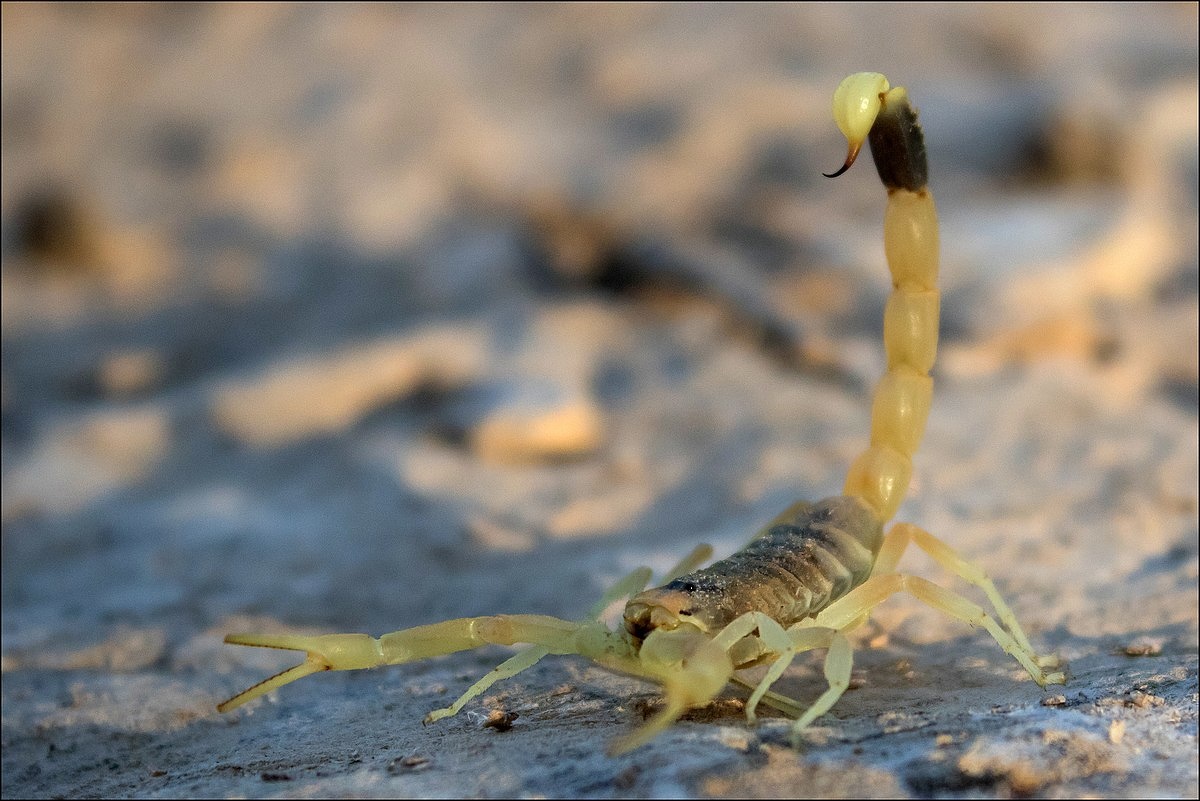
deathstalker scorpion
Deathstalkers (Leiurus quinquestriatus) are also known as Palestine yellow scorpions, Omdurman scorpions, and Naqab desert scorpion, as well as by many other colloquial names, which generally originate from the commercial captive trade of the animal. Deathstalkers can be found in desert and scrubland habitats in much of North Africa and Middle East and parts of Central Asia and India. Their range covers a wide sweep of territory in the Sahara, Arabian Desert eastward to Kazakhstan and the Thar Desert in Pakistan and western India.
Deathstalkers are found in arid and hyper-arid regions. They generally reside under rocks or in abandoned burrows of other animals. They also create their own burrows about 20 centimeters below rocks. Members of the nominal subspecies Deathstalkers quinquestriatus are found in northeastern Africa as far west as Algeria and Niger, as far south as Sudan, and as far west as Somalia. Members of the subspecies Deathstalkers hebraeus are found throughout the Middle East as far north as Turkey, east to Iran, and south to Oman and Yemen. [Source: Ahmet Ceceli and John Horsfield, Animal Diversity Web (ADW) /=]
On the International Union for Conservation of Nature (IUCN) Red List deathstalkers are listed as Not Evaluated. In CITES (Convention on International Trade in Endangered Species of Wild) they have no special status. Deathstalkers are commonly preyed upon members of their own species and by other scorpions. Other invertebrate predators such centipedes and vertebrates such as snakes and various mammals also prey on deathstalkers. They have high mortality directly after birth. Mortality is higher in adults than individuals of intermediate age. The lifespan of deathstalkers is not known. Other scorpions have lifespans ranging from four to 25 years. /=\
The elimination of confusion especially important when treating potentially dangerous species of scorpion, ths the scientific name is normally used to refer to them. The Deathstalker’s scientific name — Leiurus quinquestriatus — roughly translates into English as "five-striped smooth-tail". In 2014, the subspecies L. q. hebraeus was separated from it and elevated to its own species Leiurus hebraeus. Other species of the genus Leiurus are also often referred to as "deathstalkers".
Some people keep deathstalkers as pets. Possession of them may be illegal or regulated in countries with laws prohibiting the keeping of dangerous animals in general. Jurisdictions are increasingly and explicitly including deathstalkers in laws requiring permits to keep animals which are not usual pets, or restricting possession of dangerous animals, and in some cases have prohibited the keeping of deathstalkers save by licensed zoos and educational facilities. In several jurisdictions departments of fish and wildlife require permits for many animals, and a number of cities and municipal governments have prohibited their possession in their bylaws.
RELATED ARTICLE: SCORPIONS, MATING HABITS, CANNIBALISM, VENOM AND HUMAN VICTIMS factsanddetails.com
DeathStalker Characteristics and Diet

range of the deathstalker scorpion
Deathstalkers are relatively large and venomous scorpions They range in weight from one to 2.5 grams (0.04 to 0.09 ounces) and range in lenth from 8 to 11 centimeters (3.15 to 4.33 inches). They are yellowish in color with brown spots on the metasomal segment V and sometimes on the carapace and tergites. The metasoma is the posterior part of the body. [Source: Ahmet Ceceli and John Horsfield, Animal Diversity Web (ADW) /=]
Scorpions have two eyes on the top of the head and often two to five pairs of eyes on the front corners of their head. Tergites are thickened dorsal plates on each segment of the body. Tergites I and II have five carinae (darkened or granular raised linear ridges, on the pedipalp )claw) segment, also called "keels"). The ventrolateral carinae between the back and sides have three to four rounded lobes, and the anal arch has three rounded lobes.
Deathstalkers are primarily carnivores (eat meat or animal parts) but are also recognized as insectivores (eat insects). Scorpions, including deathstalkers, generally consume small insects, spiders, centipedes, earthworms, and other scorpions. Scorpions detect and capture prey using their sense of touch and by utilizing vibrations. They hide under stones, bark, wood, or other objects no the ground where they search for prey or wait in ambush. Once they capture prey, scorpions use their larger pincers to crush and draw prey toward the mouth. /=\
DeathStalker Behavior and Senses
Deathstalkers are terricolous (live on the ground), nocturnal (active at night) and motile (move around as opposed to being stationary). Being active at night helps manage temperature and water balance, important functions for survival in dry habitats. Many species of scorpions dig burrows in the soil. They have flat bodies, allowing them to hide in small cracks, under rocks and under bark. [Source: Ahmet Ceceli and John Horsfield, Animal Diversity Web (ADW) /=]
Deathstalkers communicate and sense using touch and vibrations. Although scorpions have two eyes on the top of their head often two to five pairs of eyes on the front corners of their head, they do not have good vision. Scorpions, including deathstalkers, utilize their sense of touch to navigate and hunt, using their pectines (comblike structures in their bodies) and specialized organs.
Scorpions have tiny slit-like tarsal sensory organs near the tips of their legs which help detect vibrations in the sand or soil. These organs can help provide information regarding the direction and distance from potential prey. Scorpions may also use substrate vibrations to identify potential mates and reduce violent interactions. /=\
Deathstalkers — Lightning Quick Strikers
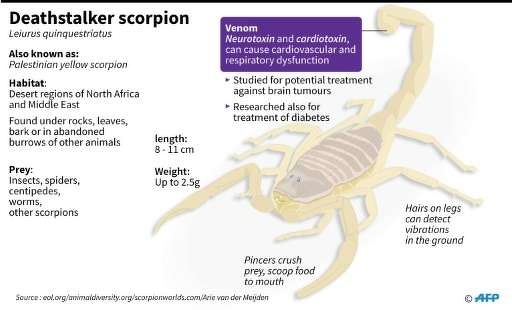
In April 2017, scientists announced in the journal Functional Ecology that they caught a deathstalker on high-speed camera for the first time striking with its lethal stinger, and found it was the quickest of a half-dozen scorpion species studied using ultra-slow motion, with its venomous stinger snapping over its head like a whip at 130 centimeters (51 inches) per second. AFP reported: It has a no-nonsense trajectory, moving straight towards its target before flicking upward. The emperor scorpion—the world's largest—has a similar open strike. Other species, such as the black spitting scorpion, which can squirt venom at a distance, and various members of the hottentotta genus, strike with a more circular motion, forming an "O". "We found that different 'tail' shapes"—some slim, some fatter—"appear to permit different strike performances," said senior author Arie van der Meijden, a professor at the University of Porto in Portugal. [Source: AFP, April 4, 2017]
To record and analyse the lightning-fast strikes, van der Meijden and his team built a small platform surrounded by mirrors on all four sides. They filmed the scorpion strikes from above with a video camera at 500 frames per second, and then created 3D models with computers. "Just taking them out of their container and putting them in the arena was enough to get them in stinging mood," van der Meijden said. "All that was necessary to make them strike was touching their pincers with a thin piece of wire."
Next on the research agenda is to figure out the evolutionary forces which explain why the strike patterns are so varied. It could be "related to the kind of predators they need to defend themselves against," van der Meijden told AFP. The differences could also arise from the fact that some scorpions rely less on their tail stingers, and more on their pincers to ward off a threat. Scorpions use their defensive arsenal against bats, snakes, lizards and other predators.
Deathstalker Mating, Reproduction and Offspring
Deathstalkers are viviparous (they give birth to live young that developed in the body of the mother). They do not lay eggs. Reproduction is external, meaning the male’s sperm fertilizes the female’s egg outside her body. The gestation period ranges from 155 to 227 minutes, with the average being 185 minutes. The number of offspring ranges from 35 to 87, with the average number being 63. The development and life cycle of scorptions is characterized by neoteny (juvenilization, delaying or slowing of the physiological development) and paedomorphism (retention in adults of infantile or juvenile characteristics). Young go through several instars (developmental stages which occurs between moults (ecdysis) until sexual maturity is reached). [Source: Ahmet Ceceli and John Horsfield, Animal Diversity Web (ADW) /=]
According to Animal Diversity Web: Courtship and sperm transfer in scorpions, including deathstalkers, is a complicated process involving a "romenade à deux." The male approaches a female and grasps her pedipalp chelae with his own chelae fingers. A form of dance then takes place, lasting for several minutes until the male ejects a spermatophore on suitable substrate. In the next stage, the male leads the female to position her genital aperture over the spermatophore, and the female takes up the sperm. Once sperm transfer has been completed, males and females usually separate. /=\
Specific information on the development and parental behaviors of deathstalkers is not available. However, in close relatives, young scorpions climb onto their mother’s back directly after birth. They remain on their mother's back for the duration of their first instar, taking advantage of their mother's protection. This also helps young regulate moisture. While inside their mother young receive nourishment in the uterus either through the embryo and uterine wall similiar to placentals or through active transport if extra-embryonic membranes, Young are relatively large when born. Most scorpions molt multiple times before becoming adults, though juveniles look like adults at all instars./=\
Deathstalker Venom
The deathstalker is one of the most dangerous species of scorpion and its venom is one of the most toxic of all scorpion venoms. This venom is a powerful mixture of neurotoxins, with a low lethal dose. But, while a sting from this scorpion can excruciatingly painful, it normally does not contain enough toxins kill a healthy adult human but can possibly kill young children, the elderly, or people who have a heart condition or are allergic. Any envenomation runs the risk of anaphylaxis, a potentially life-threatening allergic reaction to the venom. A study from Israel shows a high rate of pancreatitis following being stung. If a sting is fatal, the cause of death is usually pulmonary edema. [Source: Wikipedia, Ahmet Ceceli and John Horsfield, Animal Diversity Web (ADW)]
Envenomation (getting stung and being injected with venom) by the deathstalker is considered a medical emergency even with antivenom treatment, as its venom is unusually resistant to treatment and typically requires large doses of antivenom. Antivenom for the treatment of deathstalker envenomations is produced by pharmaceutical companies AbbVie and Sanofi Pasteur,and by the National Antivenom and Vaccine Production Center in Riyadh. For those wanting to jeep deathstalkers as pets keep in mind that In the United States and other countries outside of the typical range of deathstalker, none of the existing antivenoms have been approved by the Food and Drug Administration (or equivalent agencies) and are only available as investigational drugs (INDs). The US Armed Forces maintain some investigational drug sipp;ies.
The peptide chlorotoxin originally isolated from deathstalker venom is used in cancer research and has shown potential for treating human brain tumors. Research is also being pursued regarding the possible use of other components of their venom in the treatment of diabetes, as channels on which the neurotoxins act have been linked to the regulation of insulin. In 2015 clinical trials were beginning of the use of chlorotoxin with a fluorescent molecule attached as brain tumour "paint" (BLZ-100), to mark cancerous cells in real time during an operation. This is important in brain cancer surgery, where it is vital both to remove as many cancerous cells as possible, but not to remove healthy tissue necessary for brain functioning. In preclinical animal trials the technique could highlight extremely small clusters of as few as 200 cancer cells, compared to the standard use of MRI, with a lower limit in excess of 500,000.
Indian Red Scorpion — World;s Most Venomous Scorpions
Indian red scorpions(Hottentotta tamulus) are also known as the eastern Indian scorpions. Occurs in most of India, eastern Pakistan, Sri Lanka and the eastern lowlands of Nepal, they are regarded as the most toxic of all scorpions. They are is widespread across vegetated lowlands with subtropical to tropical, humid climate and often lives close to or in human settlements, especially in rural areas. [Source: Wikipedia]
Indian red scorpions are five to nine centimeters (2 to 3.5 inches) long. Their legs legs and the tip of their pedipalp pincers are bright orange-yellow to light reddish-brown in color. The mesosomal tergites always bear three distinct carinae. Their habitus is typical of buthid scorpions, with rather small pedipalp pincers, moderately thickened metasomal segments and a rather bulbous telson with large stinger. Sexual Dimorphism (differences between males and females) is present: The base of the pedipalp pincers (manus) of males is slightly bigger than that of females.
Indian red scorpions occasionally causes human fatalities in part because they are found in some densely populated areas of India and Nepal. Fatality rates of 8–40 percent have been reported in clinical studies; with most of the victims being children. Symptoms of envenomation by this species include: severe local pain, vomiting, sweating, priapism, cyanosis, unconsciousness, muscular convulsions, breathlessness, pink frothy sputum, abnormal heart rhythms, a fast or slow heart rate, low or high blood pressure, acute myocarditis, shock and death,
The venom mainly affects the cardiovascular and pulmonary system, eventually leading to a pulmonary oedema, which may cause death. Scorpion antivenoms have little effect in clinical treatment but application of prazosin reduces the mortality rate to less than 4 percent. As in other scorpions, the venom of Indian red scorpionsis comprised of a complex mixture of proteins. Some major components have been isolated, including the toxin tamapin.
Black Scorpions
Black scorpions belong to the Hottentotta genus of scorpions of the family Buthidae. They are distributed widely across Africa, except for most of the Sahara desert, and also occur in the Middle East, the Arabian Peninsula, southeastern Turkey, Iraq, Iran, Afghanistan, Pakistan, India, Nepal, Cape Verde Islands, and Sri Lanka (introduced).
1) Common Names: Black scorpion. 2) Family: Buthidae. 3) Scientific Names: Hottentotta alticola, Buthus alticola (in part). [Source: Armed Forces Pest Management Board ~]
Description: Medium-sized scorpion, adults usually 50-70 millimeters long (maximum 80+ millimeters). Body usually very dark brown above (sometimes tinged with green or dull yellowish-brown), lighter greenish or yellowish along sides. Legs and pedipalps yellowish-green; cauda mainly yellowish-green, except 5th segment very dark. Tips of pincers dark brown. ~
Habitat: Found in a variety of habitats, from seasonally dry to semiarid sites (sometimes in desert margins), with mainly sandy and rocky soil and scattered vegetation. Has been reported from some agricultural sites, but is not common in urban settings. Found mainly at moderate to higher elevations (mainly at 500-1,000+ meters) in various parts of its fairly extensive geographic range in south-central Asia. ~
Activity and Behavior: May be both diurnal (in colder months) and nocturnal (during warmer months), and mainly terrestrial (but often climbs rough surfaces). Ovoviviparous, and preys on available insects and arthropods. Tends to avoid humans (and other larger animals) but will sting quickly if molested, stepped on, or trapped within clothing being donned. ~
Venom Characteristics: Not well studied, but probably mainly neurotoxic with some cytotoxic factors. Has reportedly caused a number of painful human envenomations, with localized swelling, redness and discoloration, but no human fatalities documented, so far. ~
Marten’s Scorpions
Martens scorpions (Olivierus martensii or Buthus martensi) also known as Chinese scorpions, Manchurian scorpion, Chinese armor-tail scorpion and Chinese golden scorpion. Despite their common name, they are also found in Korea, Mongolia and perhaps some parts of Central Asia. [Source: Armed Forces Pest Management Board ~]
Description: Small to Medium-sized scorpion, adults usually about 35-50 millimeters long (maximum 60+ millimeters). Cephalothorax and preabdomen brown to blackish dorsally, legs, pedipalps and postabdomen (cauda) and telson usually yellow (except 5th caudal segment darker). Pincer tips and telson spine (sting) very dark. Distinct "H-shaped" and "lyre-shaped" pattern of keels on top of carapace. Young specimens (juveniles) often have a distinct reddish tinge in their legs, pedipalps, and cauda. ~
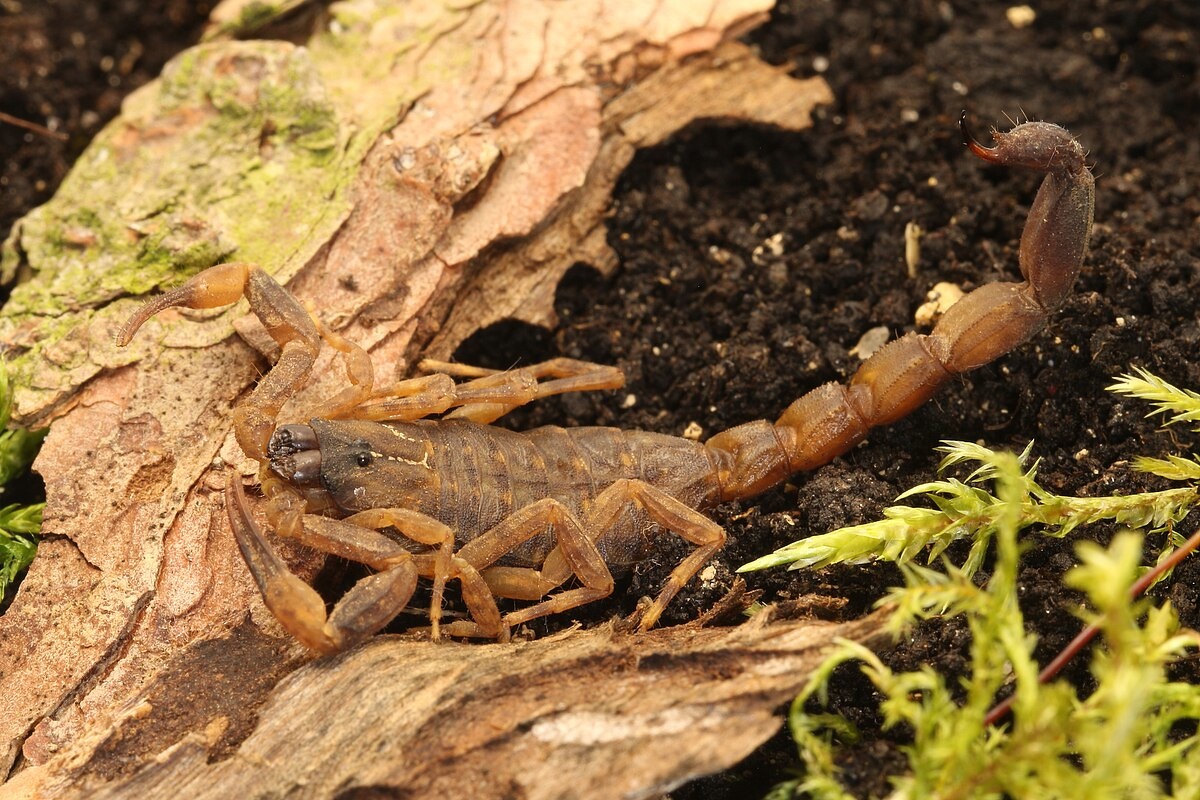
Martens scorpion
Habitat: Mainly found under stones or in similarly cool, moist sites within relatively dry or seasonally dry and sparsely-vegetated areas. Mainly occur naturally in sites outside human habitations, but sometimes found inside buildings. Distribution includes some seasonally very cold regions (e.g., Mongolia, North Korea), where it is most active during the summer (hotest) months. ~
Activity and Behavior: Usually remain relatively inactive during colder months, usually nocturnal but sometimes diurnal; depending on ambient temperatures, any recent rains, and the habits and abundance of locally available primary prey insects and arthropods. Terrestrial, but climb well. Tend to avoid humans, but sting readily if molested, stepped on, or trapped inside clothing being donned. Ovoviviparous, typical litter size not reported. ~
Venom Characteristics: Mainly neurotoxic, with cytotoxic (and possibly also cardiotoxic) factors. Stings usually cause localized pain, swelling, and redness (and occasionally discoloration). This species causes a considerable number of stings of humans annually in parts of its range, but serious envenomations are not common, and human fatalities (reported to have been caused by this species) have not been well documented. ~
Lesser Asian Scorpions
Lesser Asian scorpions (Mesobuthus eupeus) are a polymorphic scorpion species also known as mottled scorpions They are one of most widely dispersed — of not THE most widely dispersed — species of scorpion. They mostly live in arid or semi-arid habitats with little or no vegetation and are found in eastern Turkey, Armenia, Azerbaijan, Georgia, southern Russia, northern Syria, eastern Iraq, Iran, Afghanistan, Pakistan, Turkmenistan, Uzbekistan, Kyrgyzstan, Tajikistan, Kazakhstan, southern Mongolia and northern China.
1) Common Names: Lesser Asian scorpion. 2) Family: Buthidae. 3) Scientific Names: Mesobuthus eupeus, Buthotus eupeus, Buthus eupeus. [Source: Armed Forces Pest Management Board ~]
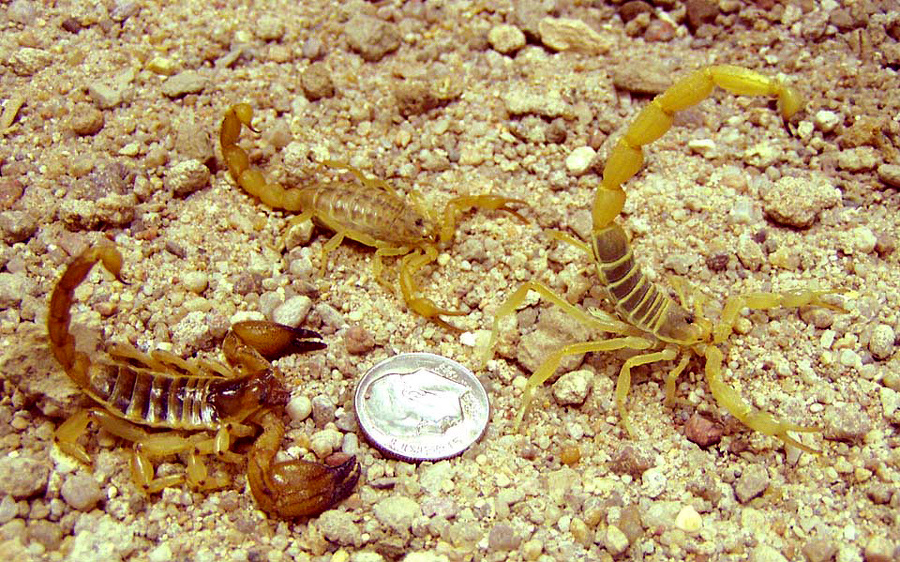
Lesser Asian scorpions
Description: Medium-sized scorpions (adults usually 50-80 millimeters long). Body usually medium yellow-brown to darker brown dorsally, with legs and cauda lighter brown or yellowish-brown (often with greenish tinge), 5th caudal segment often dark. Median dorsal ocular tubercle prominent, 2 darker brown longitudinal stripes on dorsal cephalothorax. Dorsal keels form distinct "H-shaped" and lyre-shaped designs on top of carapace. ~
Habitat: Typically found under stones and similar cool, moist sites within relatively dry, rocky, sparsely vegetated places, and usually remote from human habitations. Very wide-spread geographically in the Palearctic region. May be present but not yet documented from additional Middle Eastern and southwestern Asian countries (e.g., Kazakhstan, Jordan, Lebanon, Iseael, northern India). ~
Activity and Behavior: Nocturnal (but sometimes active at dawn or dusk), and mainly terrestrial, but can climb well. Ovoviviparous, and preys on locally available insects and arthropods. ~
Venom Characteristics: Not well documented, but mainly neurotoxic, with cytotoxic (and possibly cardiotoxic) factors. Envenomations by this species usually cause localized pain, swelling, redness, and often discoloration. Stings of nomadic and rural humans are fairly common in remote locations (usually due to their disturbing stones in sandaled feet, or while sleeping on the ground), but serious systemic effects or fatalities are reportedly rare. ~
Scientists Find New Species of Scorpion in Saudi Arabia with Black Light
In September 2023, scientists announced they had discovered a new species of scorpion in Saudi Arabia the Majami al-Hadb protected area with ultraviolet lights in the journal ZooKeys. Aspen Pflughoeft wrote in the Miami Herald: Their approach followed a “common technique” for finding scorpions, co-author Ahmed Badry said. The animals glow under ultraviolet light “due to certain chemicals in their exoskeleton” reacting to the light, he said. “The color of the glow can vary depending on the species of scorpion, but it is usually a blue-green color.” [Source:Aspen Pflughoeft, Miami Herald, September 9, 2023]
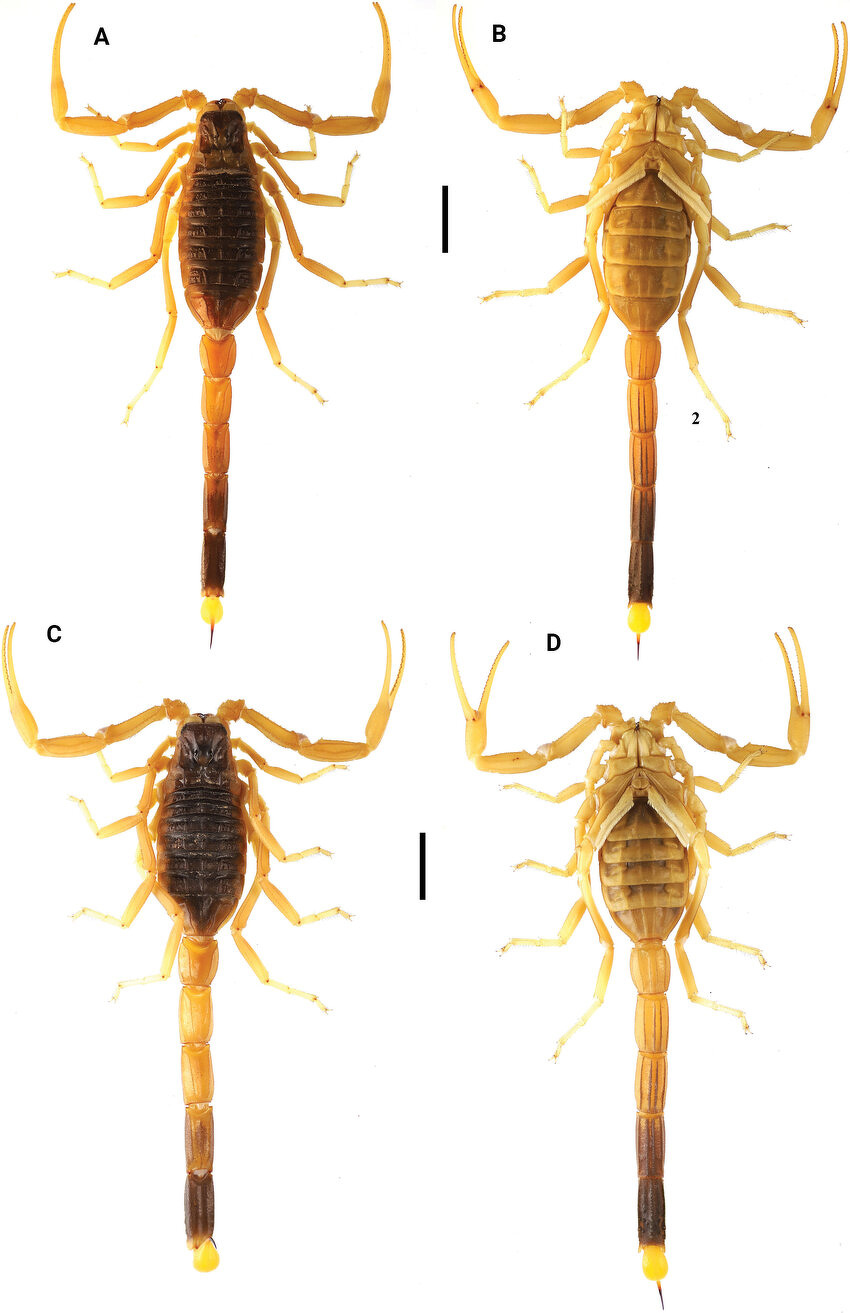
Leiurus hadb: A) back of male; B) bottom of male; C) back of female; D) bottom of female; Scale bar: 10 mm.
Scanning the desert ravines, known as wadis, the researchers found 11 glowing scorpions and captured them, the study said. Analyzing the scorpions, scientists realized they’d discovered a new species: Leiurus hadb, or the Majami al-Hadb scorpion. Majami al-Hadb scorpions are “medium to large” scorpions, ranging from about 2.5 inches to about 4.5 inches in size, the study said. They have a “yellow or yellow-orange” coloring with darker brown coloring on their backs and tail.
Researchers named the new species after the area where it was discovered, the Majami al-Hadb protected area. The area is “dominated by dark volcanic mountains, sandy desert plains, and faded granite domes,” the study said. The new species of scorpion “may be restricted to this particular (protected) area,” researchers said. The Majami al-Hadb protected area is in Wadi ad-Dawasir and about 380 miles southwest of Riyadh, the capital city.
The new species was identified based on its body shape, smoother texture and coloring, the study said. DNA analysis found the new species had between six percent and 12 percent genetic divergence from other scorpion species. “We are thrilled about this discovery and believe that it will contribute significantly to our understanding of scorpion biodiversity,” Badry said. The research team included Abdulmani Al-Qahtni, Abdullah Al-Salem, Fahad Mesfer, Manal Al Balawi, Wasayf Allahyani, Abdulaziz Alqahtani and Badry.
Image Sources: Wikimedia Commons
Text Sources: Animal Diversity Web animaldiversity.org ; National Geographic, Live Science, Natural History magazine, CNTO (China National Tourism Administration) David Attenborough books, New York Times, Washington Post, Los Angeles Times, Smithsonian magazine, Discover magazine, The New Yorker, Time, BBC, CNN, Reuters, Associated Press, AFP, Lonely Planet Guides, Wikipedia, The Guardian, Top Secret Animal Attack Files website and various books and other publications.
Last updated May 2025