
Home | Category: Desert Animals
STRIPED HYENAS
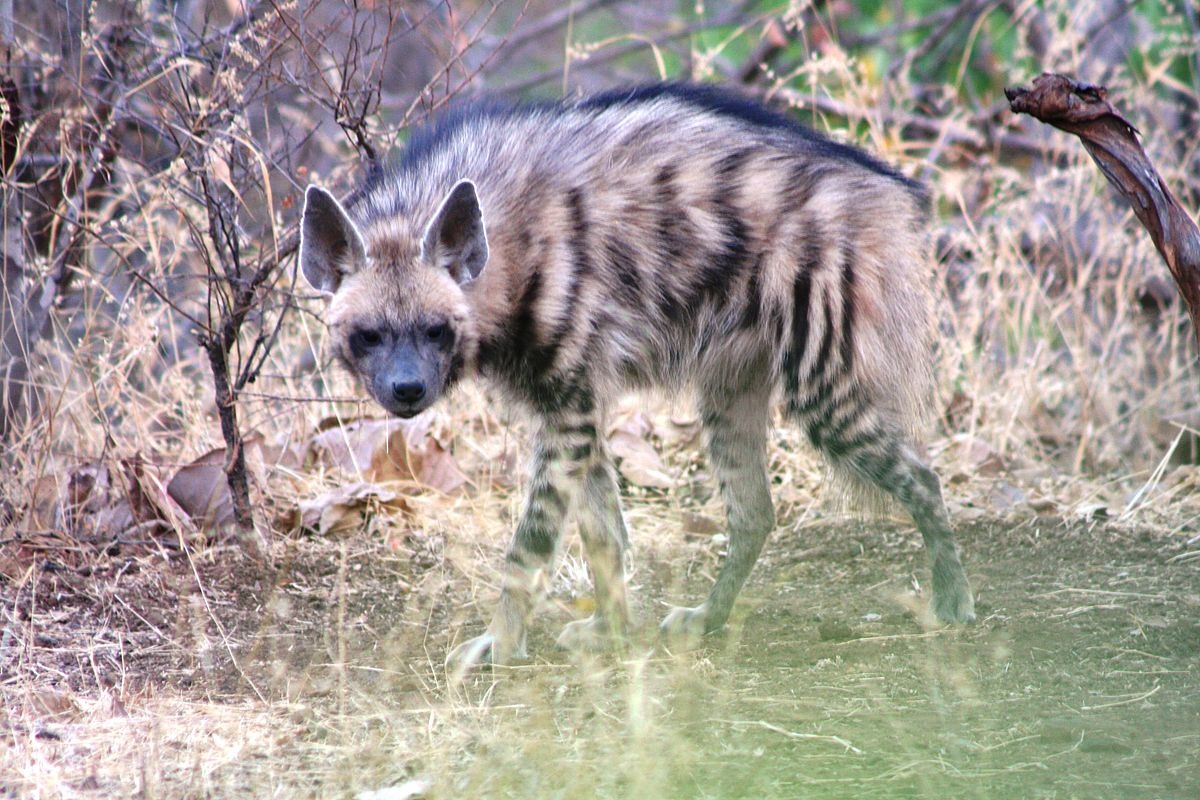
Striped hyena in Gir National Park, India
Striped hyenas (Hyaena hyaena) are a species of hyena that are fairly rare but are scattered over a very large range — in North and East Africa, the Middle East, the Caucasus, Central Asia, and the Indian subcontinent. Listed on the International Union for Conservation of Nature (IUCN) Red List as near-threatened, they are only extant species in the genus Hyaena — in which the extinct Neanderthal-era cave hyenas of Europe belonged. The global population of striped hyenas is estimated to be under 10,000. [Source: Wikipedia]
Striped hyenas are the smallest of the bone-cracking hyenas and retains many primitive viverrid-like characteristics possessed by their extinct ancestors that have been lost in larger hyena species. They are primarily scavengers, but some large individuals have been known to kill their own prey. Attacks on humans have occurred but are in rare. Striped hyenas are nocturnal and usually only come out in complete darkness, and make sure they are back in their lair before the sun comes up. When attacked, striped hyenas sometimes play dead and other times put up a fierce defense and stand its ground against larger predators in disputes over food.
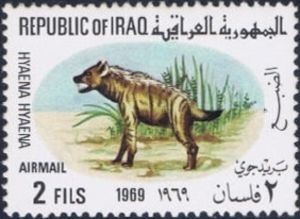
Striped hyenas feature prominently in Middle Eastern and Asian folklore. They were never hunted much for food or for their pelt but in some areas, their body parts are considered magical, and are used as charms or talismans. They are mentioned and referred to as tzebua or zevoa in the Hebrew Bible but are absent in some Bible translations into English. The Ancient Greeks knew them glános and húaina and placed them on the Aegean coast of Asia Minor. Striped hyena is the national animal of Lebanon. One of their main benefits is getting rid of carrion and unwanted human refuse. In some village, people leave their garbage outside at night for the striped hyenas to feed on. They rarely attack livestock or people and are unaggressive, often allowing dogs to attack them without attempting to defend themselves.
Striped hyenas generally live in arid, mountainous regions with scrub woodland but can also be found in open savannah areas with dense grassland. They make their dens in rocky hills, ravines, and crevices. In Africa, they are outcompeted by spotted hyena in open areas and are thus relegated to other habitats. [Source: Craig Howard, Animal Diversity Web (ADW) /=]
Striped Hyena Characteristics
Striped hyenas are fairly large animals. Adults weigh from 22 to 55 kilograms (49 to 121 pounds), averaging about 35 kilograms (77 pounds). Their head and body length ranges from .85 to 1.3 meters (2.75 to 4.25 feet), excluding their 25-to-40 centimeters (9.8-to-15.7 inch). Their shoulder height is between 60 and 80 centimeters (24–31 inches) and their average basal metabolic rate is 31.954 watts. In the wild, striped hyenas can live up to 12 years, while in captivity they have been known to reach 23 years of age. Sexual Dimorphism (differences between males and females) is present. Males and females do not differ much in average height or length, but males tend to be slightly heavier. [Source: Wikipedia, Craig Howard, Animal Diversity Web (ADW) /=]
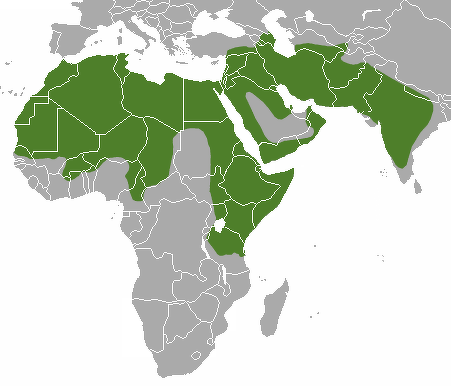
striped hyena range
Striped hyenas have a strangely-shaped body with a short torso and long legs. The hind legs are significantly shorter than the forelimbs, causing the back to slope downwards. The legs are relatively thin and weak, with the forelegs being bent in the ankle area. Their neck is thick, long and largely immobile, while the head is large and heavy with a shortened facial region. Like all hyenas, striped hyenas have bulky pads on their paws and blunt but powerful claws.
Striped hyenas have long hair and a short tail. Their eyes are small, while the sharply pointed ears are very large, broad and set high on the head. Their sense of smell is good but their eyesight and sense of hearing are relatively poor. These animals can erect the long hair on their mane and appear 38 percent bigger, which they do when threatened. They are gray to straw-colored with a black muzzle and black stripes on their head, torso, and legs. Their terminal hairs do not descend below the achilles tendon.
Male striped hyenas have a large pouch of naked skin located at the anal opening. Large sebaceous anal glands open into it from above the anus. The anus can be everted (extended outwards).up to five centimeters. This occurs during social interaction and mating. When attacked, striped hyenas evert their rectum (and sprays a pungent smelling liquid from its anal glands. Female striped hyena's genitalia are transiently masculinized (temporarily exhibit traits of males) and lack the enlarged clitoris and false scrotal sack that female spotted hyenas have. Female striped hyenas have three pairs of nipples.
The largest striped hyenas come from the Middle East, Asia Minor, Central Asia and the Indian subcontinent, while those of East Africa and the Arabian peninsula are smaller. No subspecies are recognized but there is geographical variation. animal. Hyenas in the Arabian peninsula have an accentuated blackish mane on their back, with hairs reaching 20 centimeters in length. The base color of Arabian hyenas is grey to whitish grey, with dusky grey muzzles and buff yellow below the eyes. Hyenas in Israel have a dorsal crest which is mixed grey and black in color, rather than being predominantly black.
Striped Hyena Food and Eating Behavior
Striped hyenas are omnivores (eat a variety of things, including plants and animals) but predominantly scavengers, witha diet consisting mainly of carrion and human refuse. In Africa they scavenge large and medium-sized mammals, such as zebras, wildebeests, gazelles, and impalas. They even eat bones from carcasses if the meat has been picked off. Generally, they crush long bones into fine particles and swallow them, but sometimes they consumer entire bones whole. When nothing else is available striped hyenas supplement their diet with fruit, insects, and occasionally by killing small animals like hares, rodents, reptiles, and birds. Striped hyenas hunt prey by running it down, grabbing its flanks or groin and inflicting mortal wounds by tearing out the viscera. It has been suggested that only the large striped hyenas of the Middle East, Asia Minor, Central Asia, and the Indian subcontinent attack large prey, while their smaller Arabian and East African cousins do not. [Source: Wikipedia, Craig Howard, Animal Diversity Web (ADW) /=]
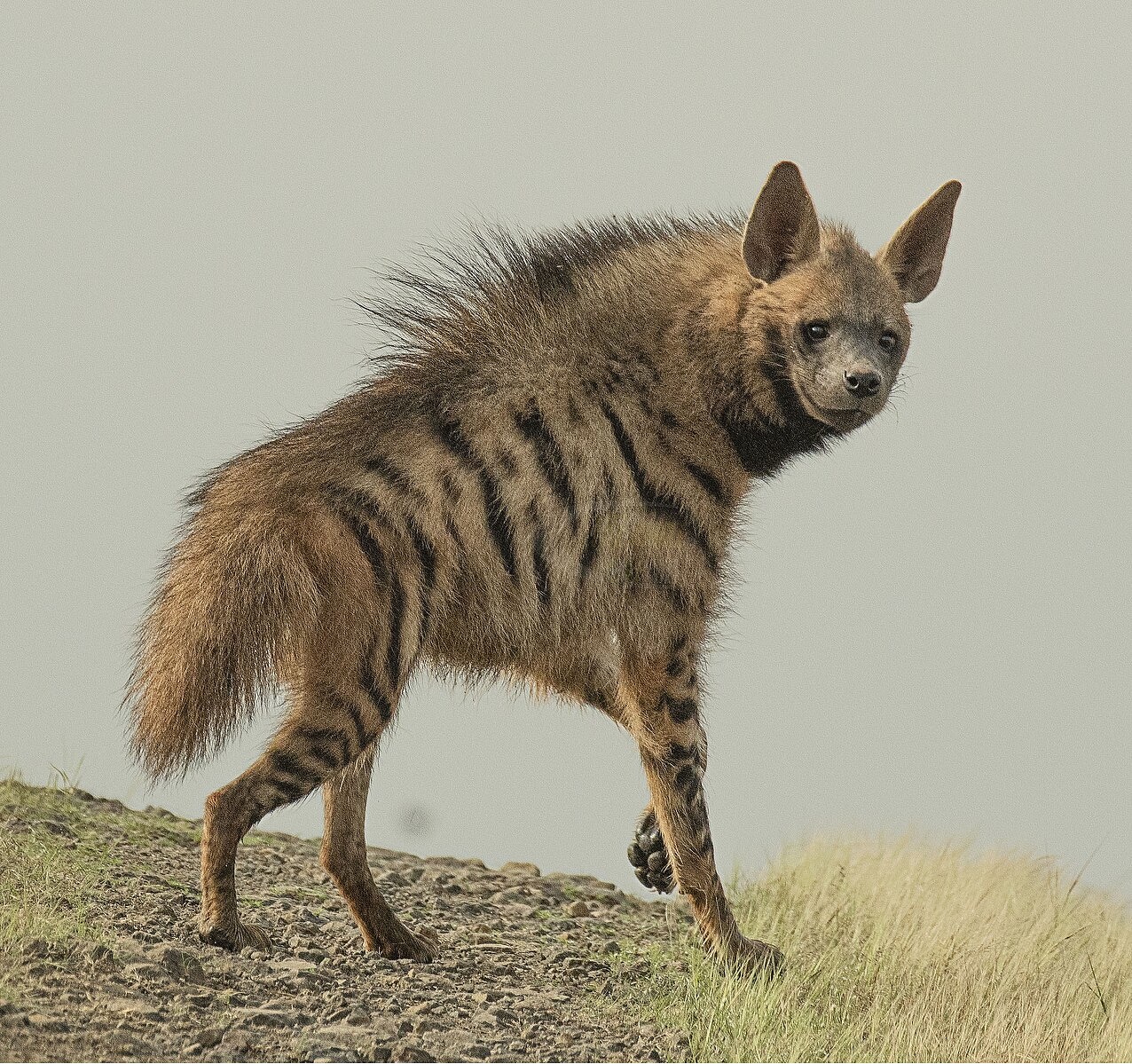
striped hyena
Striped hyenas are not picky fussy eaters, though they do have an aversion to vulture flesh. They forage mainly at night, alone, traveling through their home range searching for food with no apparent pattern. They move at an average speed of 2-4 km/h, occasionally increasing to eight km/h when trotting. Wind direction is not used to determine direction of travel, but striped hyena do respond quickly if the scent of carrion is picked up in the wind. They visit established food sites, such as garbage dumps around human settlements, fruit trees, and temporary sites of large kills. Water is consumed every night when available, but the striped hyena can survive without water for long periods and live in desert conditions. But because of their scavenging diet, which lacks the moisture of fresh kills, striped hyena requires more water to survive than most carnivores./=\
In Turkmenistan, striped hyenas have been recorded feeding on wild boar, kulan, porcupines, and tortoises. The seasonal abundance of oil willow fruits is an important food source in Uzbekistan and Tajikistan, while in the Caucasus, grasshoppers fulfill this role. In Israel, striped hyena feed on garbage, carrion, and fruits. In eastern Jordan, their main sources of food are feral horse and water buffalo carcasses and village refuse. When eating, striped hyenas gorge themselves until satisfied, though hyenas with cubs will transport food to their dens. Because of the high content of calcium in its diet, the feces of the striped hyena becomes white very rapidly, and can be visible from long distances.
Striped Hyena Behavior and Liars
Striped hyenas are motile motile (move around as opposed to being stationary) and communicate with chemicals usually detected with smell. Craig Howard wrote in Animal Diversity Web: The striped hyena is generally considered solitary, but has some social organization. It forages individually and is rarely seen in groups. It does, however, associate in small family groups at the den. Immature family members will help feed younger siblings by bringing food back to the den. Vocal communication is not highly developed. It consists mainly of soft growls and other sounds used during intraspecific encounters. Territorial ity is not a prominent feature in striped hyena behavior, but does exist to some extent. Dens are often used merely for short periods of time, and therefore rarely need to be defended. In some areas, however, anal-gland marks and latrines have been found near feeding sites and well-used pathways.[Source: Craig Howard, Animal Diversity Web (ADW) /=]
Submissiveness in a social encounter is shown by presentation of the anal gland. First, the hyenas sniff noses, followed by anogenital sniffing. Immature young display submission to adults, and one adult will often display to another upon meeting, with the second adult reciprocating. Fighting consists of ritualized wrestling matches, each hyena attempting to grab the other around the cheek region while attempting to evade or break the other's cheek hold.
The loser of the competition displays submission by the anal presentation. The striped hyena is not a favored prey species of any predator. They keep a safe distance, usually around 50 meters, from larger, carnivorous mammals like lions and tigers. They also have the ability to chase or keep leopards and cheetahs away from food sources. The striped hyena behaves submissively towards the larger spotted hyena, and will allow spotted hyenas to steal its food.
Striped hyenas hide and shelter from predators, heat, or winter cold. in caves, niches, pits, dense thickets, reeds, and plume grass during the day. They hyena may dig their own dens, but they often establish lairs in caves, rock fissures, erosion channels, and burrows formerly occupied by porcupines, wolves, warthogs, and aardvarks. Hyena dens can be identified by the presence of bones or whitish feces at the entrances. The size and elaboration of striped hyena dens varies according to location; dens in the Karakum have entrances 0.67–0.72 meters wide and are extended over a distance of 4.15–5 meters, with no lateral extensions or special chambers. In contrast, hyena dens in Israel are much more elaborate and large, exceeding 27 meters in length. [Source: Wikipedia]
Striped Hyena Mating, Reproduction and Offspring
Striped hyenas are monogamous. Males help females establish the den and help them raise and feed the cubs after theu are born. The mating season varies according to location; in Transcaucasia, it is January–February; in Turkmenistan it is in October–November. In captivity, breeding is non-seasonal. Mating can occur at any time of the day, during which the male grips the skin of the female's neck. [Source: Wikipedia; [Source: Craig Howard, Animal Diversity Web (ADW)]
Based on observations in captivity, estrus lasts one day, with the female mating several times at 15-25 minute intervals throughout the day. The average gestation period is 90 days. The average number of offspring being 2.5. Striped hyena cubs are born with adult markings, closed eyes, and small ears. This is in marked different from newborn spotted hyena cubs which are born almost fully developed. The eyes of striped hyena young open after seven to eight days, and the cubs leave their dens after one month.
The mother brings food to the den for her cubs after they are one month old, but continues to nurse for approximately 12 months. Cubs are fed by both parents. By autumn, the cubs are half the size of their parents. On average males and females reach sexual or reproductive maturity at 26 months.
Humans and Striped Hyenas: Folklore, Magic and Attacks
Striped hyenas appear quite often Middle Eastern literature and folklore, often as symbols of treachery and stupidity. In the Near and Middle East, striped hyenas are generally regarded as physical incarnations of jinns (spirits). In his book “Marvels of Creatures and the Strange Things Existing”, Zakariya al-Qazwini (1204–1283) wrote of a tribe of people called "Hyena People" and should one of this tribe be in a group of 1,000 people, a hyena could pick him out and eat him. A Persian medical treatise written in 1376 describes a cure for cannibalistic "half-men, half-hyenas". In “Hawayan Al-Koubra” (1406), Al-Doumairy wrote that striped hyenas were vampiric creatures that attacked people at night and sucked the blood from their necks and said hyenas only attacked brave people. Arab folklore describes how hyenas coul mesmerise victims with their eyes or sometimes with their pheromones. Until the end of the 19th century, Greeks believed that the bodies of werewolves, if not destroyed, would haunt battlefields as vampiric hyenas, dring the blood of dying soldiers. Depictions of striped hyenas in India, Pakistan, Afghanistan, and Palestine is more varied. Though feared, striped hyenas were also symbolic of love and fertility, and various love medicine were made from hyena body parts. The Baloch people of Pakistan and Iran have traditionally believed that witches and magicians rode striped hyenas at night. [Source: Wikipedia]
In ordinary cases, striped hyenas are extremely timid around humans though they can display bold behaviors toward people at night. On rare occasions, striped hyenas have preyed on humans, usually children. In the 1880s, a hyena reportedly attacked humans, especially sleeping children, over a three-year period in the Erivan Governorate in the Russian Caucasus, with 25 children and three adults being wounded in one year. The attacks provoked local authorities into announcing a reward of 100 rubles for every hyena killed. More attacks were reported later in some parts of Transcaucasia, particularly in 1908. During the 1930s and 1940s there were reports in Azerbaijan of striped hyenas killing children sleeping in courtyards. In 1942, a guard sleeping in his hut was mauled by a hyena in Golyndzhakh (Qalıncaq, Azerbaijan). Cases of children being taken by hyenas at night are known in Bathyz Nature Reserve in southeast Turkmenistan. An additional attack on a child was reported around Serakhs in 1948. Several attacks have occurred in India. In in 1962, nine children were thought to have been taken by hyenas in the town of Bhagalpur in the Bihar State in a six-week period and 19 children up to the age of four were killed by hyenas in Karnataka and Bihar in 1974. A census on wild animal attacks during a five-year period in the Indian state of Madhya Pradesh showed that hyenas had only attacked three people — much lower than those by wolves, gaur, wild boar, elephants, tigers, leopards, and sloth bears.
Ancient Greeks and Romans believed the blood, excrement, rectum, genitalia, eyes, tongue, hair, skin, and fat, as well as the ash of different parts of the striped hyena's body, were effective means to ward off evil and to ensure love and fertility. Greeks and Romans believed that the genitalia of a hyena "would hold a couple peaceably together" and that a hyena anus worn as an amulet on the upper arm of man would make him irresistible to women. In West and South Asia, hyena body parts have been used in love magic and in the making of amulets. In Afghanistan and Pakistan striped hyena hair is used in love magic or as a charm in sickness. Hyena blood has been held in high regard in northern India as potent medicine, and the eating of the tongue helps fight tumors. The Pashtun of Pakistan and Afghanistan keep the vulva of female striped hyenas in vermilion powder, which is believed to have aphrodesic qualities. The rectum of a freshly killed striped hyena is likewise used by homosexuals and bisexuals to attract young men. This has led to the expression "to possess the anus of a hyena" — meaning a person is attractive and has many lovers. A striped hyena's penis kept in a small box filled with vermilion powder can be used for the same reasons. For more on this topic see the Wikipedia article on Striped Hyenas.
Striped hyenas are easily tamed and can be fully trained, particularly if they training starts when they are youn. Although the Ancient Egyptians did not consider striped hyenas sacred, they did supposedly tame them for use in hunting. When they are raised with a firm hand, they may eventually become affectionate and as amenable as well-trained dogs. On the downside they emit a strong odour which no amount of bathing will cover. Although they kill dogs in the wild, striped hyenas raised in captivity can form bonds with them.

Hyena species: 1) Aardwolf (Proteles cristata), 2) Spotted Hyena (Crocuta crocuta), 3) Striped Hyena (Hyaena hyaena), 4) Brown Hyena (Parahyaena brunnea)
Image Sources: Wikimedia Commons
Text Sources: Animal Diversity Web animaldiversity.org ; National Geographic, Live Science, Natural History magazine, CNTO (China National Tourism Administration) David Attenborough books, New York Times, Washington Post, Los Angeles Times, Smithsonian magazine, Discover magazine, The New Yorker, Time, BBC, CNN, Reuters, Associated Press, AFP, Lonely Planet Guides, Wikipedia, The Guardian, Top Secret Animal Attack Files website and various books and other publications.
Last updated May 2025