
Home | Category: Desert Animals
BARBARY MACAQUES
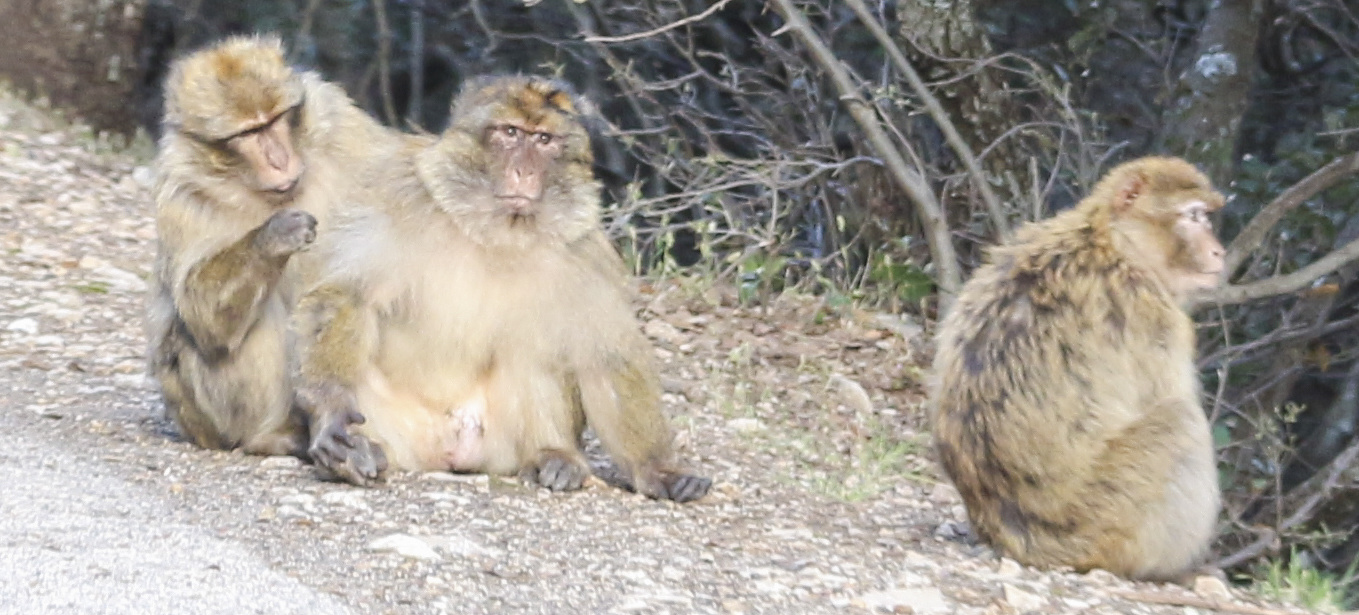
Barbary macaques in Michlifen forest, Middle Atlas
Barbary macaques (Macaca sylvanus) are also known as Barbary apes. They are native to the Atlas Mountains of Algeria, Tunisia and Morocco. There is also a small introduced population in Gibraltar to the south of Spain. The species is of particular interest to primatologists because males play an unusual role in rearing young; they play an integral role in raising all infants, not just their own. The name Barbary ape is not correct because Barbary macaques are not apes.
Barbary macaques live at elevations from sea level to 2600 meters (8530 feet). The majority of them are found in the Middle and High Atlas mountains and in the Rif mountain regions of Morocco. A smaller population is located in the Tellian Atlas mountains of Algeria. Within the Atlas mountains, Barbary macaques are restricted to the Grand Kabylie mountains, the Petit Kabylie mountains, and the Chiffa Gorges. There are approximately 300 Barbary macaques living in Gibralter, most on the Rock of Gibraltar. This is the only free-living monkey population in Europe and are managed by the Gibraltar Ornithological and Natural History Society and the Gibraltar Veterinary Clinic.
Barbary macaques are mainly found in mountains, cliffs, and gorges. Their primary habitat is cedar forests, but they are also found in mixed forests of cedar and holm-cork oak, pure oak forests, shrubby rock outcrops along coasts, and occasionally in grasslands at low elevations. During the winter they the spend much of their time in trees; during summer they spend more time on the ground. [Source: Judy Jinn, Animal Diversity Web (ADW) /=]
The primary predators of Barbary macaques are large eagles that inhabit the mountains where they live. These birds of prey mainly target macaque young which are also prey upon by golden jackals and red foxes. Barbary macaques tend to hang out in troops. At least one troop member serves as a lookout for danger. They emit a special high-frequency "ah-ah" alarm call when eagles are spotted. Upon hearing this call, tropp members quickly escape to the lower canopy to hide.
Barbary Macaque Characteristics and Diet
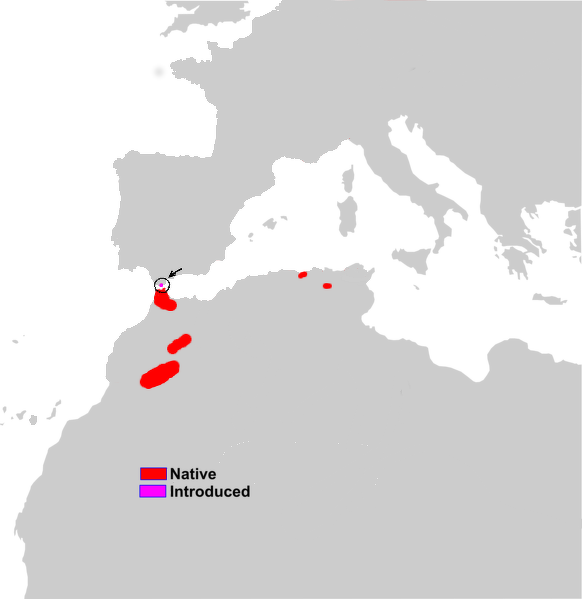
Barbary macaque range
Barbary macaques range in weight from 11 to 16 kilograms (24.2 to 35.4 pounds) and range in weight from 45 to 60 centimeters (17.7 to 23.6 inches). They typically live 22 years in the wild. Males rarely live more than 25 years, and females appear to live slightly longer than males. Infants have a 10 percent mortality rate in the wild. Sexual Dimorphism (differences between males and females) is present: Males are larger than females. Sexes are colored or patterned differently. Females average 45 centimeters (17.7 inches) in length and weigh about 11 kilograms (24.2 pounds, and display estrus during the mating season with large anogenital swellings. Males weigh 16 kilograms (35.4 pounds) on average and range in length from 55 to 60 centimeters (21.6 to 23.6 inches). [Source: Judy Jinn, Animal Diversity Web (ADW) /=]
Barbary macaques are covered in thick fur that presumably helps keep them warm in cold temperatures that occur during the winter and at night. Fur color ranges from yellowish-gray to darker grayish-brown. Their chests and stomachs are much lighter than the rest of their bodies while their faces are often dark pink. Barbary macaques have short tails that are about one to two centimeters long. Like all Old World monkeys, Barbary macaques have large cheek pouches for carrying food. Their dental formula is I2/2, C1/1, P2/2, M3/3.
Barbary macaques are omnivores (eats a variety of things, including plants and animals). Animal foods include amphibians and insects. Among the plant foods they eat are leaves, roots, tubers, wood, bark, stems seeds, grains, nuts, fruit, flowers and fungus. The climate of the mountains where Barbary macaques live goes through significant seasonal changes throughout the year, and the diet of Barbary macaques changes along with the seasons. During spring, they eat various vegetation and gorge on caterpillars that live in oak trees. In the summer, fruits, small seeds, roots, and fungi are abundant and they eat a lot of those by foraging along the ground. Occasionally, they also eat small vertebrates such as frogs and tadpoles. Oaks produce acorns during fall, which Barbary macaques feed on during this time. During years in which there are lots of acorns, these macaques may subsist on them for more than half the year. During winter, ground forage becomes limited and Barbary macaques take to the trees and feed mainly on the leaves, seeds, and bark of conifers.
Barbary Macaque Behavior
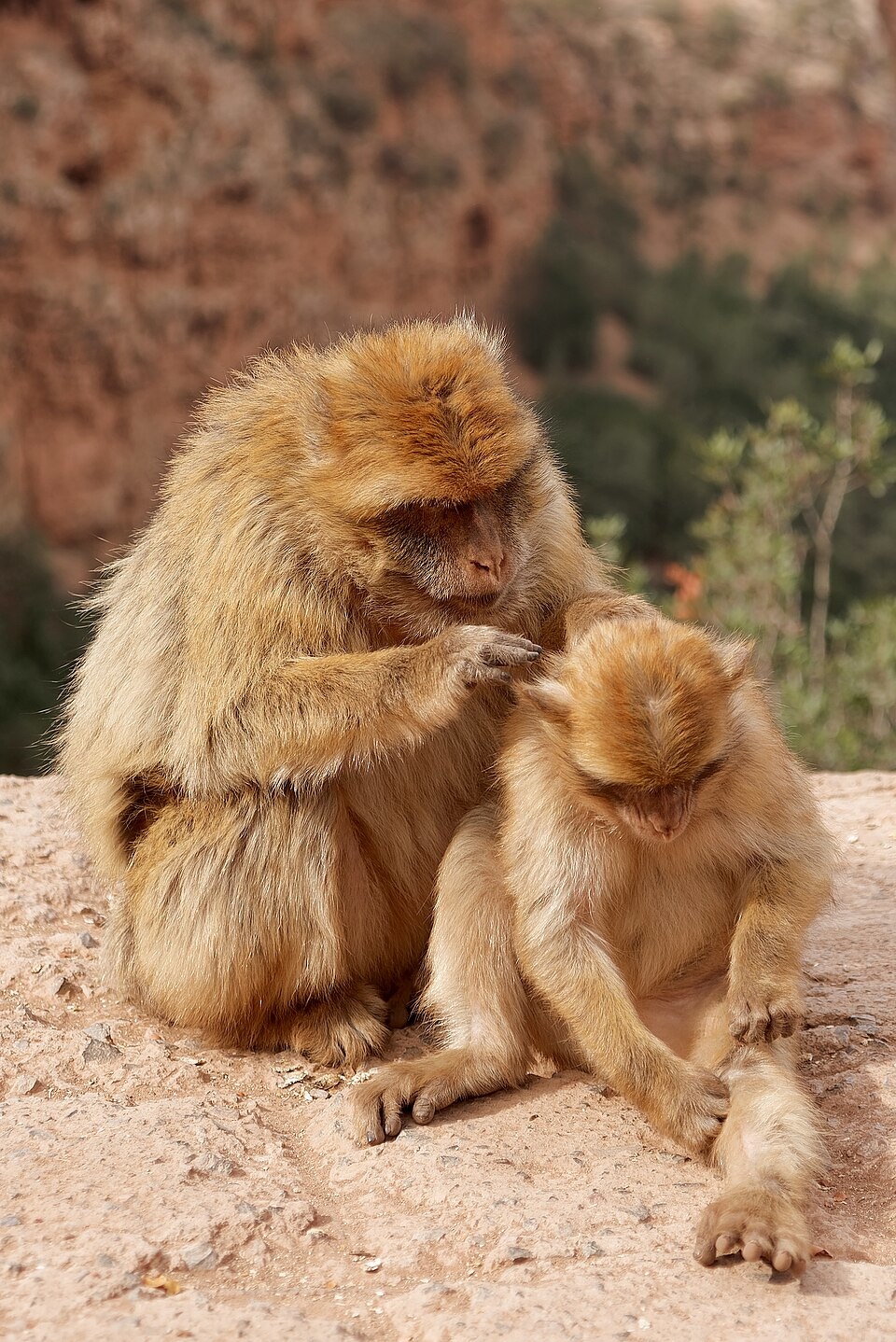
Barbary macaques allogrooming at Ouzoud Falls, Morocco
Barbary macaques are arboreal (live in trees), scansorial (able to or good at climbing), terricolous (live on the ground), diurnal (active mainly during the daytime), motile (move around as opposed to being stationary), territorial (defend an area within the home range), social (associates with others of its species; forms social groups), and have dominance hierarchies (ranking systems or pecking orders among members of a long-term social group, where dominance status affects access to resources or mates). [Source: Judy Jinn, Animal Diversity Web (ADW) /=]
Barbary macaques do most of their foraging and traveling during the day. At night, two to three individuals may sleep together in same-sex clusters. The home territory of a Barbary macaque troop ranges from three to nine square kilometers (1.2 to 3.5 square miles), with their average territory size being 7.25 square kilometers (2.8 square miles). Home ranges may overlap with those of other troops by 39 percent to 100 percent.
An average Barbary macaque troop has 24 members but can contain up to 59 individuals and generally has a 1:1 males-female ratio. Males and females form their own hierarchies. Female hierarchies are strictly matrilinear, and each female holds a specific rank with the troop. Newborn daughters inherit the next highest position under her mother, above their older sisters and other in the troop. Females protect social status via aggression. Rank is relatively stable and rarely changes. Male have looser dominance hierarchies and show less aggression towards one another. Compared to most primates, Barbary macaques are a relatively peaceful species. Most aggressive interactions are restricted to chases and retreats, and 20 percent of aggressive acts are followed by reconciliatory acts between individuals. Like many social primates, Barbary macaques allogroom one another. This is an important daily ritual that builds strong bonds between individuals, removes parasites, and lowers stress.
Barbary Macaque Communication
Barbary macaques sense using vision, touch, sound and chemicals usually detected with smell and communicate with vision, touch and sound. They have variety of facial expressions, some of which express emotions. Females show rounded-mouth threats towards other females as a sign of aggression and dominance. Bared teeth show submission. Lip-smacking and teeth-chattering are signs of appeasement which are often directed at a dominant individual or towards infants. Barbary macaques also display relaxed, open-mouthed, play faces which are thought express happiness. [Source: Judy Jinn, Animal Diversity Web (ADW) /=]
Sounds and vocalizations play an important role in communication for many primates. Barbary macaques scream and grunt at trespassing troops. They also use a loud, high-pitched "ah-ah" call to warn troop members of potential danger. Mating calls from females during copulation have been shown to increase the likelihood of ejaculation in males.
Barbary macaques are capable of recognizing individuals by calls, and mothers can recognize their infants by their cries. Young cry a string of high-pitched calls at dusk, presumably to find their mother in sleeping clusters. Troops are familiar with the vocalizations of neighboring troops. Studies have shown calls are learned through experience and different social groups may use different dialects.
Barbary Macaque Mating and Reproduction
Barbary macaques are polygynandrous (promiscuous), with both males and females having multiple partners. They engage in seasonal breeding — once a year in November and December The gestation period ranges from 158 to 170 days, with the average being 164.2 days. The number of offspring is usually one or two. Females remain in estrus for about one month and have their first offspring around five years of age. The time between births ranges from 13 to 36 months, and the first offspring is generally smaller than subsequent offspring. Females reach menopause during the last five years of their lives, though estrus may continue for a few more years. Females often continue to copulate, even when conception is no longer possible.[Source: Judy Jinn, Animal Diversity Web (ADW) /=]
Females display estrus with large anogenital swellings. They initiate and terminate matings and compete with each other for mates by interrupting copulation. Male rank has little impact on which individuals females choose to mate with. Judy Jinn wrote in Animal Diversity Web: By the time estrus is complete, each female has mated with all or nearly all males in her troop. Often, females continue to copulate even when conception is impossible. At the end of breeding season, the combined number of copulations by all the females in a troop can number in the hundreds. Female promiscuity is thought to mask the true identity of an infant's father resulting in paternal support from more than one male. /=\
Although male Barbary macaques have little influence over who they mate with, dominant individuals tend to mate more often than subordinates and tend to mate more with dominant females. Despite competition for females, male Barbary macaques show high tolerance for each other. They compensate for intense sperm competition by having large testical-size to body-size ratios. Older males have more breeding success than younger individuals.
Males use three mating strategies when attracting females. 1) Individuals using "proximity-possession" remain in close proximity to a female, which usually ensures one's opportunity to mate. 2) Others use the "pertinacious strategy", where they closely follow a female until they are noticed and allowed to mate. 3) Lastly, lowest ranking males use a "peripheralize and attract strategy", where they stay far away from the female, but shake branches or carry other infants in full view of the female in order to attract her attention. Successful males then mate with a female, only mounting her once for a short period of time before both part ways. /=\
Barbary Macaque Offspring and Parenting
Barbary macaques are very social and parental care is provided by both females and males. Young are altricial, meaning they are relatively underdeveloped at birth. Once infants are born, the entire troop takes part in caring for infants. This is known as cooperative breeders, which technically means helpers provide assistance in raising young that are not their own). There is an extended period of juvenile learning. The position of the mother in the dominance hierarchy affects status of young. Generally, members of both sexes and all ages contribute in alloparental care of young. On average males and females reach sexual or reproductive maturity at age at three years and 10 months. [Source: Judy Jinn, Animal Diversity Web (ADW) /=]
Barbary macaques young are usually born between April and June. Average birth weight for Barbary macaques is 450 grams. Female rhesus macaques, a close relative to Barbary macaques, stay in close contact with their newborns for the first three months after birth. In young macaques, weight is often used as a substitute for age. Rhesus macaques are weaned between 1.3 and to 1.4 kilograms. Depending on environmental conditions and resource abundance, infants can be weaned between 200 to 362 days./=\
Judy Jinn wrote in Animal Diversity Web: Barbary macaques live in matrilineal societies with youngest daughter ascendancy, thus newborn females outrank everyone else in the immediate family except their mothers. Alloparenting is common among Barbary macaques. The entire troop shows interest in newborns and displays friendly teeth-chattering or lip-smacking towards infants. Unlike many primates, Barbary macaques actively take care of unweaned infants more than weaned infants. Females often help "baby-sit" infants of other females. Infants of closely related females and of the highest ranking female usually receive the most attention. Nulliparous females (i.e., females without offspring) engage in infant-carrying more than other females, but this has not been linked to an increase in the survival of their own infants. Females who have recently lost infants are also more likely to carry others' infants. Research suggests that extensive infant handling may allow females to rise in rank. Infants receiving extra care do not experience higher survival rates than those who do not receive extra care./=\
Due to the promiscuous mating system of Barbary macaques, males have no way of knowing which infant is theirs. As a result, they provide paternal care to infants in their troop. For example, adult males group around infants to protect them from approaching predators. In general, males appear to show preference to male infants. Young-adult males tend to develop strong bonds with male infants, and older adult males prefer to take care of any infants from high-ranking females. Females appear to show mating preference to males that provide the most paternal care to their offspring. /=\
Barbary Macaques, Humans and Conservation
On the International Union for Conservation of Nature (IUCN) Red List, Barbary macaques are listed as Endangered. In CITES (Convention on International Trade in Endangered Species of Wild) they are in Appendix II, which lists species not necessarily threatened with extinction now but that may become so unless trade is closely controlled. [Source: Judy Jinn, Animal Diversity Web (ADW) /=]
In Morocco and Algeria, Barbary macaques are a federally protected species, but are still in danger of local extinction. Their greatest threat is habitat loss, primarily in the form of logging, which pushes them farther up the mountains into nutrient poor areas where survival is more difficult. Resource competition with domestic goats is also a problem. In some places Barbary macaques have changed their feeding behavior to incorporate more bark and flowers. Minor threats include illegal poaching, trapping, and attacks by herding dogs. In the 2000s, about 300 infants were taken out of Morocco annually for pet trade.
Because of their low numbers in the wild, Barbary macaques are not used much by labs like some other macaques, but some labs still utilized them for biomedical research in the 2000s.. There is also a small illegal pet trade for them. Barbary macaques occasionally raid gardens or farms and are thus regarded as crop pests and have sometimes been trapped due to this. In Gibraltar, Barbary macaques are a tourism draw..
Image Sources: Wikimedia Commons
Text Sources: Animal Diversity Web animaldiversity.org ; National Geographic, Live Science, Natural History magazine, CNTO (China National Tourism Administration) David Attenborough books, New York Times, Washington Post, Los Angeles Times, Smithsonian magazine, Discover magazine, The New Yorker, Time, BBC, CNN, Reuters, Associated Press, AFP, Lonely Planet Guides, Wikipedia, The Guardian, Top Secret Animal Attack Files website and various books and other publications.
Last updated May 2025