
Home | Category: Desert Animals
MIDDLE EAST BLIND MOLE-RATS
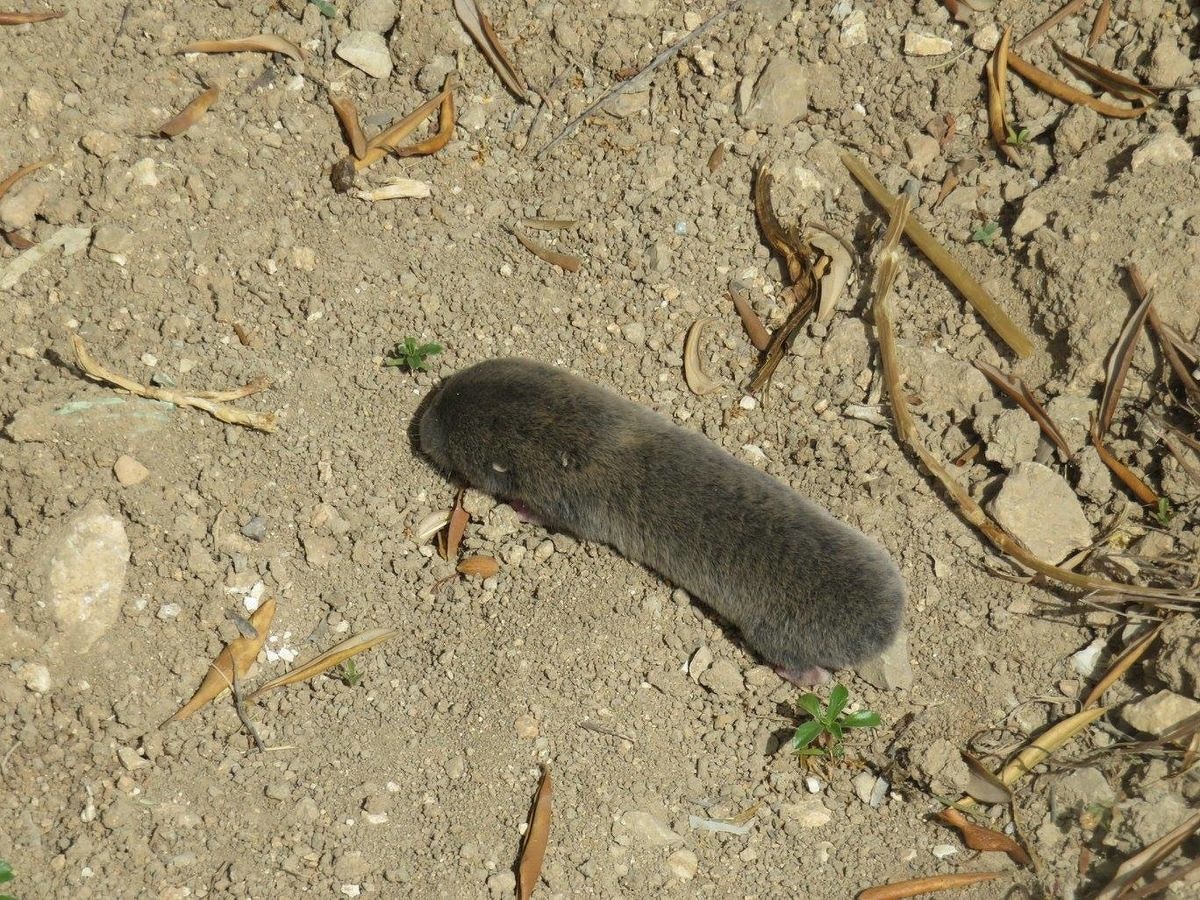
Middle East blind mole-rat
Middle East blind mole-rats (Nannospalax ehrenbergi or Spalax ehrenbergi) are also known as Palestine mole-rats and Ehrenberg's mole-rats. They are widely distributed in eastern North Africa and the Middle East and are found from northeastern Libya and Egypt, Israel, Lebanon, Jordan, Syria, Iraq and southern Turkey. Within this region, these mole-rats are found in fragmented areas with appropriate soils for burrowing. They live three to five years in the wild, and have lived up to 20 years in captivity. [Source: Wikipedia]
Middle East blind mole-rats are generally not found in desert areas. They prefer habitats with sandy and loamy soils in dry steppes, semi-desert, and agricultural areas, especially cultivated fields, at elevations from sea level to 2000 meters (6562 feet). They spend nearly all their time in their underground burrows and tunnel systems. These are complex, with nesting chambers, storage areas, tunnels used for foraging, and above-ground mounds with sleeping chambers. Burrows are dug deeper in the hot months of the year.[Source: Nicole Santarosa and Phill Moll, Animal Diversity Web (ADW) /=]
Middle East blind mole-rats favor places with Mediterranean-type shrubbish vegetation. They are strict herbivores and primarily feed on the underground roots, stems, tubers, and seeds of plants. They dig extensive underground tunnels in search of food and use underground chambers to store excess, harvested food. The strict underground lifestyle of Middle East blind mole-rats provides good protection from most predators.
Middle East blind mole-rats have a highly polymorphic karyotype with over 30 chromosomal forms. It has been suggested that some of these forms are likely to be distinct species. At least four distinct cryptic species exist.In 2001, four new Middle East blind mole-rat species endemic to geographical regions within Israel, Palestine and the Golan Heights were described based on chromosome divergence by a team of researchers led by Eviatar Nevo. These were: 1) Mount Carmel blind mole-rats (N. carmeli) — endemic to Mount Carmel in northern Israel; 2) Upper Galilee Mountains blind mole rat (N. galili) — endemic to Upper Galilee in northern Israel; 3) Golan Heights blind mole-rats (N. golani) — endemic to the Golan Heights, including the areas of Mount Hermon, Quneitra and Eliad; and 4) Judean Mountains blind mole-rats (N. judaei) — endemic to the Judaean Mountains in central Israel and Palestine. [Source: Wikipedia]
Middle East Blind Mole-Rat Characteristics
Middle East blind mole-rats range in weight from 250 to 400 grams (8.8 to 14.1 ounces) and range in length from 15 to 27 centimeters (5.9 to 10.6 inches). Their basal metabolic rate ranges from 0.62 to 1.03 cubic centimeters of oxygen per gram per hour. Sexual Dimorphism (differences between males and females): Males are larger than females. [Source: Nicole Santarosa and Phill Moll, Animal Diversity Web (ADW) /=]
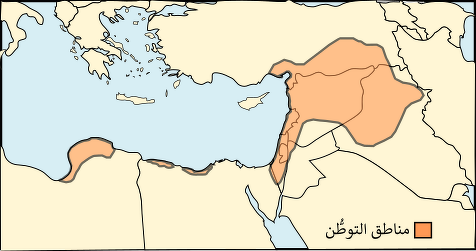
Middle East blind mole-rat range
Middle East blind mole-rats have bluish, dark gray fur. They don’t have an external tail and their external ears have been reduced to small ridges. These are morphological adaptations for their underground lifestyle. Other ones include a muscular, streamlined bodies with large heads, powerful limbs, and small claws. Middle East blind mole-rats are completely blind. Their eyes are located underneath a layer of skin.
Middle East blind mole-rats have four sharp teeth: two large teeth in the upper jaw and two smaller teeth in the lower jaw. Their dental formula is 1/1, 0/0, 0/0, 3/3 = 16. The two large incisors are orthodont and are oriented in front of the lips so that the incisors can be used to dig even when the mouth is closed. The cheek teeth are rooted and display enamel patterns that resemble the letters "z" and "s." /=\
Middle East blind mole-rats are known for their adaptability to survive in underground environments with very little oxygen. Their exceptional ecological adaptation strategies of blind mole-rats can be observed in their different tongue morphologies, particularly their tongue papillae (the tiny, raised structures on the tongue's surface). Tongue papillae differ between individuals in a species to adapt to different environmental regions and their different soil characteristics and food types. [Source: Wikipedia]
Middle East Blind Mole-Rat Behavior and Communication
Middle East blind mole-rats are fossorial (engaged in a burrowing life-style or behavior, and good at digging or burrowing), diurnal (active mainly during the daytime), motile (move around as opposed to being stationary), sedentary (remain in the same area), territorial (defend an area within the home range) and solitary . [Source: Nicole Santarosa and Phill Moll, Animal Diversity Web (ADW) /=]
Middle East blind mole-rats dig complex underground burrows and establish complex networks of tunnels in pursuit of food. Generally single individuals occupy burrow systems. These animals are quite territorial and can be be highly aggressive.
Middle East blind mole-rats sense and communicate using touch, sound, vibrations and chemicals usually detected with smelling or smelling-like senses. They also employ pheromones (chemicals released into air or water that are detected by and responded to by other animals of the same species).
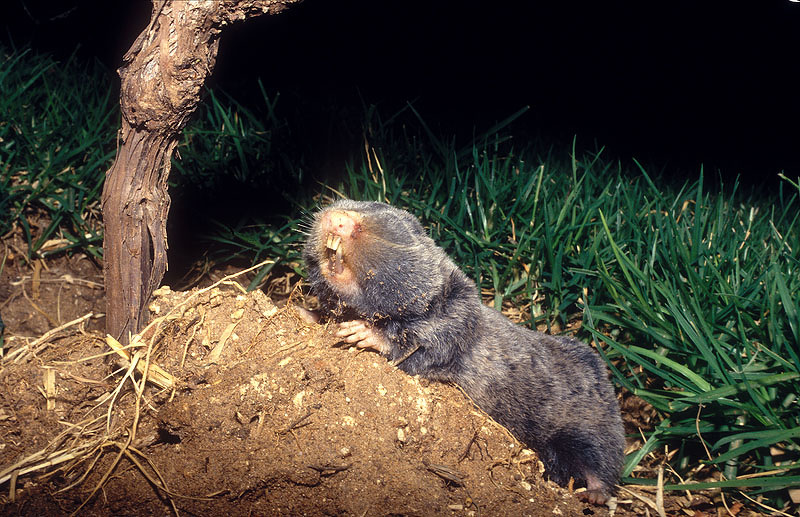
Middle East blind mole-rat
As Middle East blind mole-rats are blind, they rely heavily on vocalizations, smell and touch. They use six distinct vocalizations which are associated with attacking, crying, inviting courting, releasing and threatening. Courtship calls consist of a low murmur that reduces aggression between potential mates. All Middle East blind mole-rats calls are at a low frequency and are specialized for low frequency hearing. Head thumping against tunnel ceilings is a form a vibrational communication, which appears to advantageous over long distances and communication and is used to signal territoriality and initiate mating rituals. Although the eyes Middle East blind mole-rats are not used for normal visual purposes, they are still photoreceptive. A study by Sanyal et al. (1990), showed that the eyes can detect photoperiodicity, and thus allow them to distinguish times of the day.
Middle East Blind Mole-Rat Mating, Reproduction and Offspring
Middle East blind mole-rats are monogamous (having one mate at a time). They engage in seasonal breeding, breed once yearly, in the winter, from November to March. The average gestation period is 34 days. The number of offspring is usually three or four. Young are altricial, meaning they are relatively underdeveloped at birth. During the pre-weaning stage provisioning and protecting are done by females. The average age in which they become independent ranges from four to six weeks. Time to first reproduction is not reported, but is likely to be within their first year of life. [Source:Nicole Santarosa and Phill Moll, Animal Diversity Web (ADW) /=]
Nicole Santarosa and Phill Moll wrote in Animal Diversity Web: Females only mate with one male for each breeding season, but may mate with different males throughout their lifetime, making them making them serially monogamous. Middle East blind mole-rats mating behavior is categorized into three stages: agonistic, courtship, and copulation. Courtship takes place during the winter season, which is the only time males and females will be found in overlapping territory. This species is highly aggressive, with severe aggressive displays occurring within and between the sexes. Due to their aggressive nature, courtship is a very long process involving the male and female engaging in repeated mating displays until their aggressive behavior is attenuated.

soil mounds dug by Middle East blind mole-rats in Israel
Seismic signaling is used to initiate the first contact between the male and female's respective burrows. This involves both males and females drumming their heads against the ceilings of their burrows to create vibrations. The mating pair begins with face-to-face touching of their incisors which proceeds to nibbling and courtship calls, which contributes to reducing the intensity of the aggressive displays between the pair. After the courtship ritual the male will dig a “copulation hollow” which is where the actual mating will take place. After the pair becomes habituated to the hollow the female will initiate copulation by turning her back towards the male. Immediately after copulation the male will fill in the “copulation hollow” and the pair will separate and return to solitary lifestyles. /=\
Females construct elaborate breeding mounds and nesting chambers in preparation for breeding. Young are born from January to April. Females provide sole parental care. In a study done by Gazit and Terkel, males exhibited limited parental care and intermittently brought food to the female’s territory if the males had acquired a large food surplus during the wet season. Young are born naked but develop quickly. As they grow aggressive interactions between the pups increase to the point where they are forced to disperse from each other. Once the pups begin dispersing, the mother reciprocates aggressive displays to aid in kin dispersal and ensure her young do not attempt to settle in her territory.
Middle East Blind Mole-Rats, Humans and Cancer
Middle East blind mole-rats are found in a relatively limited area but are not regarded as endangered or threatened. On the International Union for Conservation of Nature (IUCN) Red List they are listed as Data Deficient.In CITES (Convention on International Trade in Endangered Species of Wild) they have No special status. Populations are believed to be decreasing, perhaps as a result of intensified agriculture in some areas and campaigns against them because they are considered agricultural pests in some areas. The natural habitat of the mole and it is threatened by habitat loss.
Middle East blind mole-rats are considered crop pests in some areas because they eat roots and tubers in agricultural fields. In Israel, they dig long tunnels up to 80 centimeters deep and store onions and tubers in underground chambers. Some Libyans believe that touching Middle East blind mole-rats results in blindness. To date these mole-rats have not been linked to any human diseases./=\
It turns out Middle East blind mole-rats are quite useful to humans in a number of ways. They have been help archaeologists make significant and important discoveries by digging up artifacts and bones and bring them to the surface. Examining dirt displaced by burrowing mole rats help archaeologists decide where to dig. Middle East blind mole-rat appear to be undergoing rapid speciation and there is great chromosomal and allozyme diversity within species. The study of this is helping scientists better understand the patterns and mechanisms behind speciation.
Middle East blind mole-rats are important in medical research. Their unique adaptions to the low-oxygen environments are of great interest to medical researchers studying ischemia (low blood flow in parts of the body). They are also useful in cancer research. According to Israeli scientists at Haifa University, Middle East blind mole-rats have an apparent resistance to cancer. No spontaneous tumors have ever been noticed in blind mole rats, based on examinations of thousands of individuals over half a century. In a lab, chemical carcinogens that induce cancer in nearly all cases with mice and rats after two to six months, affect mole-rats much less. Only 2 out of 12 Middle East blind mole-rats and old ones developed the expected tumor with one of the carcinogens and only after 18 and 30 months. Nannospalax cells (fibroblasts) from Middle East blind mole-rats, when grown in co-culture with a wide range of human cancer cells, kill the cancer cells. This is also true when "feeding" the cancer cells with the medium that Nannospalax cells grew in — opening an avenue for a general cure to cancer. [Source: Wikipedia]
Studies on the growth of fibroblasts in vitro of Middle East blind mole-rats showed that the process of necrosis (tissue death) replaces apoptosis (the process of programmed cell death) normally used in most organisms. Generally low-oxygen conditions, such as those common in blind mole rats’ burrows, usually cause cells to undergo apoptosis. One study showed that in adaptation to a higher tendency of cell death, blind mole rats evolved a mutation in the tumor suppressor protein p53, also used in humans, to prevent cells from undergoing apoptosis. Human cancer patients have similar mutations, and blind mole rats were thought to be more susceptible to cancer because their cells cannot undergo apoptosis. However, after a specific amount of time (within 3 days according to one study), the cells in blind mole rats release interferon-beta (which the immune system normally uses to counter viruses) in response to over-proliferation of cells caused by the suppression of apoptosis. In this case, the interferon-beta triggers cells to undergo necrosis, and this mechanism also kills cancer cells in blind mole rats. Because of tumor suppression mechanisms such as this, blind mole rats and other spalacids are resistant to cancer.
Image Sources: Wikimedia Commons
Text Sources: Animal Diversity Web animaldiversity.org ; National Geographic, Live Science, Natural History magazine, CNTO (China National Tourism Administration) David Attenborough books, New York Times, Washington Post, Los Angeles Times, Smithsonian magazine, Discover magazine, The New Yorker, Time, BBC, CNN, Reuters, Associated Press, AFP, Lonely Planet Guides, Wikipedia, The Guardian, Top Secret Animal Attack Files website and various books and other publications.
Last updated May 2025