
Home | Category: Desert Animals
SAND CATS
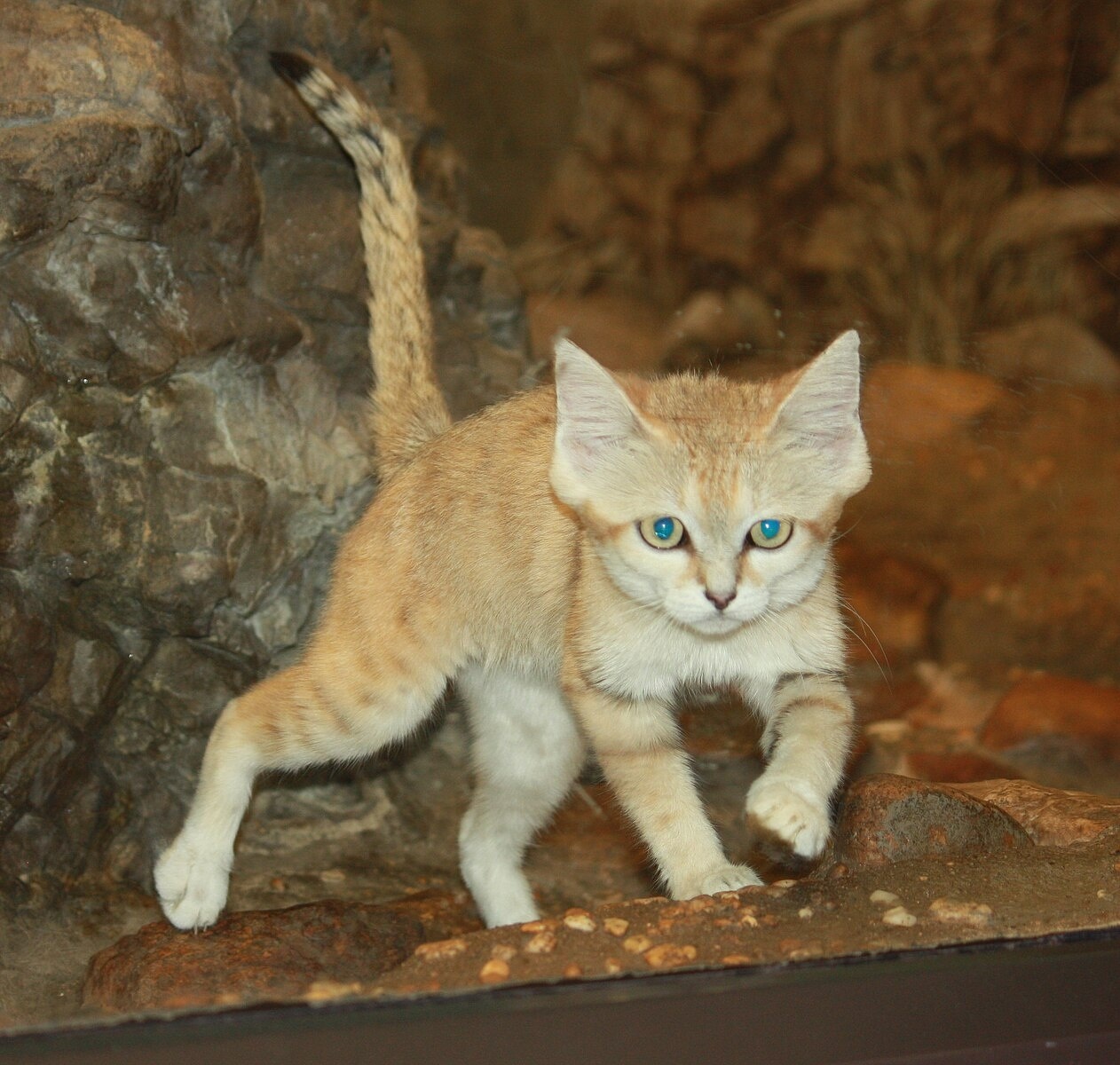
sand cat
Sand cats (Felis margarita) are housecat-size predators found in the northern Sahara, the Middle East, Central Asia and Pakistan. Little is known about because them because they are shy, active mostly at night and their habitat is so harsh and unwelcoming to humans. They are rarely seen. Few live beyond a year in captivity. [Canon advertisement in March 1993 National Geographic].
Sand cats became better known in 2017 when photos of them from a study conducted by Grégory Breton, managing director of Panthera France, drew a lot of attention on the Internet. They are very cute and uniquely adapted to live in some of the world’s harshest deserts. The sand cat is one of the more difficult cats to study in the wild. According to bigcatrescue.org: “Their foot coverings allow them to walk on sand without sinking, leaving their footprints nearly invisible. They have learned to crouch down and shut their eyes when a light is shone on them, which prevents the light from reflecting their eyes for tracking. That combined with their protective coat color makes them blend right into their habitat. They also bury all of their excrement making it impossible to find and analyze so their diet can be studied. In captivity, they have lived up to 13 years, but have a high juvenile mortality rate (41percent).[Source: bigcatrescue.org; Source: Melissa Breyer, Treehugger, April 5, 2023]]
Sand cat adaptions for the desert include sand-colored fur that provides camouflage and keeps them cool. Their large ears can pick up the faintest sounds and help to disperse heat. They feed primarily on jerboas, sand voles, gerbils, hares, birds, reptiles and insects. They are able get moisture from their food and don’t need to drink. They hunt primarily at night and spend their days sleeping and resting in holes dug under rocks and bushes. Young sand cats live in a den.
Predators of sand cats include of snakes, jackals and owls. Their main Anti-predator adaptations, camouflage, stealth and abilty to put a fierce fight if cornered. . In addition to natural predators, the sand cat is also threatened by humans in the form of poisoning and capturing for the illegal pet trade. Overall, the sand cat is the least threatened of wild cats.
Sand Cat Habitat, Range and Subspecies
Sand cats live in some of the world's hottest and driest climates: the Sahara Desert, Arabian Peninsula and parts of Central Asia that are very hot in the very cold in the winter. In the Sahara Desert of Africa region they can be found in Algeria, Egypt, Niger, Chad and Morocco. On the Arabian Peninsula and the Middle East they can be found in Oman, Yemen, Israel, Jordan and the United Arab Emirates as well Saudi Arabia. In Central Asia they inhabit Kazakhstan, Turkmenistan, Iran, Pakistan and Afghanistan.
Scientifically, sand cats are categorized as psammophillic (sand dwelling). They reside desert habitats ranging from plains with little vegetation to rocky valleys with shrubs and trees. Places they live in the Sahara have daily surface temperatures reaching up to 51ºC during the daytime. In Kazakhstan’s deserts temperatures can drop to -30ºC during the winter. [Source: Shanna Wheeler, Animal Diversity Web (ADW) /=]
There are four subspecies of sand cat: 1) F.m. thinobia in Central Asia between the Caspian and Aral Seas in northern Iran, Turkmenistan, southern Kazakhstan and western Uzbekistan; 2) F.m margarita in The Sahara; 3) F.m. scheffeli in Pakistan; and 4) F.m. harrisoni in Arabia and Jordan. There are some differences between sand cats found in Africa and those found on the Arabian Peninsula. Felis meters. margarita, of Africa, has a narrow skull, small carnassials, buffy-white colored paws and two to six rings on the tail. Felis meters. harrisoni, from the Arabian Peninsula, has a broad skull, large carnassials, bright white paws and five to seven rings on the tail.
Sand Cat Characteristics
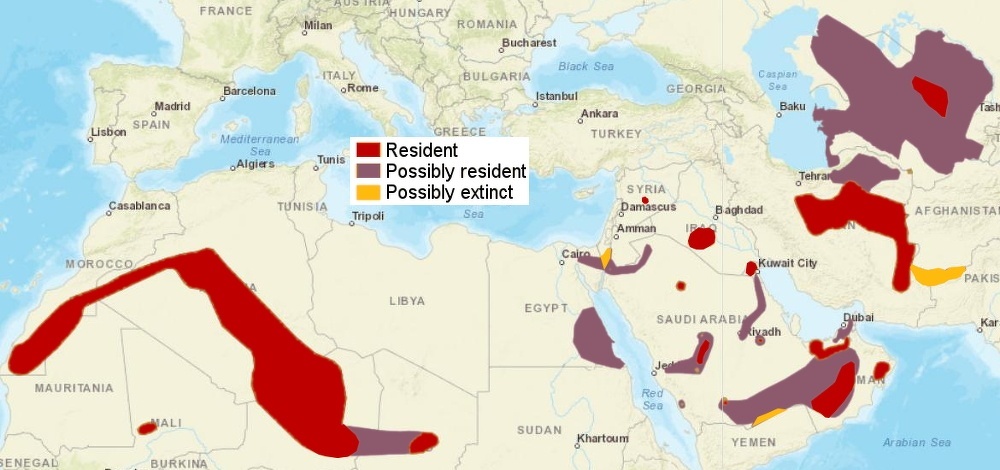
sand cat range
Sand cats are the size of domestic cats and the smallest of all wild cats, They range in weight from 1.4 to 3.4 kilograms (3 to 7.5 pounds) and have a head and body length that ranges from 45 to 57 centimeters (17.7 to 22.4 inches). They are 25 to 40 centimeters (10 to 2 inches) tall and have a a 23–31 centimeter (9.1–12.2 inch) tail. tail. Sexual Dimorphism (differences between males and females) is present: Males are larger than females. Males weigh between 2.1 and 3.4 kilograms (2.4 to 7.5 pounds) and females weigh between 1.4 and 3.1 kilograms (3 and 6.8 pounds) [Source: Shanna Wheeler, Animal Diversity Web (ADW) /=]
Sand cats are pretty cute. They have a wide face and huge eyes, which give them a that "baby face" look. Their large, braod heads makes them appear top heavy. The large external parts of the ear, protect the ears from blowing sand. Sand cats are able to skim across the surface of the sand without leaving an imprint due to fur padding made of wiry black hair between the toes that prevents them from sinking in the sand, increasing the maneuverability in sand, and protecting the feet from burning. Sand cats do a lot of digging. Their claws are not very sharp in part because of a lack of places to sharpen them in the desert. [Source: bigcatrescue.org ^^^]
Sand cats are covered by soft, thick, dense, medium-length fur that protects them from the harsh nighttime temperatures. Coat colors range from pale yellow to grey. They have dark brown to black stripes covering the tail and limbs. The chest and chin are always white. A reddish streak that runs from its eyes across its cheeks. The ears are reddish-brown and black-tipped.
Sand Cat Food and Hunting Behavior
Sand cats are mostly carnivorous and eat a variety of prey such as sand voles, gerbils, jerboa, hares, spiders, reptiles, birds, insects and venomous snakes. They are known as “fearless snake hunters” that kill and eat venomous vipers. They actively hunt but are also considered opportunistic feeders that take what they can find in their barren habitat. Prey provide the sand cat with the fluids they need to live in places where there is little water. They sometimes store and cache food: covering large kills with sand, returning later to feed. [Source: Shanna Wheeler, Animal Diversity Web (ADW) /=]
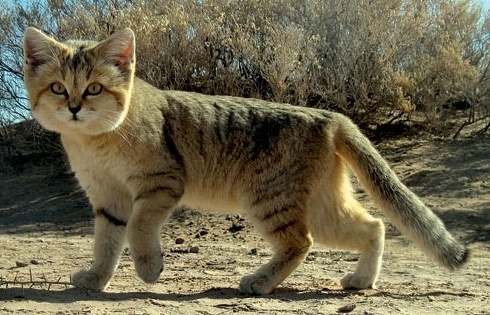
Persian sand cat
Sand cats are primarily nocturnal and often hunt by digging. Their highly developed hearing allows the to locate prey which are sparsely distributed, but underground. Their primary diet consists of three species of gerbils. They kill snakes with a rapid blow to the head that stuns, and then administer a killing bite to the neck.[Source: bigcatrescue.org ^^^]
In the Ténéré, a desert region in south central Sahara, sand cats were observed preying mostly on small rodents, and the young of cape hare but also hunted greater hoopoe lark, desert monitors, sandfish and venomous Cerastes vipers. They satisfied their moisture requirements from their prey but drank water if it was available. The Toubou people reported that of sand cats coming came to their camps at night and drank fresh camel milk. In Israel, remains of Egyptian spiny-tailed lizards were found near burrows used by sand cats and they were observed preying on jirds, Cairo spiny mouse, desert lark and small reptiles. [Source: Wikipedia]
Sand cats were collected in eastern Karakum Desert in the late 1950s. Their feces and stomachs contained remains of tolai hare, small rodents, birds, small reptiles and invertebrates. In March 2018, a sand cat was recorded feeding on a MacQueen's bustard in the Kyzylkum Desert. In central Iran, remains of Blanford's jerboa, and Balochistan gerbil were the most frequent prey species found around sand cat dens.
Sand Cat Behavior
Sand cats are terricolous (live on the ground), nocturnal (active at night), crepuscular (active at dawn and dusk), motile (move around as opposed to being stationary), sedentary (remain in the same area) and solitary. Their average territory size is 16 square kilometers (6.1 square miles). Male and females have overlapping territoris. Four radio-collared sand cats in Israel moved traveled five to 10 kilometers (3.1–6.2 miles) in a single night. They were generally active throughout the night, hunting and covering an average distance of 5.4 kilometers (3.4 miles). They sought refuge below ground at dawn and stayed in the burrow during the day. During the survey period, they used several burrows in their home ranges.[Source: Shanna Wheeler, Animal Diversity Web (ADW) /=\; Wikipedia ]
Sand cats are not good climbers or jumpers, but they are excellent diggers. They use their digging ability to dig up prey in their underground burrows and to dig shallow burrows for themselves to escape the heat of the desert during the day. They are known to lie on their backs outside their burrows to release internal heat. The way sand cats move is unique: with its belly close to the ground, it moves at a fast run punctuated with occasional leaps. It is capable of sudden bursts of speed and can sprint at speeds of 30–40 kph (19–25 mph).
Sand cats are solitary, except during the mating season and when a female has kittens.[Sand cats are generally nocturnal although members of a subspecies from Pakistan are nocturnal during the summer and active at dawn and dusk during the winter. Their burrows are shared with other individuals, but more than one cat never occupies the same burrow simultaneously. Burrows are about 1.5 meters (5 feet) deep and dug in slightly slanting ground with usually only a single entrance, though burrows with two or three entrances have also been observed. These burrows were either abandoned by foxes or porcupines, or dug by gerbils or other rodents.
Sand Cat Senses and Communication
Sand cats sense using touch, sound and chemicals detected by smelling. The have highly developed senses of hearing and smelling. Being nocturnal (active at night), animals, they rely on sensitive hearing to locate prey moving below the surface of the ground. Their ear canals and auditory bulla (bony structure that encloses and protects the middle ear) are relatively much larger in this species than in any other felids. [Source: Shanna Wheeler, Animal Diversity Web (ADW) /=\; Wikipedia]
Sand cats communicate with sound and chemicals usually detected by smelling Their vocalizations include meowing, growling, hissing, spitting, screaming and purring. They make loud, high-pitched and short rasping sounds, especially when seeking a mate. Some of the vocalizations are similar to those of domestic cat. Sand cats also communicates by urine spraying and using scent and scratch marks. They bury their feces and covers it with sand.
Sand cats produce a call that sounds likea cross between a yodel and bark. The call is sometimes mistaken for that of a dog and iis used to locate mates. Bark-like sounds are used as mating calls to communicate between individuals. They allow individuals to locate one another over long distances.
Sand Cat Mating, Reproduction and Offspring
Sand cats engage in seasonal breeding — once a year — with different subspecies mating at different times of year: January-April for Sahara sand cats; April for ones in Turkmenistan and September- October for ones in Pakistan. The differences may be due to climate or availability of resources. Sand cats have been reported to have two 2 litters per year in parts of their territory in both March-April, and again in October.
Sand cats are a solitary species and not much is known of their mating systems. It is believed that their hearing plays an important part in communication during the mating season. The gestation period ranges from 59 to 63 days The number of offspring ranges from two to eight, with the average number of offspring being four. Females and males reach sexual or reproductive maturity at nine to 14 months.[Source: Shanna Wheeler, Animal Diversity Web (ADW) /=]
Young are altricial, meaning they are born relatively underdeveloped and are unable to feed or care for themselves or move independently for a period of time after birth. At birth, newborns weigh approximately 1.5-2 ounces, and gain about 12 grams per day. Their eyes normally be open by the 14th day, and they will begin to walk by the 21st day. They begin to take solid food at 5 weeks and become independent at six to eight months. become independent by 3-4 months. [Source: bigcatrescue.org ^^^]
Sand Cats in Morocco
In 2023, Panthera France published a study in the Journal of Arid Environments, provides the largest dataset on the home range of sand cats ever recorded. In conjunction with scientists from the Rabat and Cologne Zoos, Panthera France researchers tracked 22 sand cats with VHF radio collars and intermittently following and observing them in southern Morocco between December 2015 and December 2019. [Source:Melissa Breyer, Treehugger, April 5, 2023]
Among other things the scientists discovered that sand cat ranges are much more extensive than previously thought. “Incredibly, they rival ranges of much larger cats like leopards and tigers, with one sand cat covering an area of up to 1,758 square kilometers (about 1,093 square miles) over 6.5 months,” Panthera said. The researchers now believe that sand cats probably maintain the largest range of cats of their Felis genus, including black-footed cats and African wildcats.
“Our journey began in a scorching desert, with temperatures that can soar up to 50 degrees Celsius (122 degrees Fahrenheit) during the summer months,” Panthera said. “Local herders flock by with goats or camels, often accompanied by guard dogs. Though the flat, arid land may sometimes look bleak and barren, it is alive with incredible wildlife including poisonous snakes, golden eagles, African golden wolves and African wildcats.”
Of the 22 cats tracked, good data was collected from 10 of them. “We even managed to track one cat for over a year: a male that ventured far and wide. It is this behavior which we found so eye-opening; we discovered that sand cat home ranges are likely considerably larger than previously estimated,” Breton said.
Melissa Breyer wrote in Treehugger: The study’s findings suggest that sand cats may not rely on defined home ranges, but rather, maintain a somewhat nomadic lifestyle, moving from one location to another based on influences like rainfall fluctuations. “If true, this type of movement in response to rainfall is previously unrecorded among wild cat species,” says Panthera.
Another interesting point from the study possibly hints at social dynamics. The authors note that all the sand cats they observed in the area, along with the ones they tagged, were in good external condition, showing no wounds, very few scars, and no broken teeth. From the study: “We hypothesize that the sand cats are tolerant of each other and likely non-territorial. Our understanding of their ecology remains however limited and their social organization and mating pattern almost unknown.”
Sand Cats, Humans and Conservation
Humans have utilized sand cats for the pet trade, research and education On the International Union for Conservation of Nature (IUCN) Red List sand cats are listed as Near Threatened. On the US Federal List they are classified as Endangered. In CITES (Convention on International Trade in Endangered Species of Wild) they are in Appendix II, which lists species not necessarily threatened with extinction now but that may become so unless trade is closely controlled. [Source: Shanna Wheeler, Animal Diversity Web (ADW) /=]
The sand cat is not well studied. Because they live in such vast, desert locations, and they are so elusive and secretive, it is hard to track the true number of individualsa and it is believed that their current population and distribution may be greater than estimated. Sand cats have been described as closing their eyes at night when humans approach making so the reflective material in their eyes to give away their location. It is difficult to see them anyway because they blend in with their environment.
Habitat degradation is the major threat to the sand cat. Vulnerable arid ecosystems are being rapidly degraded by human settlement and activity, especially livestock grazing. The sand cat’s small mammal prey base depends on having adequate vegetation, and may experience large fluctuations due to drought, or declines due to desertification and loss of natural vegetation. Other localized threats include the introduction of feral and domestic dogs and cats, creating direct competition and through predation and disease transmission. They also may be killed in traps laid out by inhabitants of oases targeting foxes and jackals or in retaliation for killing their chickens. There are occasional reports of animals shot in south-east Arabia. [Source: bigcatrescue.org ^^^]
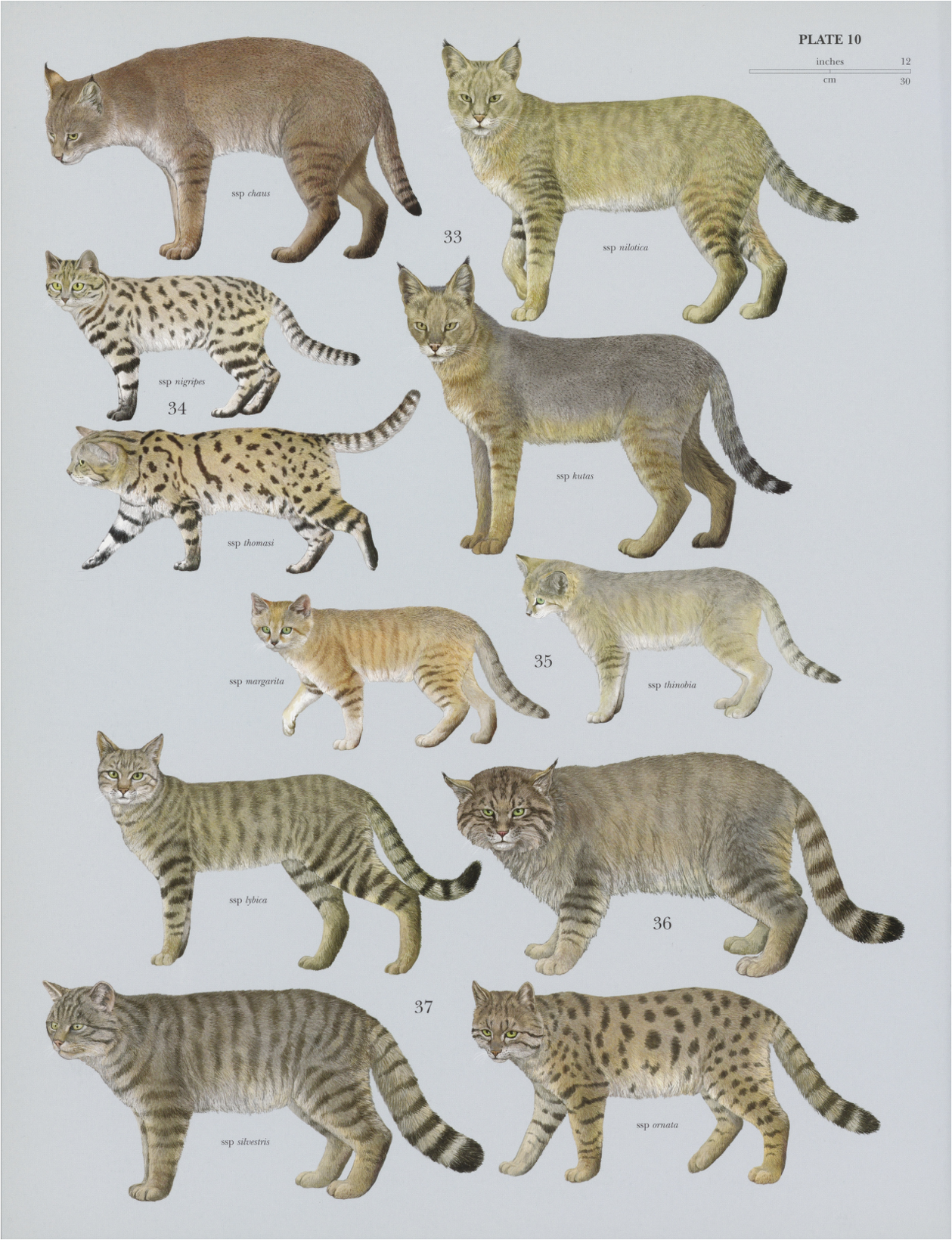
sand cat and some of its relatives: 33) Jungle Cat (Felis chaus), 34) Black-footed Cat (Felis nigripes), 35) Sand Cat (Felis margarita), 36) Chinese Mountain Cat (Felis bieti), 37) Wildcat (Felis silvestris)
Image Sources: Wikimedia Commons
Text Sources: Animal Diversity Web animaldiversity.org ; National Geographic, Live Science, Natural History magazine, CNTO (China National Tourism Administration) David Attenborough books, New York Times, Washington Post, Los Angeles Times, Smithsonian magazine, Discover magazine, The New Yorker, Time, BBC, CNN, Reuters, Associated Press, AFP, Lonely Planet Guides, Wikipedia, The Guardian, Top Secret Animal Attack Files website and various books and other publications.
Last updated April 2025