
Home | Category: Religion and Gods
HISTORY OF ANCIENT EGYPTIAN RELIGION
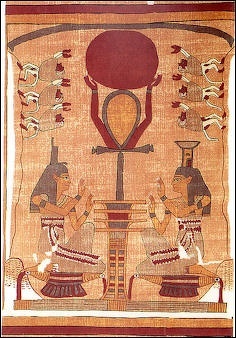
Ankh Djed and Sun from the Book of the Dead
Owen Jarus wrote in Live Science: Throughout much of Egypt's ancient history its people followed a polytheistic religion in which a vast number of gods and goddesses were venerated. One of the most important was Osiris, god of the underworld. Abydos was an important cult center for him, and numerous temples and shrines were constructed at the site in his honor. Amun-Ra — a god associated with the sun — became particularly important during the New Kingdom and was associated with the city of Luxor (ancient Thebes). The Karnak Temple complex was built near Luxor in honor of this god. [Source:Owen Jarus, Live Science June 2, 2023]
Egyptian religion did not remain static but changed over time. One major change occurred during the reign of the pharaoh Akhenaten (circa 1353 to 1335 B.C.), a ruler who unleashed a religious revolution that saw Egyptian religion become focused around the worship of "Aten" the sun disk. Akhenaten built an entirely new capital in the desert at Amarna and ordered the names of some of Egypt's deities to be defaced. After Akhenaten's death his son, Tutankhamun, denounced him and returned ancient Egypt to its previous polytheistic religion.
When Egypt came under Greek and Roman rule, the new rulers' gods and goddesses were incorporated into Egyptian religion. Another major change occurred after the first century A.D. when Christianity spread throughout Egypt. At this time Gnosticism, a religion that incorporated some Christian beliefs, also spread throughout Egypt, and a large corpus of Gnostic texts were discovered in 1945 in southern Egypt near the city of Nag Hammadi.
Websites on Ancient Egypt: UCLA Encyclopedia of Egyptology, escholarship.org ; Internet Ancient History Sourcebook: Egypt sourcebooks.fordham.edu ; Discovering Egypt discoveringegypt.com; BBC History: Egyptians bbc.co.uk/history/ancient/egyptians ; Ancient History Encyclopedia on Egypt ancient.eu/egypt; Digital Egypt for Universities. Scholarly treatment with broad coverage and cross references (internal and external). Artifacts used extensively to illustrate topics. ucl.ac.uk/museums-static/digitalegypt ; British Museum: Ancient Egypt ancientegypt.co.uk; Egypt’s Golden Empire pbs.org/empires/egypt; Metropolitan Museum of Art www.metmuseum.org ; Oriental Institute Ancient Egypt (Egypt and Sudan) Projects ; Egyptian Antiquities at the Louvre in Paris louvre.fr/en/departments/egyptian-antiquities; KMT: A Modern Journal of Ancient Egypt kmtjournal.com; Egypt Exploration Society ees.ac.uk ; Amarna Project amarnaproject.com; Abzu: Guide to Resources for the Study of the Ancient Near East etana.org; Egyptology Resources fitzmuseum.cam.ac.uk
RECOMMENDED BOOKS:
”Religion and Ritual in Ancient Egypt” by Emily Teeter (2011) Amazon.com;
“The Complete Gods and Goddesses of Ancient Egypt” by Richard H. Wilkinson (2003) Amazon.com;
“Conceptions of God in Ancient Egypt: The One and the Many” by Erik Hornung (1982) Amazon.com;
“The Search for God in Ancient Egypt” by Jan Assmann (2001) Amazon.com;
“Gods, Rites, Rituals and Religion of Ancient Egypt” by Lucia Gahlin (2001) Amazon.com;
“Gods and Religion of Ancient Egypt: An In-depth Study, Over 200 Photographs” by Lucia Gahlin (2011) Amazon.com;
“Religion and Magic in Ancient Egypt” by Rosalie David (2003) Amazon.com;
“Ancient Egyptian Religion an Interpretation” by Henri Frankfort (1948, 2011) Amazon.com;
“The Ancient Gods Speak: A Guide to Egyptian Religion” by Donald B. Redford (2002) Amazon.com;
“Ancient Egyptian Religion” by Stephen Quirke (1992) Amazon.com;
“Religion in Ancient Egypt: Gods, Myths,and Personal Practice” by John Baines (1991) Amazon.com;
“Ancient Egyptians, Religious Beliefs and Practices” by Ann Rosalie David (1982) Amazon.com;
“Ancient Egypt: The Light of the World” by Gerald Massey (1907) Amazon.com;
“The Religion of Ancient Egypt” by Flinders Petrie (1906) Amazon.com;
“Christianity: An Ancient Egyptian Religion” by Ahmed Osman (2005) Amazon.com;
“The Ancient Egyptian Roots of Christianity” by Moustafa Gadalla (2007) Amazon.com;
Pyramid Texts and Early Ancient Egyptian Religious Texts
The Pyramid Texts are among the oldest texts. They were based on inscriptions of spells found in the burial chambers of the pyramids and dated to around 2600 B.C. They were like an early compendium on the Egyptian religion. The Amduat (“The Book of the Netherworld”) and The Book of the Dead are based on them. A typical spell from the Pyramid Texts went: “O Osiris, the King, may you be protected. I give to you all the gods, their heritages, their provisions, and all their possessions, for you have not died."
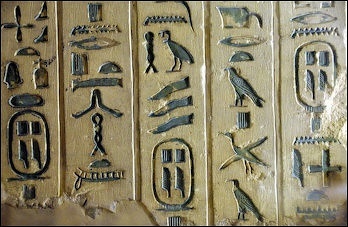
Pyramid text
The Pyramid Texts are ascribed to Unis (2345–2315 B.C.), also spelled Unas, the ninth and last ruler of the Fifth Dynasty of Egypt during the Old Kingdom. According to Archaeology magazine: The Unis pyramid at Saqqara was also the smallest one ever built during the Old Kingdom, but inside the modest complex was an innovation that would endure for thousands of years.Unis commissioned a series of sacred formulas or spells known as the Pyramid Texts to be carved on the walls of his burial chamber. These include instructions for properly carrying out a funeral and references to the sun that were both codified earlier, perhaps during the 4th Dynasty. But most of the text is devoted to the worship of Osiris. By this time, the god of death had finally become more important than the sun god, upon whose power the earlier 5th Dynasty rulers had relied. Nevertheless, the Pyramid Texts were still intended to reinforce the pharaoh’s legitimacy. “On a symbolic level, the king needed to come up with a new unique form of his extraordinary standing, being a deputy of the gods on Earth,” says Bárta. “The Pyramid Texts were just such a means of achieving this.” Variations of the Pyramid Texts would be included in the tombs of the 6th Dynasty pharaohs, and even in the pyramids of their queens. Within just a few hundred years, the formulas and spells of the Pyramid Texts had spread beyond royal burials, and were inscribed on the coffins of officials throughout Egypt. [Source: Eric A. Powell, Archaeology magazine, November-December 2020]
The Pyramid Texts evolved into the Coffin Texts , dated to around 2000 B.C., a collection of spells placed by artisans in wooden coffins. Neither the Pyramid Texts nor the Coffin Texts ever appeared in book form. They were written on tomb walls or coffins.
Amduat (“The Book of the Netherworld”) was a narrative that described the daily journey of a dead pharaoh through the netherworld on a boat of the sun god Re, and his victory over dangers and obstacles to rise again the next morning. The book was originally restricted to use by the pharaoh and those that attended him.
Other important texts included: 1) The Book of Two Way , describing the underworld as composed of canals, streams, islands, fires and boiling water; 2) The Book of Gates , describing the night journey of Osiris and the rewards and punishments for inhabitants of the Underworld; 3) The Book of That Which Is , describing the 12 sections of the Underworld, each related to an hour of the Night; and 4) The Book of Adophis , detailing the battle between the sun god Ra and the giant serpent Apophis.
Heliopolitan Scheme and the Origin of Egypt’s First Gods
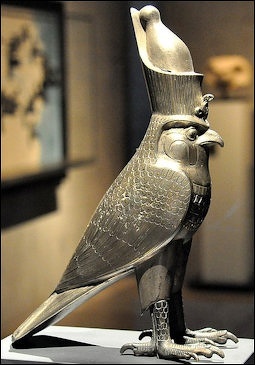
27th dynasty Horus
The Heliopolitan Scheme was a religious concept elaborated by the priests of Heliopolis, a religious center now underneath a suburb of Cairo. Lee Huddleston of the University of North Texas wrote: “The theology of Heliopolis recognized the aboriginal existence of God and Entities sometimes spoken of as if divine. These were the: Primordial Entities; a) Nun, the Universal Water, a metaphor of the Womb, and b) Apophis, the Night, the Encircling Serpent. This was a metaphor of the placenta and/or the umbilicus. Apophis was also the limit of the universe: the black deep beyond the stars. Atum pre-existed and co-existed inside Nun, and brought himself into consciousness. He was the first, and ALL. [Source: Lee Huddleston, Ancient Near East Page, January, 2001, Internet Archive, from UNT \=/]
“The Gods of Heliopolis. Atum contained All that would be. There became God's: 1) Eye. Its visible self was the Sun and it was called by many names, including Re or Ra, Amon Re/Ra and Aten. Atum's Hearing alerted the Heart of God; Seeing informed it. Eye frequently displaced Atum In Pharoah's favor. Atum might also project Aspects of itself through Eye, such as Sekhmet, the Storm, and Hathor. Hathor was, and was motivated by, Passions such as Love and Hate, and by considerations of fertility. Atum was an Androgyne, the Great He-She.
“The Hand of Atum. Finding himself alone, Atum used his hand and begat, then brought out of himself, the first generation of Gods: a) Shu [Air], and his sister/wife Tefnut [Ma'at/ Mayet]. The root meaning of Ma'at is right-thinking or Order, but she was also Space. They then wandered off into the endless body of Nun. Atum sent Eye to find them and return them. While Eye was gone, Atum created a second eye, possibly the Moon. When Shu and Tefnut returned, Tefnut gave birth to b) Geb [Earth], and his sister/wife b) Nut [Sky]. Geb and Nut were born in sexual embrace. Shu forcibly interposed himself between them, thus separating Earth from Sky. Nut gave birth to two sets of twins: d) Osiris [the Nile, God of the Dead] and his sister e) Isis, who was his wife [the Fertile soil, the star Sirius]; f) Seth [Disorder, Foreign Places], brother to Nepthys, his wife, and to Osiris and Isis. The son of Isis and Osiris was g) Horus [the Pharaoh, the Fruit of the Land]. An older God, h) Thoth, who was reborn as the son of Horus and Seth, was the Law [of God], the Word [of God], the Seed [of God]. \=/
By the time of Herodotus the Temple in Heliopolis was devoted to Ra. Probably the largest temple in the world, it was about 2/3 of a mile long, and a 1/4 of a mile in width. The courtyard was made with polished black basalt stones, so polished that it reflected the stars above and made it look as if one were walking amidst the stars. In the middle of the courtyard was a full size tree, its trunk and branches were made of Lapis Lazuli,its leaves of Turquoise.” [Source: Michael Poe]
Horus Versus Seth and Pharaonic Rule
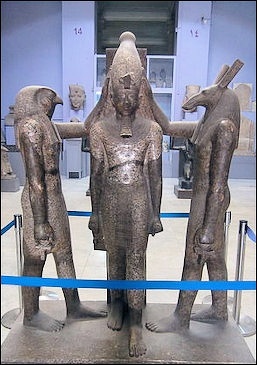
Horus and Seth crown Ramses III
On the fight between Horus and Seth at the beginning of creation, Lee Huddleston of the University of North Texas wrote: “Father Geb faced a unique problem. Atum had resigned his rule to his only son, Shu; Shu in turn gave way for his only son, Geb. Geb had two sets of twins from Nut's one pregnancy. When it came time for him to turn over control of earth [EGYPT], he had two sons from which to choose the next ruler. Some stories suggest he may have divided Egypt; others say he gave it all to Osiris and gave the rest of the world to Seth. Whatever the circumstance may have been, Seth was unhappy with his lot. He murdered his brother, Osiris; cut his body into small pieces, and threw them into the NILE. There, Osiris merged with, and became the River. Isis, assisted by her sister, Nepthys, found all the pieces of Osiris except the phallus. Isis hovered over him imploring him to arise and impreg-nate her. Miraculously, Osiris did revive, and did impregnate his wife before passing to the West, the home of Atum, where he became the Spirit in whom the souls of the righteous dead would eventually find salvation. [Source: Lee Huddleston, Ancient Near East Page, January, 2001, Internet Archive, from UNT \=/]
“In term, Isis gave birth to Horus. She hid him from his uncle, Seth, until he was eighteen. Then she presented Horus to the Council of the Gods arguing that, as the only son of Osiris, Horus ought to be given his father's realm [Egypt]. Geb was unable to decide whether the young Horus or the older and stronger Seth should rule. There followed a series of contendings between the ex-ruler's brother and his son to determine which of them was best suited to rule Egypt. In the process, Seth was tricked into admitting that a son's rights of inheritance took precedence over the rights of a brother; and into the appearance of having dishonored himself. As a result of these contendings, the following conventions evolve.
“1) Horus is always Pharaoh, and Pharaoh was King of Egypt by Right of Divinity. (In actuality, not all Pharaohs claimed to be Horus; some identified with Seth, especially if they were involved with foreign lands or their capitals lay in Seth's land; others identified with their own preferred gods.) The idea of a Divine King persisted in the Mediterranean basin until the triumph of monotheistic religions more than 3400 years later. 2) Pharaoh, at first possessed sole right to enter Heaven, but by 2200 B.C. the spiritual dynamics of Salvation were understood and the Democratization of Heaven completed.
“3) The Rule of primogeniture was another victor in the struggle between Horus and Seth for the birthright of Osiris. Horus, Isis, and their supporters used the argument that Osiris, the first born son of Geb, rightfully owned Egypt and that his Domain should pass intact to his Son, not to his brother. Horus' victory was, retroactively, a victory for Osiris' contention in his earlier quarrel with Seth. The Institution called Primogeniture has endured for more than five thousand years, but has declined in social acceptance with the decay of the Institution called the Nobility.”
Religion Pre-Dynastic and Early Dynastic Egypt
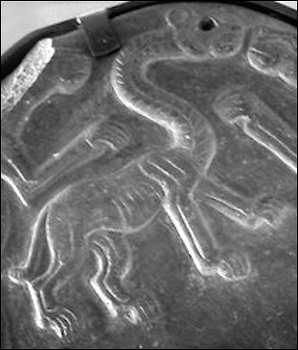
Naqada culture image
Lee Huddleston of the University of North Texas wrote in Ancient Near East Page: “Pre-Pharoanic Egypt consisted of many [42?] small states centered around a community religious compound. All of them possessed many divinities in common but differed in their perceptions of the relative power of the individual divinities. Upper Egypt [to the south of the Delta of the Nile] had stronger kings and were more zenophobic than their contemporary rulers in Lower Egypt [the Delta]. All considered themselves divine. Communities in the Delta allowed resident foreigners and had considerable commerce with non-Egyptian peoples. [Source: Lee Huddleston, Ancient Near East Page, January, 2001, Internet Archive, from UNT \=/]
“The kings took servants with them when they died; i. e., subjects were ritually buried in the king's burial precinct-a practice called Sati. Other Egyptians [and foreigners in the Delta] had separate cemeteries. In Upper Egypt royal cemeteries were much grander in relation to those of other Egyptians than in the Delta. Around 3200-3000 BCE Egypt was unified by a king from Thebes in the south. His traditional name was Menes and he may have been one of the two men depicted on the Narmer Pallette, Narmer and his presumed father identified as Scorpion. \=/
In unified Egypt, with a capital and religious center in Memphis, “Theocracy, or rule by God or by terms dictated by God, describes Egyptian government. Each of the Forty-two nomes [provinces] of Egypt were the property of a Divinity and all of Egypt belonged to the Divine Pharoah. Gods were territorial and people in the land of a particular God must give him/her priority deference. Since Memphis was owned by the God Ptah, Ptah was recognized as the national deity.” \=/
Religion in the Second and Third Dynasties (2800-2600 B.C.)
Toby Wilkinson of Cambridge University wrote: “The scale and growing sophistication of royal funerary monuments during the 2nd-3rd dynasties contrast sharply with the near- invisibility of temples or shrines to deities. Only a handful of sacred buildings are attested outside the royal necropoleis, but even here—at Hierakonpolis, Elkab, Gebelein, and Heliopolis—the surviving fragments of relief decoration emphasize the king and his role as founder of temples and companion of the gods. At Buto in the northwestern Delta, a large, official building of the 2nd Dynasty has been identified as a royal cult complex rather than a temple; a limestone pedestal in one of the innermost chambers may have supported a cult statue of the king, now lost. Hence, at sites rather than of local deities seems to have been the dominant feature of state religion in the 2nd-3rd dynasties. Likewise, contemporary seal-impressions and inscriptions on stone vases, when they mention deities at all, tend to emphasize gods and goddesses intimately connected with kingship—for example, Ash, the god of royal estates, or Hedjet, the divine embodiment of the white crown. [Source: Toby Wilkinson, Cambridge University, UCLA Encyclopedia of Egyptology, 2014, escholarship.org ]
“Taken together, the evidence—albeit slim and fragmentary—suggests that Pharaonic religion in its classic form was not yet established during the Early Dynastic Period. Rather, it seems to have been a development of later eras, a theological elaboration of a system designed, from the outset, to magnify the monarch and serve his interests. Beyond the royal court, private religious observance was an aspect of daily life from earliest times, but it seems to have had little connection with the realm of official, royal theology. Hence, archaeological excavations on Elephantine have revealed an early shrine underlying the later temple of Satet, but the extensive corpus of votive material does not point to any particular deity having been worshipped at the site; rather, the shrine may have been a general “sacred space,” used from Predynastic times as a focus of community worship.
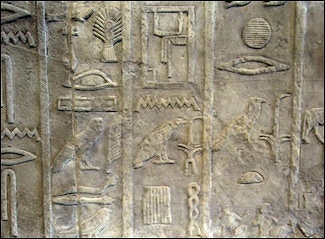
from the 2nd or 3rd dynasty
“The disconnect between state and private spheres of religious activity reflects a broader division in Egyptian society—present at all periods of Pharaonic civilization, but especially marked in the early dynasties—between the small ruling elite (pat) and the mass of the population (rekhyt). The sharp distinction between the pat and the rekhyt was one of the defining features of a society run by and for a restricted circle of royal kinsmen and acolytes. The structure of the Early Dynastic administration can be reconstructed from officials’ titles and the names of institutions preserved on seal-impressions, and it is the treasury—tasked with funding the state and its projects—that emerges as the most important department of government, closely followed by the royal household itself.
Yet there are signs in the 2nd-3rd dynasties that the administration, including the highest offices of state, was beginning to be opened up to commoners. In the reign of Netjerykhet, several officials of apparent non-royal origin were appointed to prestigious posts. These included the controller of the royal barque, Ankhwa; the master of royal scribes and chief dentist, Hesira; the controller of the royal workshops, Khabausokar; and, most famous of all, the overseer of sculptors and painters, and presumed architect of the Step Pyramid complex, Imhotep. It seems that, for the first time, the early 3rd-Dynasty state, with its focus on large-scale royal building projects, relied on a close-knit cadre of trusted professionals to carry out the principal tasks of government.”
Democratization of Heaven in Ancient Egypt
Lee Huddleston of the University of North Texas wrote: “The phenomenon called the Democratization of Heaven took place during an Egyptian Dark Age called the First Intermediate Period, ca.2400-2200 B.C.. Previously, Pharaoh, because he was the incarnation of Horus, had a right to ascend to Heaven at death. His soul returned to Osiris, but retained its Earthly identity as well. Other Egyptians could acquire Heaven only at the invitation of Pharaoh, whom they would serve in death as they had in life. Some local theologies had their own "heavens," but only after the Democratization were they all joined into the "national" heaven. [Source: Lee Huddleston, Ancient Near East Page, January, 2001, Internet Archive, from UNT \=/]
“By 2200 B.C., a refined understanding of the dynamics of salvation allowed all Egyptians an independent right to Heaven. Horus was continually reincarnated in each new Pharaoh. In turn, Horus extended his Soul to each Egyptian. Each Egyptian possessed not only his Horus-given Soul, but also a second Soul which contained his/her individuality. If the proper mortuary rituals were performed at death, the person's identity-soul was carried by his or her Horus-given Soul to a union with Osiris, where the dead merged with and became Osiris. At the end of time, when Atum resorbs all his creations into himself, only Atum, Osiris, and Horus will retain their identities. But, the souls of all Egyptians who followed the proper death rituals and joined Osiris, will retain their identities as a part of Osiris and remain forever One with God. \=/
“This complex salvationist theology only worked in Egypt because it was tied inextricably to the life cycle of the Nile [Osiris]. Annually and predictably as his wife, Isis, in her celestial form as Sirius, hovered over him, Osiris rose from death and fertilized Isis, in her aspect as the flood-plain made rich and black by his floodwaters. Their son, Horus, grew abund-antly from their co-mingling. He was the life in the land, the Spirit incarnated in the person of Pharaoh. Though Horus wore many bodies in his aspect as God-King of Egypt, he remained the Horus. His human heirodules [Pharaohs] merged with him, but retained their autonomous divinity, and through him ascended to Osiris. This dynamic made possible a perception of Salvation as the transition from the Physical Realm to the Spiritual Realm.” \=/
Religion, Culture and Life in the Late Middle Kingdom (1980-1640 B.C.)
Wolfram Grajetzki of University College London wrote: “Royal and private sculpture often no longer show an idealized image of young men (or women), but depict people of advanced age, maturity, and wisdom. Burial customs underwent a change presumably reflecting development in religious beliefs. Coffins were no longer provided with inner decoration or coffin texts. No wooden models showing food and craft production were placed into the burials, while magical objects used in daily life (magical wands, faience figures) were now included as burial goods. Other objects placed into tombs, such as papyri or gaming boards, were taken from work and leisure in daily life. The first shabtis in mummy form and heart scarabs are attested. In contrast, at the highest social level the deceased were equipped with royal insignia otherwise best known from the context of the underworld god Osiris . Mainly from the texts included in these tombs (but also from New Kingdom finds), several literary compositions are known. A number of them were most likely composed in the late Middle Kingdom. Especially several works of “pessimistic” literature, such as the Dialogue Between a Man and His Ba or the Admonitions of Ipuwer, should be mentioned. [Source: Wolfram Grajetzki, University College London, UCLA Encyclopedia of Egyptology, 2013 escholarship.org ]
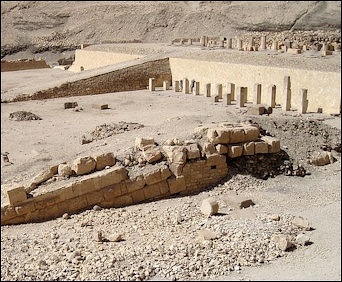
Middle Kingdom temple
“In private inscriptions mainly on stelae, biographical inscriptions became rare. Now the stela owner is often shown together with colleagues including officials on the same social level, but also socially inferior colleagues working in lower ranks of the administration under the stela owner, while the core family— typical for the early Middle Kingdom— appears less often. Depictions of deities in private context are rare in the early Middle Kingdom. In the late Middle Kingdom, they can appear in the roundel in the uppermost part of private stelae or are depicted in front of the stela owner. The latter stela type often bears hymns to gods. These new features do not appear at exactly the same time; instead, they are a general development over several reigns, from about Senusret III (or even earlier) to the end of the 12th Dynasty and peaking in the early 13th Dynasty.
“Several late Middle Kingdom town sites have been at least partly excavated and provide valuable information on the living conditions of the population. HetepSenusret (el-Lahun) and Wahsut (at Abydos) were planned towns on a grid pattern with large houses for the ruling class in one quarter and smaller ones in others. For the rulers of the late 12th Dynasty, expeditions to the Eastern Desert including Sinai and the Red Sea are well attested. These enterprises left many inscriptions. For the 13th Dynasty, there is less evidence. Expeditions to Sinai are unattested. Only at Wadi el-Hudi, there are a number of inscriptions datable to Sobekhotep IV. There is also some evidence for ongoing activity at Gebel Zeit on the Red Sea coast, covering the late 12th and 13th Dynasties.”
Religion in the Late Late Period (522–343 B.C.)
Ivan Ladynin of Lomonosov Moscow State University wrote: “Of the Late Dynastic Period, Dynasty 30 is especially known for excessive temple building, which touched both major and minor temple centers (Thebes, Memphis, Abydos, Heliopolis, Hermopolis Magna, Hermopolis Parva, Sais, Bubastis, Mendes, Sebennytos, Saft el-Henna, Edfu, Dendara, Elephantine, Philae, Hibis in the Kharga Oasis, etc.), its climax being the reign of Nectanebo II. This required great expenditures, which might have been covered by the income of the temples themselves. [Source: Ivan Ladynin, Lomonosov Moscow State University, UCLA Encyclopedia of Egyptology 2013, escholarship.org ]
“The reform that presumably made it possible was carried out by Nectanebo I, the result being visible in the growth of the state income and the architectural boom under Nectanebo II . The integration of the royal cult with the local cults of sacred animals, once established under Amasis, took a more definite shape under Dynasty 30: the kings provided for the organization of special rearing places for sacred animals and their cemeteries; the most important was the Serapeum at Saqqara that was built and enlarged by Nectanebo I and II and housed their cult temple and perhaps burials. Evidence of the cult of the sacred bull Buchis (embodiment of the god Montu worshiped in the Theban region) appeared under Nectanebo II.
“The building strategies of Dynasty 30 in Egyptian temples often focused on the creation of processional avenues and enclosure walls, as well as the erection of naoi. The former two devices were undoubtedly intended to delineate and partly to expand the sacred space of temples; as for the naoi with rich decoration in imagery and text, their installation is considered
Image Sources: Wikimedia Commons
Text Sources: UCLA Encyclopedia of Egyptology, escholarship.org ; Internet Ancient History Sourcebook: Egypt sourcebooks.fordham.edu ; Tour Egypt, Minnesota State University, Mankato, ethanholman.com; Mark Millmore, discoveringegypt.com discoveringegypt.com; Metropolitan Museum of Art, National Geographic, Smithsonian magazine, New York Times, Washington Post, Los Angeles Times, Discover magazine, Times of London, Natural History magazine, Archaeology magazine, The New Yorker, BBC, Encyclopædia Britannica, Time, Newsweek, Wikipedia, Reuters, Associated Press, The Guardian, AFP, Lonely Planet Guides, “World Religions” edited by Geoffrey Parrinder (Facts on File Publications, New York); “History of Warfare” by John Keegan (Vintage Books); “History of Art” by H.W. Janson Prentice Hall, Englewood Cliffs, N.J.), Compton’s Encyclopedia and various books and other publications.
Last updated July 2024