
Home | Category: Late Dynasties, Persians, Nubians, Ptolemies, Cleopatra, Greeks and Romans
CULTURE OF THE ANCIENT NUBIANS
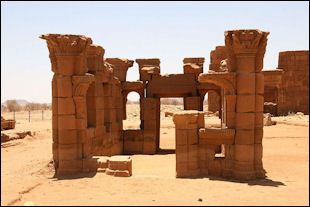
Nubian ruins near Khartoum Nubian Kushite culture merged Egyptian customs into its own, creating a distinctive, visual style. Nubian pyramids — truncated and with steep sides — left by the long line of Nubian kings can be seen today in the desert near the site of Meroë.
Núria Castellano wrote in National Geographic History: With access to mines and minerals, the Meroites were expert goldworkers. They built temples, palaces, and royal baths in their capital. Perhaps their grandest achievements are the more than 200 pyramids built at the necropolis at Meroë, giving Sudan more pyramids than all of Egypt. Tall, slender, graceful: These monuments bear witness to the lasting splendor that was Kush. [Source Núria Castellano, National Geographic History]
Archaeologist Charles Bonnet of the University of Geneva spent five decades excavating Kerma and its necropolis, which was established around 4000 B.C. Matt Stirn wrote in Archaeology magazine: Bonnet’s analysis of the multiple building stages of the Deffufa shows that it was enlarged from a chapel into a multistory temple and became the city’s religious center. Cults devoted to the sun likely worshipped atop the Deffufa and those dedicated to the underworld practiced rituals in a nearby windowless chapel. Excavations throughout the city show that the number of bakeries, workshops, religious structures, courtyards, and houses increased dramatically at this time. Bonnet also discovered that there was a significant increase in the number of wealthy houses, and that the royal quarters were expanded. The construction of increasingly robust fortifications suggests there were frequent military clashes with Egypt as both powers competed for control of the Nile Valley. [Source: Matt Stirn, Archaeology magazine, September-October 2020]
"Some cultural traditions established at Kerma endured throughout the history of Kush — and much longer. Modern Nubians in Sudan still bury their dead on wooden funeral beds in the same style found in Kerma’s necropolis, and graves in the region are still marked with decorative patterns of black and white stones. Public drinking water for thirsty travelers and workers is also provided in large ceramic vessels throughout Nubia, just as it was in ancient Kerma. Archaeologist Salaheldin Ahmed, coordinator of the Qatar-Sudan Archaeological Project, points out that for modern Sudanese, Kerma continues to provide a touchstone. “Kerma culture,” he says, “represents the real roots of Sudanese identity.”
RECOMMENDED BOOKS:
“Nubian Gold: Ancient Jewelry from Sudan and Egypt” by Peter Lacovara and Yvonne J. Markowitz (2019) Amazon.com
“Arts of Ancient Nubia” by Denise Doxey (2018) Amazon.com;
“Jewels of Ancient Nubia” by Yvonne Markowitz, Denise Doxey (2014) Amazon.com;
“Ancient Nubia: African Kingdoms on the Nile” by Marjorie M. Fisher, Peter Lacovara , et al. (2013) Amazon.com;
“The Oxford Handbook of Ancient Nubia” by Geoff Emberling and Bruce Williams (2021) Amazon.com;
“Nubia: Lost Civilizations” by Sarah M. Schellinger (2023) Amazon.com;
“New Perspectives on Ancient Nubia” by Aaron Brody, Solange Ashby (2024) Amazon.com;
“The Nubian Pharaohs of Egypt: Their Lives and Afterlives” by Aidan Dodson (2023) Amazon.com;
“Nubian Pharaohs and Meroitic Kings: The Kingdom Of Kush” by Necia Desiree Harkless (2006) Amazon.com;
“Ancient Egypt and Nubia — Fully Explained: A New History of the Nile Valley” by Adam Muksawa 2023) Amazon.com;
“Afterglow of Empire: Egypt from the Fall of the New Kingdom to the Saite Renaissance”
by Aidan Dodson (2019) Amazon.com;
“The Late New Kingdom in Egypt (c. 1300–664 BC) A Genealogical and Chronological Investigation (Oxbow Classics in Egyptology) by M. L. Bierbrier (2024) Amazon.com;
“The Rise and Fall of Ancient Egypt” by Toby Wilkinson (2010) Amazon.com;
“The Oxford History of Ancient Egypt” by Ian Shaw , Illustrated (2004) Amazon.com;
“Ancient Egypt” by Salima Ikram (2013) Amazon.com;
“Ancient Egypt: A History from Beginning to End” by History Hourly (2017) Amazon.com;
“Atlas of Ancient Egypt” by John Baines (1991) Amazon.com;
Nubian Art
Among the 3,000 items on display at the Nubian Museum in Aswan are tomb paintings, bas-reliefs, a black stone head of a pharaoh, rock drawings of wolves, life-size models of mud homes, water wheels and stone tombs. Many of the ancient objects were rescued before the completion of the Aswan High Dam. A cylindrical burner circled by a frieze of incised figured has been dated to 3300 B.C.
Ancient Nubian painting resembles Egyptian painting but that does not mean all of their art was derivative. Meroitic art was especially idiosyncratic and full of playfulness.Emily Teeter of the Oriental Institute told Smithsonian, "It became a very spontaneous art, full of free-flowing improvisation."
Nubian craftsmen made wonderful pieces of gold jewelry with semiprecious stones. They also produced cream-colored pots decorated with ankh-carrying cobras; ram-head sphinxes on columns with colored glass inlays, fired clay sculptures of hippopotamuses, antelope-shaped calcite jars, bronze bed legs with a goose-shaped pedestals, glass and glod pendants with the head of the goddess Hathor, gold pectorals with a winged goddesses, pots with two-legged crocodiles, giraffes and abstract waves and curlicues, golden rams heads and balls a pitcher shaped like a hippopotamus whose mouth serves as a spout (1700-1550 B.C.).
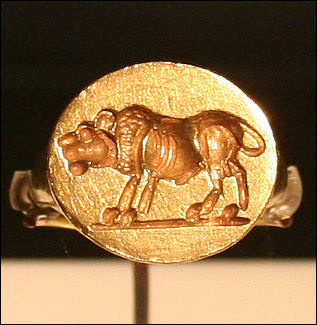
On an exhibition called “Nubia: Ancient Kingdoms of Africa” at New York University’s Institute for the Study of the Ancient World, Karen Rosenberg wrote in the New York Times, Nubian “pottery and faience, offers a glimpse of Nubia before the Egyptian conquest. The Nubians, who were among the earliest peoples to fire clay, became expert shapers of it. Their tradition of hand-formed ceramics more or less disappeared when the Egyptians arrived, bringing pottery wheels, but it produced some remarkable objects while it lasted...Other vessels have incised patterns that cleverly mimic basket weaves, like the chevrons on a large redware bowl from 3100-3000 B.C. [Source: Karen Rosenberg, New York Times, March 24, 2011]
One of Reisner’s excavations turned up pieces of large-scale architectural faience, including a rosette-patterned ceiling block and a wall inlay of a lion, which are both on view. They are thought to have decorated the funeral beds of the kings of Kerma (the capital of Kush). Faience is a blue-green paste made from crushed quartz or sand and often substituted for the more precious turquoise or lapis lazuli. Though an Egyptian invention, faience became an important status symbol for the Nubian elite and was locally produced.
Cemeteries and Tombs at Kerma
The necropolis at Kerma in northern Suda contains over 30,000 burials, making it one of the largest cemeteries so far discovered in the ancient world. A royal tomb for one of Kerma’s last king measures 15 meters (50 feet) in diameter and about five meters (18 feet) deep. Matt Stirn wrote in Archaeology magazine: A Swiss team, now under the direction of University of Neuchatel archaeologist Matthieu Honegger found that beginning around 3100 B.C., driven in part by an increasingly arid climate, people began to settle on the island in the Nile where Kerma would rise. These new arrivals lived in small settlements and used red brushed ceramics of a type that their descendants at Kerma would also use, and placed their huts in a distinctive semicircular pattern. [Source: Matt Stirn, Archaeology magazine, September-October 2020]
Some of the best evidence that Nubians and the people of the C-Group coexisted at Kerma has been uncovered by Honegger’s team in the necropolis. They found that graves of Kerma people from this early period were generally small pit burials in which the dead were placed in a fetal position on a mat made from either leather or woven plants. Small rows of cattle skulls were often placed in an arc outside the grave, and additional objects such as ceramic vessels, jewelry, and sacrificed animals were arranged around the body. Most men were buried with an ostrich-plume bow, and most women had a wooden staff in their graves.
“Honegger’s team has also discovered that during the necropolis’ earliest phases, graves from the C-Group culture were surrounded by multiple stelas, and those of the Kerma culture were covered in a decorative pattern of black and white stones. Honegger was surprised that the style of ceramics found in the graves did not always correspond to the culture suggested by the decorations on the outside. In several instances, Honegger observed that Kerma pottery was found in graves marked by C-Group stelas, and C-Group pottery was excavated from graves marked by Kerma pebbles. For him, the mixture of funerary styles indicates that the two groups not only coexisted, but probably intermarried, and that upon their death, a person could be buried in a way that honored both traditions. Bonnet and Honegger’s excavations in the necropolis show that around 2000 B.C., Kerma’s kings initiated construction of elaborate royal tombs surrounded by thousands of cattle skulls. This signaled the beginning of a new phase in the city’s history as it grew in size and its rulers began to exert their influence across northeast Africa.
Nubian Art From Kerma
Dozens of royal tombs were uncovered in the 1920s and 30s by George A. Reisner at the royal necropolis at Deffufa in Kerma that date to between 1750 and 1500 B.C., when the city was at its height. Matt Stirn wrote in Archaeology magazine: These tombs contained hundreds of human and animal sacrifices, jewelry crafted from quartz, amethyst, and gold, and preserved wooden funerary beds inlaid with scenes of African wildlife fashioned of ivory and mica. In one of the tombs Reisner unearthed a large, elegant granite statue depicting Lady Sennuwy, the wife of the prominent Egyptian governor Djefaihapi, who ruled a district north of Luxor sometime between 1971 and 1926 B.C. Nearby, Reisner found a broken bust of Djefaihapi himself. [Source: Matt Stirn, Archaeology magazine, September-October 2020]
Numerous effigies of giraffes made of mica and elephants fashioned from ivory were unearthed in royal tombs in Kerma’s necropolis. These figures were embedded in the sides and headboards of wooden funeral beds. A fragment of an Egyptian faience vessel depicting a hippopotamus and a faience-bead belt with a glazed quartz pendant were discovered in Kerma’s necropolis during Reisner’s early excavations.
In 2003, while excavating a New Kingdom temple complex near Dukki Gel, Bonnet’s team uncovered a cache of granite statues nearby depicting prominent Kushite kings, such as the great pharaoh Taharqa, (r. ca. 690–664 B.C.) who ruled over Egypt, and one of his successors, King Anlamani (r. ca. 623–593 B.C.). Even though the cache postdates the abandonment of Kerma by 800 years, it is clear evidence that Kushite kings continued to honor the area as the royal site where their ancestors had laid the groundwork for the rise of the Nubian Kingdom.
Royal Tombs of Meroe and the Art Found in Them
Núria Castellano wrote in National Geographic History: The Kushites’ burial culture had been touched by a synthesis of Egyptian and African religious and cultural practices. Even after relocating south, the Kushite kings continued to be buried in the necropolis at Nuri, near Napata, a center of the cult of the Egyptian god Amun.[Source Núria Castellano, National Geographic History]
Meroë would become the preferred necropolis later, around 250 B.C. There are two main burial areas: the south cemetery and the northern burial ground. The south cemetery was the oldest. When it reached capacity, the northern burial ground was begun. The northern area today contains the best preserved of the pyramids at Meroë. Some of the most impressive tombs here are the final resting places for 30 kings, eight queens, and three princes.
There are 41 tombs in Meroë’s north cemetery, 38 of which belong to monarchs who ruled the region between 250 B.C. and A.D. 320. The tomb of Queen Khennuwa in Meroë dates to the fourth-century B.C. The art in it related to the style of Egypt’s 25th dynasty, the Black Pharaohs, four centuries earlier. A gold ring found in a Meroë tomb is an Egyptian-influenced piece depicting an udjat—eye of Horus—flanked by two cobras.
Karen Rosenberg wrote in the New York Times, Many of the remains from the period from Egypt’s conquest of Nubia through the reign of the Napatan dynasty (the Nubian kings who ruled Egypt) are many more funerary objects that are hard to distinguish from Egyptians ones. The tomb of the Napatan king Senkamanisken contained more than a thousand shawabtis, slaves of the afterlife. A large statue of Senkamanisken, who ruled from 640 to 620 B.C. Has one-foot-forward pose and serpent crown that looks very Egyptian, though there are subtle differences; the crown has two serpents, as opposed to the one favored by the Egyptian pharaohs. [Source: Karen Rosenberg, New York Times, March 24, 2011]
There are objects recovered from the pyramids of other Nubian kings. But the real buried treasure in this show is the story of the Nubian queens; A delicate crystal pendant showing the Egyptian goddess Hathor with a cow’s horns is one of the show’s most extraordinary objects. It was found in the tomb of an unidentified queen of the Napatan king Piye. Among the the Queen's Treasures found at Meroë are a ring made of glass paste and gold, a royal armlet and a seal ring.
Statues of Nubian Kings
Daniel Weiss wrote in Archaeology magazine: “At Dangeil, archaeologists have found fragments of statues of at least three Kushite kings who ruled during the sixth and seventh centuries B.C., along with evidence of a monumental structure they believe might have been a temple to Amun dating to the same period. The earliest of these kings is Taharqa, one of the Kushite pharaohs, who ruled Nubia and Egypt from 690 to 664 B.C. Intact, Taharqa’s statue would have stood almost nine feet tall. Inscribed on a belt on one of the statue’s recovered fragments are Egyptian hieroglyphs that read: “The perfect god Taharqa, beloved of Amun-Re.” Indeed, Kushite kings during this period were considered sons of Amun, and it was believed the god would select new kings through his priests. Coronation took place at the temple at Jebel Barkal, after which the new king would visit other temples to Amun and then build new ones and renovate old ones — all steps taken to establish the king’s connection to the god and affirm his right to rule. The territories covered could be vast. [Source: Daniel Weiss, Archaeology magazine, May-June 2015]
“Taharqa was a particularly ambitious leader in this regard who presided over a kingdom that extended as far north as Palestine. He renovated and built temples throughout Egypt and Nubia, perhaps even the possible temple to Amun in Dangeil. Dangeil is the farthest south a colossal statue of Taharqa has been discovered, suggesting that it may well mark the southern extent of his kingdom. Over time, Kushite control extended even farther south, and, by the third century B.C., the capital is thought to have moved from Napata to Meroe, south of Dangeil. “We don’t know exactly when the south began to have greater influence, but it looks as if it starts to happen during the seventh century B.C.,” says Julie Anderson of the British Museum, a codirector of the dig at Dangeil. “With the statues in Dangeil and the presence of this early building, it looks as if the royalty at Napata have direct control over that area during this period.”
Kushite rule over Egypt reached its height under Taharqa, but his reign ended in defeat, with Egypt largely lost to Assyrian invaders. Ultimately, the Nubian expulsion from Egypt was completed under Taharqa’s successor, Tanutamun (r. ca. 664–657 B.C.). The other Kushite kings whose statues were found at Dangeil are Senkamanisken (r. ca. 643–623 B.C.) and probably Aspelta (r. ca. 593–568 B.C.). Hieroglyphs on the back of the Senkamanisken statue identify him as “King of Upper and Lower Egypt,” suggesting that despite having been kicked out of the country decades earlier, the Kushites still saw themselves as the rightful rulers of Egypt. However, any designs they might have had on reconquering Egypt were snuffed out around the beginning of Aspelta’s reign. In 593 B.C., the Egyptian pharaoh Psamtek II invaded and defeated Nubia.
“The statues of the kings found at Dangeil were intentionally broken at the neck, knees, and ankles, but were not defaced. Caches of statues of the same kings, and a few others, all broken in a similar manner, have also been found at Jebel Barkal and another location in Nubia. The most likely explanations for the statues’ ritual breakage, according to archaeologists, are that they were destroyed during Psamtek II’s invasion, or later, during infighting among competing Kushite dynasties. At least in the case of Dangeil, Anderson favors the latter explanation, noting that it is unlikely that Psamtek II made it that far south and, if he did, it’s unlikely that the statues would have been broken but not defaced. “It’s more like a polite decommissioning rather than a pillaging and a looting,” she says. Janice Yellin, a professor of art history at Babson College who specializes in ancient Nubia, agrees: “If it’s some kind of ritual destruction of the enemy, it seems you would smash the faces and smash out the names, and that doesn’t happen here.”
Nubian Pyramids
There are more pyramids in Sudan than in Egypt. Eric A. Powell wrote in Archaeology magazine: Pyramids clearly fascinated the Nubian kings and Egypt’s influence on their own cultural practices was long-lasting. As ongoing archaeological work shows, the inhabitants of Nubia, particularly those in the kingdom of Meroe, found a way to imitate Egypt’s monuments. Even so not much is left of many Nubian pyramids. The Nubians primarily built the structures from mud brick. [Source: Eric A. Powell, Archaeology magazine, July-August 2013]
At the royal cemetery at Meroe there are about 80 pyramids, some up to 100 feet tall. Since a French explorer first described the cemetery at Meroe in the early nineteenth century, archaeologists have identified the remains of more than 220 royal pyramids in Sudan. Excavations show that early in the Meroitic period (ca. 300 B.C.–A.D. 350), pyramids were built exclusively for those of noble blood. “It would have been sacrilege to erect a pyramid for a nonroyal person,” says Francigny. But later in the kingdom’s history the taboo was relaxed somewhat, and a few wealthy people were allowed to erect monuments for themselves. But their pyramids never rivaled the royals’ in size. Royal or not, Nubians would have viewed the pyramids much as the ancient Egyptians did. For the pharaohs, pyramids were symbols of the, their massive, steep sides representing the angle of the sun’s rays reaching earth. The people of Meroe elaborated on this theme by adding capstones to their pyramids shaped in classic Egyptian forms, such as birds or lotuses emerging from solar discs.
Núria Castellano wrote in National Geographic History: Meroë’s earliest pyramids were step pyramids. Scholars have speculated that cylinders or spheres may have once topped the pyramids, made of materials that have since been destroyed or perished. The later structures, built in the third century A.D., are simpler with smooth, steep sides. In spite of the clear influence of the classic Egyptian design, Meroë’s pyramids are notably smaller and generally lack the pyramidion, a pointed capstone. The stones on these pyramids were set in place with a shaduf, or shaft, a device used as a lever to raise stone blocks. The outside was faced with brick and then covered with brightly painted plaster. Their design more closely resembles the chapel pyramids built at Deir el Medina near Luxor. These were built during Egypt’s New Kingdom period (1539-1075 B.C.), a period when many Egyptian customs began to appear in Kushite culture. [Source Núria Castellano, National Geographic History]
Steps were carved into the rock to the east of each pyramid leading down to a sealed entrance. Behind it lay underground rooms with vaulted ceilings: three for a king and two for a queen. In the oldest pyramids, the burial chamber was decorated with scenes from the Egyptian Book of the Dead. A wooden coffin, depicting the dead person’s face, was placed in the burial chamber. The sacrificed bodies of animals and, in some cases, of human servants were placed nearby. Attached to one side of a standard Meroë pyramid was a chapel, its entrance formed by twin tapering pylons. Inside, it was common to place a stela, an offering table, and a distinctive element of Meroë culture: a statue of the ba—the aspect of the human soul believed to give the deceased their individuality—depicted as the body of a bird and a human head.
Sixteen Pyramids Discovered in Ancient Cemetery in Gematon, Sudan
In September 2015, archaeologists announced they had discovery the remains of 16 pyramids with tombs underneath them in a cemetery near the ancient town of Gematon in Sudan. They date back around 2,000 years, to a time when the kingdom of "Kush" flourished in Sudan. The discovered was made a tema led by Derek Welsby, a curator at the British Museum in London, who has been excavating at Gematon since 1998. [Source: Owen Jarus, Live Science, September 16, 2015]
The largest pyramid found at Gematon was 10.6 meters (about 35 feet) long on each side and would have risen around 13 meters (43 feet) off the ground. Wealthy and powerful individuals built some of the pyramids, while people of more modest means built the others, Welsby said. "They're not just the upper-elite burials," he said. In fact, not all the tombs in the cemetery have pyramids: Some are buried beneath simple rectangular structures called "mastaba," whereas others are topped with piles of rocks called "tumuli. " Meanwhile, other tombs have no surviving burial markers at all.
In one tomb, archaeologists discovered an offering table made of tin-bronze. Carved into the tableis a scene showing a prince or priest offering incense and libations to the god Osiris, the ruler of the underworld. Behind Osiris is the goddess Isis, who is also shown pouring libations to Osiris. Though Osiris and Isis originated in Egypt, they were also venerated in Kush as well as other parts of the ancient world. The offering table "is a royal object," Welsby said. The person buried with this table "must have been someone very senior in the royal family. "
Hundreds of Miniature Pyramids Found in Northern Sudan
In the early 2010s, archaeologists excavating on the banks of the Nile uncovered a necropolis where hundreds of small pyramids once stood. Eric A. Powell wrote in Archaeology magazine: At the Meroitic royal cemetery, 80 radically downsized pyramids were constructed over the tombs of kings and queens. And now, new excavations at Sedeinga, a necropolis of the same era but 450 miles from Meroe, tell us that the practice of building diminutive pyramids trickled down from royals to the wealthy elite much more extensively than previously believed. Sedeinga contains a dense field of small pyramids, one just 30 inches across. “It is a crazy site,” says Vincent Francigny, a research associate at the American Museum of Natural History and codirector of the excavations at Sedeinga. “I’ve never seen a cemetery like this, with so many small monuments packed so closely together.” [Source: Eric A. Powell, Archaeology magazine, July-August 2013]
The nonroyal cemetery of Sedeinga, which lies on the west bank of the Nile, not far from the Egyptian border, is one of the few already known sites left in Sudan where archaeologists can still excavate graves from the Meroitic period. Rilly and Francigny, an expert in Meroitic funerary monuments, reasoned that uncovering burials at Sedeinga could turn up all-important new inscriptions. This, in large part, is what led them to assemble a team to begin excavating at the site in 2009.
“In four years, the team has recovered five new inscriptions, but they also discovered something astonishing. They expected to unearth a modest number of burials, but it didn’t take long before Francigny and his colleagues realized that the cemetery had once held thousands of burial chambers, many of which lay beneath small pyramids. In less than half an acre, they discovered the bases of 35 pyramids. The largest was 22 feet wide and once stood just over 30 feet high. Much smaller monuments, such as the 30-inch-wide pyramid, were built over the graves of children. “It’s a fantastic gathering of pyramidal structures,” says Francigny. “In other cemeteries of this time you might have 20 to 30 elite graves with monuments. But here we have hundreds of pyramids, with thousands of associated graves around them, many built on top of each other.”
“Most of the burials at Sedeinga date to later in the history of the kingdom, when the royal monopoly on pyramid buildings was eased. But for Francigny, that alone doesn’t explain the sheer number of monuments, which is unique in Nubia. He thinks geography might have also played a role. Francigny notes that the site was isolated from the royal and administrative centers of Meroe to the south. People at Sedeinga might have felt freer to mimic royalty than their countrymen who lived closer to the capital, which could help explain the zeal with which they erected pyramids. “There could have been a certain degree of democratization here,” says Francigny. “It would only have been possible because Sedeinga was in a remote and far northern province. These people were closer to Egypt than to Meroe.”
“Distance from the cultural center of the kingdom might also explain a unique element in the design of the Sedeinga pyramids. Meroitic pyramids are typically constructed by building courses of stone bricks around rubble fill, but several monuments that the team has excavated at Sedeinga have a round masonry structure inside that would not have supported the walls of the pyramid. “They have no structural purpose,” says Francigny, who thinks they might be related to an older burial tradition in the area. Before pyramids came into fashion, the local custom was to bury people under earthen mounds and stone cairns. These round masonry structures, which would not have been visible, might be a continuation of this local tradition. Other finds at the site point to an enduring Egyptian influence. Fracigny and his team have discovered several examples of capstones in the shape of lotuses emerging from a solar disc.
Most graves at Sedeinga were looted in antiquity, but excavations have still yielded a number of artifacts, including two pyramid capstones in the shape of a lotus emerging from a solar disc, an inscribed funerary stela depicting a winged sun-disc, a glazed faience figurine in the shape of the fertility god Bes, that demonstrate links to Egypt, and a shell-and-clay-bead necklace. One man was even buried atop a prone stela taken from a nearby New Kingdom temple, built when Egypt ruled the region in the fourteenth century B.C.
“Ties to Egypt might also explain the wealth that enabled the people of Sedeinga to erect so many pyramids. “Sedeinga is alone in the desert,” says Francigny. “But it was next to a road that connected the Kingdom of Meroe directly to the middle of Egypt.” In Meroitic times, Sedeinga was one of the first places in Nubia where Egyptian traders bearing goods such as glass and other luxury items could have stopped. “Maybe this is where trade with Egypt happened,” says Francigny. “Trade could explain the wealth of Sedeinga’s population, [which is] at a level hardly seen in the provinces of the Kingdom.
Image Sources: Wikimedia Commons, The Louvre, The British Museum, The Egyptian Museum in Cairo
Text Sources: Internet Ancient History Sourcebook: Mesopotamia sourcebooks.fordham.edu , National Geographic, Smithsonian magazine, especially Merle Severy, National Geographic, May 1991 and Marion Steinmann, Smithsonian, December 1988, New York Times, Washington Post, Los Angeles Times, Discover magazine, Times of London, Natural History magazine, Archaeology magazine, The New Yorker, BBC, Encyclopædia Britannica, Metropolitan Museum of Art, Time, Newsweek, Wikipedia, Reuters, Associated Press, The Guardian, AFP, Lonely Planet Guides, “World Religions” edited by Geoffrey Parrinder (Facts on File Publications, New York); “History of Warfare” by John Keegan (Vintage Books); “History of Art” by H.W. Janson Prentice Hall, Englewood Cliffs, N.J.), Compton’s Encyclopedia and various books and other publications.
Last updated July 2024