
Home | Category: Late Dynasties, Persians, Nubians, Ptolemies, Cleopatra, Greeks and Romans
LIFE OF THE ANCIENT NUBIANS
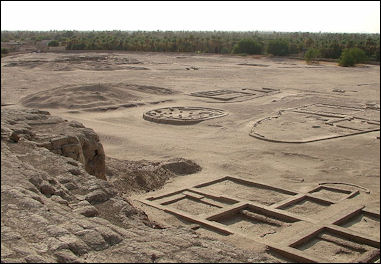
Kerma Nubia is a loosely defined region of southern Egypt and northern Sudan which used to stretch more or less 800 kilometers from Aswan to the FoUrth Cataract on the Nile in Sudan but now extends from south of Luxor to Khartoum, Sudan. In Pharonic times, Nubia was known as the ancient kingdom of Kush. the Nubian people, a black-African people with a history as old as ancient Egypt. The Nubians have their own language, and many of them have traditionally made a living farming or fishing on the Nile. Others work as captains and crew members on feluccas. In ancient tomb paintings and reliefs they were often depicted as traders and merchants. Generally, Nubians found in Sudan, especially those who live in the desert, are darker skinned than their Egyptian cousins who have intermarried with Arabs.
Kerma was the main city of Nubia. It emerged around 1785 B.C. as Egypt’s Middle Kingdom was declining. By 1500 B.C. the Nubian empire stretched between the Second and Fifth Cataracts. Nubians in Kerma lived in circular thatch-roof huts made from wood. The dwellings were oriented towards the north wind, which provides relief in the summer. In the winter temporary walls were set up to block the wind. Kerma was surrounded by a defensive palisade.
The wood-and-palm-fiber beds, liquid receptacles, thorn removal-kits and boomerang-like throwing sticks used by modern Sudanese are similar to beds, receptacles, tools and throwing sticks found in Nubian royal tombs. Sudanese-style hairstyles and scarification also appear on paintings of ancient Nubian
Nubians at Kerma raised crops, chiefly wheat and barely, in fields and gardens and raised cattle and goats. Herodotus said the were able to live long lives because they consumed a lot of boiled meat and milk. Nubians liked to drink. Archaeologists have unearthed large barrooms and pots for drinking wine.
The Nubians were excellent horsemen and cattle raisers. They built a large smelting operation in ore-rich region around Merowe. Nubian religious images included falcons represented gods and depictions of bound prisoners have their heads dashed open in front of images of gods.
According to Archaeology magazine: Study of more than 200 Nubian mummies shows that these ancient people struggled with schistosomiasis, a water-borne disease caused by parasitic worms that still infects millions of people today. The study looked at mummies from two populations between 1,000 and 1,500 years old — one that practiced irrigation agriculture and one that did not. Those who practiced irrigation were almost three times as likely to be infected, which shows how human alteration of the environment has helped spread the disease. [Source: Archaeology magazine, September-October 2011]
RECOMMENDED BOOKS:
“Ancient Nubia: African Kingdoms on the Nile” by Marjorie M. Fisher, Peter Lacovara , et al. (2013) Amazon.com;
“Nubian Gold: Ancient Jewelry from Sudan and Egypt” by Peter Lacovara and Yvonne J. Markowitz (2019) Amazon.com
“The Oxford Handbook of Ancient Nubia” by Geoff Emberling and Bruce Williams (2021) Amazon.com;
“Nubia: Lost Civilizations” by Sarah M. Schellinger (2023) Amazon.com;
“New Perspectives on Ancient Nubia” by Aaron Brody, Solange Ashby (2024) Amazon.com;
“The Nubian Pharaohs of Egypt: Their Lives and Afterlives” by Aidan Dodson (2023) Amazon.com;
“Nubian Pharaohs and Meroitic Kings: The Kingdom Of Kush” by Necia Desiree Harkless (2006) Amazon.com;
“Ancient Egypt and Nubia — Fully Explained: A New History of the Nile Valley” by Adam Muksawa 2023) Amazon.com;
“Arts of Ancient Nubia” by Denise Doxey (2018) Amazon.com;
“Jewels of Ancient Nubia” by Yvonne Markowitz, Denise Doxey (2014) Amazon.com;
“Afterglow of Empire: Egypt from the Fall of the New Kingdom to the Saite Renaissance”
by Aidan Dodson (2019) Amazon.com;
“The Late New Kingdom in Egypt (c. 1300–664 BC) A Genealogical and Chronological Investigation (Oxbow Classics in Egyptology) by M. L. Bierbrier (2024) Amazon.com;
“The Rise and Fall of Ancient Egypt” by Toby Wilkinson (2010) Amazon.com;
“The Oxford History of Ancient Egypt” by Ian Shaw , Illustrated (2004) Amazon.com;
“Ancient Egypt” by Salima Ikram (2013) Amazon.com;
“Ancient Egypt: A History from Beginning to End” by History Hourly (2017) Amazon.com;
“Atlas of Ancient Egypt” by John Baines (1991) Amazon.com;
Strabo on the Life of the Nubians and Ethiopians
Strabo (63 B.C.-A.D. 24) was a Greek geographer, philosopher, and historian who lived in Asia Minor during the transitional period of the Roman Republic into the Roman Empire Strabo wrote in “Geography” (A.D. 22): “The mode of life of the Ethiopians is wretched; they are for the most part naked, and wander from place to place with their flocks. Their flocks and herds are small in size, whether sheep, goats, or oxen; the dogs also, though fierce and quarrelsome, are small. . . . They live on millet and barley, from which also a drink is prepared. They have no oil, but use butter and fat instead. There are no fruits, except the produce of trees in the royal gardens. Some feed even upon grass, the tender twigs of trees, the lotus, or the roots of reeds. They live also upon the flesh and blood of animals, milk, and cheese. They reverence their kings as gods, who are for the most part shut up in their palaces. [Source: Strabo, “The Geography of Strabo:” XVI.iv.4-17; XVII.i.53-54, ii.1-3, iii.1-11, translated by H. C. Hamilton, esq., & W. Falconer (London: H. G. Bohn, 1854-1857), pp. 191-203, 266-272, 275-284]
.jpg "20120214-Tawaret_figurine_(Boston_MFA).jpg")
Tawaret figurine “Their largest royal seat is the city of Meroë, [ancient capital of Kush on the east bank of the Nile about 200 kilometers north-east of Khartoum in present-day Sudan] of the same name as the island. The shape of the island is said to be that of a shield. Its size is perhaps exaggerated. Its length is about 3000 stadia, and its breadth 1000 stadia. It is very mountainous, and contains great forests. The inhabitants are nomads, who are partly hunters and partly farmers. There are also mines of copper, iron, gold, and various kinds of precious stones. It is surrounded on the side of Libya by great hills. of sand, and on that of Arabia by continuous precipices. In the higher parts on the south, it is bounded by the confluence of the rivers Astaboras [modern Atbara], Astapa [the White Nile], and Astasobas [the Blue Nile]. On the north is the continuous course of the Nile to Egypt, with its windings, of which we have spoken before.
“The houses in the cities are formed by interweaving split pieces of palm wood or of bricks. They have fossil salt [rock salt], as in Arabia. Palm, the persea [the peach], ebony, and carob trees are found in abundance. They hunt elephants, lions and panthers. There are also serpents, which encounter elephants, and there are many other kinds of wild animals, which take refuge, from the hotter and parched districts, in watery and marshy districts. Above Meroë is Psebo [the modern Lake Tana], a large lake, containing a well-inhabited island. As the Libyans occupy the western bank off the Nile, and the Ethiopians the country on the other side of the river, they thus dispute by turns the possession of the islands and the banks of the river, one party repulsing the other, or yielding to the superiority of its opponent.
“The Ethiopians use bows of wood four cubits long, and hardened in the fire. The women also are armed, most of whom wear in the upper lip a copper ring. They wear sheepskins, without wool; for the sheep have hair like goats. Some go naked, or wear small skins or girdles of well-woven hair around the loins. They regard as god one being who is immortal, the cause of all things; another who is mortal, a being without a name, whose nature is not clearly understood. In general they consider as gods benefactors and royal person, some of whom are their kings, the common saviors and guardians of all; others are private persons, esteemed as gods by those who have individually received benefits from them. Of those who inhabit the torrid region, some are even supposed not to acknowledge any god, and are said to abhor even the sun, and to apply opprobrious names to him, when they behold him rising, because he scorches and tortures them with his heat; these people take refuge in the marshes. The inhabitants of Meroë worship Hercules, Pan, and Isis, besides some other barbaric deities. Some tribes throw the dead into the river; others keep them in the house, enclosed in hyalus. Some bury them around the temples in coffins of baked clay. They swear an oath by them, which is reverenced as more sacred than all others.
“Kings are appointed from among persons distinguished by their personal beauty, or by their breeding of cattle, or by their courage, or their riches. In Meroë the priests anciently held the highest rank, an sometimes sent orders even to the king, by a messenger, to put an end to himself; when they appointed another keeper, in his place. At last one of their kings abolished this custom, going with an armed body to the temple where the golden shrine is, and slaughtering all the priests. The following custom exists among the Ethiopians. If a king is mutilated in any part of the body, those who are most attached to his person, as attendants, mutilate themselves in the same manner, and even die with him. Hence the king is guarded with the utmost care.”
Nubian Languages
Cushitic and Omotic were among the earliest known languages in ancient Nubia. They have predominantly verb-final syntax, which differs dramatically from the other Afroasiatic subgroups, Egyptian, Semitico-Berber, and Chadic. This is presumably as a result of geographical separation. Cushitic was orginally spoken in the Ethiopian Highlands and Omotic was spoken in the Nile region during the Late Pleistocene period. [Source:Gerrit J. Dimmendaal, UCLA Encyclopedia of Egyptology]
Meroitic, also referred to as Kushite, was the language in Meroë (in present-day Sudan) during the Meroitic period of Nubian history from 300 B.C. until it became extinct about A.D. 400. It was written in two forms of the Meroitic alphabet: Meroitic Cursive, which was written with a stylus and was used for general record-keeping; and Meroitic Hieroglyphic, which was carved in stone or used for royal or religious documents. It is poorly understood, owing to the scarcity of bilingual texts.
Old Nubian is the modern designation for a literary language attested in texts from the Nubian kingdoms of Nobadia and Makuria in the Middle Nile Valley between the A.D. late eighth and fifteenth centuries ce. It belongs to the Nilo-Saharan linguistic phylum and is written in an alphabetic script based on Coptic, with the addition of several characters from the Meroitic alphasyllabary. Old Nubian was written in a multiliterate context, alongside Greek, Coptic, and Arabic, and its materials encompass documents and inscriptions of both a religious and secular nature. [Source: van Gerven Oei, Vincent W. J., UCLA, 2024]
Gerrit J. Dimmendaal wrote: The milieu of Egyptian in pharaonic times points towards a different sociolinguistic situation. Whereas speakers of Egyptian and early representatives of the Nubian language family were in contact over a considerable period of time, linguistic evidence for this contact is restricted to technical vocabulary and trade-based words from Egyptian in the lexicons of Old Nubian (as well as Meroitic).
According to Cooper: “Much of this lexical material may be the product of Egyptian imperialism and ‘colonial’administration in Nubia during the New Kingdom”.. There appears to be no evidence for grammatical convergence between these two languages, as they were diametrically opposed with respect to the position of the verb (verb-initial versus verb-final) and other relevant morphosyntactic features. This in turn suggests that bilingualism was uncommon among speakers of Egyptian.
Until the late Middle Ages, the Nubian language area probably covered the Nile Valley south of Aswan as far upstream as the confluence of the Blue Nile and the White Nile, and possibly beyond . The area west of the middle Nile Valley across the savanna of Kordofan and Darfur, where speakers of Nile Nubian languages probably originated, and the northern Nuba Mountains in Sudan were part of the former Nubian language area, as witnessed by their presence in these regions even today. The most recent and detailed survey of the literature on Nubian languages and their position within the Eastern Sudanic branch of Nilo-Saharan is found in Rilly (2010).
Rilly provide phonological evidence for a subclassification of the Nubian language family into the two main branches based on phonological innovations:1) Nile Nubian, which includes the medieval language Old Nubian; and 2) Western Nubian, comprising two branches: a) Darfur Nubian; and b) Kordofan Nubian (Hill Nubian).
For the complete articles from which the material here is derived see The Linguistic Prehistory of Nubia UCLA escholarship.org ; Old Nubian UCLA escholarship.org
Meroitic
The Meroitic language was the primary language of ancient Sudan. Written Meroitic is the oldest known written language in sub-Saharan Africa. Eric A. Powell wrote in Archaeology magazine: In Meroe, two scripts were used that were also inspired by Egypt. But the Meroitic language was considered untranslatable until philologist Claude Rilly, who heads the French Archaeological Mission to Sudan, made some headway beginning in the 1990s. Fewer than 2,000 Meroitic inscriptions are known to exist, many of them funerary inscriptions found in the northern part of Sudan and in Egyptian Nubia. To continue his translation effort, Rilly needed more. But he had a problem: Rising waters from dam projects on the Nile over the past decade have inundated most of the recently discovered Meroitic-era cemeteries.[Source: Eric A. Powell, Archaeology magazine, July-August 2013]
Claude Rilly wrote: Although it was written only during the Kingdom of Meroe (300 B.C.–A.D. 350), the language is already attested in Egyptian transcriptions of personal names from the second millennium B.C. on. Meroitic was written in two scripts, cursive and hieroglyphic, both derived from Egyptian scripts. The system is alphasyllabic and uses twenty-three signs plus a word-divider made of two or three dots. The scripts were deciphered in 1907-1911 by F. Ll. Griffith, but knowledge of the language itself still remains incomplete. However, the linguistic affiliation of Meroitic has been recently established: it belongs to the Northern East Sudanic branch of the Nilo-Saharan phylum. Further advances in understanding the Meroitic texts are expected from comparative linguistic research made possibly by this discovery. [Source:Claude Rilly, UCLA Encyclopedia of Egyptology, 2016]
Meroitic remained unwritten for at least two millennia. There were only rare transcriptions of proper names in Egyptian texts. With the rise of the 25th “Kushite” Dynasty, Egyptian script and language became the official means of written communication in Kush. A local form of Demotic was probably used in addition to the hieroglyphs, although archaeological evidence thereof is lacking. This local Demotic was very likely the ancestor of the Meroitic cursive script, which appeared in the third century B.C.. [Source: Rilly, Claude, UCLA Encyclopedia of Egyptology, 2022]
A century later, a second script, called “hieroglyphic,” was created in order to replace Egyptian in monumental inscriptions. The signs were selected from the Egyptian hieroglyphs, but this new script was merely the prestigious counterpart of the Meroitic cursive characters, with a one-to-one correspondence between signs. The Meroitic writing system is an alphasyllabary. It includes 16 basic signs for syllables, with a default vowel /a/and three vocalic modifiers used to write syllables with /e/, /ə/, /i/, and /u/. Four additional signs are used for the frequent syllables ne, se, te, and to. A word-divider made of two or three dots is inserted between the different groups of sentences. The Meroitic script disappeared in the fifth century CE, but three signs were integrated in the Old Nubian alphabet, which remained in use until the Islamic Period.
For the complete articles from which the material here is derived see Meroitic UCLA escholarship.org ; Meroitic Writing UCLA escholarship.org
Meroitic — One of the World's Yet-to-be-Deciphered Scripts
The Meroitic script of the Kingdom of Meroe and Kush in Sudan during Napatan Period 700–300 B.C. is derived from Egyptian hieroglyphs From 300 B.C. to A.D. 350, people of Meroe and Kush used a language called Meroitic to write texts, said Claude Rilly, Director of the French archaeological mission in Sedeinga, in an article published in 2016 in the UCLA Encyclopedia of Egyptology. [Source Owen Jarus, Live Science, July 19, 2017]
"Meroitic was written in two scripts, cursive and hieroglyphic, both derived from Egyptian scripts," Rilly wrote. "The scripts were deciphered in 1907-1911 by F. Ll. Griffith, but knowledge of the language itself still remains incomplete. Without understanding the language, scholars have a difficult time accurately translating the texts.
"However, the linguistic affiliation of Meroitic has been recently established: It belongs to the Northern East Sudanic branch of the Nilo-Saharan phylum [a group of languages that are related to each other]," wrote Rilly. "Further advances in understanding the Meroitic texts are expected from comparative linguistic research made [possible] by this discovery."
Meroitic is an example of the decipherment problem where "the script is known, but not the language," James Allen, a professor emeritus of Egyptology at Brown University, said. "Examples are Etruscan, which uses the Latin alphabet, and Meroitic, which uses a script derived from Egyptian hieroglyphs. In this case, we can read the words, but we don't know what they mean," Allen said. [Source: Owen Jarus, Live Science, August 14, 2021]
Andréas Stauder, an Egyptology professor at École Pratique des Hautes Études in Paris, told Live Science that scholars who are trying to decipher Meroitic are making more progress because they now know that it is related to the Northeast Sudanese language family. "The further decipherment of Meroitic is now greatly helped by comparison with other languages from the Northeast Sudanese and the reconstruction of substantial parts of the lexicon of proto-Northeast-Sudanese based on the currently spoken languages of that family" Stauder said.
Nubian and Egyptian Trade
African products presented
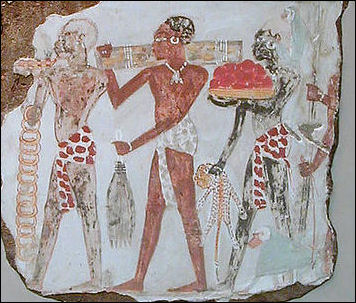
to the Egyptian pharaoh Exotic materials that originated in Nubia included gold, frankincense, ebony, ivory, panther skins, giraffe tails and hippopotamus teeth. Nubia was also an important link between Egypt and Africa during ancient times. Honey, wheat and cloth flowed south on the Nile from Egypt, and ebony, leopard skins, ivory and pygmies headed north from Africa. Goods were transported by a combination of river boats and caravans that traversed the "short cuts" between the S-shaped loops on the Nile.
The ancient Egyptians obtained gold from Nubia beginning in the Middle Kingdom. Gold was called “ nub” in ancient Egypt and is thought to the source of the name Nubia. Punt, a mysterious fabled land south of Egypt, supplied Egypt with myrrh, ebony, ivory, gold, spices, panther skins, live baboons and other exotic animals and frankincense. The exact location of Punt is still unknown. It may have been in modern-day Somalia, Yemen or Oman. Traders crossed the Eastern desert and sailed from the Red Sea to get there. Much of what is known about Punt is based on reliefs found on the wall of the Deir el Bahri temple, built around 1490 B.C. in western Thebes. The reliefs show trade between rulers of Punt and emissaries of Queen Hatshepsut.
John Noble Wilford wrote in New York Times, “Over the last two decades, John Coleman Darnell and his wife, Deborah, hiked and drove caravan tracks west of the Nile from the monuments of Thebes, at present-day Luxor. The explorations of the Theban Desert Road Survey, a Yale University project co-directed by the Darnells, called attention to the previously underappreciated significance of caravan routes and oasis settlements in Egyptian antiquity. In August 2010, the Egyptian government announced what may be the survey’s most spectacular find: the extensive remains of a settlement — apparently an administrative, economic and military center — that flourished more than 3,500 years ago in the western desert 110 miles west of Luxor and 300 miles south of Cairo. No such urban center so early in history had ever been found in the forbidding desert. [Source: John Noble Wilford, New York Times, September 6, 2010]
The new research, Dr. Darnell said, “completely explains the rise and importance of Thebes.” From there rulers commanded the shortest route from the Nile west to desert oases and also the shortest eastern road to the Red Sea. Inscriptions from about 2000 B.C. show that a Theban ruler, most likely Mentuhotep II, annexed both the western oasis region and northern Nubia. With further investigations at Umm Mawagir, Dr. Darnell said, scholars may recognize the desert as a kind of fourth power, in addition to the Hyksos, Nubians and Thebans, in the political equation in those uncertain times. It was perhaps their control of desert roads and alliance with vibrant oasis communities that gave the Thebans an edge in the struggle to control Egypt’s future.
Nubian Religion
The Kushites worshipped the Theban god Amun and had strong cultural ties to Egypt due to the long relationship between Egypt and Nubia. Hathor, an Egyptian goddess who took the form of a cow, was especially revered in Nubia, where many people were pastoralists. Sebiumeker, the Meriotic god of procreation, was associated with the Egyptian creator god, Atum. An engraved gold plaque at the Archaeological Museum in Khartoum depicts a Meroë king standing before the Egyptian god Ra.
In regards to the preference for local gods over Egyptianone, Jeremy Pope wrote: A stela erected by Aspelta at Barkal carefully emphasizes that some earlier traditions were rejected during his selection in favor of specifically Kushite alternatives. A 2014 article by Jean Revez notes a divine competition at the heart of the account pitting an “essentially Egyptian” god against a local one: even though the army first conceded that the selection of a king “has been the decision of Ra [the Ancient Egyptian sub god] since heaven came into being and since crowning the king came into being.
The Nubians eventually decided to appeal instead to “Amen-Ra, Lord of the Thrones of Two-Lands, who resides in the Pure Mountain [Gebel Barkal],” because “he is the god of Kush” and “has been the god of the kings of Kush since the time of Ra,” so that “the kings of Kush have (always) been in his hands”. The text thereby claims that preference for Amen-Ra over Ra had not initially been self-evident to all, suggesting that the royal investiture involved some degree of negotiation between foreign and local traditions, as well as between groups of Kushite citizens (viz., the army, priesthood, and royal family). [Source: Jeremy Pope, College of William & Mary, UCLA Encyclopedia of Egyptology, 2020]
Amun Worship in Nubia
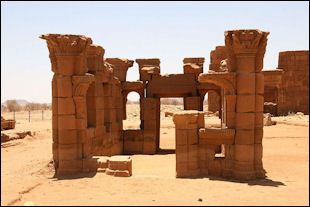
Nubian ruins near Khartoum With connections to the sun god Ra and the pharaoh, Amun was the dominant god in all of Egypt. The word "amen" is said to have originated in ancient Egypt as a tribute to Amun.
Amun was originally a local god of fertility and growth. Amun-Re (a combination of Amun and the sun god Re) became the state god during the New Kingdom.
Daniel Weiss wrote in Archaeology magazine: As they expanded their control of Nubia, the Egyptians built a number of temples to Amun, the largest of which stood at the foot of a holy mountain called Jebel Barkal. This the Egyptians declared to be the god’s southern home, thereby conceptualizing Egypt and Nubia as a unified whole and justifying their rule of both. After Egypt’s New Kingdom collapsed around 1069 B.C., the kingdom of Kush rose in Nubia, with its court based in Napata, the town adjacent to Jebel Barkal. The Egyptian colonizers may have been gone, but their religious legacy lived on, as the Kushite rulers were by this time fervently devoted to Amun. Just as the Egyptians had used the god to validate their conquest of Nubia, the Kushites now returned the favor. During a period of discord in Egypt, the Kushite king Piye first secured Amun’s northern home, in Karnak, Egypt. Then, claiming to act on the god’s behalf to restore unified control of Nubia and Egypt, he conquered the rest of Egypt and, in 728 B.C., became the first in a line of Kushite pharaohs who ruled Egypt for around 70 years. [Source: Daniel Weiss, Archaeology magazine, May-June 2015]
The cult of Amun remained central to religion — and politics — in Nubia for centuries to come. This has been illustrated by the findings of an excavation in Dangeil, a royal Kushite town on the banks of the Nile south of Napata. The excavation, which has been carried out since 2000 with support from Sudan’s National Corporation for Antiquities and Museums, the British Museum, and the Nubian Archaeological Development Organization (Qatar-Sudan), has turned up evidence of what may have been a series of temples to Amun that stood on the same location for around a thousand years in all — from the period when Kushite pharaohs ruled Egypt to the first few centuries A.D., when Kushite civilization entered a new golden age and Egypt served as a Roman colony.
In a rubbish dump behind the temple, archaeologists have found evidence that the complex drew worshippers in large numbers. In just a small trench, they have found more than a million fragments of cone-shaped ceramic molds used to make offerings to Amun. Based on a count of mold bases, at least 77,000 such offerings are in evidence. “Ordinary people really worshipped there,” says Yellin. “The cult of Amun was culturally and religiously meaningful to them. Dangeil’s temple was more than just a structure that a ruler built there for political reasons.”
Philae — Ancient Nubian Religious Center
The island of Philae near Aswan was once an important ancient Nubian religious center, Today it lies submerged as a result of the construction of the Aswan High Dam. All the archaeological structures were moved to higher ground on the nearby island of Agilkia in the 1960s and 1970s. Isma’il Kushkush wrote in Archaeology Magazine: These include the island’s main temple, dedicated to Isis, and its entryway of two monumental sets of pylons, as well as a number of smaller temples dedicated to other gods. Archaeological excavations on the island prior to the flooding showed that, for much of Egyptian history, Philae was not a major Egyptian religious site along the lines of Thebes or Memphis, but that it did seem to have long-standing significance to Nubians. This may have had to do with its proximity to the island of Biga, where Nubians worshipped Hathor, a goddess who took the form of a cow. Hathor was especially revered in Nubia, where many people were pastoralists.[Source: Isma’il Kushkush, Archaeology Magazine, November/December 2021]
A temple known as the Kiosk of Nectanebo was built at Philae during the reign of the pharaoh Nectanebo I and was probably used as a shrine for the Nubian-Egyptian god known as Thoth Pnubs.A number of extant small temples in the forecourt of the temple of Isis that were dedicated to Nubian gods provide further evidence that Philae was significant to Nubians. One such temple was devoted to Arensnuphis, a local god of Lower Nubia who is often depicted as a desert hunter and companion of Isis, and who sometimes appears as a lion.
Another small temple, in the form of a kiosk, or a colonnaded pavilion, was built at Philae during the reign of the pharaoh Nectanebo I (r. 380–362 B.C.), founder of the 30th Dynasty, the last native-born Egyptian dynasty. Cruz-Uribe proposed that the building was used as a shrine for a hybrid Nubian-Egyptian god known as Thoth Pnubs, whose name links him to the ancient Nubian city of Kerma, which was known as Pnubs to the Nubians. There was also a small temple at Philae dedicated to the Nubian deity Mandulis, a sun god associated with the nomadic people known as the Blemmyes, who lived in the deserts to the east of Egypt and Nubia. “There are all kinds of Nubian religious activities that happened before the Ptolemaic Isis temple was erected,” says Egyptologist Solange Ashby of the University of California, Los Angeles.
Nubian sponsorship of the temples at Philae ensured the continued survival of the worship of ancient Egyptian gods for centuries. A depiction of the Nubian sun god Mandulis on the Gate of Hadrian is accompanied by the last known hieroglyphic inscription anywhere, which dates to A.D. 394. But by the fourth century A.D., Christianity had begun to win many converts in the region. Around this time, Meroe fell to the Axum Empire, based in modern-day Ethiopia, ending Nubia’s contribution to the rites at Philae. Christians and adherents of traditional Egyptian and Nubian religions, however, continued to share the island for at least another 100 years. Ashby has found that a number of Nubian inscriptions date to this period, from about A.D. 408 to 456.
These were made by priests representing the kings of the Blemmyes and included religious officials known as the prophets of Ptiris, a crocodile-like Nubian god. A Nubian family known as the Esmets served at Philae as priests for three generations, and its members eventually attained the rank of First Prophet of Isis. But the inscriptions they left were in isolated and marginal areas of the temple complex, suggesting that the priests no longer had access to the most sacred spaces. They even made inscriptions on the roof of the Isis temple, probably placed there to avoid scrutiny by Christians. One Demotic inscription, on the western wall of the temple of Isis, refers to “an abominable command,” possibly an allusion to the A.D. 435 edict of the Roman emperor Theodosius II (r. A.D. 408–450) that called for the destruction of all pagan temples in the empire. The last Demotic inscription was written in A.D. 452 on the roof of the temple of Isis, and the last pagan Greek inscription was made in A.D. 456.
The Nubians continued practicing their traditional religion at Philae until the Byzantine emperor Justinian (r. A.D. 527–565) outlawed pagan worship on the island. Perhaps nothing better illustrates the manner in which the Nubians preserved these ancient traditions than a hieroglyphic inscription inside the Gate of Hadrian that accompanied a depiction of the sun god Mandulis. The inscription was made by Esmet-Akhom, a member of the Esmet priestly family, and refers to words spoken by Mandulis “for all time and eternity.” It dates to A.D. 394 and is the latest hieroglyphic text known anywhere. “This final hieroglyphic inscription was made for a Nubian god,” says Ashby. For her, it comes as no surprise that the site where the last Egyptian hieroglyphs were written was, in fact, a sacred Nubian space.
Temples in the 25th Dynasty
Christiane Zivie-Coche wrote: The Kushite kings exercised their power primarily at Thebes, although Memphis was also the object of their attention, as indicated by the “Shabaqo Stone”, a copy of an ancient mythological text, the cosmological part probably Ramesside. A further indication of the importance of the northern city was a restoration decree, on a stele of Taharqa, for the Memphite temple of “Amun at the head of the gods”. Previously, Piankhy had recorded his offerings in all the temples of the conquered land on his victory stele, found at Gebel Barkal. [Source: Christiane Zivie-Coche, Ecole Pratique des Hautes Etudes, Paris Sorbonne, UCLA Encyclopedia of Egyptology 2008, escholarship.org ]
“In the temple of Karnak, Taharqa built a western colonnade in the temple court west of the second pylon, of which only one column is extant today, while of the other columns only the lower parts and remains of the “screen” walls that once connected the columns have been preserved. Three additional colonnades at each of the other cardinal points completed the design. A similar construction was built in front of the temple of Montu in north Karnak and at the entrance of the 18th-Dynasty temple at Medinet Habu. The most original monument is the Edifice of Taharqa, built near the sacred lake of Karnak. At present only the subterranean part of the structure is extant, the superstructure having been for the most part destroyed. There is no building that parallels this unique structure; we therefore have no comparison on which to base a reconstruction of the upper part. The underground rooms are dedicated to Amun- Ra, narrowly associated with Osiris. The walls are decorated with the “Litany of Ra”, a hymn to the ten “bas” of Amun, and the first known representation of the Mount of “Djeme”, which was thought to cover the cenotaph of Osiris on the west bank of the Nile at Thebes. The fundamental aspects of the theology of Amun that become manifest during the Late Period are found for the first time on the walls of the Edifice of Taharqa. A restoration text of Montuemhat, governor of Thebes, inscribed in one of the small rooms of the Mut temple, relates a temple inventory that took place during the reign of Taharqa as part of a program of repairs executed at that time.
“The rulers of the 25th Dynasty also constructed several temples in southern Egypt and northern Sudan, at Tabo, Kawa, and Sanam. These were mostly dedicated to Amun and built on the classical Egyptian model, with the exception of particular details that might reflect relationships with local cults. At the foot of the sacred mountain at Gebel Barkal the cult spaces were transformed or rebuilt. The style of sculpture and relief is characterized by the search for a certain classicism, of which the paradigms hark back to the Old Kingdom (Memphis) and Middle Kingdom (Thebes). This taste for archaism continued in the succeeding dynasty.
Nubian-Egyptian Temples
The Temple of Kalabasha (on an island in Lake Nasser near the Aswan High Dam) was moved in 1970 from the banks of the Nile 30 miles to a new site near the Aswan High Dam. Dating back to the Roman Emperor Augustus (30 B.C.-14 A.D.), this huge Nubian style sandstone temple is dedicated to the fertility god Mandulis, represented by a human-headed bird. The temple features rectangular staging area used in processional celebrations and a wall covered with texts, inscriptions and depictions of Egyptian deities such as Isis, Osiris and other.
Nearby is the Kiosk of Kertassi. Dedicated to Hathor, who is often depicted with the ears of a cow, it features two Hathor-headed columns with grape-arbor motifs, a reference to Hathor's link to drunkenness. It was moved at the same time as Kalabasha and now sits near the water and have fine view of Lake Nasser. Nearby are petroglyphs with images of boats, elephants and giraffes carved into the hillsides.
Wadi al-Seboua al Gerdid (90 miles south of Aswan) is the home of a temple built by Seatau, a viceroy from Nubia, in honor of Ramses II. It features a pylon (gate) in front of a courtyard and colossal images of Ramses II. On the walls of the temples is a list of all of Ramses II children — nearly 100 of them — on the walls. Later Christians used the cliff-cut halls of the temple for chapels, decorating many of them with frescos. The temple is beautifully situated among sand dunes. The causeway leading to it features the El Sibû Lions, a half dozen 3,200-year-old, badly-worn sphinxes with big turbans on their heads. El Sibû Lions were relocated to higher ground during the construction of the Aswan Dam.
Near Wadi al-Seboua al Gerdid is a temple dedicated to Thoth, which features sanctuaries honoring Nubia, Ptolemaic, Roman and Egyptian rulers with well-preserved reliefs from the Ptolemaic and Roman periods. In the area you can also find traditional Nubian adobe houses, decorated with painted symbols and built with 600 year old construction techniques. Painted villages include Abu Hôr and Qûrta.
Amum Temple in Nubia
Daniel Weiss wrote in Archaeology magazine: “On the same site in Dangeil where they believe a temple to Amun may have stood starting around the seventh century B.C., the archaeologists have found far more extensive evidence of a temple to Amun dating to the first century A.D. It has the same directional orientation as the earlier building and used some of its walls as foundations. According to Anderson, this suggests that the earlier building was probably still functioning when it was replaced. This later temple was likely built during the reign of Queen Amanitore and her co-regent Natakamani, a period of peace and prosperity remembered as a golden age of Kushite civilization. A war with the Romans, who had by this time colonized Egypt, had come to an end around 20 B.C. with a nonaggression pact and resumption of trade. Following the pattern of leaders such as Taharqa, the co-regents pursued an ambitious campaign of building, renovating, and expanding temples throughout Nubia. [Source: Daniel Weiss, Archaeology magazine, May-June 2015]
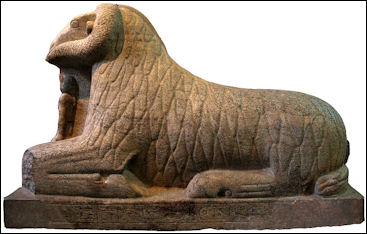
“The remains of the temple complex the co-regents are associated with in Dangeil suggest that it must have been stunning. A monumental gate facing the Nile measured roughly 100 feet across. Inside, a processional way was lined with sandstone sculptures of kneeling rams, which were strongly associated with Amun in Nubia. There, the god was portrayed with a ram’s head, having been amalgamated with indigenous ram-headed gods when he was imported from Egypt, where he was generally portrayed with a human head. Along the processional way was a kiosk where Amun — in the form of the temple’s ram-headed cult statue carried by priests in a sacred barque — would rest on trips out of the temple sanctuary during festivals. These festivals featured large crowds and allowed common people, who were barred from the temple sanctuary, to revel in the presence of the god. “These were big holidays,” says Yellin. “There was probably feasting, and certainly drinking — it was a good time.”
“In the sanctuary itself, a series of columns that the archaeologists found partially standing were decorated with plump river gods designed to ensure plentiful flooding, with plants and flowers growing from their heads. “In a season when the Nile didn’t flood, people would starve,” says Anderson. “The Nile is everything, and the inundation is everything, and that’s what makes the fertility figures so important.” Amun, too, was associated with fertility in Nubia. Also inside the sanctuary were several altars, including a finely carved one made from pink sandstone. Fragments of this altar discovered by the archaeologists were inscribed with cartouches containing Queen Amanitore’s name, which suggests that the temple was built or modified during her reign in the first century A.D. Cartouches with her name have also been found on fragments of the ram statues, and carbon dating of the temple’s wooden beams also points to construction during the first century A.D.
“Pigment found on the temple and kiosk indicates that they were painted blue, red, and yellow, colors that would have stood out vividly against the austere desert backdrop. “Most temples in the past would have been painted or colored in some way,” says Anderson. “But we have been fortunate, because of the conditions, to have some of the pigments preserved. Because we’ve actually found them on pieces of plaster, we’ve been able to reconstruct to a certain degree what, for example, the kiosk looked like — and, boy, was it a brightly colored building.” The complex’s coloring would have made it all the more impressive. “The statement the temple would have made about the state religion would have been fabulous,” says Yellin, “especially if you went for one of these festivals with the procession and all the pomp.”
“Despite its once formidable appearance and popularity among the public, the first-century A.D. temple to Amun was eventually destroyed in a large fire that was preceded by looting and smashing of the altars. “The looters dug a hole through the sanctuary floor — perhaps they were looking for gold or treasure,” says Anderson. “The ram statues are also smashed into tiny little pieces, so it looks as if a group of people came, looted the temple, smashed stuff up, and then may have set it on fire.”
“Archaeologists have found no evidence of the date of the fire, though it most likely took place near the end of the Meroitic Kushite kingdom, which fell in the fourth century A.D. Anderson says that the temple appears to have been neglected and ultimately abandoned before the fire. “This might suggest a decline or weakening of centralized authority at Meroe and of the priesthood,” she says. Anderson is skeptical, however, that the destruction of the temple indicates a growing disregard for Amun. Evidence suggests that the god continued to be worshipped in Nubia for several centuries after the fall of the Meroitic kingdom — that is, until the Byzantines introduced Christianity in the sixth century A.D.
Temple of Isis at Philae
Philae was an island near Aswan in southern Egypt. Two monumental pylons form the entryway to the temple of Isis at Philae, which was built by the pharaoh Ptolemy II beginning around 260 B.C. Reliefs on this pylon depict the pharaoh Ptolemy XII smiting his enemies and preparing to sacrifice them to the gods Isis, Horus, and Hathor.
Isma’il Kushkush wrote in Archaeology Magazine: When the Romans conquered Egypt in 30 B.C., the country’s system of temples, which had sustained religious traditions dating back more than 3,000 years, began to slowly wither away. Starved of the funds that pharaohs traditionally supplied to religious institutions, priests lost their vocation and temples fell into disuse throughout the country. The introduction of Christianity in the first century A.D. only hastened this process. But there was one exception to this trend: In the temples on the island of Philae in the Nile River, rites dedicated to the goddess Isis and the god Osiris continued to be celebrated in high style for some 500 years after the Roman conquest. This final flowering of ancient Egyptian religion was only possible because of the piety and support of Egypt’s neighbors to the south, the Nubians. [Source: Isma’il Kushkush, Archaeology Magazine, November/December 2021]
A group of inscriptions Egyptologist Solange Ashby of the University of California, Los Angele has identified date from A.D. 175 to 275 and reflect the pinnacle of Nubian influence at Philae. Many of these inscriptions were commissioned by Nubians who, by this point, were active as priests at the top of the religious hierarchy. The inscriptions, which were made populain the most restricted areas of the temples, show that Nubians were claiming the loftiest religious titles, such as prophet or purity priest, as well as Meroitic titles such as the King’s Son of Kush and the Royal Scribe of Kush. The inscriptions also refer to the Nubian priests’ astronomical knowledge and imply that they were fluent in Egyptian, Greek, and Meroitic. Most prominent in the inscriptions are five generations of a Nubian family known as the Wayekiyes, who were powerful priests and who had both religious and military obligations.
Many of the inscriptions in the most sacred spaces refer to the annual Festival of Entry celebrations that honored Osiris and Isis. While some Egyptian names do appear in references to the festival, most of the participants appear to have been Nubian, in particular members of the Wayekiye family, says Egyptologist Jeremy Pope of the College of William and Mary. “In addition to being a focus of sincere piety, theological reflection, and communal bonds,” he says, “the worship of Isis would also have been important to elite Nubian families like the Wayekiyes as an occupation, a mark of social status, and thus a source of political power.”
Ashby says that Nubian inscriptions tend to be clustered together at Philae in particular buildings, such as the Gate of Hadrian and a room in the temple of Isis known as the Meroitic Chamber. She notes that Nubians seem to have been especially interested in leaving inscriptions near depictions of milk libations, reinforcing their importance in Kushite rituals. The Nubian expressions of piety also differ from those left by Greeks, which are short, often one-line inscriptions, and by Egyptians, which tend to be dry and repetitive. “They are much more heartfelt, longer, and more reverent toward Isis,” says Ashby. “They often have very dramatic phrases, such as ‘I am bending my arm, I am calling out to you, Isis!’” It’s likely that Nubians recited these prayers aloud in front of the reliefs and statues depicting Isis and Osiris.
The inscriptions are not just filled with pious expressions. They also detail particulars of the annual voyage made by envoys from the kings of Meroe to the Festival of Entry, such as the amount of gold the Meroitic rulers sent to Philae. The longest such inscription was written on behalf of one of Meroe’s envoys to Rome, a man named Sasan. Dating to April 10, A.D. 253, this is not just the longest Demotic inscription at Philae, but the longest known in Egypt. Its 26-line text suggests that Nubian pilgrims and priests journeying to Philae played both political and religious roles at the temples. In the inscription, Sasan discusses how he was commanded by the king of Meroe to set aside funds and throw a party for the entire district. “When these Nubian priests came, the local population would have been so excited to see them arriving on their majestic ships down the Nile,” says Ashby. “They knew that the Nubians were coming with pounds and pounds of gold, and that part of that money would be used to buy and slaughter animals and to provide beer, music, and dancing.” The entire district, the inscription says, celebrated for eight days in the forecourt of the Isis temple at Philae. From a long colonnade along the west side of the island, people could watch as Sasan crossed the Nile with his entourage to the Abaton sanctuary on Biga to worship Osiris. Another festival sponsored by the kings of Meroe was nearing its end, and Philae’s coffers were replenished for another year.
Milk Libation Images at Philae
Some of the massive reliefs on the temples on the island of Philae near Aswan in southern Egypt depict Ptolemaic pharaohs and other important religious officials offering libations to gods, often Isis and Osiris and their son Horus. Isma’il Kushkush wrote in Archaeology Magazine: In Egyptian mythology, Osiris was killed and dismembered by his brother Seth. Their sister and Osiris’ wife, Isis, managed to reassemble his body and he was brought back to life as the god of the underworld. The Egyptians offered libations, usually water or wine, to Osiris during rituals intended to symbolically aid in his rebirth. At Philae, depictions of this ritual include examples that show Ptolemaic pharaohs offering Osiris water in two small bottles, as was customary in Egyptian practice. However, others appear to show them offering Osiris libations of milk, which they pour out before the god from a situla, a long narrow vessel with a looped handle. This, Egyptologist Solange Ashby of the University of California, Los Angeles believes, was a distinctly Nubian practice. “What we see at these temples is this different type of libation, which is to pour out a stream of milk that goes over offerings laid out on an offering table,” she says. [Source: Isma’il Kushkush, Archaeology Magazine, November/December 2021]
Egyptologists have debated for a century whether or not these scenes are intended to depict milk libations or offerings of wine or water. “I say this is milk,” says Ashby. She points to a scene inside the temple of Isis at Philae depicting Ptolemy VIII (r. 170–116 B.C.) offering a libation to Osiris, with Isis standing behind the god. “The hieroglyphs around him say this milk comes from the breast of the goddess Hesat,” Ashby explains, referring to a celestial cow goddess. Some scholars have argued that even if the depictions show milk libations, they must represent an Egyptian tradition. For Ashby, even though the depictions of the milk libation occur in Ptolemaic temples, the ritual is a purely Nubian practice. “I suggest they adopted it from Nubian worshippers,” she says. She points out that the earliest depictions of milk libations are found in Lower Nubia at the temple of Dakka, in a sanctuary that was built by the Meroitic king Arkamani (r. 275–250 B.C.). Milk libations are also depicted in royal funeral chapels farther south, in Upper Nubia, which is part of modern-day Sudan. At the temple of Musawwarat es-Sufra, for example, reliefs depict herdsmen preparing milk offerings for the Nubian lion-headed god Apedemak. But there are no such depictions in temples north of the first cataract, in Egypt proper.
Hieroglyphs at Philae’s temple of Isis refer to milk as ankh-was, or “life and power.” “Milk seems to be infused with this magical element of transferring life and power to the one who is deceased, much in the way that the breast milk of a mother keeps her infant alive and growing,” says Ashby. “There seems to be this connection in the mind of Nubians.” For the Nubians, then, milk would have been the ideal offering to aid in the rebirth of Osiris.
Milk libation rituals would have been performed during annual funerary rites for Osiris. Known as the Festival of Entry, this ceremony was held during the month of Khoiak, in the early fall, when the Nile flooding reached its peak. Gilded statues of Isis and Osiris were taken from the Isis temple at Philae to boats moored outside a structure known as the Gate of Hadrian. They were then rowed across the Nile to the island of Biga, where Osiris was thought to have been buried. There, at a sanctuary known as the Abaton, milk libations were offered to the god. Ashby notes that, until quite recently, milk played a central role in rituals surrounding death in Nubia. Within living memory, a widow would traditionally pour milk on her husband’s grave on the second day after his death, a distant echo, perhaps, of the milk libations offered to Osiris.
Image Sources: Wikimedia Commons, The Louvre, The British Museum, The Egyptian Museum in Cairo
Text Sources: Internet Ancient History Sourcebook: Mesopotamia sourcebooks.fordham.edu , National Geographic, Smithsonian magazine, especially Merle Severy, National Geographic, May 1991 and Marion Steinmann, Smithsonian, December 1988, New York Times, Washington Post, Los Angeles Times, Discover magazine, Times of London, Natural History magazine, Archaeology magazine, The New Yorker, BBC, Encyclopædia Britannica, Metropolitan Museum of Art, Time, Newsweek, Wikipedia, Reuters, Associated Press, The Guardian, AFP, Lonely Planet Guides, “World Religions” edited by Geoffrey Parrinder (Facts on File Publications, New York); “History of Warfare” by John Keegan (Vintage Books); “History of Art” by H.W. Janson Prentice Hall, Englewood Cliffs, N.J.), Compton’s Encyclopedia and various books and other publications.
Last updated July 2024