
Home | Category: Early Mesopotamia, the Fertile Crescent and Archaeology / Sumerians and Akkadians
UR ARCHAEOLOGY
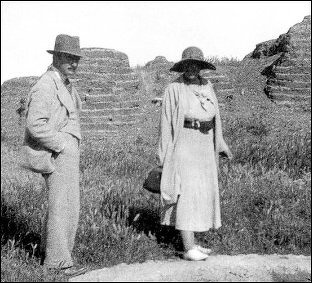
Agatha Christie and Max Mallowan
Andrew Lawler wrote in National Geographic: “In the 1920s and 1930s, British archaeologist Leonard Woolley dug up some 35,000 artifacts from Ur, including the spectacular remains of a royal cemetery that included more than 2,000 burials and a stunning array of gold helmets, crowns, and jewelry that date to about 2600 B.C. At the time, the discovery rivaled that of King Tut’s tomb in Egypt.” [Source: Andrew Lawler, National Geographic, March 11, 2016 -]
“But Ur and most of southern Iraq has been off limits to most archaeologists during the past half-century of war, invasion, and civil strife. A joint U.S.-Iraqi team reopened excavations there last fall, digging at the site for ten weeks. The work was supported in part by the National Geographic Society. Unlike earlier generations, today’s archaeologists are less interested in breathtaking gold objects than in clues like the bit of ebony that will help them understand more fully this critical time in human history.” -
“Most digs in the past, including Woolley’s, focused on the temples, tombs, and palaces. But during the recent excavation, the team uncovered a modest-sized building dating to a couple of centuries after Ur’s peak. “This is a typical Iraqi house,” said Abdul-Amir Hamdani, the senior Iraqi archaeologist on the project, who grew up in the area. He gestures at the mud-brick walls. “There are stairs to the roof and rooms around a courtyard. I lived in a house just like this. There’s a continuity in the way people live here.” -
“That hints, Stone and Hamdani said, at a society that wasn’t under the control of a small tyrannical minority. By bringing such analysis to bear on common objects like grains, bones, and less flashy artifacts, the team hopes to shed light on how workers lived, the role of women in the wool factories, and how environmental changes might have impacted the eventual decline of Ur’s power.” -
RECOMMENDED BOOKS:
“Excavations at Ur” by Sir Leonard Woolley Amazon.com;
“Ur: The City of the Moon God” by Harriet Crawford (2015) Amazon.com;
“Ur: A Captivating Guide to One of the Most Important Sumerian City-States” (2018) Amazon.com;
“Treasures from the Royal Tombs of Ur” by Richard L. Zettler and Lee Horne (1998) Amazon.com;
“On the Third Dynasty of Ur: Studies in Honor of Marcel Sigrist” (2008) Amazon.com;
“Abraham: One Nomad's Amazing Journey of Faith” by Charles R. Swindoll, Bob Souer, et al. Amazon.com ;
“Abraham: A Journey in the Heart of Three Faiths” by Bruce Feiler (William Morrow, 2002)
Amazon.com ;
“Abraham and Sarah: History's Most Fascinating Story of Faith and Love” by J. SerVaas Williams Amazon.com
“Uruk: The First City” (BibleWorld) by Mario Liverani , Zainab Bahrani, et al. (2006) Amazon.com;
“Uruk: First City of the Ancient World”
by Nicola Crusemann, Margarete van Ess, et al. (2019) Amazon.com;
“For the Gods of Girsu: City-State Formation in Ancient Sumer” by Sébastien Rey (2016) Amazon.com;
“Nippur V: The Area WF Sounding: The Early Dynastic to Akkadian Transition (Oriental Institute Publications) by Augusta McMahon , McGuire Gibson, et al. (2006) Amazon.com;
“Nippur IV: The Early Neo-Babylonian Governor's Archive from Nippur (Oriental Institute Publications) by Steven W. Cole (1996) Amazon.com;
“The Sumerians: Their History, Culture, and Character” by Samuel Noah Kramer (1971) Amazon.com;
“The Sumerians: A History from Beginning to End” by Hourly History (2023) Amazon.com;
“The Sumerians” by Leonard Woolley (1927) Amazon.com;
“History Begins at Sumer” by Samuel Noah Kramer (1956, 1988) Amazon.com;
“The Sumerian World” by Harriet Crawford (2013) Amazon.com;
“The Sumerian Civilization” (2022) Amazon.com;
History of Archaeology in Ur
Michael Taylor wrote in Archaeological magazine,“In 1854, James E. Taylor, the British consul at Basra, conducted an excavation at Tell al-Muqayyar, the "Mound of Pitch," so named by the locals for the bitumen mortar visible in it. He revealed the crumbling ruins of the ziggurat, as well as cuneiform tablets that identified the site as the biblical "Ur of the Chaldees," birthplace of Abraham in Genesis. [Source: Michael Taylor, Archaeological magazine, March/April 2011 |+|]
“There were a few minor British digs in the waning years of World War I, but the landmark excavation of the site was conducted between 1922 and 1934 through a joint expedition sponsored by the British Museum and the University of Pennsylvania. The chief archaeologist was Leonard Woolley, an experienced Near East excavator who had previously dug in Syria with T.E. Lawrence. The dig captured the public imagination and proved curiously conducive to romance. Woolley married his assistant Katherine Merke in 1927. |+|
In 2009, U.S. military authorities turned the site of Ur over to the Iraq State Board of Antiquities and Heritage.
Leonard Woolley and the Excavation of Ur
Ur was excavated in the 1920s and 30s by a team led by the British archaeologist Leonard Woolley, who found a great temple complex, royal tombs, and the remains of houses on city streets. In the tombs were treasures — including scores of stunning objects made with gold, silver and precious stones — that rivaled treasures found at famous burial sites in ancient Egypt. Most of the objects were taken to the British Museum.
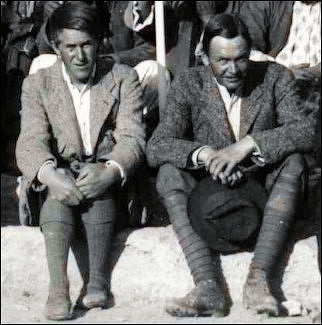
TE Lawrence (Lawrence of Arabia) and Leonard Woolley
Michael Taylor wrote in Archaeological magazine,“Although he really didn’t do so Woolley is credited with discovering the ancient Sumerian city of Ur in 1922, nine miles west of Nasiriya, Iraq. He and his team excavated the site in the 1922 and 1934. Woolley excavated 2,000 tombs at Ur, conducted extensive excavation of the ziggurat and other large buildings, made headlines when he claimed to have found evidence of Noah's flood (10-foot-thick deposit of river clay found in a 40 foot, reasoned to have come from a catastrophic flood). [Source: Michael Taylor, Archaeological magazine, March/April 2011 |+|]
“Woolley was also a friend of Lawrence of Arabia. He and his wife Katherine did much of the most delicate archeological work themselves. Woolley realized the importance of working the locals when his camp was attacked and robbed. Sheik Manshet of the al-Ghizzi tribe took responsibility for the robbers, turned them over to authorities and assured Woolley he would be no more trouble. |+|
“Woolley especially excelled in the excavation of delicate objects. He extracted fragile artifacts (such as the two "Ram in a Thicket" statues) by coating them in melted wax before removing them. Noticing two voids in the earth left by decaying organic matter, he carefully filled them with plaster, producing a precise cast of a lyre. Woolley continued excavating until diminishing finds and funds forced an end to the expedition. There has not been an excavation at Ur since.” |+|
Woolley, the Royal Graves of Ur and Queen Pu-abi
Michael Taylor wrote in Archaeological magazine,“Woolley's most dramatic finds were in the necropolis, where he uncovered the remains of around 1,850 people from all stages of the city's life. He defined 16 tombs as "royal," and identified a grisly burial practice: Human sacrificial victims were arranged around the royal dead, producing what he dubbed "death pits." The largest of these, the "Great Death Pit," contained the bodies of 68 women and six men. Woolley excavated 660 tombs in the so called Royal Cemetery at Ur, dated at 2600-2500 B.C.. Sixteen of the tombs contained such riches they were considered the tombs of royalty. [Source: Michael Taylor, Archaeological magazine, March/April 2011 |+|]

reconstructed headgear and jewelry of Queen Pu-abi
Some of the most spectacular Sumerian art was unearthed from the grave of Queen Pu-abi, a 4,600-year-old site excavated by Woolleys' team in Ur. The pieces found there included lyres decorated with golden bull heads and a wiglike helmet of gold described above as well as earrings, necklaces, a gold dagger with a filigree sheath, a toilet box with a shell relief of lion eating a wild goat, inlaid wooden furniture, a golden tumbler, cups and bowls, and tools and weapons made of copper, gold and silver. She was buried with 11 others presumably her attendants
Taylor wrote: “The pit containing the grave of Queen Pu-abi was guarded by the bodies of five men with copper daggers. Further inside was the remains of a chariot with the bones of ozen and four men . Further inside still were two rows of five women with musical instruments, including a harp famous its bull head harp. In a funerary chamber at a lower level was the body of Queen Puaba, wh lived between 2550 and 2400 B.C. and was less than five feet tall. Three other bodies were buried with her.” |+|
Queen Pu-abi was buried, wearing, a necklace of gold and lapi lazuli, 10 gold rings, garters of gold and lapis lazuli, and a striking cape made of gold, silver, lapis lazuli, agate and carnelian beads.. Her headdress was made of gold ribbons, carnelian and lapis lazuli beads, bands of gold leaves, all surmounted by a high comb of silver with eight-petaled gold rosettes, symbols of goddess Inana. Archaeologists working at the Queen Pu-abi site also unearthed a mosaic with figures made from limestone, muscle shell and mother of pearl, on a lapis background that shows a military procession with troops driving their chariots over captured enemies.
Agatha Christie at Ur, Nimrud and Nineveh
The English mystery writer Agatha Christie met archeologist, Max Mallowan, 15 years her junior, at an archaeological dig at Ur. Later they were married after Christie made Mallowan promise that he wouldn't play golf or run off with other women. The couple got on quite well. He liked "digging the dead." She wrote about "copses and stiffs.” He often took her on his expeditions to Egypt and the Near East. It was the second marriage for Christie. Her first was to an English army officer, Achier Christie, who she met when she was 22 and married in the middle of World War I. After Agatha became successful, Archie spent most of his time on the golf course. The marriage fell part when he confessed he loved another woman, Teresa Neele. They were divorced in 1928.
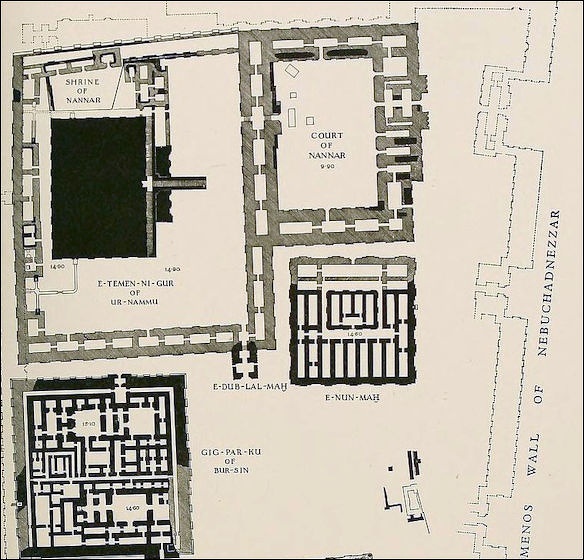
map of Ur excavations in 1900
Christie caught the eye of Mallowan when she visited to Ur, They were married in 1930.. Michael Taylor wrote in Archaeological magazine, “ Katherine Woolley quickly came to detest Christie, who was subsequently banished from the dig. Mallowan lamented that "there was only room for one woman at Ur," and spent the first dig season after his marriage separated from his bride.”
Christie and Mallowan participated in the archaeological work at Ur and searched in vain for the lost city of Ukresh. Mallowan served as an assistant to Woolley between 1925 and 1930. Agatha Christie wrote her 1936 mystery “ Murder in Mesopotamia” based on her experiences in at Ur. In the novel an archaeologist's sickly wife, Mrs. Leidner, is brutally murdered. Similarities between the victim and Katherine Woolley are said to have been more than a coincidence.
Mallowan and Christie worked at the Assyrian sites of Nimrud and Nineveh in the 1950s. Amy Davidson wrote in The New Yorker: “Mallowan was the reason that Hercule Poirot, in one novel, visits Aleppo. (He was also the source for a classic Daily Mail headline: “British Museum buys 3,000-year-old ivory carvings Agatha Christie cleaned with her face cream.”) In her autobiography, in which she talks about the face cream, she writes about how “times in Baghdad were gradually worsening politically,” and so, for a few years, there were no new excavations in Iraq; instead, “everyone went to Syria.” [Source: Amy Davidson, The New Yorker , February 27, 2015]
Objects Found in Ur
Objects Woolley found in the grave of Queen Pu-abi, including the Queen’s Lyre, a stringed lyre with the a golden bearded bull’s head decorated with lapis lazuli and limestone, dated to 2600-2400 B.C., a gold cup with deep rounded sides, an electrum beaker, a lapis lazuli pouring cup, a double silver reign ring, and a figure of a wild ass, They are currently in the British Museum.
Other object found in the cemetery of Ur, dated to 2550 to 2400 B.C., included gold and lapis lazuli jewelry and statues, and an ornate hammered gold, carnelian and lapis lazuli headdress.
The “ Standard of Ur”is a trapezoidal inlaid box, 18½ inches long and 8 inches high, found near a man’s shoulder and though to have been carried like a banner, or standard. One side depicts a banquet. Another side depicts a battle with an elaborately detailed mosaic made from shell and lapis lazuli. .
The mosaic was broken when it was found in the grave of Queen Pu-abi. Wax was poured on the pieces. After the wax hardened the pieces were cut free and bound and reinforced with muslin. Photographs and notes were taken of the location of each piece. Archaeologists also found some holes. Plaster was poured down them. Inside one of the plaster cast was the famous harp. The wood had rotted away but the metal parts, including the golden ram’s head were in still place.
Ur Under Saddam Hussein
Michael Taylor wrote in Archaeological magazine,“The Ba'ath Party, which dominated Iraq from 1968 to 2003, was keenly interested in Iraq's Mesopotamian heritage and its potential to unite a population fragmented by sectarian differences. As part of an aggressive program in the 1970s to restore Mesopotamian antiquities, the Ba'athists installed a new facade on the ziggurat's stairways and around the top of the first tier, in addition to making other repairs. A grand festival in 1977 celebrated the restoration, hailing the legacy of Ur-Nammu who, according to the official Ba'ath newspaper, "united the state administratively and politically after it had been divided and split." [Source: Michael Taylor, Archaeological magazine, March/April 2011 |+|]
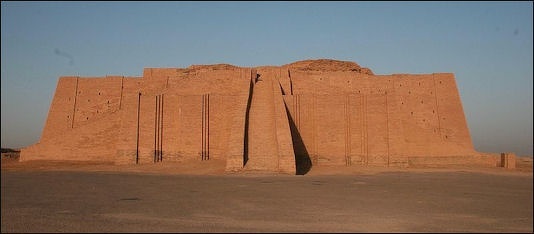
Ziggarat of Ur today
“Ur, treated modestly by Hussein, was fortunate not to have captured the dictator's self-aggrandizing imagination the way Babylon had. Hussein liked to compare himself to that city's Hammurabi and Nebuchadnezzar II, and ordered an elaborate reconstruction of the Babylonian ruins, transforming them into a gaudy Ba'athist theme park. He even had his name stamped in cuneiform on the new bricks. Ur, on the other hand, received only basic restoration—with modern bricks protecting ancient ones within, thankfully devoid of megalomaniac excess. As a general rule, most of the bricks in the massive first tier of the ziggurat are the originals of Ur-Nammu, while rubble on the second tier dates to Nabonidus. Facade elements, such as the banisters on the stairways, fencing around the edge of the first tier, and the facing on the second tier, are modern restoration. |+|
“The site was incorporated into a Hussein-era military base, which was strafed by Allied warplanes during the First Gulf War, causing minor collateral damage. The city was in turn occupied by U.S. forces in 2003, which prevented the orgy of destructive looting that took place at other ancient Iraqi sites. While we were subject to mortar and Katyusha rocket attacks at the base, there does not appear to have been any significant damage to Ur itself.” |+|
Modern Ur
Ur today is a dusty and depressing. The only hint that it was once a great is the ziggurat. Some of the royal tombs are well preserved. The largest house, dating between 2000 and 1596 B.C., is sometimes described as Abraham's house although there is evidence to back up this claim.
Michael Taylor wrote in Archaeological magazine, “The city of Ur, once the largest in the world and the crown jewel of one of humanity's first civilizations, sits in a wasteland at the edge of a war zone. In late spring, the temperature easily hits 120 degrees as the blazing sun reflects off endless sand flats and yellow Sumerian brick. A 45-minute walk around the site is exhausting even for a very fit person. The ruins, which were inhabited from roughly 3000 to 300 B.C., consist mostly of brick walls, some of which are partially restored, revealing the outlines of monumental complexes such as shrines, storehouses, and elite residences. The ruins are now abandoned, save for a solitary shopkeeper who sits in a ramshackle hut marked "Shop Ziggurat," where he sells trinkets and Mesopotamian-themed souvenirs. [Source: Michael Taylor, Archaeological magazine, March/April 2011] “The ancient Sumerian city is within Tallil Air Force Base, near Nasiriya, Iraq. Few Westerners have been privileged to see it. In 1999, Saddam Hussein even denied Pope John Paul II access to the site, supposedly the birthplace of Abraham (ca. 1800 B.C.).
At the heart of Ur is the best-preserved ziggurat in all of Iraq. The ruins of the city cover roughly 30 acres around the ziggurat. As one walks through the larger site, potsherds crunch underfoot. It is impossible not to step on them. And a few hundred yards from the ziggurat, there is the great necropolis of Ur, where dozens of tombs and pits lie open, their inhabitants removed by British archaeologists decades ago. Little of the architecture visible today dates to Ur's early history, though artifacts from early tombs can be viewed in the museums of London, Philadelphia, and Baghdad. The city's greatest and most enduring monuments were constructed in the period that followed the collapse of the Akkadian dynasty around 2050 B.C.
Image Sources: Wikimedia Commons
Text Sources: Internet Ancient History Sourcebook: Mesopotamia sourcebooks.fordham.edu , National Geographic, Smithsonian magazine, especially Merle Severy, National Geographic, May 1991 and Marion Steinmann, Smithsonian, December 1988, New York Times, Washington Post, Los Angeles Times, Discover magazine, Times of London, Natural History magazine, Archaeology magazine, The New Yorker, BBC, Encyclopædia Britannica, Metropolitan Museum of Art, Time, Newsweek, Wikipedia, Reuters, Associated Press, The Guardian, AFP, Lonely Planet Guides, “World Religions” edited by Geoffrey Parrinder (Facts on File Publications, New York); “History of Warfare” by John Keegan (Vintage Books); “History of Art” by H.W. Janson Prentice Hall, Englewood Cliffs, N.J.), Compton’s Encyclopedia and various books and other publications.
Last updated July 2024